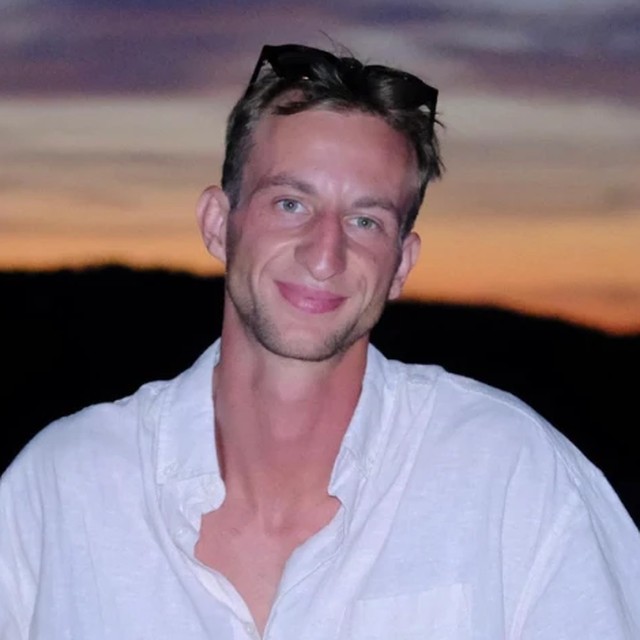
 Pierre Vetsch
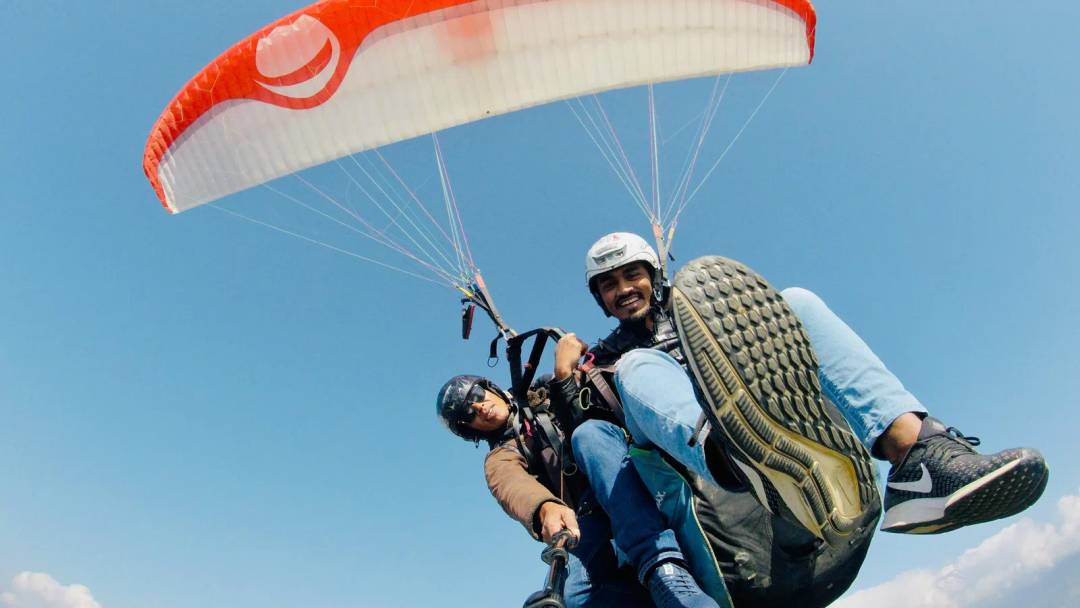
Tandem paragliding in Interlaken costs CHF 180 to 199 per person at Alpin Air and Paragliding Interlaken; we sell the Alpin Air flight at CHF 190 from April to October and CHF 180 from November to March. Expect 10 to 20 minutes in the air and about 75 minutes in total; photos and video cost CHF 40. My honest verdict, explained in the price section below: at that price, I would choose another activity.
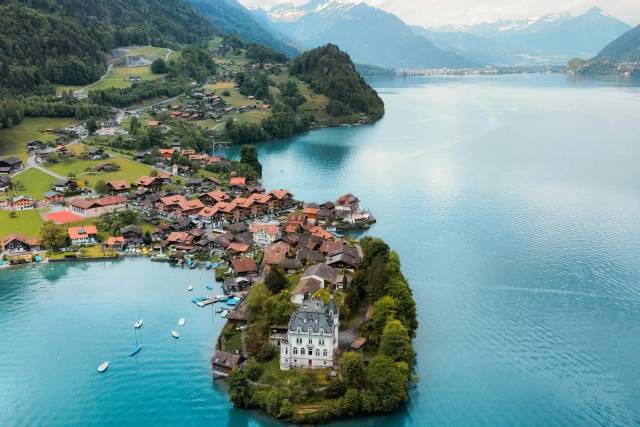
You stand at the edge. Behind you, a wing the colour of summer sky lies unfurled across the alpine grass, breathing softly in the wind. In front of you, the world drops away. The Bernese Oberland spreads out like a folded map: the turquoise of Lake Thun on one side, the deeper blue of Lake Brienz on the other, and between them the rooftops of Interlaken catching the afternoon light.
Your pilot calls your name. He is calm in the way only people who have done something a thousand times can be calm. He counts down: three, two, one. You run. The grass is gone. The air takes you.
This is the first second of paragliding in Interlaken. After that, the sky belongs to you.
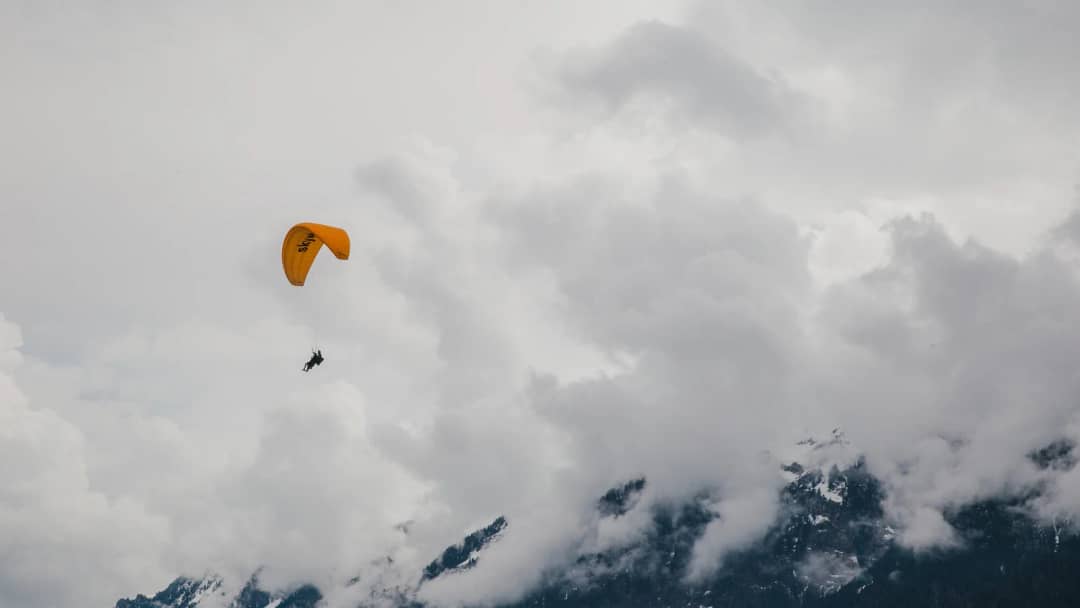
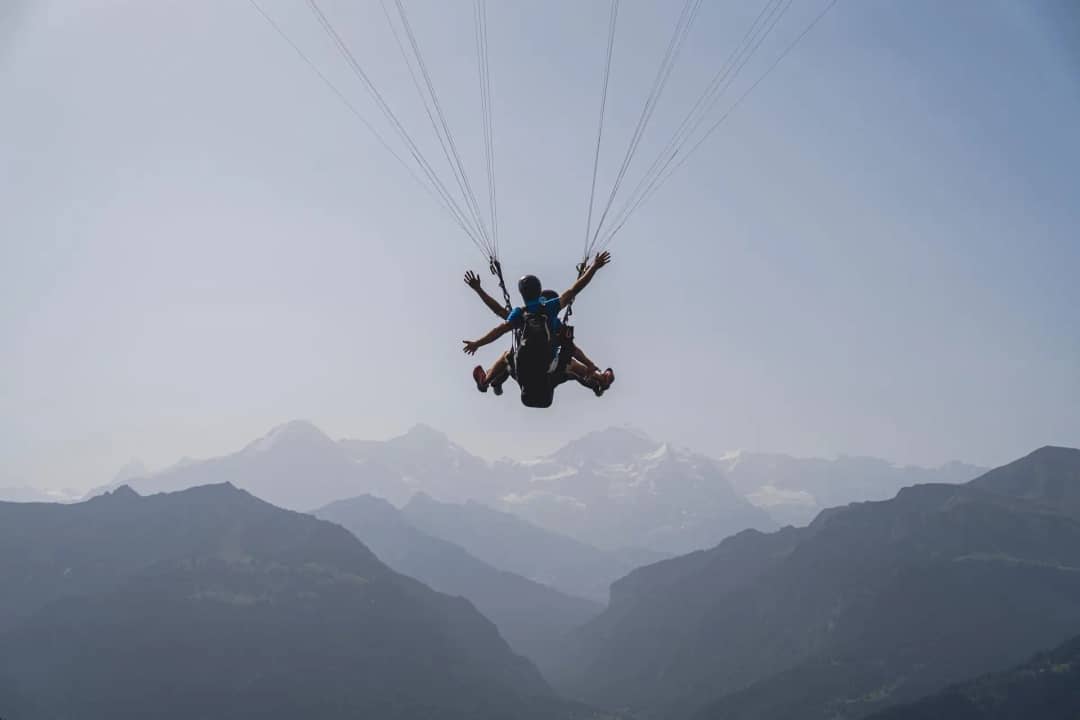
The mountains become smaller. The lakes more brilliant. For 10 to 20 minutes, you drift between Lake Thun and Lake Brienz, with the Eiger, Mönch and Jungfrau in front of you on a clear day.
Why Interlaken Became the Paragliding Capital of Switzerland
Interlaken was not chosen by accident. The geography wrote the story before the pilots arrived.
The town sits in a flat alluvial plain between two large lakes, surrounded on three sides by steep mountain walls. When the morning sun hits those walls, the air heats and rises. By midday, predictable thermal columns spiral upward from the south face of the Niederhorn and the slopes above Beatenberg. By late afternoon, a soft lake breeze pulls the warm air back down. For a paraglider, this is choreography. You launch into rising air, you glide, you land on a meadow surrounded by snow peaks. The valley itself is the stage.
Add to that two more rare conditions. The first is the Höhematte, a vast central meadow inside Interlaken that we will come back to. The second is access. The van ride from the town centre up to the Beatenberg take-off takes about 20 minutes (Alpin Air, checked on 15 October 2026). You can be in your harness less than an hour after eating breakfast.
Few alpine resorts in Europe combine this kind of geography, this kind of reliability, and this kind of logistics. That is why paragliding in Interlaken evolved from a fringe sport in the 1980s to one of the most booked summer activities in the entire Bernese Oberland.
The Pilots Who Brought Paragliding to Interlaken
Modern paragliding is younger than most people think. The first true parapente flights took place in Mieussy, a small village in the French Alps, when a group of climbers decided to descend a mountain using a rectangular skydiving canopy instead of climbing back down. The idea crossed into Switzerland within a few years, and Interlaken caught the attention of early pilots immediately: predictable thermals, a soft landing zone, and a town already comfortable with adventurous visitors.
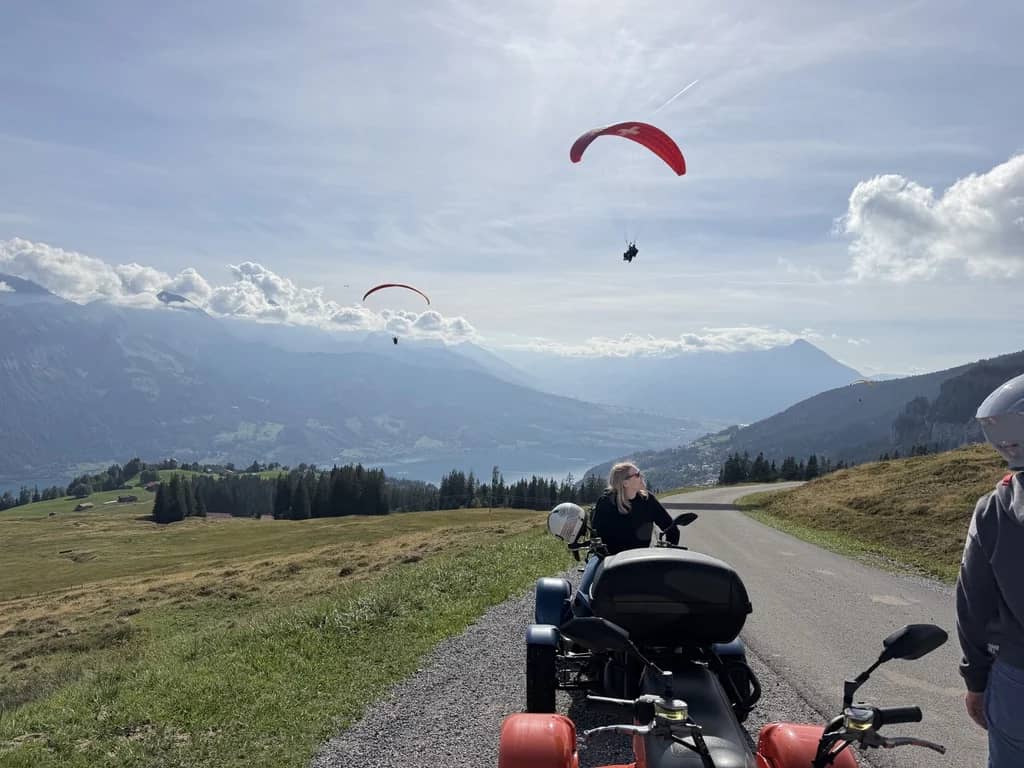
Today, Alpin Air and Paragliding Interlaken are among the established tandem operators above Interlaken. Alpin Air's pilots take their passengers up from Beatenberg.
Höhematte: The Meadow That Refused to Disappear
To understand paragliding in Interlaken, you need to understand a single, stubborn meadow.
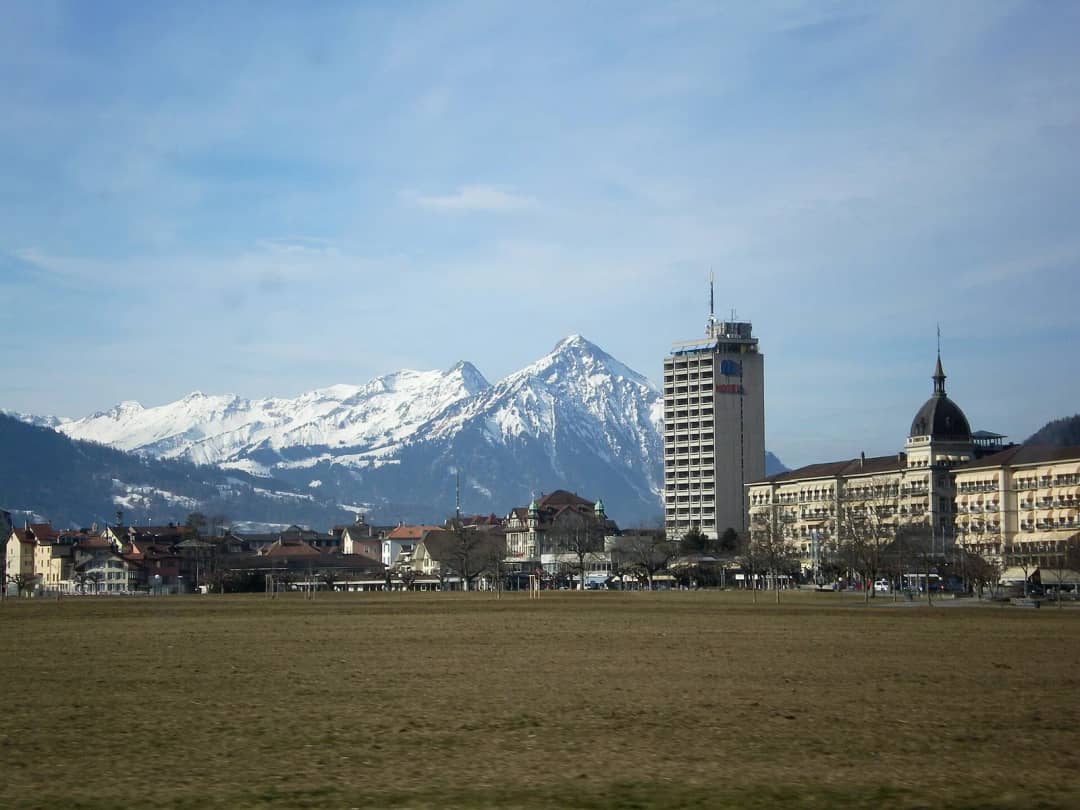
The Höhematte is a large green field in the very centre of town. While every other Swiss city built up its core with hotels, banks and boutiques, Interlaken kept this enormous open space. There is a reason for that, and the reason is older than paragliding itself.
In 1864, almost all of Interlaken's big hoteliers, led by Peter Ober, bought the meadow from the canton of Bern for 150,000 francs and split it among several co-owners. Their purchase came with three rules: no building, no splitting into parcels, no felling of trees. Neighbouring owners, the municipality and the canton all received the right to enforce them. The view of the Jungfrau massif from the centre of town stayed open.
More than 160 years later, the agreement still holds. The Höhematte is still grass. The Jungfrau still rises above it. And, by happy coincidence of geography, it became the most iconic landing zone in the world of tandem paragliding.
Almost every commercial paragliding flight in Interlaken ends here. On a sunny afternoon, you can sit on the grass with a drink and watch tandems land every two or three minutes. The pilots often spin the wing or do a small swoop above the field before touching down, partly for the passenger, partly because the audience has been waiting. Children clap. Tourists film. The pilot folds the wing in three seconds, passes the harness back, and walks off to a waiting van that will take him back up to the launch site for another flight.
That open field in the middle of a resort town is no accident. If you are curious why it was never built on, the story of how the Höhematte stayed a meadow explains what Interlaken's hoteliers decided in 1864 and why pilots can still land here today.
It is, quietly, one of the most beautiful daily rituals in Switzerland.
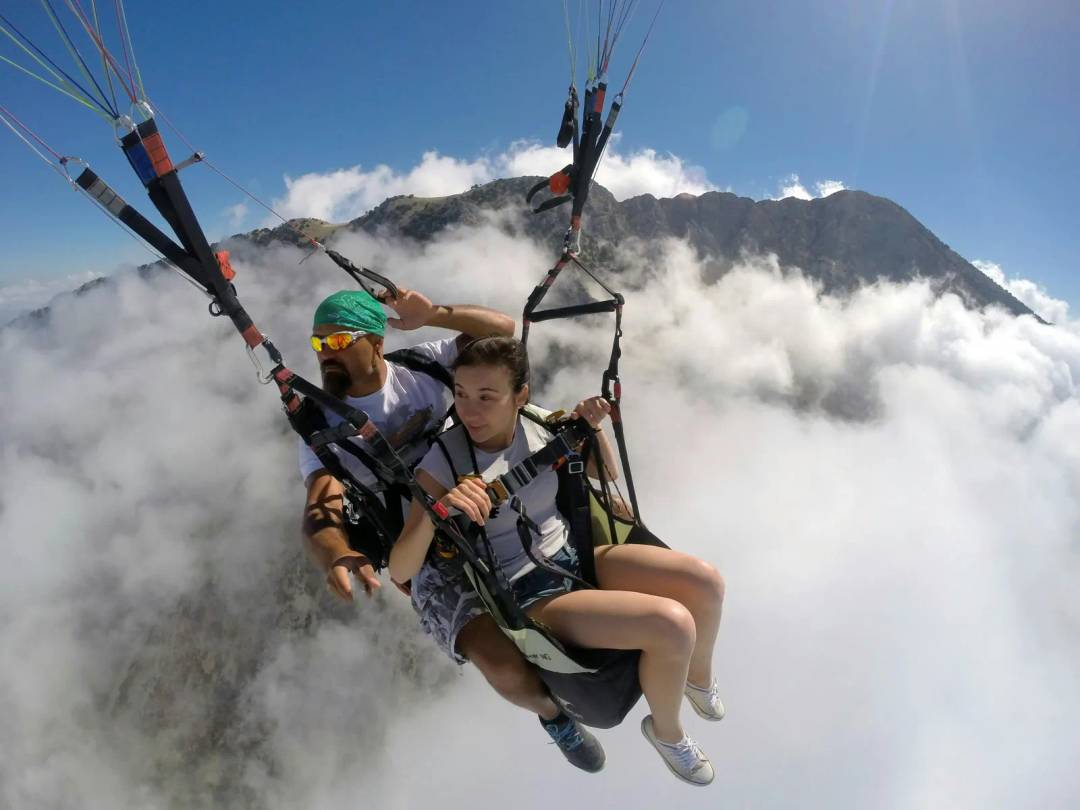
What It Actually Feels Like to Fly Above the Bernese Oberland
The takeoff is the hardest part. Not technically, because your pilot does the technical work, but psychologically. You are running off a hill. Your body knows this is wrong. Your brain has spent your entire life building reflexes against this exact movement.
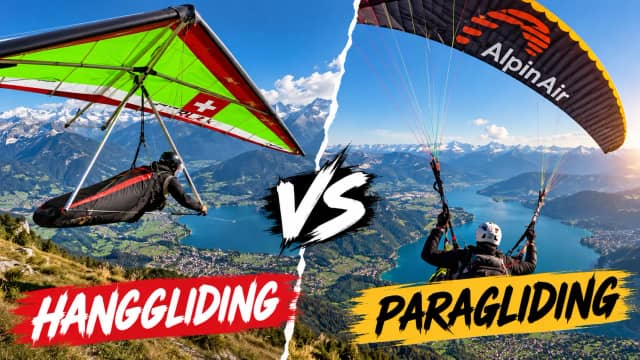
If the running start is the part that worries you, it helps to know the launch is different on a hang glider, with a stiffer wing and a longer run. Our hang gliding versus paragliding comparison walks through both takeoffs, the flight feel and the price gap of CHF 61 to 80, so you can pick the one that suits your nerves.
I often talk about paragliding with Marc Herzig, who runs Alpin Air, which flies from Beatenberg. We talk about everything. In my view, he is one of the pioneers: one of the pilots who started flying spirals of sorts with passengers, and filming the flights. He has a lot of knowledge and tips. Now, back to your take-off.
Then your feet leave the ground and the resistance disappears. You are sitting in a chair in the sky. The harness cradles you. The wing is somewhere above your head, taking the wind on your behalf. The pilot is behind you, narrating quietly: Look to your left, that is the Eiger. The dark face. The Mönch is the one in the middle. The Jungfrau is the highest one, the queen.
You smell pine first. Then the strange, mineral coldness of high air. If the cows are out, their bells will reach you in long, irregular waves from the slopes below, sometimes half a kilometre away, somehow still clear. You will hear a sound you did not expect: silence. Real silence. The kind that exists only when you are no longer near roads, engines, or other humans.
My clearest paragliding flight above Interlaken, in one line:
"Sunset in winter, magnificent colour but very cold."
Pierre Vetsch, guide and founder, interviewed on 14 October 2026
The view changes by the minute. As you spiral up in a thermal, Lake Thun shifts from an aerial photograph into a living thing, ferries leaving thin white trails, vineyard terraces above Spiez catching the last sun. As you turn south, the Eiger Nordwand fills your peripheral vision, the most famous north face in mountaineering history, dark and solemn even in summer.
Halfway through the flight, your pilot may offer to do an acrobatic move. A wingover, a spiral, a quick dive that lifts your stomach into your throat. Most people accept once and ask not to do it again. A few ask for two more. There is no judgment in either choice.
The descent toward the Höhematte takes longer than you expect. The pilot uses the landing approach to circle the town one last time, dropping altitude in soft S-shapes. The grass comes up. You hear: feet up. You glide in, you slide for two metres, you stop.
Then your legs remember they are legs. You laugh. You always laugh.
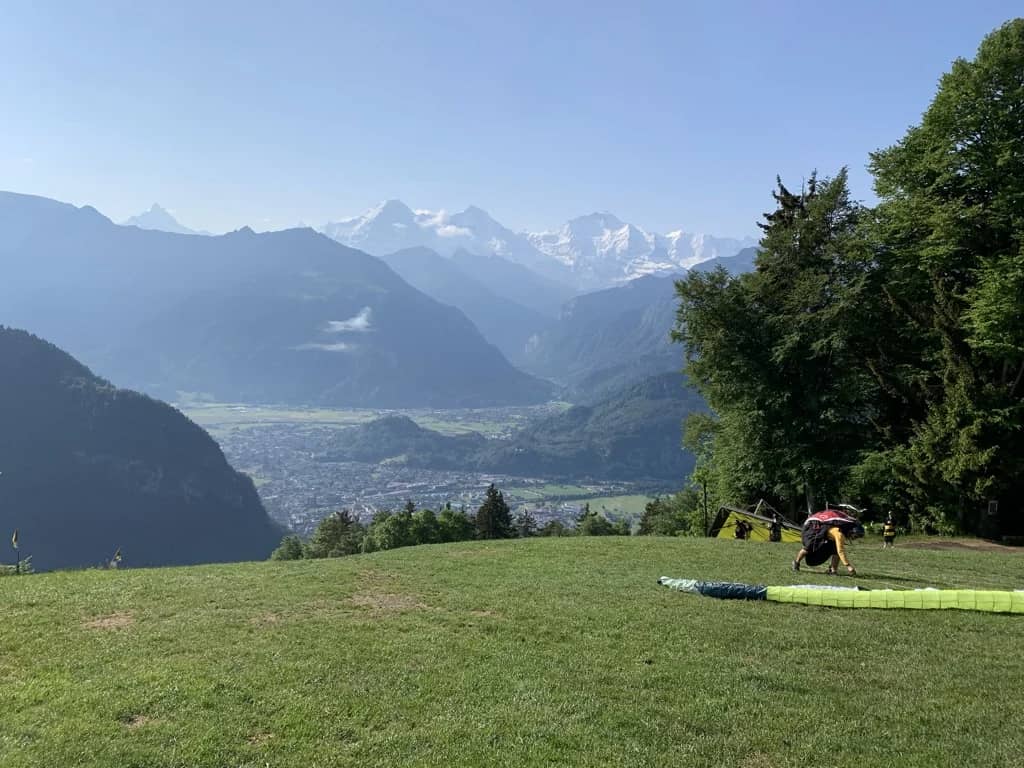
Where Pilots Take Off: Beatenberg, Niederhorn, and the Hidden Sites
Most commercial flights in Interlaken launch from one of three sites, each with a different character and a different view.
Beatenberg-Amisbühl sits at around 1,350 metres above sea level (Alpin Air figure for its Beatenberg take-off, checked on 8 October 2026), about 20 minutes from Interlaken by van (Alpin Air, checked on 15 October 2026). It offers panoramic views over both lakes, and it is where Alpin Air's tandem flights start. Time in the air is ten to twenty minutes.
Niederhorn is higher and is reached by the 18-minute gondola from Beatenberg (timetable.search.ch, checked on 15 October 2026). The views are wider. If you want a flight from the Niederhorn, ask your operator before booking whether it is offered and how long it lasts.
Further take-off sites lie elsewhere in the Jungfrau region. Before you book, check where your flight starts: Alpin Air takes off at Beatenberg, and both operators compared here land on the Höhematte in the centre of Interlaken.
A few smaller, lesser-known sites such as Brienzer Rothorn are flown by advanced pilots only and are not part of standard tandem operations. They exist mostly in conversations between local pilots over a beer in the evening.
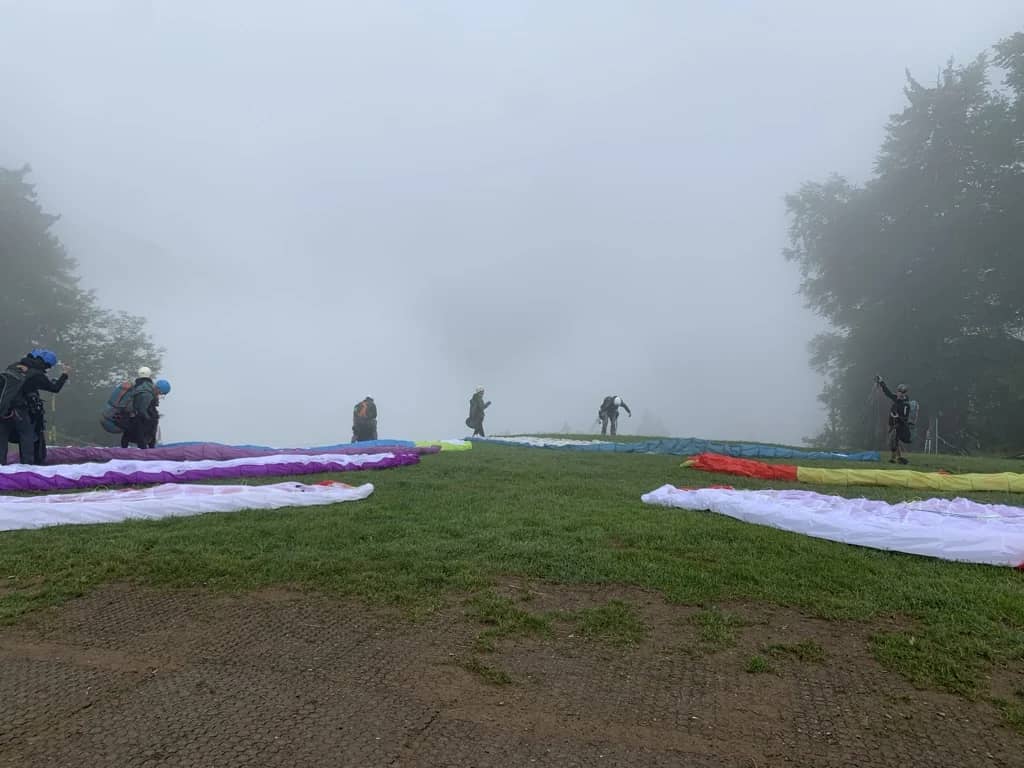
The Best Time of Year to Paraglide in Interlaken
Paragliding Interlaken's summer season runs from 1 April to 31 October, and Alpin Air flies all year when the weather allows (both checked on 8 October 2026). Within the summer season, the experience changes month by month.
Those same months are when the town itself is at its fullest. For what to do on the ground between flights, read how locals spend summer in Interlaken, from the swimming spots on Lake Brienz to the evening trails that stay empty after the day trippers leave.
May and June offer fresh green slopes, snow still capping the high peaks, and quieter launch sites. Mornings are calm and afternoons can be glorious.
July and August are peak season. The weather is most reliable, but launch sites can be busy and you may share the sky with twenty other tandems. The light is high and bright. Cows are on the alpages, which means you will hear the bells.
September and October bring golden light. The first dustings of snow appear on the Jungfrau, and the vineyards above Spiez turn red and gold. For September, my own tip is the late-afternoon flight, below.
Each flight is weather-dependent. Strong wind, low clouds, or thunderstorm risk will ground operations. Both operators may cancel at short notice, and then offer you another date or a full refund (alpinair.com, paragliding-interlaken.ch and our booking pages, checked on 15 October 2026).
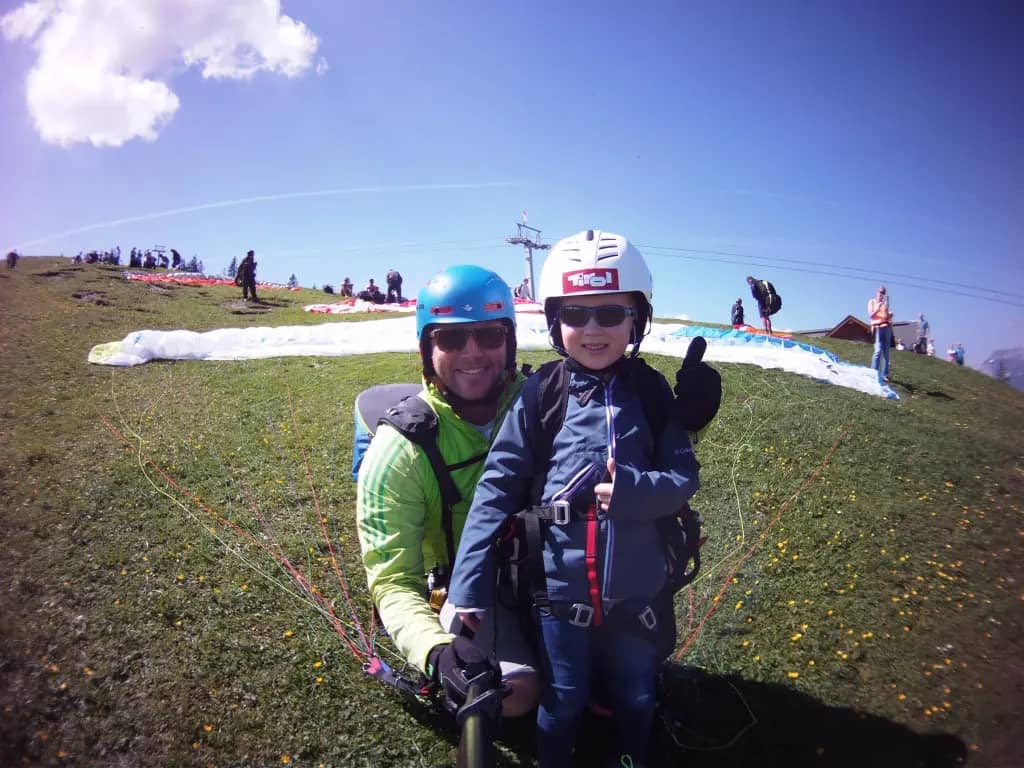
What to Expect on Your First Tandem Flight
You arrive at the meeting point, usually in the centre of Interlaken or near the Höhematte. A van picks up the passengers of the day and their pilots, and drives up to the launch site. There is a short briefing. Your pilot will explain how to run, where to put your hands, and what to do during landing, then fits your harness.
If the idea of jumping into the void is what holds you back, here is my answer:
"You run, you don't jump, and there's no vertigo."
Pierre Vetsch, guide and founder, interviewed on 14 October 2026
You land in the Höhematte, the park in the centre of Interlaken. People eating lunch on the grass look up. Some of them clap. It is one of the stranger and better moments of the whole experience.
A standard flight lasts between ten and twenty minutes, depending on the launch site, the thermal conditions, and the altitude difference. You can request photos and a video, which the pilot will take using a small camera mounted on his arm or a selfie stick.
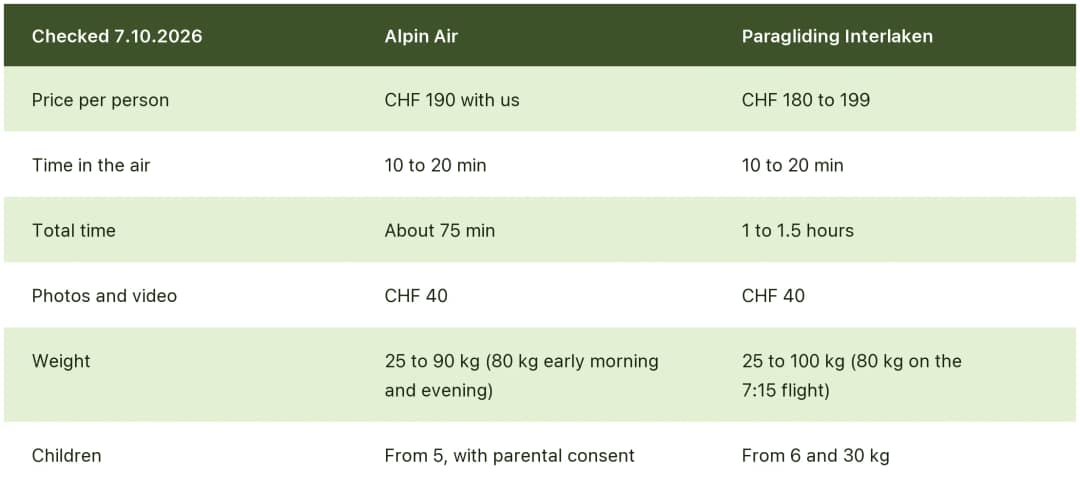
After landing on the Höhematte, your pilot can show you the photos and video right away (on a tablet at Alpin Air, CHF 40 if you keep them). From the Höhematte, hotels and both stations are within walking distance. The whole experience takes about 75 minutes at Alpin Air and 1 to 1.5 hours at Paragliding Interlaken.
You do not need to be an athlete, but you do need to be able to run at take-off. You do not need to know anything about flying. You do not need any equipment beyond closed shoes and a layer warmer than you think you need. Children can fly from age 5 at Alpin Air and from age 6 at Paragliding Interlaken.
💡 Insider Tip from Pierre: If you can choose, book the late-afternoon flight on a clear day in September. The light starts turning golden around 5 p.m., the thermals are smooth, and the pilots have more time to extend the flight. I have seen people land in tears, in a good way, three or four times. Bring a layer for after the landing, even when it is warm in town. The high air is colder than you expect.
Tandem Paragliding Prices in Interlaken: CHF 180 to 199
Tandem paragliding in Interlaken costs CHF 180 to 199 per person at Alpin Air and Paragliding Interlaken (prices checked on 7 October 2026); we sell the Alpin Air flight from Beatenberg at CHF 190 from April to October and CHF 180 from November to March (our booking pages, checked on 15 October 2026). A standard flight lasts 10 to 20 minutes in the air. From spring to late summer, Paragliding Interlaken also sells a longer thermal flight, Double Airtime, with 30 to 40 minutes in the air. Photo and video packages cost CHF 40 more.
So is it worth it? I have flown here myself, in winter too. On 8 October 2026 I named paragliding as the thrill activity in Interlaken that is not worth its price, and on 14 October, asked who I would still recommend it to, I said:
"It's not worth the price, no; better to do another activity, hang gliding instead, otherwise kayaking or something else; keep paragliding for France, Spain or Portugal, for 70 euros."
Pierre Vetsch, guide and founder, interviewed on 14 October 2026
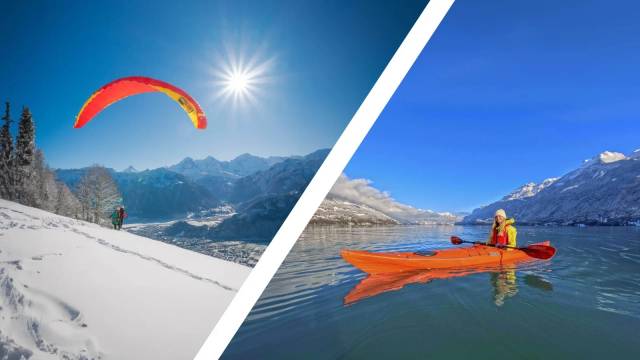
The 70 euros is my rough idea of what a flight costs there, not a quoted price. Why hang gliding? I have done my own hang-gliding flight here, and I find it better: more feeling of flight, for a bit more money (the comparison linked above shows the gap). My verdict is about the price of 10 to 20 minutes in the air, not about either operator.
Prices vary by operator and season. Always confirm directly when booking.
Short flight or long flight: which should I book?
If my verdict above has not put you off, here is how to choose. If it has, look at hang gliding, kayaking or another activity instead.
Book the standard flight if: it is your first time, you have a tight schedule, or you are booking for children or someone who is nervous. It gives you 10 to 20 minutes in the air.
Book a longer flight, such as Double Airtime, if: you have some experience flying, you want the widest possible panorama, or you are a photographer and want time to shoot.
About the photo package: on Alpin Air flights your phone stays on the ground, and only a small pocket camera with a wrist strap is allowed. Your pilot films and photographs the flight and shows you the files right after landing; you pay CHF 40 only if you keep them.
Your Questions About Tandem Paragliding in Interlaken
How much is paragliding in Switzerland?
Paragliding Interlaken puts a tandem flight in Switzerland at CHF 160 to 220, depending on the area and the operator. Its own longer flight, Double Airtime, keeps you 30 to 40 minutes in the air instead of 10 to 20.
How long does a paragliding flight in Interlaken last?
A standard tandem flight lasts 10 to 20 minutes in the air at Alpin Air and Paragliding Interlaken. The full experience (pickup, briefing, drive to launch, flight, return) takes about 75 minutes at Alpin Air and 1 to 1.5 hours at Paragliding Interlaken. From spring to late summer, Paragliding Interlaken's longer Double Airtime flight keeps you 30 to 40 minutes in the air.
Is paragliding in Interlaken safe?
The national body for the sport is the . No aerial sport is risk-free. Every flight depends on the weather, and when conditions are not good enough, the operators offer you another date or a full refund.
Is paragliding scary if you are afraid of heights?
Not in the way most people expect. The sensation is floating, not falling. You are seated in a harness that cradles you like an armchair. There is no sudden drop unless you accept the spirals or other figures your pilot may offer. My answer to that fear is in the first-flight section above: you run, you do not jump.
Before the run, your pilot gives you a short briefing at the take-off and tells you when to go.
Is there a weight limit for paragliding in Interlaken?
Both operators set a minimum weight of 25 kg. The maximum is 90 kg at Alpin Air (80 kg on early morning and evening flights) and 100 kg at Paragliding Interlaken (80 kg on its 7:15 a.m. flight). Alpin Air flies children from age 5 with a declaration of consent from their parents, and Paragliding Interlaken from age 6 and 30 kg.
No sporting level is required, but you must be able to run: Paragliding Interlaken asks every guest to be fit, in good health and able to run well, about 40 metres (checked on 15 October 2026). Paragliding is generally not recommended for people with severe cardiac conditions, chronic vertigo, or during pregnancy. If in doubt, contact your operator before booking.
If paragliding is off the table for you, or you want a second activity for the same trip, our guide to the best outdoor adventures in Interlaken compares canyoning, rafting, skydiving and the quieter options by price, fitness needed and how much nerve each one asks of you.
What should I wear for a paragliding flight?
Closed shoes (sneakers are fine), comfortable clothes that allow you to run a few steps, and one layer warmer than the temperature in town. Sunglasses are recommended. Loose items should be left in the van.
Can children paraglide in Interlaken?
Yes. Alpin Air flies children from age 5 with a declaration of consent from their parents, and Paragliding Interlaken from age 6 and 30 kg. Children tend to be remarkably calm once in the air.
How far in advance should I book?
The number one mistake visitors make when they want to fly, in my view:
"Booking on the last day, with no margin if the weather cancels."
Pierre Vetsch, guide and founder, interviewed on 14 October 2026
Book your flight for the start of your stay, so a cancelled flight can move to another day. Paragliding Interlaken gives the same advice: book at the earliest possible date, so you can reschedule if the weather cancels (checked on 15 October 2026).
If the weather cancels your flight, both operators offer another date or a full refund. Paragliding Interlaken lets you change or cancel free of charge up to 24 hours before the flight time, and if you book Alpin Air through us, keep your phone on: Alpin Air calls you if the weather changes the plan (checked on 15 October 2026).
A grounded morning is not a lost day. Our local guide to things to do in Interlaken lists what is worth doing in town and around the lakes when the wind is up, including the options that work in rain, so you can fill the gap while you wait for the new slot.
Do I get photos and video from my flight?
Yes. At both operators, the pilot films and photographs the flight and sells you the files for CHF 40. At Alpin Air, the pilot shows you the files on a tablet right after landing and you get the original SD card or a copy on your phone; at Paragliding Interlaken, you can prepay or view them first and pay the pilot afterwards (both checked on 15 October 2026).
Can I paraglide in Interlaken in winter?
Yes, but the offer is more limited. Alpin Air sells its Top Flight all year, with daily flights when the weather allows (alpinair.com, checked on 15 October 2026). Through us, the winter flight costs CHF 180 from November to March, with six departures a day from 08:30 to 15:00 between 1 November and 10 February (our winter paragliding page, checked on 10 November 2026). Alpin Air lends shoes, jackets and ski pants free of charge.
"Paragliding is very good in winter too; it's cold, though, and the air is fresh."
Pierre Vetsch, guide and founder, interviewed on 6 October 2026
Dress warmly and keep a spare day for the weather.
Is paragliding in Interlaken worth it?
Not at its price, in my view: CHF 180 to 199 buys 10 to 20 minutes in the air, even though the flight is beautiful. For a stronger feeling of flight, I would pick hang gliding in Interlaken at CHF 260, or spend the money on kayaking or another activity. If you still want to fly, book it early in your stay, so the weather leaves you a spare day.
Tandem Paragliding in Interlaken and Its Price: My Verdict
My answer on the price is still no, for the reasons given in the price section, even though the flight is beautiful: the silence of high air, the cowbells reaching you from far below, and the slow descent toward a meadow that Interlaken's hoteliers kept open for 160 years.
If you still want to fly, the number one objection is the price: CHF 190 for 10 to 20 minutes in the air from April to October, CHF 180 from November to March. My answer:
"Do the paragliding in the morning, our tour in the evening."
Pierre Vetsch, guide and founder, interviewed on 14 October 2026
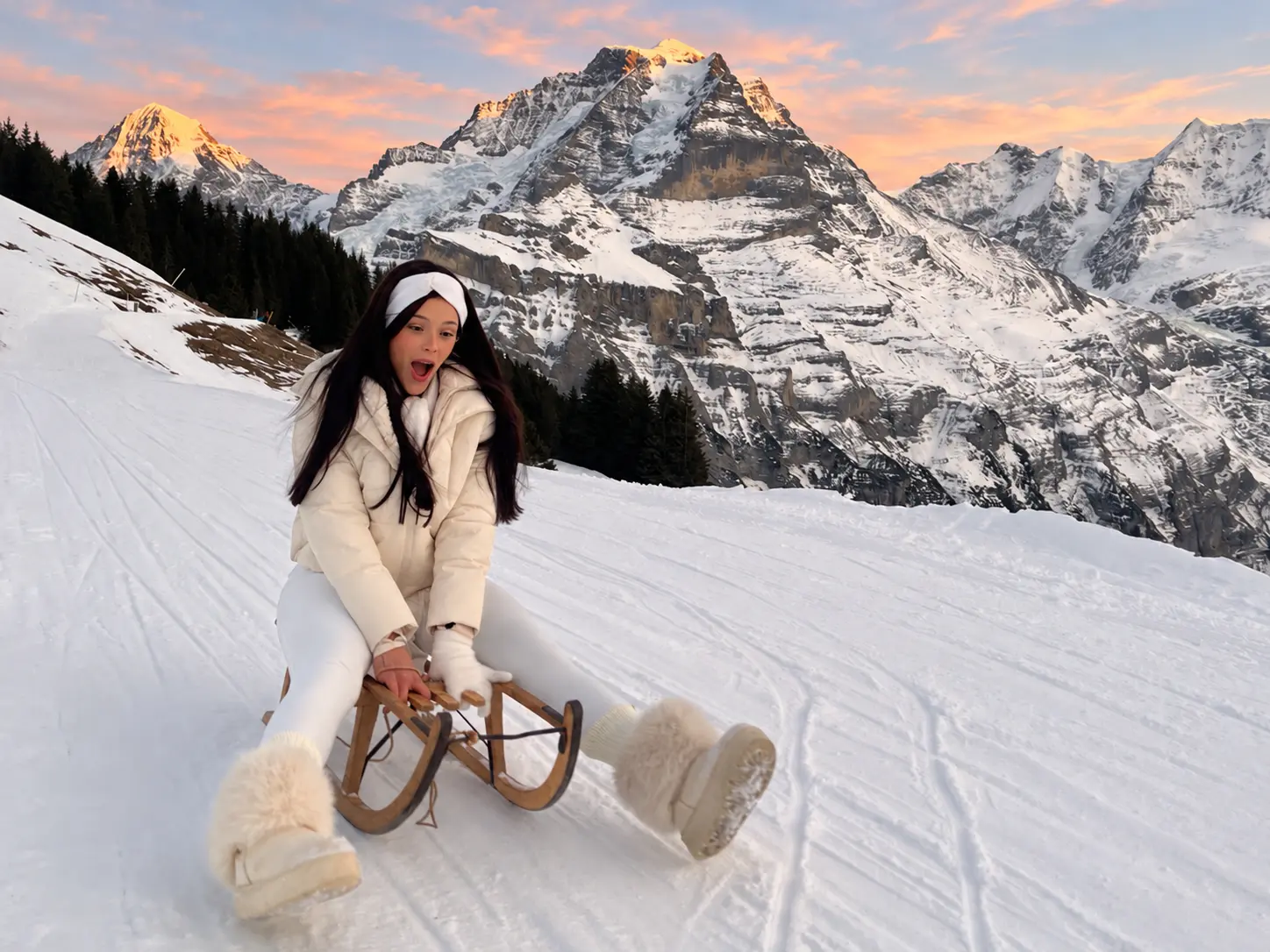
This winter, that evening tour is our Sunset Sledding & Fondue. It runs from 15 December 2026 to 11 April 2027, Wednesday to Sunday, and leaves Interlaken at 3:30 pm for about 4 hours, with eight guests at most and CHF 139 per person. Book a morning flight, so you land well before the pick-up. Cancellation is free up to 48 hours before departure, and if we cancel for the weather, you choose between a full refund and another date. Questions first? Write to us on WhatsApp; we reply within the hour. Save my seat on a Sunset Sledding & Fondue evening (from 15 December).
How we made this: facts and prices checked at the official sources on 8 October 2026, written with AI assistance. Title, prices, winter departures and the new FAQ answer checked again on 10 November 2026 against our booking pages and the sites of Alpin Air and Paragliding Interlaken.
*Written by Pierre Vetsch, founder and head guide at Swiss Local Adventures
Source:
on-site experience from the Beatenberg launch site, 2026.
Sources & References
- Swiss Hang Gliding Federation
- Alpin Air
- Photo: Tran Mau Tri Tam tranmautritam, Wikimedia Commons (CC0)
- Photo: Yiftachsam, Wikimedia Commons (Public domain)
- Swiss Local Adventures, Sunset Sledding & Cheese Fondue: season 15 December 2026 to 11 April 2027, Wednesday to Sunday, 3:30 pm departure, about 4 hours, CHF 139 (CHF 129 for groups of 6 or more), max 8 guests, free cancellation up to 48 hours, weather cancellation = refund or new date, opened 15.10.2026
- Swiss Local Adventures, Paragliding in Interlaken (Alpin Air): CHF 190, April to October, 10 to 20 min in the air between Lake Thun and Lake Brienz with the Eiger, Mönch and Jungfrau in front, about 75 min, 20-minute drive to Beatenberg 1,350 m, short briefing at the take-off, landing on the Höhematte within walking distance of hotels and both stations, photos on the pilot's tablet CHF 40 if you keep them, phones stay on the ground (pocket camera with wrist strap allowed), AlpinAir may cancel at short notice, new date or full refund, keep phone on; booking data 01.04 to 31.10.2027, opened 15.10.2026
- Swiss Local Adventures, Winter Paragliding Interlaken: CHF 180, November to March, 1 November to 10 February six departures 08:30 to 15:00, van about 20 min to Beatenberg-Amisbühl, Alpin Air calls you if the weather changes the plan, opened 15.10.2026
- Alpin Air, Top Flight: available all year, CHF 180.00 in Tour Facts and CHF 190* next to Book now, 10 to 20 min air time, 75 min total, Beatenberg 1'350 m, 20 minute drive, files shown on a tablet after the flight, SD card or phone copy, CHF 40 to the pilot, other date or full refund in bad weather, shoes, jackets and ski pants lent free, opened 15.10.2026
- Alpin Air, Legal notice: AlpinAir Paragliding GmbH, Authorized Representatives: Marc Herzig (no founder named), opened 15.10.2026
- timetable.search.ch API, Beatenberg gondola to Niederhorn: dep. 10:05, arr. 10:23 on 16.10.2026 (18 min), queried 15.10.2026