Canton of Bern
Bernese Oberland, Switzerland
Two lakes, the Eiger, Mönch and Jungfrau, and Interlaken in the middle.
How do I get there?Interlaken, its hub, is 1 h 57 from Zurich by direct trainThe Bernese Oberland is the highest part of the canton of Bern: Lake Thun and Lake Brienz, the valleys below the Eiger, Mönch and Jungfrau, and Kandersteg and the Haslital further out. Interlaken sits between the lakes, 1 h 57 from Zurich by direct train. Base yourself there for most trips outside winter. In winter, Pierre's advice is Wengen or Mürren instead.
Written by Pierre Vetsch, founder and head guide. Last checked 11 November 2026.
The Bernese Oberland at a glance
- Where: The highest and southernmost part of the canton of Bern: the upper Aare valley, with Lake Thun and Lake Brienz
Wikipedia, read 10 Nov 2026 - Hub: Interlaken, between the two lakes: 1 h 57 from Zurich and 55 minutes from Bern by direct train
SBB timetable for 20 Jan 2027, read 10 Nov 2026 - Highest summits: Finsteraarhorn 4,274 m, Jungfrau 4,158 m, Mönch 4,110 m
Wikipedia, read 10 Nov 2026 - Highest railway station: Jungfraujoch, 3,454 m, open 365 days a year
jungfrau.ch, read 9 Nov 2026 - World Heritage: Swiss Alps Jungfrau-Aletsch, on the UNESCO list since 2001: 824 km² of the Bernese Alps, across Bern and Valais
jungfraualetsch.ch, read 10 Nov 2026 - Language: German: the main language of 34,508 of the 38,182 residents of the Interlaken district in 2000
Federal Statistical Office, census of 2000, read 10 Nov 2026 - Regional pass: Berner Oberland Pass, 3, 4, 6, 8 or 10 days. CHF 240 for 3 days in 2nd class at full fare, prices valid until 31 December 2026
berneroberlandpass.ch, read 10 Nov 2026 - Time you need: Three nights for a first visit outside winter, based in Interlaken. Five nights or more to add Kandersteg, Brienz and Meiringen, still from Interlaken outside winter. In winter, Pierre says to sleep in Wengen or Mürren, even for five nights or more.
Pierre, interviews of September to November 2026
Book in the Bernese Oberland
Our own tours across the region, the regional pass, and private days we guide ourselves.
The seven areas of the Bernese Oberland, and how far each one is
Seven areas cover nearly every trip, and none needs a car. Interlaken is the hub. The train times below are sample journeys from Interlaken on the SBB timetable for 20 January 2027.
- Interlaken: The hub, between Lake Thun and Lake Brienz, with two stations: Interlaken West and Interlaken Ost
- Lauterbrunnen Valley: Lauterbrunnen 22 minutes, Wengen 37, Mürren 50 from Interlaken Ost
- Grindelwald: 36 minutes from Interlaken Ost, direct
- Lake Thun: Spiez 15 to 20 minutes from Interlaken West, Thun 34 or 35 minutes from Interlaken Ost
- Lake Brienz: Brienz 17 to 20 minutes from Interlaken Ost
- Kandertal: Kandersteg 1 h 12 with one change, Adelboden 1 h 33 with two trains and a bus
- Haslital: Meiringen 31 to 33 minutes from Interlaken Ost
Interlaken
The hubThe town between the two lakes, and a resort since about 1800. Trains to both valleys and both lakes leave from its two stations.
Our Interlaken guideLauterbrunnen
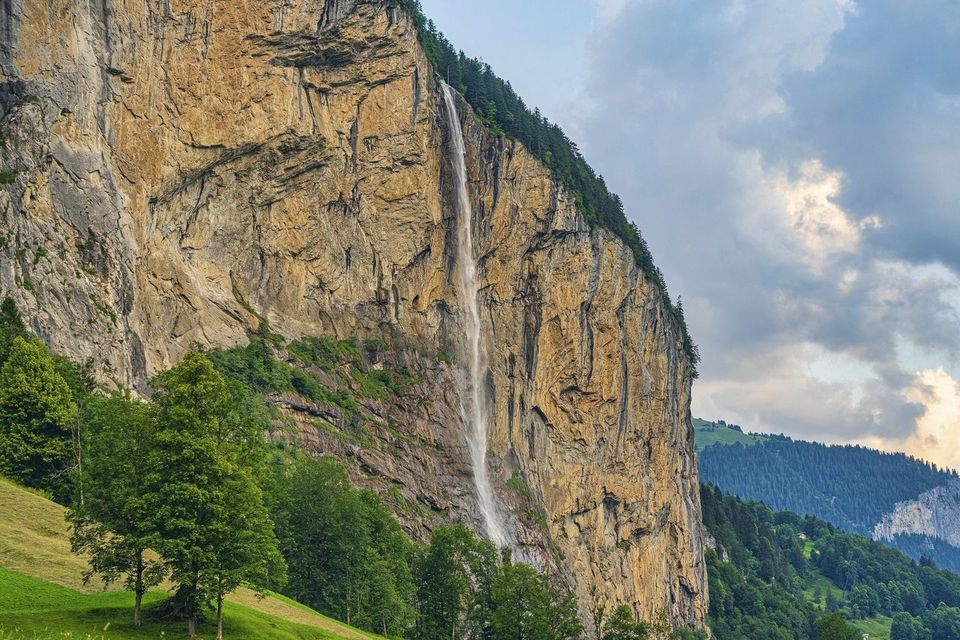
Lauterbrunnen Valley · 22 minA valley of cliffs and waterfalls. The Staubbach drops 297 m, the highest free-falling waterfall in Switzerland. Trains and cable cars climb from here to Wengen and Mürren.
Our Lauterbrunnen guideWengen
Lauterbrunnen Valley · 37 minA car-free village at 1,274 m, on a sunny terrace at the foot of the Jungfrau. Pierre's pick for a quiet stay in summer.
Our Wengen guideMürren and Gimmelwald
Lauterbrunnen Valley · 50 minMürren, at 1,650 m, is the highest consistently inhabited place in the Bernese Oberland, and car-free. Gimmelwald, at 1,367 m, is a hamlet of 109 people, 45 minutes below on foot.
Our Mürren guideGrindelwald
Grindelwald · 36 minA village of 4,318 inhabitants at 1,050 m, under the Eiger. Gondolas climb to First, and the Eiger Express reaches the Eiger Glacier station in 15 minutes, on the way to the Jungfraujoch.
Our Grindelwald guideLake Thun
Lake ThunThe longer lake, at 17.5 km, with boats all year. Made in Bern counts five castles along its shores.
Our Lake Thun guideThun
Lake Thun · 34 minThe town at the west end of Lake Thun, where the Aare leaves the lake. On a day when cloud hides the summits, Pierre sends people to its old town.
Our Thun guideSpiez
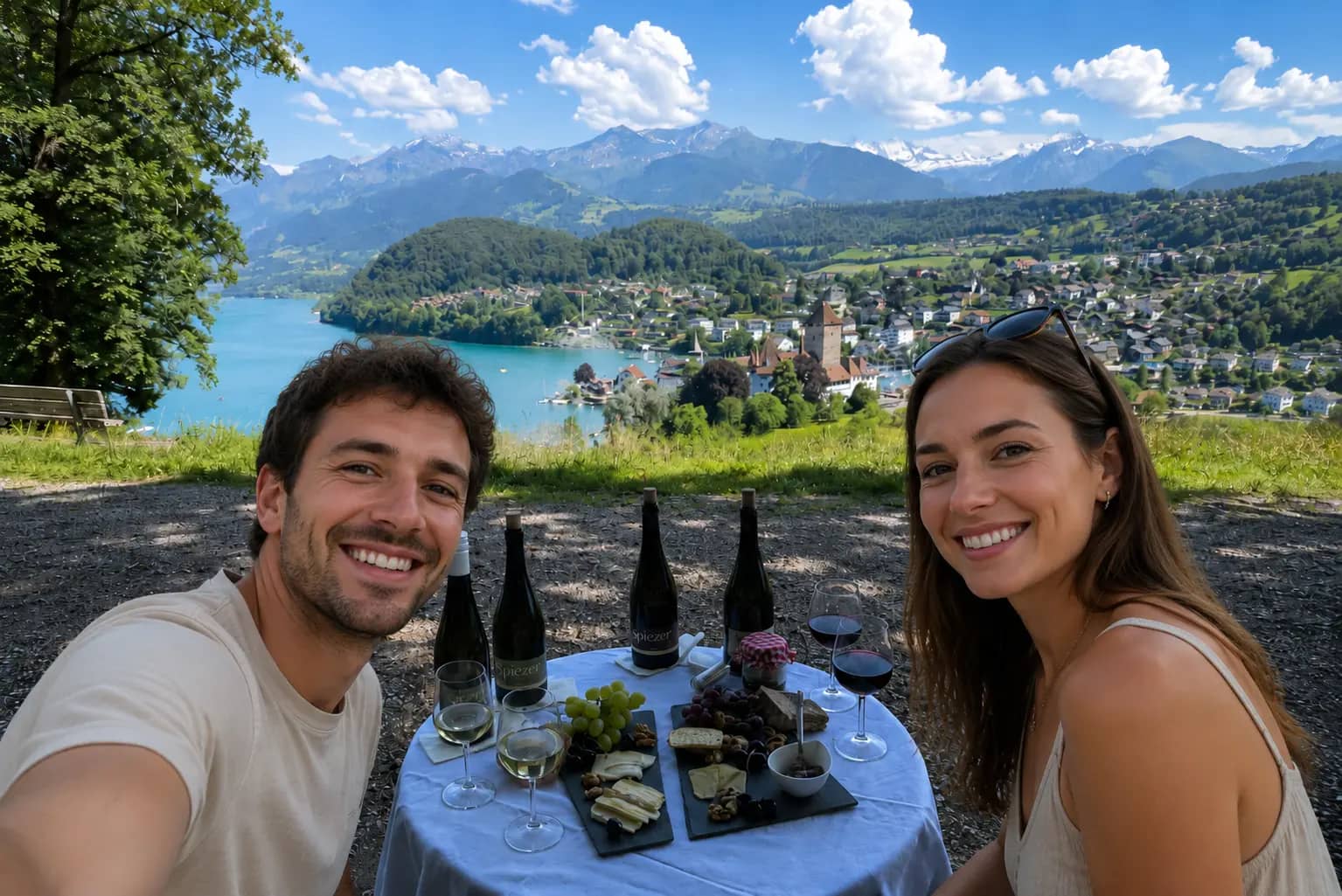
Lake Thun · 15 min from Interlaken WestA town on Lake Thun, 15 minutes from Interlaken West. For wine on a three-day trip, Pierre picks Spiez over Lavaux or the Valais.
Our Spiez guideLake Brienz
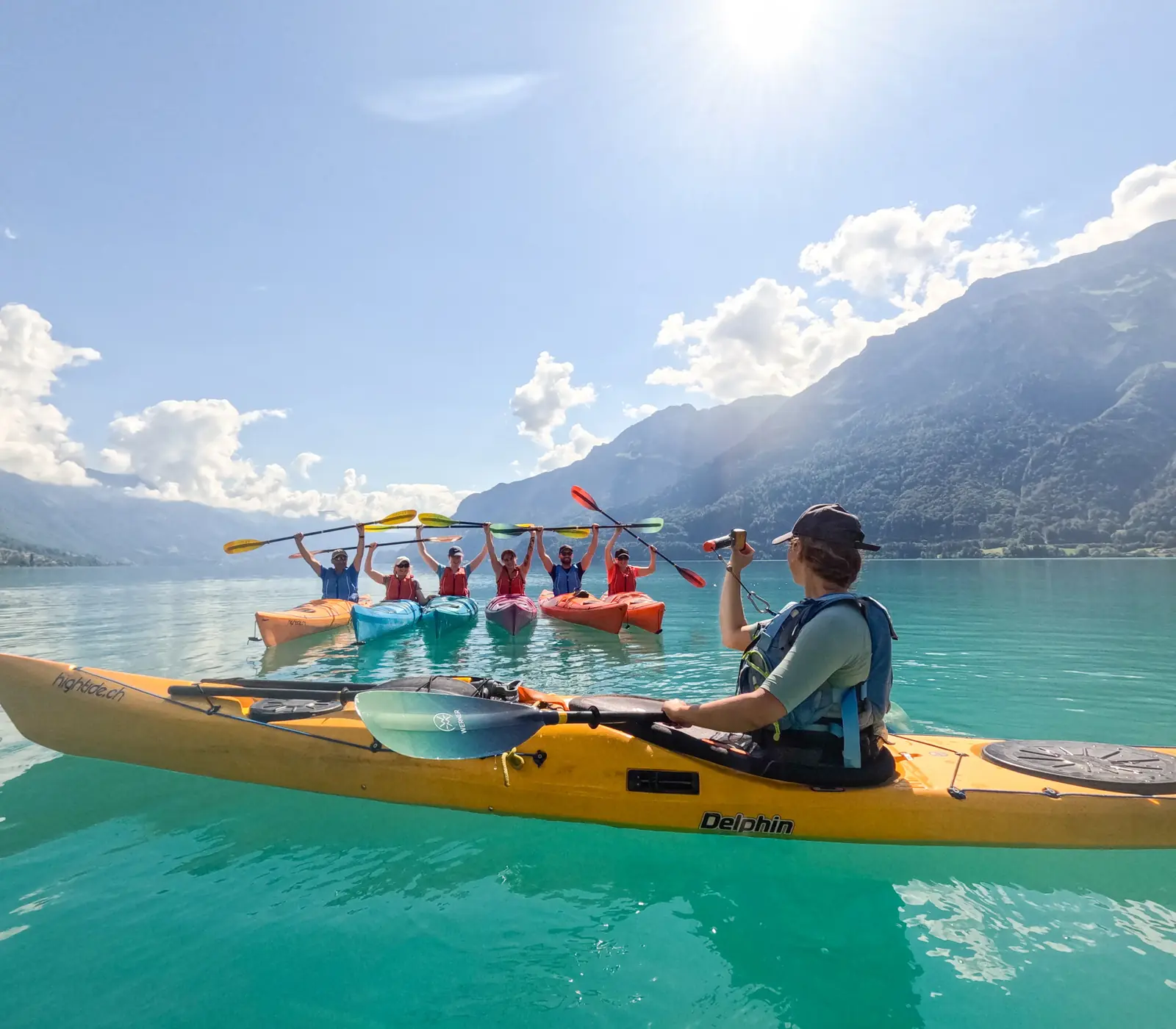
Lake BrienzThe shorter lake, 14 km long. Boats run from 3 April to 6 December 2026, then again from 26 March 2027.
Our Lake Brienz guideBrienz
Lake Brienz · 17 to 20 minThe village on Lake Brienz where the Rothorn line starts. The Rothorn steam railway runs to Planalp from 8 May 2027 and to the summit from 5 June to 24 October 2027.
Our Brienz guideKandersteg
Kandertal · 1 h 12The village at the north entrance of the old Lötschberg tunnel. Pierre pairs it with the Blausee and Lake Oeschinen, said to be one of the most beautiful lakes in Switzerland, Made in Bern writes.
Our Kandersteg guideAdelboden
Kandertal · 1 h 33The ski village whose FIS Ski World Cup draws around 40,000 fans every year, Made in Bern says. From Interlaken: two trains, then the bus.
Our Adelboden guideMeiringen and Hasliberg
Haslital · 31 to 33 minThe Haslital sits between four passes: Brünig, Grosse Scheidegg, Susten and Grimsel. High above it, the Alpen tower stands at 2,250 m, and on a good day you can count 401 peaks from it.
Our Hasliberg guideGrimsel
HaslitalThe pass at the head of the valley. The road is open in summer only. The Grimsel Hospiz was first mentioned as a guest house in 1142.
Our Grimsel guideTrain times: SBB timetable sample for 20 January 2027, after the December timetable change, read 10 November 2026. Your times depend on the hour you leave: check the SBB app.
Our verdict
Base yourself in Interlaken outside winter: Lauterbrunnen is 22 minutes away by train, Grindelwald 36 and Brienz 17 to 20, so one hotel covers both valleys and both lakes.
On a first visit of three days outside winter, keep to the Jungfrau valleys and the lakes, as in Pierre's plan below. Keep Adelboden, 1 h 33 with two trains and a bus, for a longer stay. Kandersteg, 1 h 12 with one change, is on Pierre's five-day list for Oeschinensee and the Blausee.
For one summit, we pick the Schilthorn over the Jungfraujoch, Pierre's choice too. If you hold a Berner Oberland Pass, the Schilthorn is free, while the Jungfraujoch is only 25 % off from Grindelwald or Wengen.
In November, check each lift first: in 2026 the First gondola is shut until 27 November, the Eiger Express from 9 to 20 November and the train from Wengen to Kleine Scheidegg from 9 November to 4 December.
Leave the car at home: Wengen and Mürren are car-free, and trains reach Lauterbrunnen in 22 minutes and Grindelwald in 36. The Grimsel Pass road is closed in winter.
The Bernese Alps: the summits you can ride up
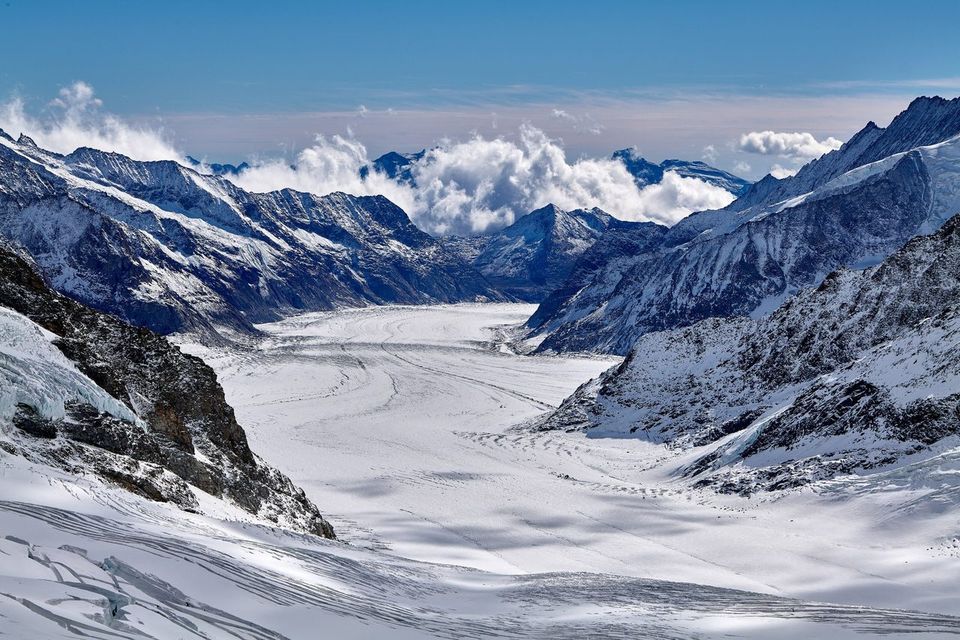
You can ride up to the Jungfraujoch, 3,454 m, Europe's highest railway station, to the Schilthorn above Mürren by cable car from Stechelberg, and to Grindelwald First by gondola; Pierre prefers the Schilthorn to the Jungfraujoch. The mountains are the reason most people come. The Swiss Alps Jungfrau-Aletsch World Heritage Site has been on the UNESCO list since 2001. It covers 824 km² across the cantons of Bern and Valais, with the Eiger, Mönch and Jungfrau and the Aletsch glacier at its centre, and holds the largest contiguous glacial area in the Alps.
Jungfraujoch
3,454 m · open all yearEurope's highest railway station. A return from Interlaken Ost cost CHF 225.60 for 20 January 2027 with no discount card. Pierre does not recommend it: often crowded, dear for what it is, sometimes in cloud. He prefers the Schilthorn.
Our Jungfraujoch guideSchilthorn
Above MürrenThe summit above Mürren, reached by cable car from Stechelberg through Mürren. Until 1967 it was an insider tip among climbers, Made in Bern says; the cable car opened it to everyone. Free with the Berner Oberland Pass, and Pierre's pick over the Jungfraujoch.
Our Schilthorn guideGrindelwald First
Above GrindelwaldA gondola from Grindelwald up to the First Cliff Walk and the First Flyer zip line. Closed for maintenance until 27 November 2026.
Our First guideJungfrau
4,158 mThe name first appears in a document in 1577: the peak looked untouched and out of reach, so locals named it after a maiden. The railway stops at the Jungfraujoch, 3,454 m, below the summit.
The Jungfrau, peak by peakEiger and Mönch
Mönch 4,110 mGrindelwald sits at the foot of the Eiger. Its north face became famous with the climbing attempt of summer 1936. The Mönch stands between the Eiger and the Jungfrau.
The Eiger and the Mönch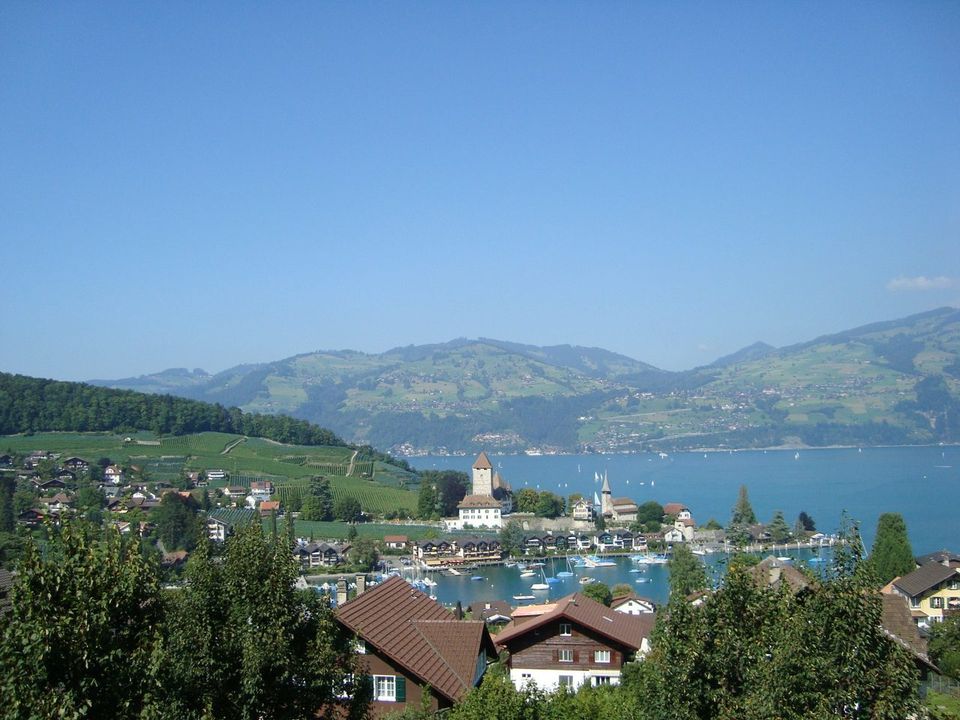
Getting around the Bernese Oberland: trains, boats and passes
You get around by train, bus and boat, and you do not need a car. Trains from Interlaken Ost reach Lauterbrunnen in 22 minutes and Grindelwald in 36, and the two valleys are 39 minutes apart with one change. Boats run on Lake Thun all year and on Lake Brienz from spring to early December.
Until 11 December 2026, the line between Interlaken West and Interlaken Ost is closed to trains, and buses replace them.
Which pass to buy
For five days of trips, Pierre advises the Swiss Travel Pass. It is not sold for five days: take the 6-day pass. The Berner Oberland Pass covers the region only, and the Jungfrau Travel Pass the Jungfrau Region and its two lakes.
- Swiss Travel Pass: Trains, buses and boats anywhere in Switzerland, for 3, 4, 6, 8 or 15 consecutive days. CHF 254 for 3 days and CHF 399 for 6 days in 2nd class for an adult aged 25 or over, on Swiss Travel System prices valid until 31 December 2026; Swiss Travel System says they stay the same in 2027. Only for people who live outside Switzerland and Liechtenstein. Free on the cable car from Stechelberg to Mürren.
- Berner Oberland Pass: The region only, from Bern, Brig, Montreux or Lucerne, for 3, 4, 6, 8 or 10 consecutive days. CHF 240 for 3 days in 2nd class at full fare, CHF 168 with a Swiss Travel Pass, a Half Fare Card or for ages 16 to 24. Prices valid until 31 December 2026, and the pass's official site says they stay the same in 2027. Boats on both lakes included. Free to the Schilthorn and the Schynige Platte, 50 % off the First gondola, 25 % off from Grindelwald or Wengen to the Jungfraujoch.
- Jungfrau Travel Pass: The Jungfrau Region, with boats on Lake Thun and Lake Brienz, 3 to 8 days. CHF 210 for 3 days for an adult on prices valid until 12 December 2026. Grindelwald First is included; the Jungfraujoch needs a connecting ticket, from CHF 63.
Pass pages, with what each one covers
The regional pass in detail: Berner Oberland Pass: prices and what it covers.
The national pass: Swiss Travel Pass.
The Jungfrau Region pass: Jungfrau Travel Pass: prices and what it covers.
Stations, trains and luggage around Interlaken: Trains, passes and stations.
By car
You can drive, but the villages Pierre likes best for a night, Wengen and Mürren, are car-free. From the south, the Grimsel Pass road is open in summer only.
Pass prices read on berneroberlandpass.ch, travelswitzerland.com (Swiss Travel System) and jungfrau.ch on 10 November 2026. Prices for 2027 were not all published: check before you buy.
When to come, and what shuts between seasons
Come in summer for hiking and the lakes, and in winter for snow up high. Avoid November and early December if the summits matter: lifts close one after another for maintenance.
- November and early December 2026: The First gondola is closed until 27 November, the Eiger Express from 9 to 20 November, and the train from Wengen to Kleine Scheidegg from 9 November to 4 December. The Wengen-Männlichen cable car is closed for maintenance; its winter timetable starts on 12 December. The Schynige Platte railway is closed for the winter until 4 June 2027. The Harder funicular stops after 29 November, and the last Lake Brienz boats sail on 6 December. Lake Thun boats and the Jungfraujoch run all year.
- Winter 2026-2027: Skiing at Grindelwald-Wengen from 21 November 2026 to 25 April 2027, at Mürren-Schilthorn until 2 May 2027, and at First from 19 December 2026 to 29 March 2027. The Lauberhorn races in Wengen run from 15 to 17 January 2027.
- Spring 2027: Lake Brienz boats and the Harder funicular restart on 26 March 2027. The Rothorn steam railway runs to Planalp from 8 May.
- Summer and autumn 2027: The Rothorn railway reaches its summit, and the Schynige Platte railway runs, from 5 June to 24 October. The Grimsel Pass road is a summer route.
- Pierre's months: May in Interlaken, outside winter. For Grindelwald: March to ski, July in summer.
Dates read on the operators' sites (jungfrau.ch, maennlichen.ch, bls.ch, brienz-rothorn-bahn.ch) and the resorts' sites (grindelwald.swiss, muerren.swiss, wengen.swiss), 9 and 10 November 2026. Operators change dates: check before you travel.
Three, five and seven days in the Bernese Oberland
Three days, first visit outside winter
Pierre says three nights for a first visit, with Interlaken as the base.
- Day 1: Lauterbrunnen, then up to Mürren, and walk down to Gimmelwald. It is Pierre's car-free summer day.
- Day 2: Grindelwald and First.
- Day 3: the lakes. Pierre's route is Thun in the morning and Spiez in the afternoon.
Five days outside winter, Pierre's own list
Outside winter, keep Interlaken as the base and go out for the day. In winter, even for five nights or more, Pierre would have you sleep in Wengen or Mürren instead.
- Grindelwald, with First and the Eiger.
- Lauterbrunnen, with Mürren and Wengen.
- Kandersteg, with the Blausee and Lake Oeschinen.
- Brienz and Iseltwald, the Rothorn and Meiringen.
- Interlaken itself.
Seven days, outside winter
Take the five days above and add two more.
- Walk from Männlichen to Kleine Scheidegg and come back by train: Pierre's route, on a trail open from mid-June to October. Another of his routes: go up by Wengen and down by Grindelwald.
- Ride up the Schilthorn on the clearest day of your week: Pierre prefers it to the Jungfraujoch. On a summer weekday, add the Schynige Platte, which Pierre finds almost empty then. Its railway runs from 5 June to 24 October 2027.
Winter
Pierre picks Wengen or Mürren for three nights without skiing, for five nights or more, and for a week of skiing. On a foggy day in the valley, go up the Schilthorn or the Niederhorn, Pierre says. When cloud hides even the summits, he sends people down to Thun, or to Bern for the day.
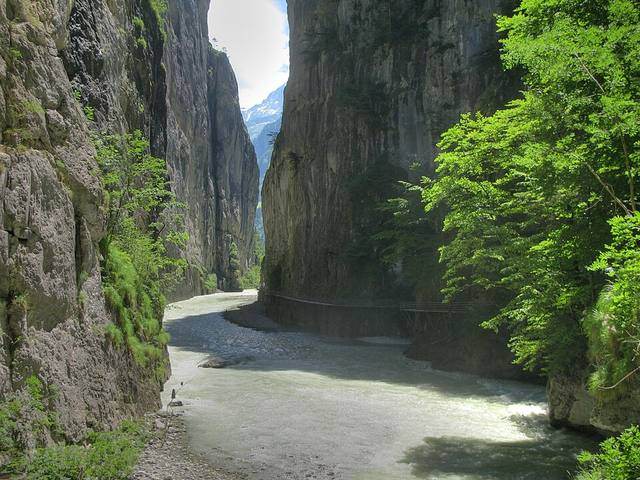
Where to stay in the Bernese Oberland
Outside winter, sleep in Interlaken. Pierre picks it over Lauterbrunnen because both valleys and both lakes are in reach, and for five nights or more his advice is to keep it as the base.
For a quiet stay up high in summer, he picks Wengen. In winter, with or without skiing and even for five nights or more, he picks Wengen or Mürren over Interlaken; between the two, Mürren, where he finds more to do. For one night up high, he picks Mürren over Gimmelwald.
In Grindelwald, sleep in the centre rather than Grund, closer to the lifts and the train. Between Interlaken and the valley, Pierre calls Wilderswil a good compromise.
Village against village, with a verdict for each pair: Where to base yourself.
Hotels and hostels by area: Where to stay around Interlaken.
Hiking in the Bernese Oberland: where to start
Start with Pierre's two walks, Männlichen to Kleine Scheidegg and the Mendelssohnweg from Wengen to Wengernalp, then two classics, Schynige Platte to First and Kandersteg to Lake Oeschinen. Each one has its own page with the distance and the climb.
Männlichen to Kleine Scheidegg
Pierre's routeFrom the Männlichen cable car to Kleine Scheidegg on foot, then the train back: Pierre's tip. The trail is open from mid-June to October.
Männlichen to Kleine ScheideggPhoto: Timo Newton-Syms from Helsinki, Finland & Maidenhead, Berkshire, UK, CC BY-SA 2.0Mendelssohnweg
Pierre's pick in WengenFrom Wengen up to Wengernalp: the summer walk Pierre gives his clients, back down by train.
Wengen to WengernalpMap ©swisstopoSchynige Platte to First
A full dayA long day from the Schynige Platte railway to the First gondola. The railway runs from 5 June to 24 October 2027.
Schynige Platte to FirstPhoto: Whgler, CC BY-SA 3.0Kandersteg to Lake Oeschinen
KandertalOn foot from the village up to the lake.
Kandersteg to OeschinenseeMap ©swisstopoMore walks
Every walk we list, with its official source: Hikes in the Bernese Oberland.
What we tell our friends
Pierre Vetsch, founder, from his answers in our interviews between 23 September and 11 November 2026.
- To visit the Lauterbrunnen Valley, I tell people to sleep in Interlaken rather than Lauterbrunnen: both valleys and both lakes are in reach.
- Outside winter, for five nights or more, keep Interlaken as the base and go out for the day: Grindelwald with First and the Eiger, Lauterbrunnen with Mürren and Wengen, Kandersteg with the Blausee and Lake Oeschinen, Brienz and Iseltwald, the Rothorn and Meiringen.
- For five days of trips, I tell people to take the Swiss Travel Pass.
- To dodge crowds: Mürren before 10 am or after 2 pm, Iseltwald after 5 pm, Harder Kulm an hour before sunset. In its summer season, the Schynige Platte is almost empty on weekdays.
- For wine on a three-day trip, I tell people to skip Lavaux and the Valais and do Spiez.
- In winter, even without skiing and even for five nights or more, I tell people to sleep in Wengen or Mürren.
- I have been to every area on this page myself.
Bernese Oberland: your questions
What is the Bernese Oberland?
The highest and southernmost part of the canton of Bern, in Switzerland. It covers the upper Aare valley, with Lake Thun and Lake Brienz, and the northern side of the Bernese Alps. Its main towns are Thun, Spiez, Interlaken, Brienz and Meiringen. Bern acquired most of it between 1323 and 1400. Tourism started after Albrecht von Haller's poem Die Alpen came out in 1729.
Where is the Bernese Oberland?
In the south of the canton of Bern, between the city of Bern and the canton of Valais, which the Lötschberg links. Interlaken, its hub, is 55 minutes from Bern and 1 h 57 from Zurich by direct train, on the SBB timetable for 20 January 2027.
What language do they speak in Bernese Oberland?
German. In the 2000 census, 34,508 of the 38,182 residents of the Interlaken district gave German as their main language.
Is Bernese Oberland worth visiting?
Yes, for mountains and lakes. The Swiss Alps Jungfrau-Aletsch have been a UNESCO World Heritage Site since 2001, the Jungfraujoch is Europe's highest railway station, and two lakes sit below. In November, check each lift first: in 2026 the First gondola is closed until 27 November and the Eiger Express from 9 to 20 November. Pierre's one warning: the classic mistake is to pay for the Jungfraujoch on an overcast day.
Which town to stay in Bernese Oberland?
Interlaken outside winter: Pierre picks it over Lauterbrunnen because both valleys and both lakes are in reach, and advises it as the base for five nights or more. For a quiet stay up high in summer, Wengen. In winter, Wengen or Mürren, with or without skiing, even for five nights or more.
How long to spend in Bernese Oberland?
Three nights for a first visit outside winter, Pierre says. With five or more outside winter, keep Interlaken as the base and add Kandersteg, Brienz and Meiringen. In winter, even for five nights or more, he says to sleep in Wengen or Mürren.
When is the best time to visit the Bernese Oberland?
Summer for hiking and the lakes, winter for snow up high. Pierre's favourite month in Interlaken outside winter is May. For Grindelwald he says March to ski and July in summer. Avoid November if the summits matter: the First gondola is closed until 27 November 2026 and the Eiger Express from 9 to 20 November.
How much does the Berner Oberland Pass cost?
CHF 240 for 3 days and CHF 435 for 10 days in 2nd class at full fare. With a Swiss Travel Pass, a Half Fare Card, or for ages 16 to 24, it costs CHF 168 to CHF 316. A child aged 6 to 15 travels on a CHF 30 pass bought with an adult's pass. These prices are valid until 31 December 2026, and the pass's official site says they stay the same in 2027.
What's included in the Berner Oberland Pass?
Trains, buses, boats and many mountain lines in the region, from Bern, Brig, Montreux or Lucerne. The Schilthorn and the Schynige Platte are free, and so is the GoldenPass Express from Interlaken to Montreux. Grindelwald First is 50 % off. The Jungfraujoch is not included: you get 25 % off from Grindelwald or Wengen. It is not a ski pass.
Is the Berner Oberland Pass worth it?
No, for five days of trips: Pierre advises the Swiss Travel Pass, which covers all of Switzerland. Neither pass is sold for five days, so you buy six: CHF 399 for the Swiss Travel Pass in 2nd class for an adult aged 25 or over, against CHF 350 for the Berner Oberland Pass at full fare, both on prices valid until 31 December 2026. The Swiss Travel Pass is only for people who live outside Switzerland and Liechtenstein.
Is the Jungfrau Region the same as the Bernese Oberland?
No, it is one part of it. Jungfrau Region Tourism covers Grindelwald, Wengen, Lauterbrunnen, Mürren with Gimmelwald, and the Haslital. Interlaken, Lake Thun and the Kandertal are in the Bernese Oberland too.
What are some good hikes in the Bernese Oberland?
Pierre's own: Männlichen to Kleine Scheidegg, back by train; Wengen to Wengernalp on the Mendelssohnweg; and the walk down from Mürren to Gimmelwald, 45 minutes. For a full day, Schynige Platte to First.
Where are the Bernese Alps?
In western Switzerland, mostly in the canton of Bern, with parts in Valais, Fribourg and Vaud. The Rhône valley borders the range to the west and south, the Grimsel Pass and the Aare valley to the east. Its highest peak is the Finsteraarhorn, 4,274 m, also the highest point of the canton of Bern. The Eiger, Mönch and Jungfrau above Interlaken belong to it.
Is the Jungfrau Region the Swiss Alps?
Yes. The Eiger, Mönch and Jungfrau stand in the Bernese Alps, a range of the Swiss Alps. The UNESCO World Heritage site Swiss Alps Jungfrau-Aletsch covers 824 km² and almost all of the Bernese Alps.
Keep reading
- Where to base yourself, village against village
- Interlaken
- Lauterbrunnen
- Wengen
- Mürren
- Grindelwald
- Jungfraujoch
- Schilthorn
- Grindelwald First
- Lake Thun
- Thun
- Spiez
- Lake Brienz
- Brienz
- Kandersteg
- Adelboden
- Hasliberg
- Grimsel
- Hikes in the Bernese Oberland
- Day trips from Interlaken
- Best day trips from Interlaken
- Schynige Platte
Sources
- Wikipedia, Bernese Oberland (geography, history, altitudes), read 10 Nov 2026
- Federal Statistical Office, census 2000, main language by district, read 10 Nov 2026
- UNESCO World Heritage Swiss Alps Jungfrau-Aletsch, read 10 Nov 2026
- UNESCO World Heritage Swiss Alps Jungfrau-Aletsch, the site, read 10 Nov 2026
- Jungfrau Region Tourism, read 10 Nov 2026
- Jungfrau Region Tourism, resorts and villages, read 10 Nov 2026
- Made in Bern, Bernese Oberland, read 10 Nov 2026
- Berner Oberland Pass, read 10 Nov 2026
- Berner Oberland Pass, prices, read 10 Nov 2026
- Berner Oberland Pass, FAQ, read 10 Nov 2026
- Berner Oberland Pass, news 2027, read 10 Nov 2026
- Swiss Travel System, Swiss Travel Pass, read 10 Nov 2026
- Jungfrau Railways, Jungfrau Travel Pass, read 10 Nov 2026
- Jungfrau Railways, Jungfraujoch, read 9 Nov 2026
- Jungfrau Railways, Jungfraujoch tickets, read 9 Nov 2026
- Jungfrau Railways, price calculator, read 10 Nov 2026
- Jungfrau Railways, Harder funicular operating data, read 10 Nov 2026
- Jungfrau Railways, Interlaken, read 9 Nov 2026
- Grindelwald Tourism, things to know, read 9 Nov 2026
- Grindelwald Tourism, skiing, read 9 Nov 2026
- Mürren Tourism, about Mürren, read 9 Nov 2026
- Mürren Tourism, places to visit, read 9 Nov 2026
- Mürren Tourism, skiing, read 9 Nov 2026
- Schilthorn Cableway, timetable and tariff, read 9 Nov 2026
- Wengen Tourism, about Wengen, read 9 Nov 2026
- Wengen Tourism, Lauberhorn races, read 9 Nov 2026
- Männlichen cable cars, winter timetable, read 9 Nov 2026
- BLS, Lake Thun and Lake Brienz boats, read 9 Nov 2026
- BLS, Lake Brienz boats, read 9 Nov 2026
- BLS Schifffahrt, timetable 2027, read 10 Nov 2026
- BLS Schifffahrt, about Lake Thun, read 9 Nov 2026
- BLS Schifffahrt, about Lake Brienz, read 9 Nov 2026
- Brienz Rothorn Bahn, timetable and prices, read 9 Nov 2026
- SBB timetable data, read 10 Nov 2026
- Swiss Travel System, 2027 fares, read 10 Nov 2026
- Jungfrau Railways, operating info, read 10 Nov 2026
- Jungfrau Railways, Schynige Platte operating data, read 10 Nov 2026
- Männlichen, Panorama Trail, read 9 Nov 2026
- Interlaken Tourism, getting here, read 10 Nov 2026
- Wikipedia, Bernese Alps, read 11 Nov 2026
Field notes: Pierre Vetsch, interviews of 23, 24, 25 and 26 September, 4, 9 and 14 October and 6, 10 and 11 November 2026. Last checked 11 November 2026. Photos: SmnBtschr (CC BY-SA 4.0), Deralpinbergsteiger (CC BY-SA 4.0), Leonhard Lenz (CC0), soniuta (CC BY 3.0), PantaRhei (CC BY-SA 4.0), Pazit Polak (CC BY-SA 2.0)
Want a local to plan your days in the Bernese Oberland? Tell us your dates and what you want to see, and we build the days with you. Ask about a private day
 Grüessech! That's hello in Bernese German. We're Pierre, Teona, Timoté and Olivia, and we all live around Interlaken.
Not sure? Ask a local
Tell us your date and what you like. A local answers on WhatsApp and tells you which free places fit your day. That is free too.