Swiss travel glossary for Interlaken
67 words you will meet on tickets, signs and menus around Interlaken, each explained in one to three short sentences by people who live here.
Ask us on WhatsAppA real person, usually within the hourFind a word
Facts checked onSix groups: passes and tickets, trains and lifts, mountain words, Swiss German, food and drink, and places people mix up. Type a word, or jump to a group.
Passes and tickets
Which one pays off depends on how many days you stay and where you go. We compare them, with 2026 prices, on our Transport page.
- Swiss Travel Pass
- One ticket for unlimited trains, buses and boats across Switzerland, for 3, 4, 6, 8 or 15 days in a row. It is only for people who live outside Switzerland and Liechtenstein. Many mountain railways are not free with it but give up to 50% off, and the Flex version lets you pick your travel days within one month.
- Swiss Half Fare Card
- A card for visitors that halves the price of train, bus and boat tickets for one month. Most mountain railways give up to 50% off with it too. It suits people who buy their own tickets day by day.
- HalbtaxHalf Fare Travelcard
- The yearly half-price subscription that many people living in Switzerland have. On Swiss price lists, “with Halbtax” means the half-price fare, which you also pay with a Swiss Half Fare Card.
- GA travelcardGeneralabonnement
- A Swiss travelcard for unlimited trains, buses and most boats, usually bought for a whole year. You will see “GA” on price lists; as a visitor you get the same freedom with a Swiss Travel Pass.
- Swiss Family Card
- A free card for visiting families. With it, children aged 6 to 15 travel free when a parent has a Swiss Travel Pass or a Swiss Half Fare Card, and children under 6 always travel free.
- Berner Oberland PassBernese Oberland Pass
- A regional pass for 3, 4, 6, 8 or 10 days. It covers most trains and buses in the Bernese Oberland, more than 25 mountain railways and the boats on Lake Thun and Lake Brienz.
- Jungfrau Travel Pass
- A pass for 3 to 8 days of unlimited trains, mountain railways, cable cars and boats in the Jungfrau Region. The Jungfraujoch is not included, but you get up to 50% off the ticket up there.
- Interlaken Guest CardGästekarte
- The card your host gives you once you stay a night in Interlaken or the villages around it, paid with the visitor’s tax. It gives free local buses within its zone and discounts on some excursions. Children from 6 to 16 get one too.
- Supersaver ticketSparbillett
- A cheaper train ticket that is only valid on the train you chose. Book early in the SBB app, because the cheap seats go first.
Trains, lifts and boats
The SBB app shows the times of trains, buses, boats and most mountain lifts, with live platforms and delays.
- Interlaken OstInterlaken East
- The bigger of the two stations, at the east end of town. Trains to Lauterbrunnen, Grindelwald and the Jungfraujoch start here, and the Lake Brienz boats leave from its pier. More in our Interlaken guide.
- Interlaken West
- The station at the west end of the town centre. Trains from Bern stop here before Interlaken Ost, and the Lake Thun boats leave from its pier.
- SBBCFF, FFS
- Swiss Federal Railways. SBB, CFF and FFS are the same company, named in German, French and Italian. Its app is the easiest place to check times, platforms and delays.
- BOBBerner Oberland-Bahn
- The train from Interlaken Ost into the mountains. It splits at Zweilütschinen: one part goes to Lauterbrunnen, the other to Grindelwald, so check you sit in the right part.
- WABWengernalpbahn
- The cogwheel train from Lauterbrunnen up to car-free Wengen and Kleine Scheidegg, and down the other side to Grindelwald.
- Jungfrau RailwayJungfraubahn
- The cogwheel train from Kleine Scheidegg to the Jungfraujoch. After Eigergletscher it runs mostly in a tunnel inside the Eiger and the Mönch. See Jungfraujoch tickets and train.
- BLMBergbahn Lauterbrunnen-Mürren
- One way up to Mürren: a cable car from Lauterbrunnen to Grütschalp, then a short train ride to the car-free village. More in our Mürren guide.
- PostBusPostAuto
- The yellow buses that reach villages the trains do not, such as Isenfluh above Lauterbrunnen. The Half Fare Card works on them, and the Swiss Travel Pass covers buses too.
- Cogwheel railwayZahnradbahn
- A train with a toothed wheel that grips a toothed rail between the tracks, so it can climb slopes too steep for a normal train. The WAB, the Jungfrau Railway and the Schynige Platte line all work this way.
- FunicularStandseilbahn
- A car pulled up a steep track by a cable. The Harder Kulm funicular from Interlaken takes 10 minutes to reach 1,322 m: walk it on our Harder Kulm hike page.
- GondolaGondelbahn
- Small cabins that hang from a cable and keep moving: you step in as they pass slowly through the station. The gondola from Grindelwald up to First is one.
- Cable carLuftseilbahn
- One or two big cabins that shuttle up and back on a cable. The Schilthorn is reached this way from Stechelberg.
- Eiger Express
- A tricable gondola from Grindelwald Terminal to Eigergletscher in 15 minutes. From there the Jungfrau Railway continues to the Jungfraujoch. More in our Grindelwald guide.
- Gleis and Sektorplatform and sector
- Gleis is the platform number on Swiss timetables. The letters A, B, C and D along the platform are sectors: the screen shows in which sector first class, second class and bike spaces stop.
Mountain words
These words hide in place names all over the map. Once you know them, the map reads itself.
- Alp
- A high summer pasture. Cows go up in early summer, spend the season there with the farmers, and their milk becomes cheese on the spot.
- Alpabzug
- The day in autumn when the cows come down from the alp, often decorated with flowers and big bells. Villages turn it into a small festival.
- Chästeilet
- Cheese sharing day. In autumn, the cheese made on an alp over the summer is shared out among the farmers whose cows grazed there. The Justistal above Lake Thun, where our farm tour goes, holds one every year.
- Kulm
- The top of a hill or mountain, as in Harder Kulm or Niesen Kulm. If a station is called Kulm, you are at the summit.
- Joch
- A saddle between two peaks. The Jungfraujoch is the saddle between the Mönch and the Jungfrau, not a summit.
- SAC hutHütte
- A mountain hut of the Swiss Alpine Club, reached on foot. You sleep in a shared dormitory and get dinner and breakfast; book ahead and bring a sleeping bag liner. See our list of huts near Interlaken.
- Föhn
- A warm, dry wind from the south that falls into the valleys on the north side of the Alps. The air turns very clear and the peaks look close. Strong föhn can stop some cable cars.
- Nebelmeersea of fog
- In autumn and winter, fog often sits over the lakes while the mountains above are in the sun. Go high enough and you stand above a white sea; mountain webcams show where the fog ends.
- AlpenglowAlpenglühen
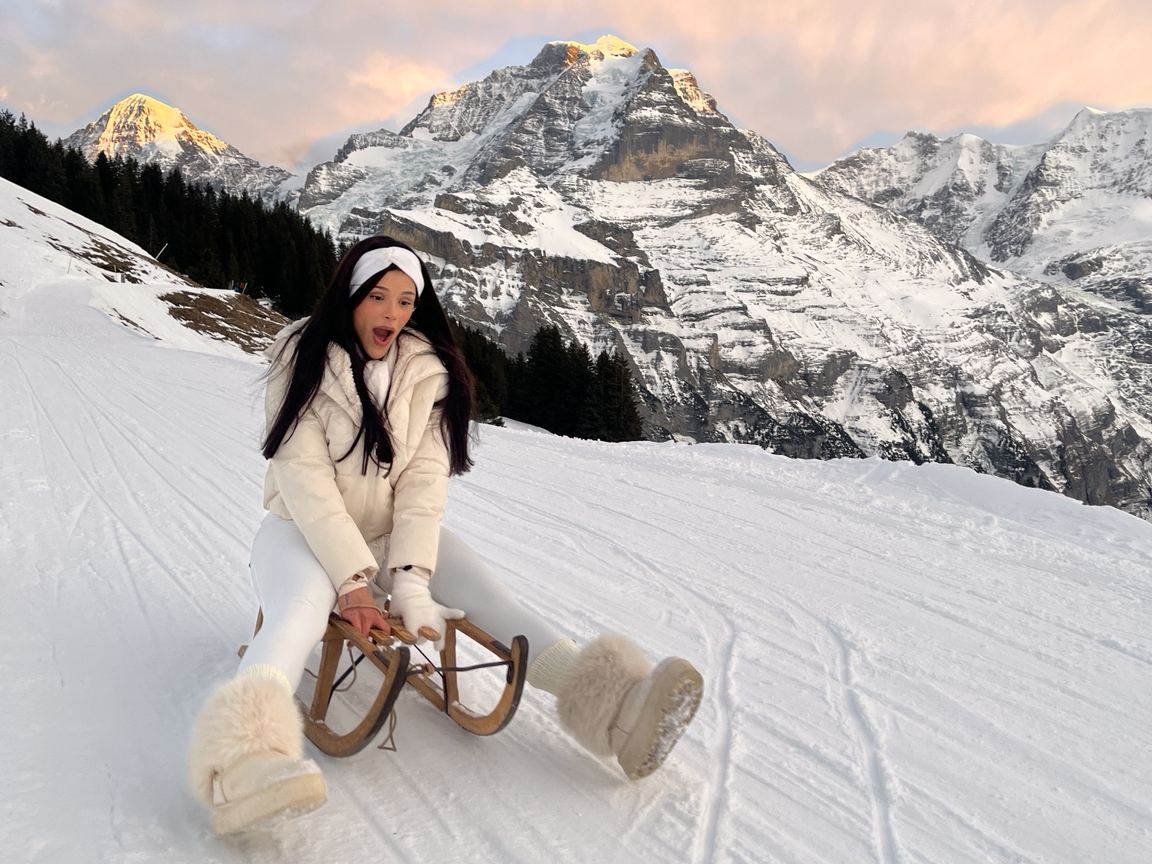
- The pink and orange light on the mountains just after sunset or just before sunrise, brightest on snowy peaks. Watch it from a sled in winter, or on our sunset walk in summer, when the Niesen starts to glow.
- Yellow, red and blue trail signsWanderweg
- Yellow signs mark hiking trails, white-red-white marks mountain trails that are often steep and narrow, and white-blue-white marks alpine routes for experienced people. Signs give the walking time without breaks, not the distance. Find a walk in our hikes near Interlaken.
- Pink winter trailsWinterwanderweg
- In winter, pink signs mark prepared winter walking paths. Snowshoe trails are pink too, with a white snowshoe on the sign, and they are not groomed. Try one on our guided snowshoe tour.
- Avalanche bulletinLawinenbulletin
- The avalanche forecast of the SLF, the Swiss institute for snow and avalanche research. It uses five danger levels, from 1 low to 5 very high. Read it on slf.ch before you leave marked trails.
- Blue, red and black pistes
- Ski runs are marked by colour: blue is easy, red is medium, black is difficult.
- Schlittelwegsled run
- A sled run, often a forest road kept for sleds in winter. You sit on a wooden sled and steer and brake with your feet. Try sledding in Interlaken at sunset with us.
Swiss German you will hear
Around Interlaken people speak Bernese German with each other. Signs and menus are in standard German, and most people in tourism also speak English.
- BärndütschBernese German
- The Swiss German spoken around Bern and Interlaken. A sure sign of it: an l often sounds like a u, so Milch (milk) becomes Miuch.
- GrüessechGrüezi
- Hello, said politely to people you do not know, in the Bern region. You will also hear Grüezi, which locals link more with Zurich.
- Merci vielmal
- Thank you very much. Yes, the Swiss German thank you starts in French. In Bern it often sounds like “merci viu mau”.
- Uf Widerluege
- Goodbye, the polite way. Friends just say tschou or ciao.
- Ä Guete
- Enjoy your meal. People say it to each other before they start eating.
- Zmorge, Zmittag, Znacht, Zvieri
- Breakfast, lunch and dinner, plus Zvieri, the small snack around four in the afternoon.
- Chuchichäschtli
- Kitchen cupboard. Swiss people love asking visitors to say it, because of the throaty ch sound.
- Röstigraben
- The “rösti ditch”: the joking name for the line between German-speaking and French-speaking Switzerland.
Food and drink
- Cheese fondueFondue moitié-moitié
- Cheese melted with white wine in a pot called a caquelon; you dip bread into it on a long fork. Moitié-moitié means half Gruyère, half Vacherin Fribourgeois. Where to eat it: fondue in Interlaken, or after a sunset sled run on our sledding tour.
- Raclette
- Half a wheel of cheese is melted and scraped onto boiled potatoes, eaten with small pickles and onions. The name comes from racler, French for to scrape.
- Rösti
- Grated potatoes fried in butter into a golden cake. It started as a farmers’ breakfast around Bern and is now a side dish everywhere.
- Älplermagronen
- Alpine herders’ macaroni: pasta and potatoes with melted cheese and cream, topped with fried onions, with apple sauce on the side.
- Alpkäsealp cheese
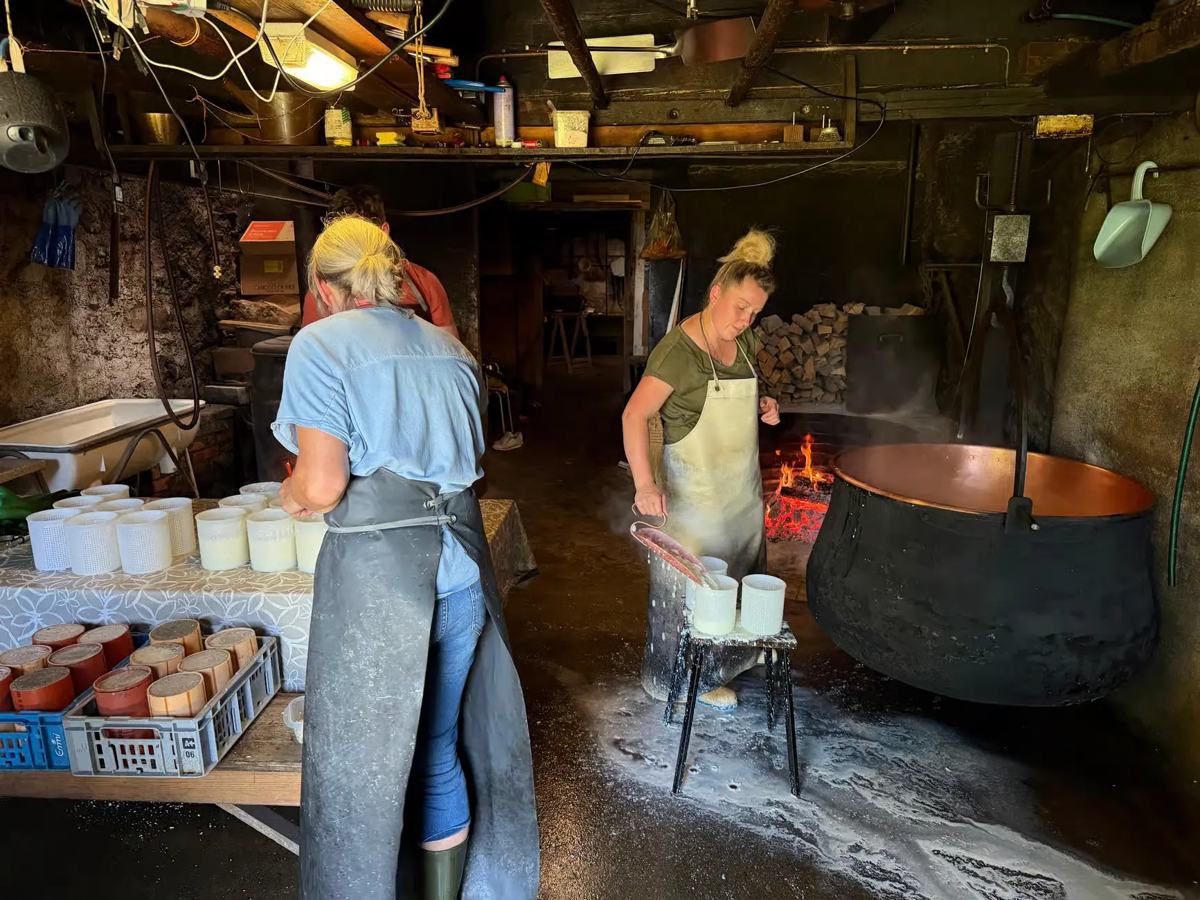
- Cheese made on an alp in summer from the milk of the cows grazing there. Each wheel tastes a little different, depending on the pasture. Watch cheese being made over a wood fire on our farm tour near Interlaken.
- Zopf
- A plaited white bread made with butter, the classic Sunday breakfast.
- Rivella
- A fizzy Swiss soft drink made with milk whey. The red bottle is the original.
- Apéro
- Drinks and small snacks before dinner, often local wine and cheese. Our wine tasting in Spiez is a long apéro above Lake Thun.
- Hahnenwassertap water
- Tap water. It is safe to drink in Switzerland, and so is the water from village fountains, unless a sign says “kein Trinkwasser” (not drinking water).
Places people mix up
Names that sound alike or sit on top of each other. Each one links to the page where we say more.
- Jungfrau and Jungfraujoch
- The Jungfrau is the mountain, 4,158 m high, and no train goes to its top. The Jungfraujoch is the saddle beside it, where the train stops at 3,454 m, the highest railway station in Europe, sold as “Top of Europe”. More in our Jungfraujoch guide.
- Eiger, Mönch and Jungfrau
- The three famous peaks south of Interlaken. The Jungfrau is the highest of the three, and the Eiger, with its North Face, stands above Grindelwald. Walk under it on the Eiger Trail.
- Grindelwald First
- First is a mountain above the village of Grindelwald, not a number. A gondola climbs to it, with the Cliff Walk, the First Flyer and the walk to the Bachalpsee at the top. See our Grindelwald First guide, and the village in our guide to Grindelwald.
- Kleine Scheidegg and Grosse Scheidegg
- Kleine Scheidegg is the pass under the Eiger where the trains from Wengen and Grindelwald meet and the Jungfrau Railway starts. Grosse Scheidegg is a different pass, on the road from Grindelwald towards Meiringen, reached in summer by a bus from Grindelwald. Walk to the first one from Männlichen to Kleine Scheidegg.
- Männlichen
- A ridge between Wengen and Grindelwald, with a lift up from each side. The short Royal Walk leads to a viewpoint at its top.
- Schilthorn, Piz Gloria and Birg
- The Schilthorn is the 2,970 m summit above Mürren, and Piz Gloria is the revolving restaurant at its top, made famous by a James Bond film. Birg is the station below it, at 2,677 m, with the Thrill Walk along the cliff. See our Schilthorn guide.
- Lauterbrunnen and Staubbach
- Lauterbrunnen is both a village and the deep valley it sits in. The Staubbach is the waterfall that drops beside the village houses. See our Lauterbrunnen guide.
- Trümmelbach Falls
- Waterfalls inside the mountain near Lauterbrunnen, carrying the melt water of the Eiger, Mönch and Jungfrau glaciers. A tunnel lift and steps take you up beside them. They close in winter: dates in our Lauterbrunnen valley guide.
- Wengen and Mürren
- Two car-free villages on opposite sides of the Lauterbrunnen valley. Wengen is reached by the WAB train. Mürren is reached by the BLM, or by cable car from Stechelberg. See Wengen and Mürren.
- Bödeli
- The locals’ name for the flat land between Lake Thun and Lake Brienz, where Interlaken, Unterseen and Matten stand. Interlaken itself means “between the lakes”. More in our guide to Interlaken.
- Höhematte
- The big open meadow in the middle of Interlaken, kept free of buildings, with the Jungfrau in view. Tandem paragliders land here: see paragliding in Interlaken.
- Lake Thun and Lake BrienzThunersee, Brienzersee
- The two lakes on each side of Interlaken. Lake Thun, to the west, has castles and vineyards; Lake Brienz, to the east, is the turquoise one with Iseltwald and the Giessbach falls. See Thun and Brienz.
- Bernese Oberland and Jungfrau RegionBerner Oberland
- The Bernese Oberland is the mountain part of the canton of Bern, from Lake Thun up to the high Alps. The Jungfrau Region is the name for the area around Interlaken, Grindelwald, Lauterbrunnen, Wengen and Mürren, at the foot of the Jungfrau. See it on our map.
Try a few of these words for real
Fondue, alp cheese, sleds and sunsets, with a local guide.
Sources and checks
Written by the local team of Swiss Local Adventures in Interlaken. We checked every figure on this page on at the official sources below. Pass prices are set for one year at a time, so this page gives none: our Transport page has the 2026 prices.
- Swiss Travel Pass: Swiss Travel System
- Swiss Travel Pass Flex: Swiss Travel System
- Swiss Half Fare Card: Swiss Travel System
- Swiss Family Card: Swiss Travel System
- Berner Oberland Pass: berneseoberlandpass.ch (BLS)
- Jungfrau Travel Pass: Jungfrau Railways
- Interlaken Guest Card: Interlaken Tourism
- Eiger Express: Jungfrau Railways
- Jungfraujoch altitude: Jungfrau Railways
- Harder Kulm funicular: Jungfrau Railways
- BOB, WAB, Jungfrau Railway and BLM stations, car-free Wengen and Mürren: Jungfrau Railways
- Jungfrau altitude: Swiss Alpine Club SAC
- Schilthorn and Birg altitudes, Stechelberg to Mürren cable car: Interlaken Tourism
- Chästeilet in the Justistal, every September: Thunersee Tourism
- PostBus line to Isenfluh: PostAuto
- Boat piers at Interlaken West and Interlaken Ost: BLS boats
- Trail sign colours and walking times: Swiss Hiking Trail Federation
- Pink winter and snowshoe trails: Swiss Hiking Trail Federation
- Avalanche danger levels: SLF
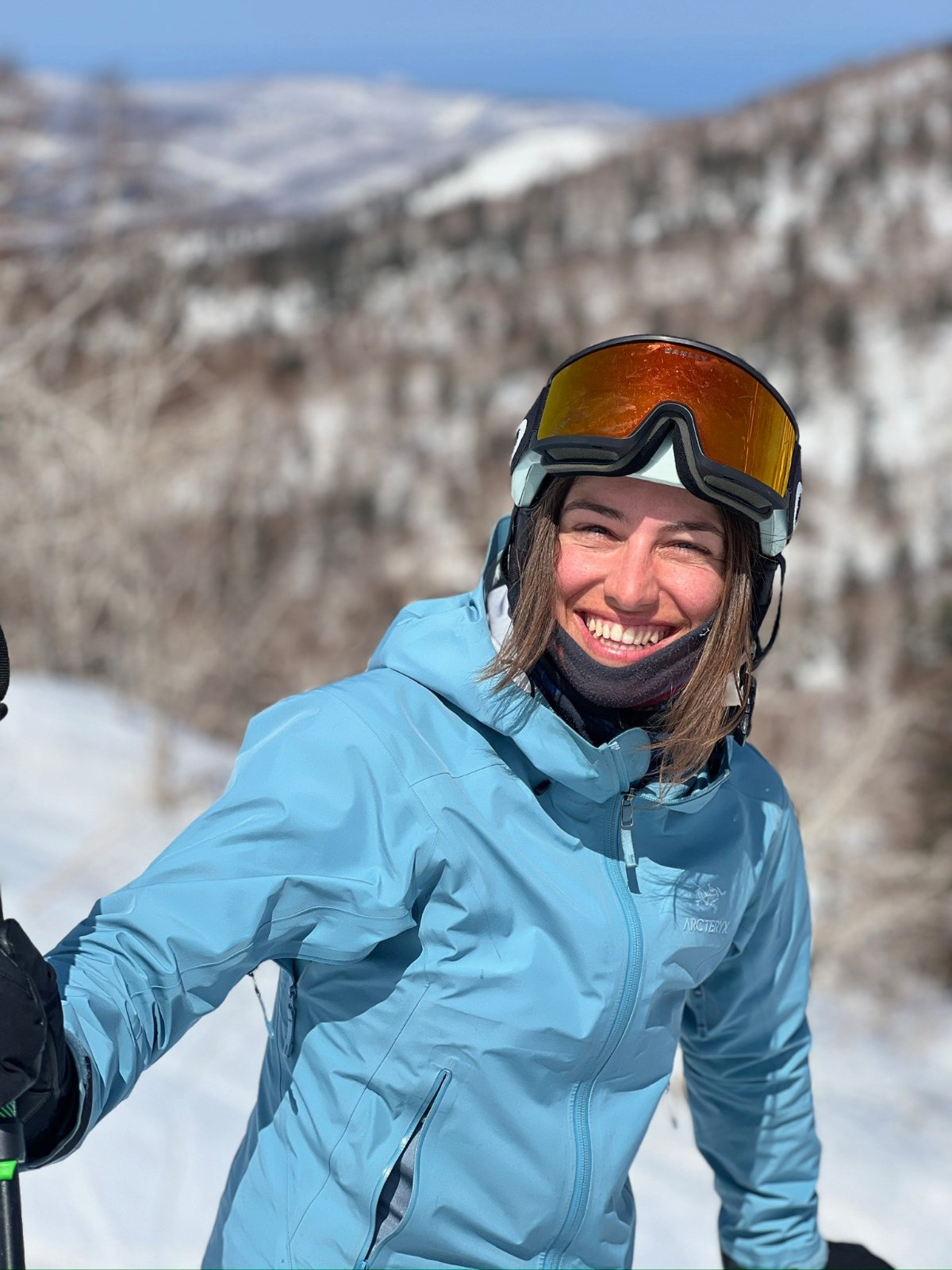
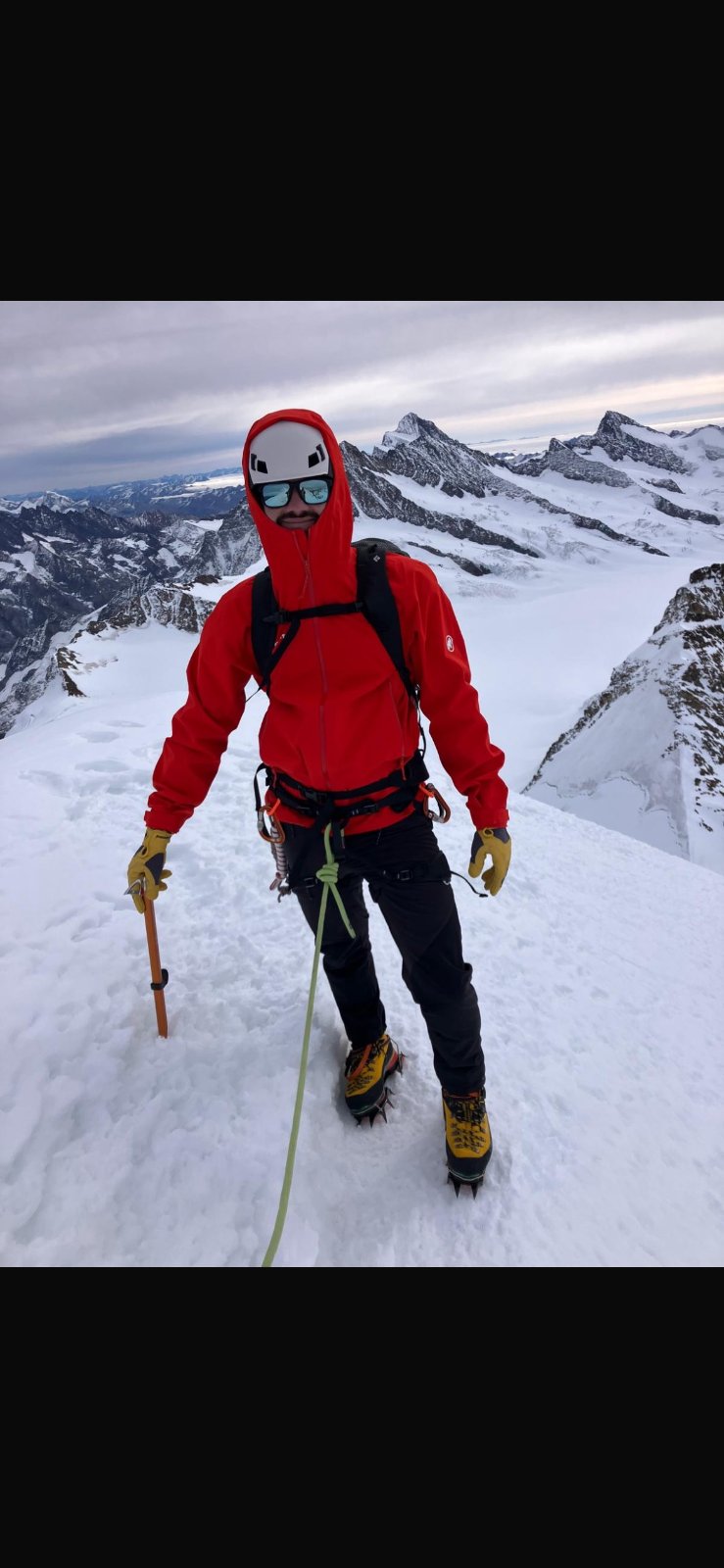
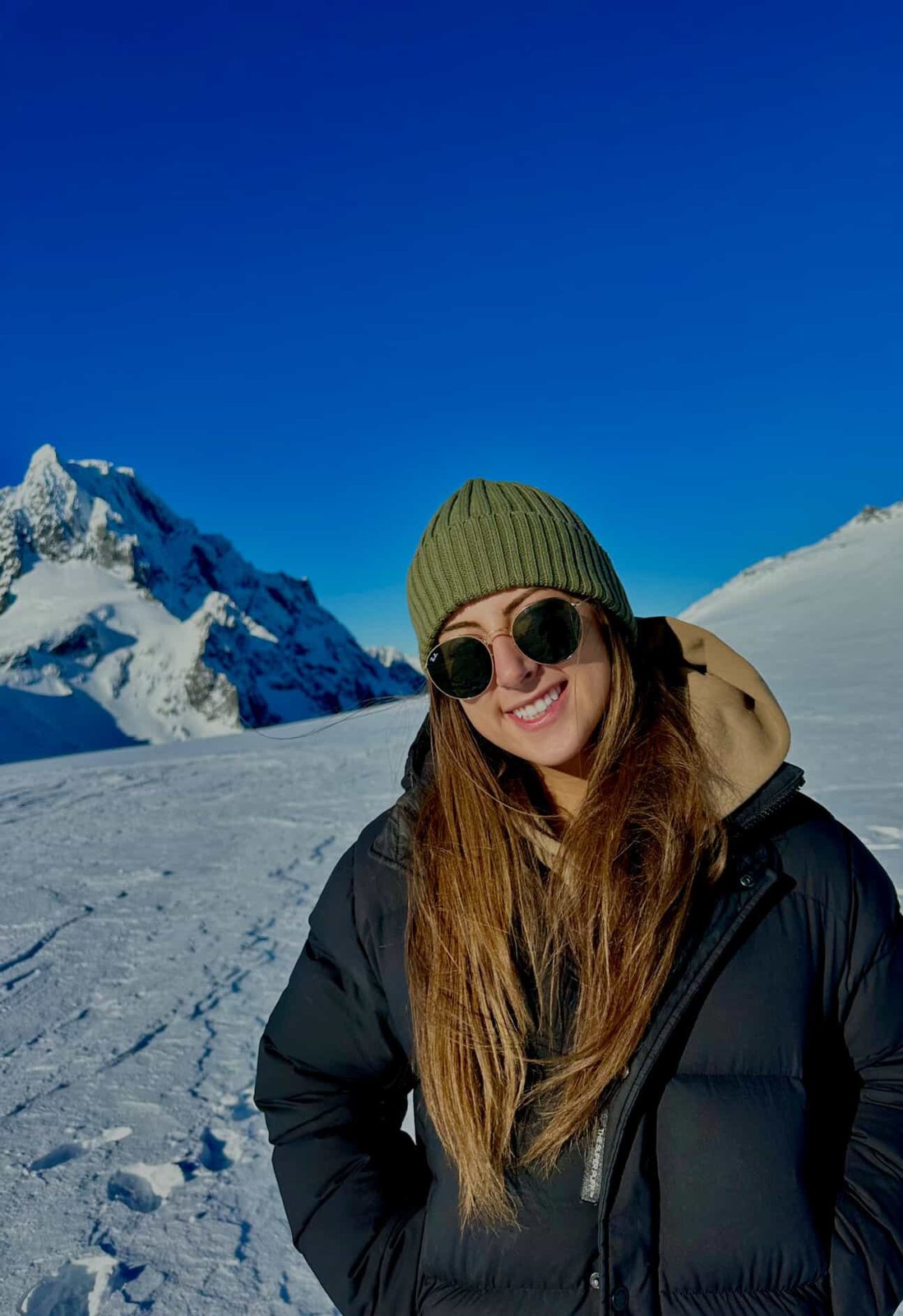 Grüessech! That's hello in Bernese German. We're Pierre, Teona, Timoté and Olivia, and we all live around Interlaken.
A word we missed?
Ask a local on WhatsApp. We answer like a friend would, not like a call centre.