Interlaken
Brienz Wood Carving School: The Weeks It Shuts
O
Olivia Lufman
Author
August 29, 2026
14 min
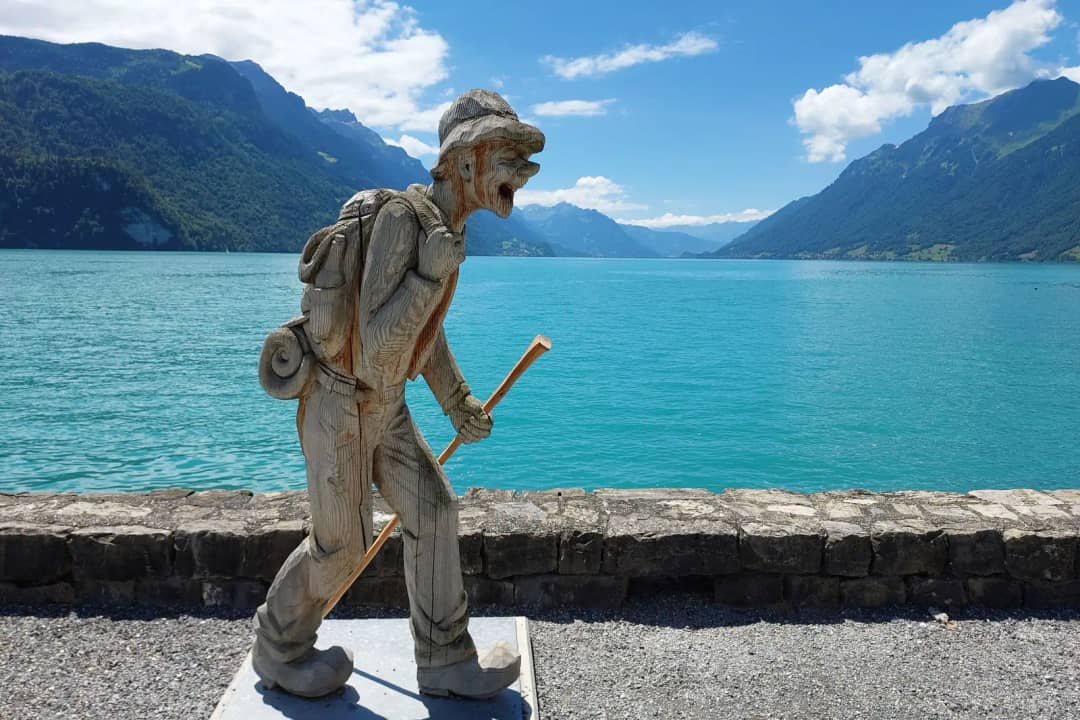
A traveller left a review of Brienz in March 2025 that has stayed with me: "I went to Brienz on Mar 2nd and it was dead, perhaps because it was a Sunday (I dont know)... many of the places were closed."
She blamed the wrong thing. It was not the Sunday. Brienz keeps three separate calendars, and the one almost nobody publishes belongs to its two craft schools. The wood carving school shuts its exhibition for four straight weeks at the height of summer, from 29 June to 26 July 2026, and then again for three weeks in autumn.
Those two schools are the reason Brienz exists as a carving village. One has trained wood sculptors since 1884, the other has trained violin makers since 1944, and both let the public in for free or close to it. They stand 56 metres apart at the far western end of the village, and neither appears on TripAdvisor at all.
Here is what they are, when you can walk in, and what you actually see when you do. For everything else around the lake, our honest local guide to Interlaken covers the rest.
Can you visit the wood carving school in Brienz?
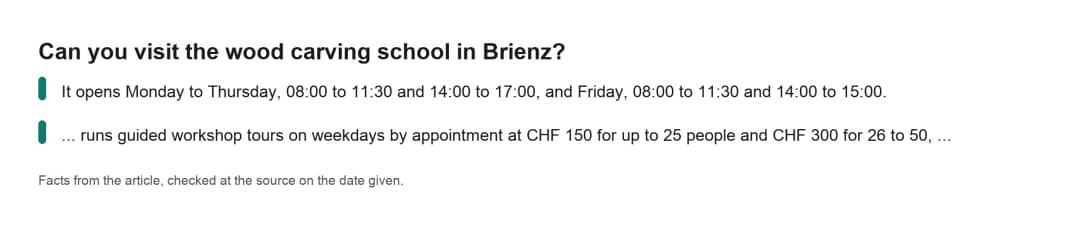
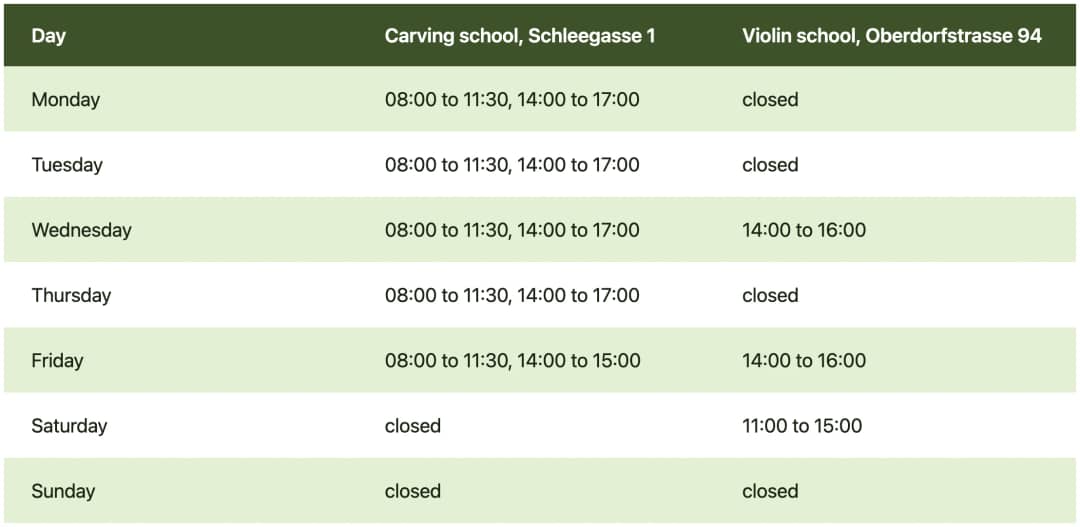
Yes, and on weekdays only. The School of Wood Carving keeps a public showroom at Schleegasse 1, reached through a visitor entrance at the side of the building, in the basement. It opens Monday to Thursday, 08:00 to 11:30 and 14:00 to 17:00, and Friday, 08:00 to 11:30 and 14:00 to 15:00. It closes at weekends.
What makes it worth the walk is not the display cases. Interlaken Tourismus puts it precisely: "Two to four students are stationed in the exhibition room during opening hours, giving you the chance to watch them as they work." The school's own wording is blunter. It invites you to look over the shoulders of apprentice wood sculptors.
So you are not visiting a museum. You are standing in a working school during a lesson, which is why the calendar is a school calendar and not a tourist one.
"I have been to the showroom, and it is worth the detour."
Olivia Lufman, travel writer at Swiss Local Adventures
It is a 351 metre walk from Brienz West station, and the violin making school stands 56 metres away.
Two practical notes. No admission price appears on any of the three official pages, the school's own, Interlaken Tourismus or MySwitzerland, so I am not going to tell you it is free. Ring +41 33 952 17 51 if the answer matters to your budget. And for groups, the school runs guided workshop tours on weekdays by appointment at CHF 150 for up to 25 people and CHF 300 for 26 to 50, with 50 the maximum.
Which weeks is the wood carving school closed in 2026?
Thirteen full weeks a year, and the school publishes them as week numbers rather than dates. Its exhibition page lists closure in weeks 7, 14, 15, 16, 27, 28, 29, 30, 39, 40, 41, 52 and 53, plus all public holidays. Converted to calendar dates, that puts the longest closure squarely inside the summer season.
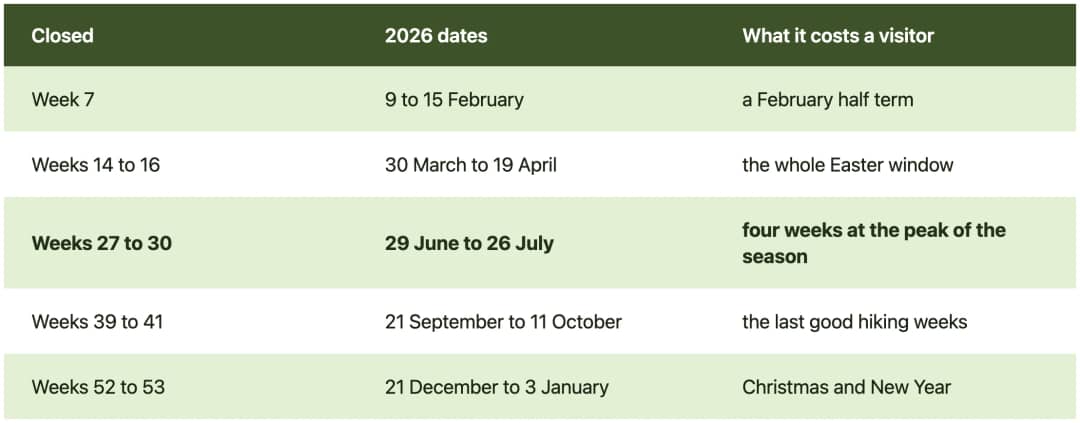
Read the middle row again. If you come to Brienz in July, there is a very good chance the school showroom is shut, and no listing on the first page of search results says so. The dates above are my conversion of the school's published week numbers, so cross-check by phone if your trip falls on an edge.
The rest of the year, the pattern is easy. May, June up to the 28th, August, most of September, and the whole of November are the clear runs.
What is Switzerland's only violin making school, and can you go in?
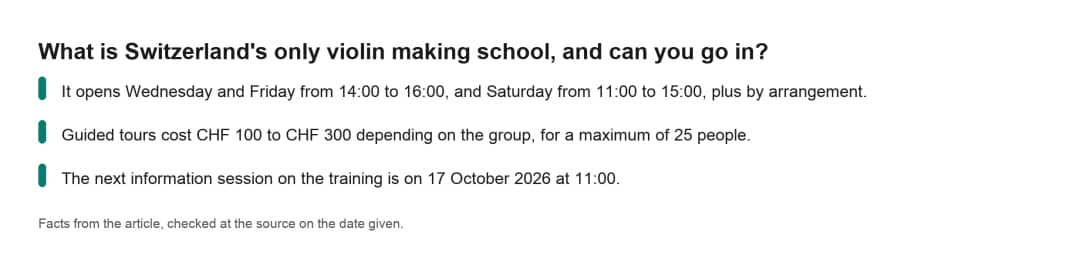
The Schweizer Geigenbauschule at Oberdorfstrasse 94 is the only school in Switzerland that trains violin makers, and it keeps a permanent exhibition called "Von Fideln und Meistergeigen", of fiddles and master violins. It opens Wednesday and Friday from 14:00 to 16:00, and Saturday from 11:00 to 15:00, plus by arrangement. Interlaken Tourismus lists admission as free of charge.
That Saturday slot matters more than it looks. It is the only craft opening in Brienz on a Saturday afternoon that involves a working school, because the carving school shuts at the weekend.
Guided tours run by arrangement only, take about an hour, are chargeable and take a maximum of 25 people. Book through info@geigenbauschule.ch or +41 33 951 18 61. Access is barrier-free, with an accessible toilet.
The school's rebuilt website now publishes its tour prices. School classes pay CHF 100 on working days and CHF 150 outside working hours or in the school holidays, and private groups pay CHF 200 and CHF 300 on the same terms, always for a maximum of 25 people. The opening hours above come from the school's own exhibition page and are confirmed by Interlaken Tourismus.
The school also runs a chamber concert series in its attic, the Dachkammerkonzerte, and holds its next open information session on the training itself on Saturday 17 October 2026 at 11:00.
How did a famine turn Brienz into a carving village?
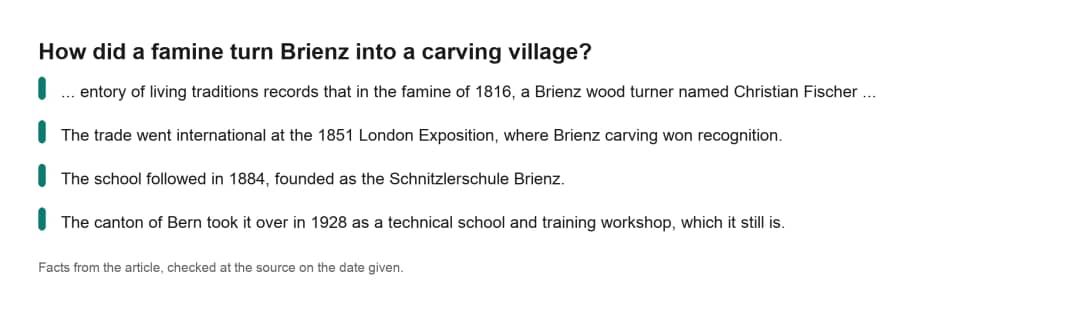
It started with a crop failure. The Swiss federal inventory of living traditions records that in the famine of 1816, a Brienz wood turner named Christian Fischer began decorating goods with carvings and selling them to the first tourists. Demand grew faster than he could work, so he taught the skill to people around him.
That is an unusually precise origin for a folk craft, and it explains the shape of everything that followed. Carving in Brienz was never a peasant pastime. It was an export trade from the start, aimed at visitors.
The trade went international at the 1851 London Exposition, where Brienz carving won recognition. The school followed in 1884, founded as the Schnitzlerschule Brienz. The canton of Bern took it over in 1928 as a technical school and training workshop, which it still is.
The last two dates are recent. An association to collect and exhibit Brienz carvings formed in 1990 and opened the Swiss Woodcarving Museum in 2009, the same year the school widened its training to include turners, basket makers, coopers and white coopers. The inventory's own summary of where things stand: the ties between woodcarving and tourism remain strong after two hundred years.
What do the two schools actually teach?
Between them, six federally recognised trades, with 36 training places. The carving school holds 24 places for wood sculptors and teaches four other wood trades as the vocational school for the whole of Switzerland, plus the classroom subjects for violin makers. The violin school holds 12 places over a four-year apprenticeship.
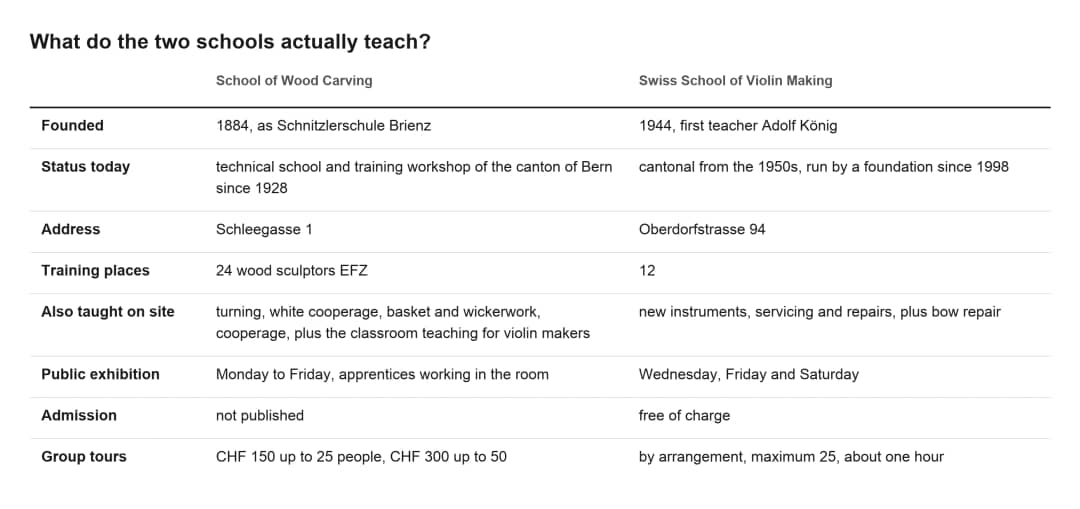
Two figures put the scale in perspective. The carving school is the only institution in Switzerland where wood carving can be learned, which means all 24 places serve the entire country. And the violin school had produced roughly 170 qualified violin makers by 2016, over seven decades, which works out at fewer than three a year.
The two are physically and academically linked. Violin-making apprentices do their practical work in the violin school's own workshop and walk 56 metres to the carving school for their classroom subjects. If you visit both in one afternoon, you are following the same short path the students take.
Which school is open on which day?
Wednesday and Friday afternoons are the only times both are open at once. On a Monday or a Tuesday only the carving school lets you in, and on a Saturday only the violin school does. Nobody is open on a Sunday.
Here is the part that changes how a bad day in Brienz plays out. Monday and Tuesday are the two days the village is usually written off, because Hauptstrasse 111, which holds the woodcarving museum, the Jobin open workshop, the shop and the bistro, runs Wednesday to Sunday and only from 2 May to 25 October.
But on those exact two days, the carving school showroom is open all day with apprentices at the bench. On a Tuesday it is the one place in Brienz where you can stand and watch someone carve. Our half day in Brienz village guide walks the rest of the street; this is the address that saves the two days it calls quiet.
How much walking is it, and how do you get there?
It is flat, and the two schools are 56 metres apart. What catches people out is the other distance. Measured on the Swiss federal geodata service on 29 August 2026, the schools sit 1,094 metres from Brienz main station in a straight line, with only about 7 metres of height gain. Allow about 20 minutes on foot, the violin school's own estimate from Brienz station.
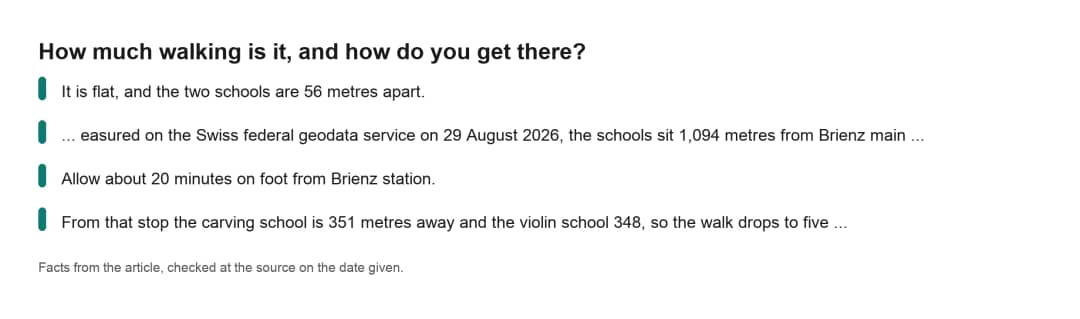
Get off at Brienz West instead. From that stop the carving school is 351 metres away and the violin school 348, so the walk drops to five minutes. The catch is that only one of the two trains stops there: the :33 regional service from Interlaken Ost reaches Brienz West in 17 minutes, direct, while the faster :04 Panorama Express runs through to Brienz main station and takes 17 to 18 minutes to get there. All three figures checked on 29 August 2026.
That difference matters more than it sounds. The schools sit at the far western end of the village, past everything else. From Brienz main station you walk the whole length of Brienz to reach them and the whole length back. From Brienz West you are almost at the door.
There is no difficulty and no equipment. The violin school's exhibition has barrier-free access and an accessible toilet. The carving school's showroom is reached through a side entrance in the basement, and Interlaken Tourismus lists it as barrier-free with an accessible toilet.
Season matters more than fitness here. Beyond the thirteen closure weeks, the carving school follows a school calendar, so it is at its liveliest in term time on a weekday morning, when the benches are full. Arrive at 08:00 in November and you will have the room and two or three apprentices largely to yourself. Arrive at 16:45 on a Friday and the room is already shut.
If the mountain above the village is your main reason for coming, the Brienzer Rothorn steam train leaves from the valley station opposite Brienz main station, about 20 minutes on foot from the schools, and both schools fit neatly into the wait between a train and a departure.
Your questions about the Brienz craft schools
Is the Brienz wood carving school free to visit?
The exhibition is free at the violin school, which Interlaken Tourismus lists explicitly as "free of charge". For the carving school showroom, no price is published anywhere official, neither on the school's own exhibition page, nor on the Interlaken Tourismus listing, nor on MySwitzerland. It may well be free, but I am not going to state it as fact. Call +41 33 952 17 51 if it matters. What does carry a published price is a group tour of the carving workshop: CHF 150 for up to 25 people and CHF 300 for 26 to 50.
Can you watch someone actually carving?
Yes, and this is the reason to go. Interlaken Tourismus states that two to four students work in the exhibition room during opening hours. Unlike a museum display, what you see depends on the school timetable, so a weekday morning in term time gives you the best chance and a Friday afternoon the worst. If the school is inside one of its thirteen closure weeks, there will be nobody there at all, which is why the dates matter more than the hours.
Is the violin making school in Brienz really the only one in Switzerland?
Yes. The Schweizer Geigenbauschule, founded in 1944, is the only school in Switzerland that trains violin makers, and the wood carving school next door is the only place in the country where wood carving can be learned as a trade. The carving school's claim comes from the school itself and is repeated by the federal inventory of living traditions, which does not mention the violin school. The violin school holds twelve training places on a four-year apprenticeship covering new instruments, servicing and repairs, plus bow repair.
What is the best day to visit both schools?
Wednesday or Friday afternoon, the only windows when both are open together. Wednesday is the stronger of the two, because the carving school runs until 17:00 rather than 15:00 and because Hauptstrasse 111 with its museum and open workshop reopens for the week that day. If you can only manage a weekend, Saturday morning gives you the violin school from 11:00 and nothing else. Sunday gives you neither.
Can you buy carvings at the schools?
The schools are training institutions, not shops, and the showroom displays apprentice work rather than stock. Brienz has working carving businesses on the main street for that, and our half day in Brienz village guide covers where they are and when they open. Treat the schools as the place you go to understand what you are looking at, and the street as the place you go to take something home.
Are the schools open in winter?
Yes, and winter is arguably the better season for them. Both follow a school year, not a tourist season, so they run through November, January, February and most of March, while the woodcarving museum at Hauptstrasse 111 opens only to groups on request between 26 October and 1 May. The exceptions are week 7 in February, weeks 14 to 16 in spring, weeks 52 and 53 over Christmas, and public holidays. On a wet January weekday, the carving school showroom is one of very few doors in Brienz that opens. For the rest of a winter stay, see our honest answer to whether Interlaken is worth visiting in winter.
Come on a weekday morning, and go early
The whole trick with these two addresses is that they run on a school bell, not on a tourist season. Weekday mornings in term time are when the benches are full, and four weeks of July are when the carving school is dark. For those July days, see what locals do in Interlaken in summer.
If you are already planning a day trip to Brienz from Interlaken, put the schools at 08:30 and the rest of the village after 10:00. That order costs nothing and it is the difference between watching someone carve and reading a label.
Want both schools built into your day? We design custom private tours around Interlaken, or message us on WhatsApp.
Source: Schule für Holzbildhauerei Brienz, Schweizer Geigenbauschule and Woodcarving in Brienz in the federal inventory of living traditions, read on 29 August 2026 and again on 13 September 2026.
Written by Olivia Lufman, your travel writer at Swiss Local Adventures
Tags
#wood-carving#swiss-crafts#violin-making#day-trips-interlaken#craft-schools-switzerland#rainy-day-interlaken
Sources & References
- •Schule für Holzbildhauerei Brienz: exhibition and tours
- •Schule für Holzbildhauerei Brienz: school portrait
- •Schweizer Geigenbauschule: exhibition
- •Schweizer Geigenbauschule: guided tours
- •Schweizer Geigenbauschule: training
- •Schweizer Geigenbauschule: information sessions
- •Schweizer Geigenbauschule: contact and directions
- •Living traditions in Switzerland: Woodcarving in Brienz
- •Interlaken Tourismus: School of Woodcarving showroom
- •Interlaken Tourismus: Swiss School of Violin Making
- •Swiss Woodcarving Museum: opening hours and prices
- •Swiss public timetable
- •Photo: Rudy Sh on Pexels
Share this article
Similar Articles
Continue your reading with these related articles
Interlaken
9/12/2026
12 min
9
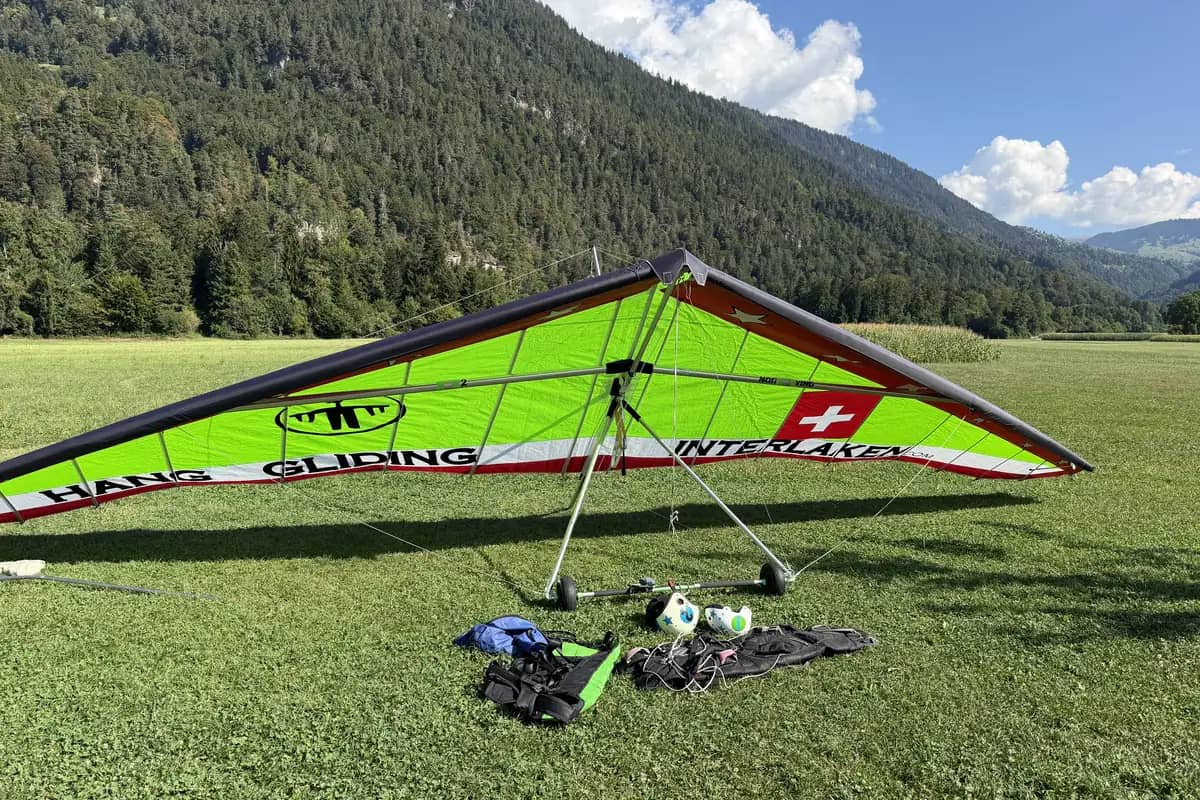
Hang Gliding or Paragliding in Interlaken?
Compare hang gliding and paragliding in Interlaken: same hill, same 20 minutes, CHF 170 against CHF 260. Here is what the extra 90 francs actually buys.
tandem-hang-glidingtandem-paraglidingadventure-sports
By Timoté BailyRead More

Interlaken
9/11/2026
15 min
12
Bönigen Historic House Trail: Free, 4 Min Away
Walk Bönigen's free historic house trail, four minutes by bus from Interlaken Ost, past carved wooden houses standing since 1549. Times and map inside.
historic-house-trailday-trip-brienzinterlaken-day-trips
By Pierre VetschRead More
Interlaken
9/9/2026
14 min
14
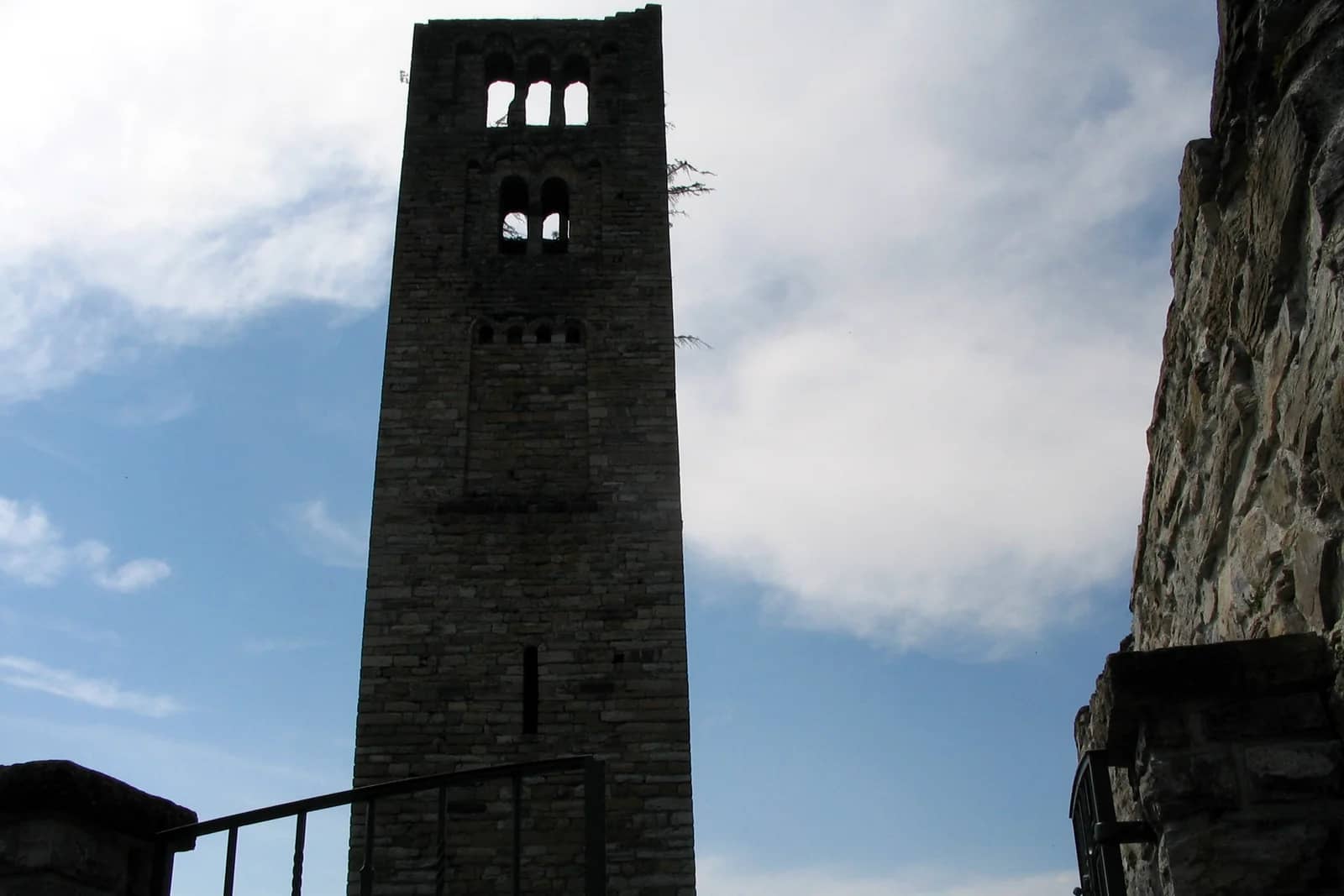
Goldswil Church Ruin Hike: A Free 680m Viewpoint
Climb to the Goldswil church ruin above Interlaken, a free eleventh century tower at 680m with the widest view over both lakes. Route and times inside.
church-ruinsmedieval-historyshort-hikes
By Timoté BailyRead More