Interlaken
Brienzer Rothorn Steam Train: When a Diesel Runs
T
Timoté Baily
Author
August 31, 2026
19 min
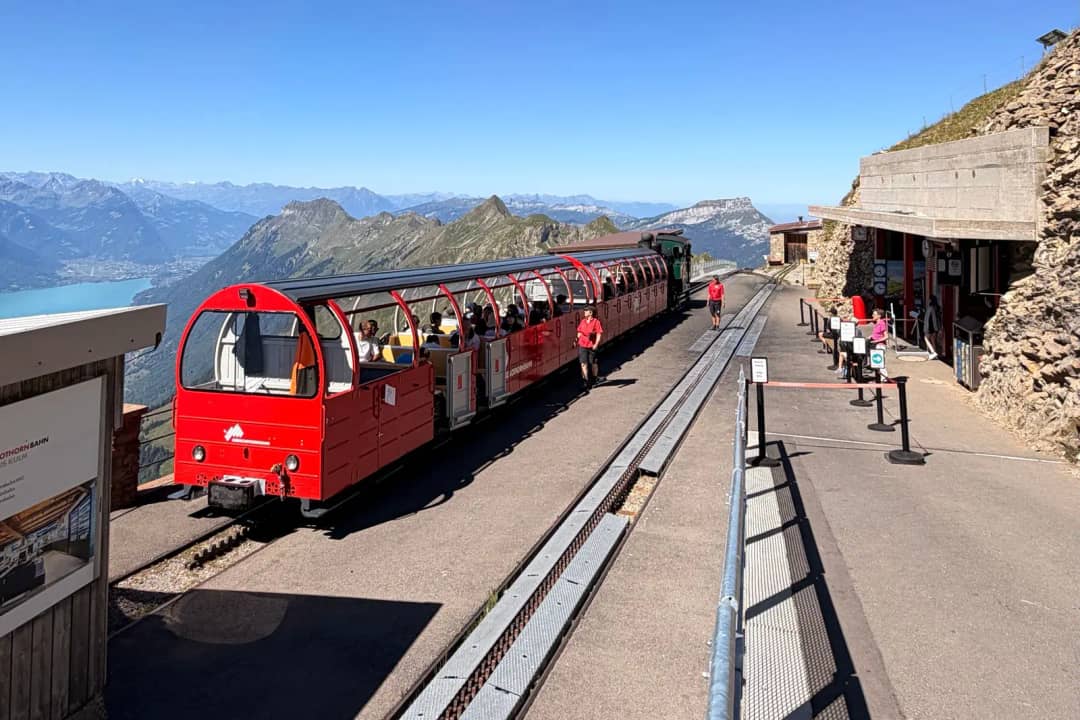
I checked the Brienz Rothorn Railway's website twice on Saturday 29 August 2026, and at 19:25 it still carried three words across the bottom of every page: HEUTE AUSGEBUCHT. Sold out today. Not one departure left on the last Saturday of August, on a line that runs nine trains a day.
That is the first thing to understand about this railway. It is not a big mountain lift with a cable car's capacity. It is a 7.6 km rack line from 1892 with compartments that seat eight, and when the compartments are full, the day is over.
The second thing is the one that fills the angry reviews. One traveller in July 2026 had a diesel on the way up and steam only on the way down. Another put the same complaint far less politely. Both paid for a steam train. Both are describing something the railway does on purpose, and it has a published answer that almost nobody has read.
Here is how the ride actually works, with every price and time read at the source on 29 August 2026. For the rest of your stay, our honest local guide to Interlaken lists what else is worth doing nearby.
Is the Brienzer Rothorn really a steam train, or will you get a diesel?
Diesel is the exception, not the rule. The railway's locomotive page says its three diesels are mainly used for the railway's own service work, and adds: "In the event of high passenger numbers or technical failure of a steam locomotive, diesel locomotives may be used for passenger services." It gives no figure for how often that happens.
If steam is the reason you came, you have one option on the day: look at what is coupled to your train on the platform and, if it is a diesel, wait for the next departure instead. That usually costs you about an hour, and it only works if the next train is not sold out.
The fleet explains why. The railway keeps eleven steam locomotives, eight of them in service, in three clearly separate generations, plus three diesels built in 1975, 1975 and 1987. On a busy August day, all of it comes out of the shed.
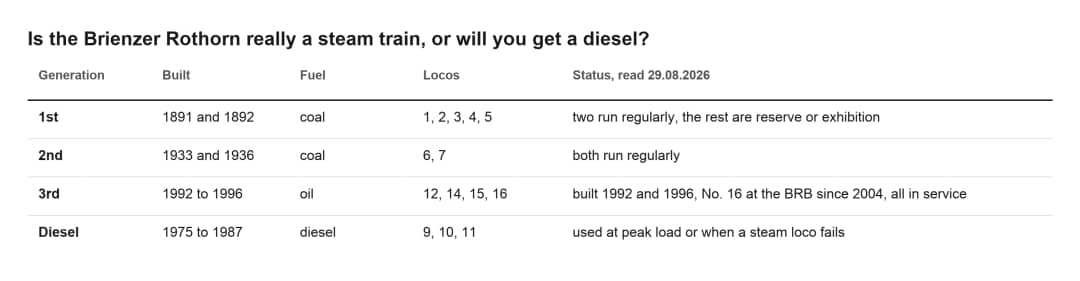
If the smoke and the smell are the reason you came, the coal-fired first and second generation are the ones you want. The 1990s locomotives are oil-fired and they burn a good deal cleaner.
You can work out which one you have before you board, because the number is painted on the machine and the railway publishes its whole roster. Numbers 1 to 7 are the coal burners. Numbers 12, 14, 15 and 16 are the oil-fired locomotives built between 1992 and 1996. Numbers 9, 10 and 11 are the diesels. Nothing else runs on this line, so one glance at a number tells you what you are getting.
A practical warning that comes up in the reviews twice, four years apart: the tunnels. In 2022 one rider found it hard to breathe in them because of the smell. Another said almost the same thing in July 2026. The line runs through six tunnels totalling about 690 metres plus two galleries. Behind a coal locomotive on the uphill run, riders describe those as the worst minutes of the day.
Do you need to book, and what does the CHF 8 seat guarantee actually buy?
Yes, book, and understand what you are buying. The seat guarantee costs CHF 8.00 per person and reserves you a place on a specific departure. It does not reserve a specific seat. The railway states it plainly: "Die Plätze sind nicht nummeriert", the seats are not numbered.
That single line resolves the most confused complaints on the whole listing. In June 2023 one traveller queued in the sun with a guaranteed seat. When the train arrived, staff opened every door and let everyone in, and seats nearly ran out. They had bought the right to board, not a numbered place.
The railway's own instruction, on the ticket shop page, read 29 August 2026: "Das Drehkreuz öffnet 30 Minuten vor Abfahrt." The turnstile opens 30 minutes before departure. Show up when it opens and you get more choice of seat. A reviewer reached the same conclusion by trial and error in July 2026. Arrive at least 30, probably 45 minutes early to get the seat you want, both ways.
So the guarantee and the queue are two separate things. The CHF 8 gets you on the train. Arriving 30 minutes early gets you the window.
Two more things the shop page says and the guidebooks do not. Tickets with a seat guarantee cannot be exchanged or refunded. And if you hold a Berner Oberland Pass, a Lucerne Travel Pass, a Camping Card Berner Oberland, a Gästekarte Brienz, an FVP tourist card or an SBB ticket, you buy the CHF 8.00 seat guarantee online and settle any remaining fare at the counter.
One charming detail, straight from the same page: travel on your birthday and you pay only the CHF 8.00 seat guarantee, with the ticket issued at the counter against an ID.
What does the Brienzer Rothorn cost in 2026?
A return to the summit costs CHF 98.00 for an adult, half that with a Half Fare card or a GA, and CHF 10.00 for a child aged 6 to 15. Under 6 travels free. The seat guarantee adds CHF 8.00 per person on top of every one of those figures.
All prices read on the railway's own timetable page on 29 August 2026.
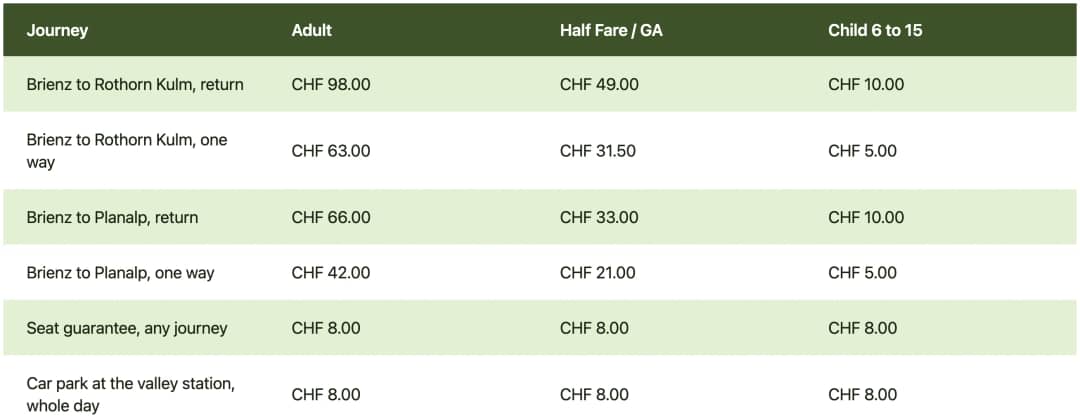
Reductions worth knowing, from the railway's FAQ read the same day. Free: Regional-Pass Berner Oberland, Lucerne Travel Pass, the red VöV card, the FVP tourist card, the SBB companion pass, and anyone travelling on their birthday. Half price: Half Fare, GA, FIP. Twenty percent off: the Brienz guest card and the Camping Card Berner Oberland. Day passes are not valid.
Note the shape of that table. The child fare is CHF 10.00 return, which is under a ninth of the adult fare. Families do far better here than at almost any other mountain railway in the region. For another family morning near Interlaken, see our guide to a farm tour with kids.
Whether CHF 98 is the right call against everything else you could do that day is a different question, and it belongs to our day trip to Brienz from Interlaken guide, which costs out the whole day.
Which train from Interlaken connects to which departure?
Trains leave Interlaken Ost for Brienz at :04 and :33 past the hour. The :04 is the Panorama Express and takes 17 to 18 minutes. The :33 is the regional and takes 20. The Brienz railway station sits directly opposite the Rothorn valley station, so the transfer is a road crossing, not a walk.
Times below queried on timetable.search.ch for Sunday 30 August 2026, matched against the railway's own 2026 departure board.
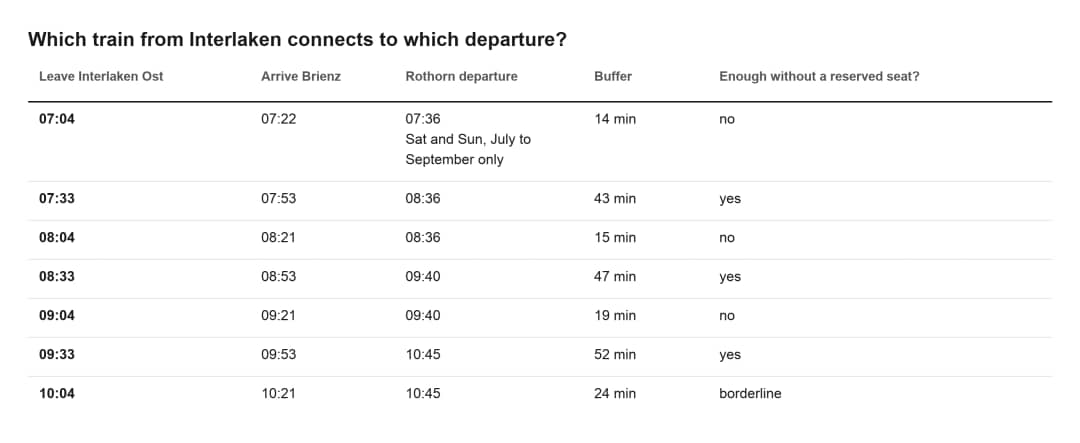
The pattern is worth reading twice. The :04 fast train lands you 14 to 24 minutes before a departure, and the :33 slow train lands you 43 to 52 minutes before one. If you hold a seat guarantee, the fast train is fine. If you do not, the slow train is the one that gets you a window seat, because it puts you at the turnstile as it opens.
Full departures from Brienz in the 2026 high season: 07:36, 08:36, 09:40, 10:45, 11:45, 12:58, 13:58, 14:58 and 16:36. The 07:36 runs only on Saturdays and Sundays in July, August and September.
Coming down, Rothorn Kulm departs at 09:06 (weekends in July to September only), 09:38, 11:15, 12:20, 13:28, 14:28, 15:28, 16:28 and 17:40, and the descent also takes about an hour. Trains back from Brienz to Interlaken Ost leave at :02 (22 minutes) and :37 (17 minutes), so the 17:40 last descent lands you in Interlaken by about 19:24.
If you would rather arrive by water, the boat docks at the Brienz quay and the valley station is three minutes on foot from the pier. Our guide to the boat from Interlaken to Brienz covers which side to sit on for that leg. For time on the lake itself, see our guide to the lakes around Interlaken.
One measurement settles what that buffer column actually means. On the Swiss federal geodata service, checked on 29 August 2026, the Brienz railway station and the Rothorn valley station sit 26 metres apart with one metre of height between them. The transfer takes under a minute even with luggage. The walk was never the problem. The problem is that the turnstile has already been open for 6 to 16 minutes by the time the fast train drops you.
Expect one more oddity at that gate. In July 2026 a rider found two queues rather than one at the valley station. People who arrived after him boarded ahead of him. The railway publishes no queueing plan. If you see two lines, ask which one is yours instead of joining the longer.
Where should you sit, and what does the ride feel like?
I sit on the right going up. Two reviewers, four years apart, preferred the left, the door side. Both add the more useful point: the edge seat next to the window matters more than the side.
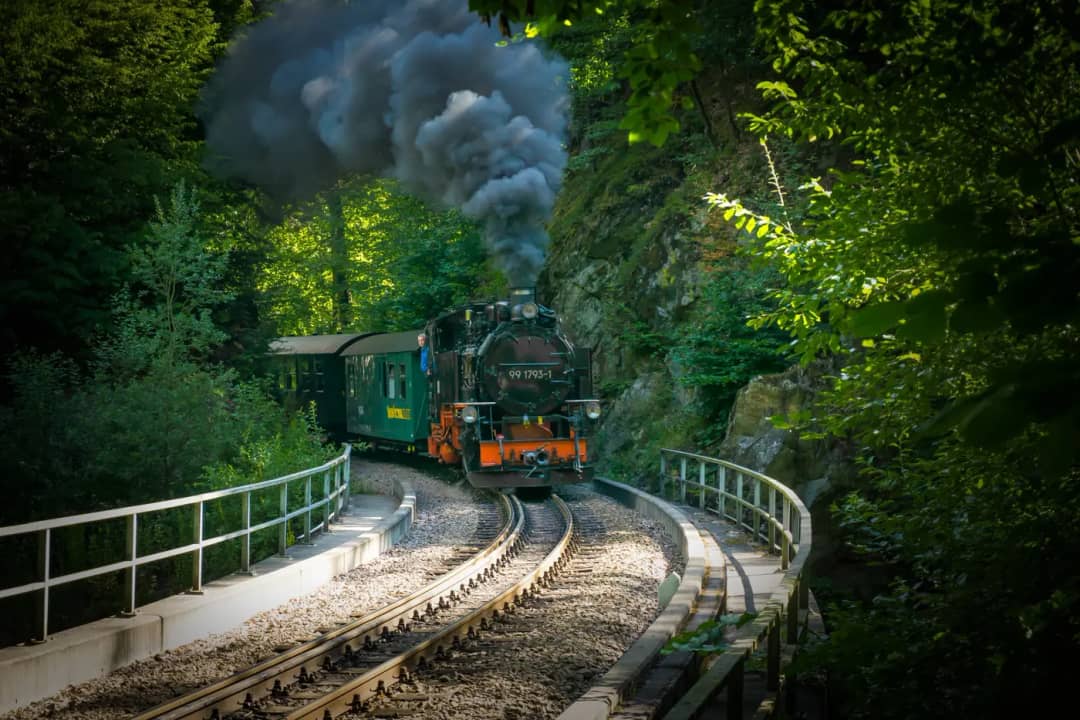
The compartments hold eight people, and the railway is unapologetic about filling them. Its timetable page puts it plainly: "Our train compartments can accommodate eight people. We use the available capacity and do not offer private compartments."
Expect that to be the dividing line in how you remember the day. One traveller in August 2026 found the ride uncomfortable, with compartments packed as full as possible. Another in July 2026 called the ride amazing for the scenery and for lasting over an hour. Having done many mountain railways, they rated it the best.
The climb is not gentle. The line uses the Abt double lamella rack, runs on 800 mm gauge, averages 225 per mille and touches 250 per mille, which is a gradient of one in four. The tightest curve has a radius of 60 metres. You feel every metre of that in a wooden compartment.
And it is slow on purpose. One reviewer called it slow, a full hour in each direction, and was right. Brienz sits at 566 m, Planalp at 1,341 m, Rothorn Kulm at 2,244 m. That is 1,678 metres of ascent in an hour, behind a steam locomotive, on 7.6 kilometres of track.
Coming down, the geometry flips, and this is the part nobody mentions. The train reverses rather than turning round, so the physical side of the compartment that faced the view on the way up is on your other hand on the way down. If you want the same outlook twice, you change sides at the summit. Which side wins on the descent is not documented anywhere I could find, and I am not going to guess it for you.
How much walking is there at the top?
The train does not reach the summit. Rothorn Kulm station sits at 2,244 m. The Brienzer Rothorn summit is at 2,350 m. You walk the last 106 metres of ascent yourself, on a path the railway describes as manageable even for the less fit.
Easy is not the same as effortless at that altitude. In July 2023 a reviewer found the short climb to the terrace left them breathless in the thin air. If you have come up from 566 m in one hour, your body has not caught up. For other active days, see our guide to the best outdoor adventures in Interlaken.
For the longer options, the railway's own FAQ gives the walking times, read on 29 August 2026:
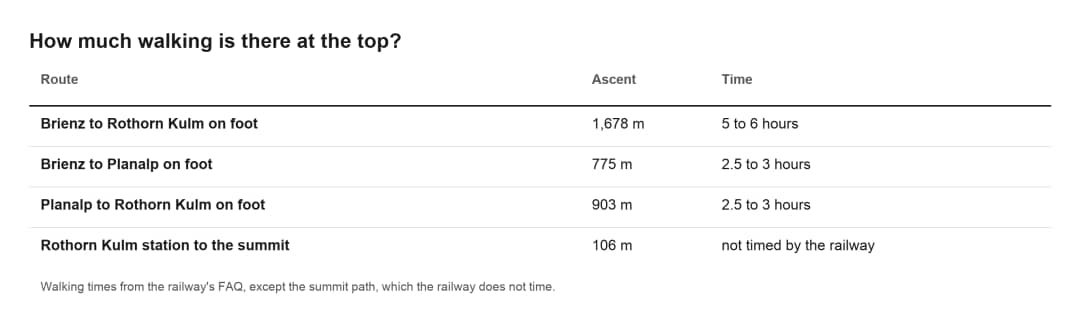
The middle two are the good ones. Ride to Planalp, walk one leg, ride the other. It halves the fare and it gets you out of the compartment for the best-looking section of the line.
"My own way on this mountain: the train up, and on foot back down."
Timoté Baily, mountain photographer at Swiss Local Adventures
Below Planalp, the federal register lists both the Milibach path and the Gäldried detour as closed.
One warning that comes straight from an incident report on the review page. In June 2023 two hikers were caught in a thunderstorm above Planalp, tried to flag down a passing train at a crossing loop and were not let on. The railway apologised publicly. If you walk any leg of this mountain, carry your own weather plan. The train is a timetable, not a rescue service.
When does it run, and what stops it?
The full line to Rothorn Kulm runs 6 June to 25 October 2026. Before that, from 9 May, trains run only as far as Planalp. There is no winter service at all. The 9 May date comes from the Bernese Oberland Pass listing, and the 6 June to 25 October season from the railway's own timetable page, both read on 29 August 2026 and again on 13 September 2026.
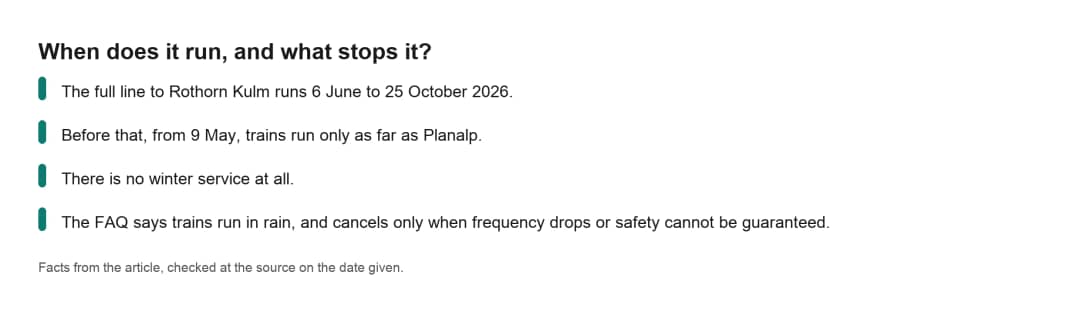
Inside the season, four separate things stop this railway, and only one of them is obvious.
Weather. The FAQ says trains run in rain, and cancels only when frequency drops or safety cannot be guaranteed. In practice, low cloud makes the 693-peak panorama pointless anyway.
Snow. In late September 2025 a group arrived to find snow had stopped the train reaching the Rothorn. They got only the Planalp section. At 2,244 m, late September can go either way.
Fire risk. This one is not published anywhere I could find, and it caught a local. On 5 August 2026 a reviewer was told at the counter there would be no seats until Sunday. The reason was the fire hazard from the steam locomotive. She accepted the closure. Her complaint was that she could find no information about it online. A coal locomotive throwing sparks over dry alpine grass is a real hazard. The railway manages it by cutting service.
Selling out. On 29 August 2026 the whole day was gone. In August 2025 a Bernese Oberland Pass holder found the railway fully booked for the next two days.
The practical conclusion is short. Check the railway's own homepage on the morning you plan to go, because the sold-out banner and any operating notice appear there and nowhere else. I checked twice on 29 August: a weather notice about Rothorn Kulm appeared on the first read of the English homepage and had gone by the second, while the sold-out banner stayed. These notices move by the hour.
For a fallback when the mountain is shut, the village below stays open and so does the museum trail. Our half day in Brienz village guide covers what works when the summit does not, and the two craft schools of Brienz are about 20 minutes on foot from the valley station.
Your questions about the Brienzer Rothorn steam train
Does the Brienzer Rothorn train run every day?
Yes, during its season. The railway answered this exact question on its review page: its trains run every day until the end of October. The full line to Rothorn Kulm runs 6 June to 25 October 2026. The shorter Brienz to Planalp section opens earlier, on 9 May. There is no winter operation. Nine departures leave Brienz on a full-season day. The first, at 07:36, runs only on Saturdays and Sundays in July, August and September. Outside the season the mountain is reachable from the Lucerne side by the Sörenberg cable car. It runs until 1 November 2026 and again from 19 December 2026 to 29 March 2027.
Is the Brienzer Rothorn included in the Swiss Travel Pass?
Not free. Swiss Travel Pass and Half Fare holders pay half price, CHF 49.00 for the summit return. The passes that give you free travel are the Regional-Pass Berner Oberland, the Lucerne Travel Pass, the red VöV card, the FVP tourist card and the SBB companion pass. Berner Oberland Pass holders booking online pay only the CHF 8.00 seat guarantee. The Brienz guest card and the Camping Card Berner Oberland give 20 percent. Ordinary day passes are not accepted at all. All of this read on the railway's FAQ on 29 August 2026.
Can you get a steam locomotive guaranteed?
No, and the railway does not pretend otherwise. Its diesels mainly do service work, but it says they may haul passenger trains when passenger numbers are high or a steam locomotive has a technical failure, and it publishes no figure for how often. If a diesel is coupled to your train, you can let it go and wait for the next departure. That costs you an hour, and it only works if the next train is not sold out. If steam is the whole reason for your trip, travel on a quieter weekday rather than an August Saturday.
How long do you need for the Brienzer Rothorn?
The railway says two and a half hours minimum for a return with a short stop at the top. The Interlaken tourism office says to allow five hours. Both are right for different trips. Two and a half hours covers an hour up, the railway's minimum stay of 30 minutes at the top and an hour down. Five hours is what you need to reach the actual summit, eat something and catch a later descent. A reviewer who had ridden most Swiss mountain railways recommended allowing at least 90 minutes at the top, which sits neatly between the two.
Is the Brienzer Rothorn suitable for small children and pushchairs?
Children do very well on it, at CHF 10.00 return for ages 6 to 15 and free under 6. Pushchairs are the problem. In 2022 a reviewer warned that big prams are not welcome, because luggage space is limited. The compartments seat eight adults with no dedicated luggage space. Bring a carrier rather than a buggy. Dogs are welcome at CHF 10.00 per dog, bought at the counter only. The railway warns that "the steam train produces noise and steam, which may cause stress for your dog."
What can you actually see from the top?
The railway claims 693 mountain peaks on a clear day, from Pilatus, the Rigi and the Titlis in Central Switzerland, across the Eiger, Mönch and Jungfrau, all the way to the Chasseral in the Jura. That figure is the railway's own and it is unusually precise, which is why it is worth quoting rather than rounding to "over 600" as several listings do. On a cloudy day you see the inside of a cloud, and there is nothing the ticket can do about that.
Take the slow train, and take the early one
If you want one instruction out of all of this, it is the 07:33 from Interlaken Ost. It is the slow regional service, and it feels like the wrong choice. It puts you at the Brienz turnstile as it opens for the 08:36. You get the compartment and the side you want, before the day fills up.
Buy the seat guarantee at CHF 8.00 the night before, look at the locomotive when you reach the platform, and if it is a diesel, decide there and then whether an hour of waiting is worth it to you. Nobody at the counter will volunteer that choice.
If you would rather spend a morning on the ground, our Farm Tour with a Swiss breakfast and cheese making takes you to a working alpine farm near Interlaken.
We drive this valley most weeks and we watch people arrive at Brienz at 11:00 in August to find the whole day sold out. If you are planning a week around Interlaken and want to know honestly what fits where, message us on WhatsApp and we will tell you which morning to spend on this mountain.
Source: Brienz Rothorn Bahn timetable and prices, Brienz Rothorn Bahn locomotives and Brienz Rothorn Bahn ticket shop, read on 29 August 2026 and again on 13 September 2026, with train times from timetable.search.ch.
Written by Timoté Baily, your mountain photographer at Swiss Local Adventures
Tags
#steam-train#rack-railway#day-trips-interlaken#mountain-railway-switzerland#family-day-trip-interlaken
Sources & References
- •Brienz Rothorn Bahn: timetable and prices
- •Brienz Rothorn Bahn: Fahrplan und Preise
- •Brienz Rothorn Bahn: locomotives
- •Brienz Rothorn Bahn: questions and answers
- •Brienz Rothorn Bahn: route
- •Brienz Rothorn Bahn: history
- •Brienz Rothorn Bahn: hiking
- •Brienz Rothorn Bahn: getting there
- •Brienz Rothorn Bahn: ticket shop
- •Bernese Oberland Pass: Brienz Rothorn Bahn
- •Interlaken Tourismus: Brienz Rothorn railway
- •Sörenberg: cable car operating times
- •Swiss public timetable
- •Photo: Stephan Leuzinger on Pexels
- •Photo: Timon Studler on Unsplash
- •Photo: M. Winkeltier on Pexels
- •Photo: Annika Wischnewsky on Unsplash
Share this article
Similar Articles
Continue your reading with these related articles
Interlaken
9/12/2026
12 min
9
Hang Gliding or Paragliding in Interlaken?
Compare hang gliding and paragliding in Interlaken: same hill, same 20 minutes, CHF 170 against CHF 260. Here is what the extra 90 francs actually buys.
tandem-hang-glidingtandem-paraglidingadventure-sports
By Timoté BailyRead More
Interlaken
9/11/2026
15 min
12
Bönigen Historic House Trail: Free, 4 Min Away
Walk Bönigen's free historic house trail, four minutes by bus from Interlaken Ost, past carved wooden houses standing since 1549. Times and map inside.
historic-house-trailday-trip-brienzinterlaken-day-trips
By Pierre VetschRead More
Interlaken
9/9/2026
14 min
14
Goldswil Church Ruin Hike: A Free 680m Viewpoint
Climb to the Goldswil church ruin above Interlaken, a free eleventh century tower at 680m with the widest view over both lakes. Route and times inside.
church-ruinsmedieval-historyshort-hikes
By Timoté BailyRead More