Interlaken
Where to Watch the Sunset in Interlaken, by Season
P
Pierre Vetsch
Author
October 18, 2026
12 min
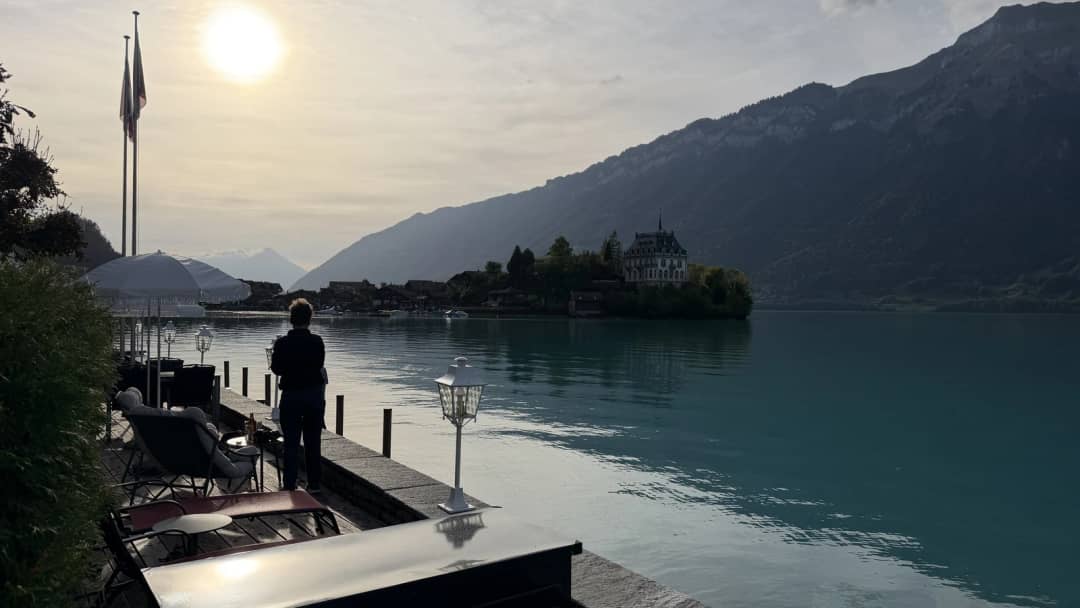
Where to watch the sunset in Interlaken depends on the month: in winter, stand on the Höhematte in the middle of town; from late March to November, ride up to Harder Kulm. Then do the thing most visitors forget and turn around. The show is not the sun going down behind the hills. It is the Jungfrau turning pink behind you.
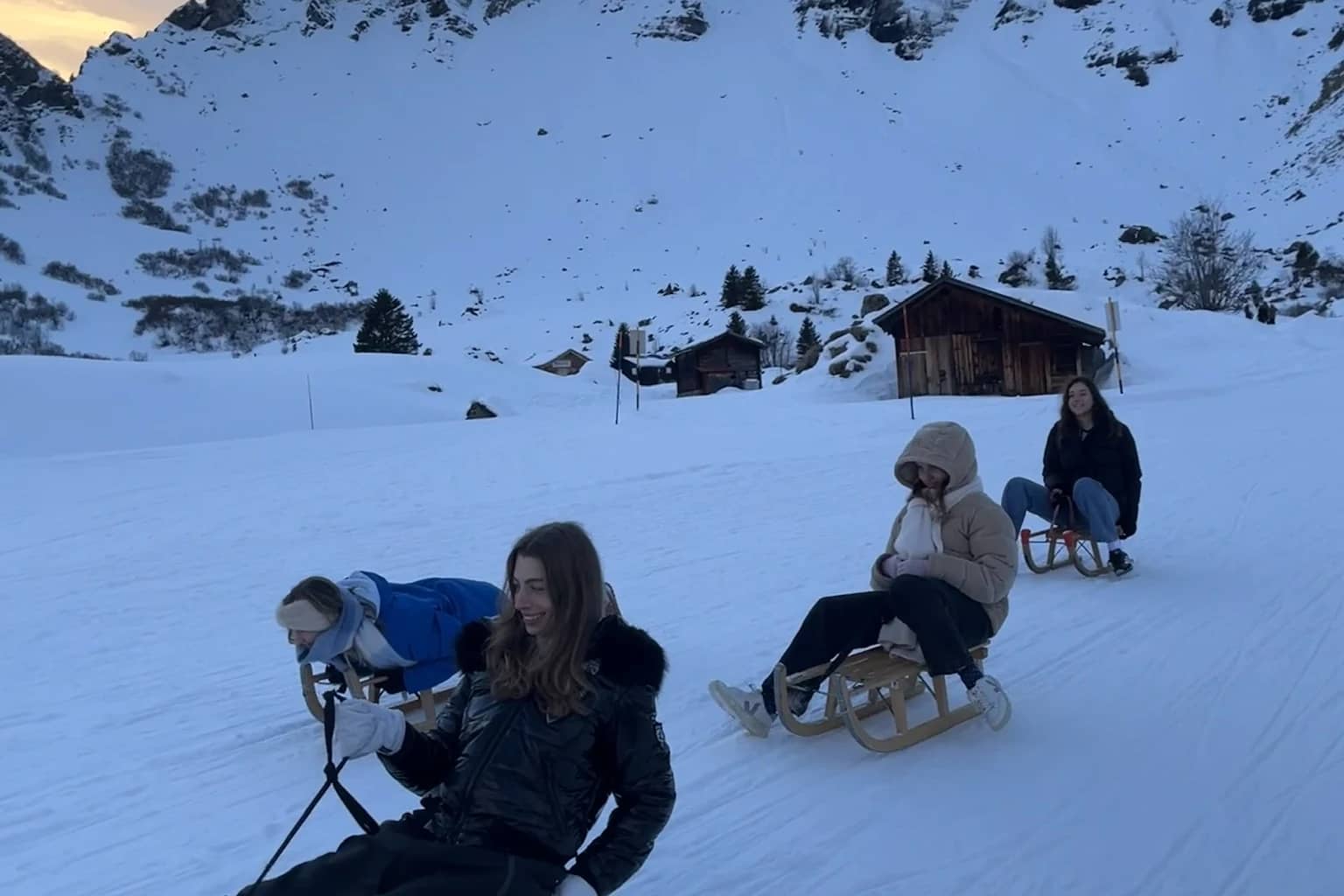
We are guides, and on our winter evenings we watch it from a sled run above Lauterbrunnen. Below are the spots Pierre Vetsch, our head guide, sends people to, the minute each one loses the sun, and the last way back down.
Where is the best place to watch the sunset in Interlaken?
In winter, the Höhematte, the open meadow between the Höheweg and the Jungfrau view. It is free, flat, a short walk from both stations, and nothing stands between you and the Jungfrau. In summer, Harder Kulm wins, because it sits 1,322 m up with both lakes below.
Pierre Vetsch, founder and head guide, says: "Höhematte." That was his whole answer when we asked where he sends someone with one winter evening in Interlaken and no sled.
Earlier this month he described his favourite moment in Interlaken itself the same way: the Höhematte at sunset, with the Jungfrau turning pink. The meadow works because of its emptiness. You do not need a ticket, a reservation or a last train.
Our sun calculation found a catch. On a clear 15 December, the Höhematte loses direct sun at 15:48, almost an hour before the flat-horizon sunset of 16:41, because the hills west of town hide the sun first. On 15 January the last ray falls at 16:17, on 15 February at 17:19. Arrive at the official sunset time and the meadow is already in shadow, but the summits are still lit. That is exactly when you want to be there.
Fun fact: the Höhematte has stayed empty on purpose since 1864. That year a cooperative of locals bought the former state land, and no building has been allowed on it since, according to the Historical Dictionary of Switzerland.
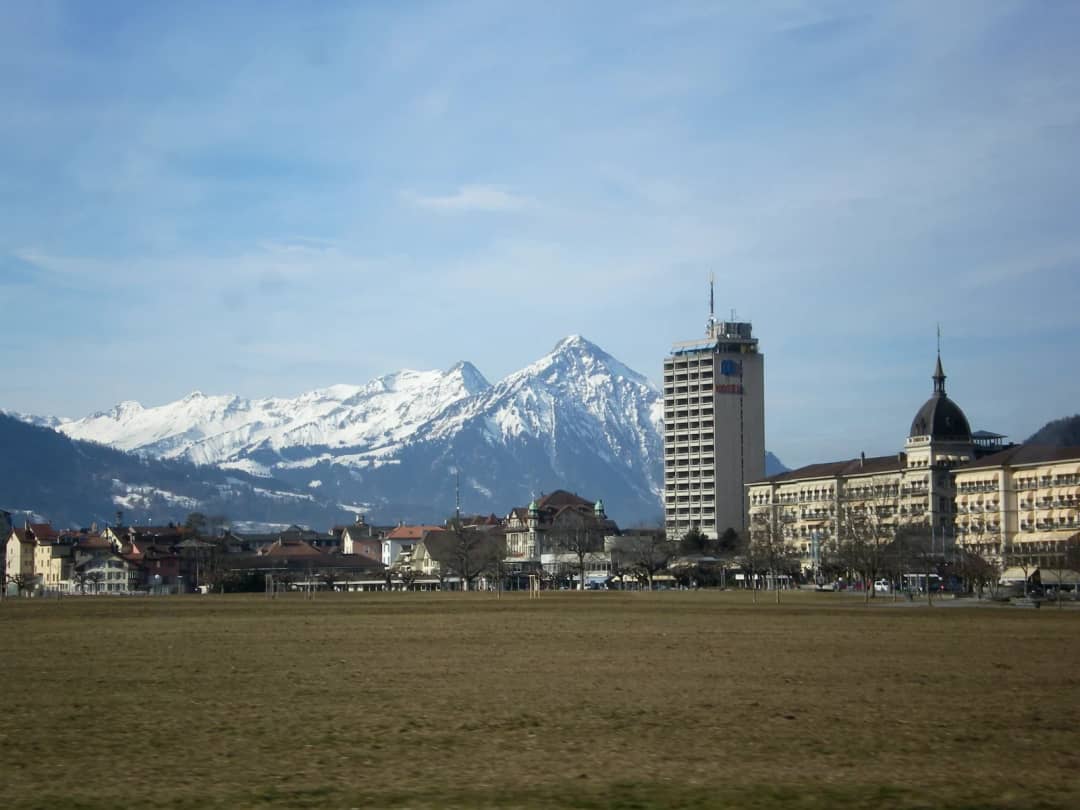
Why should you turn your back on the sunset?
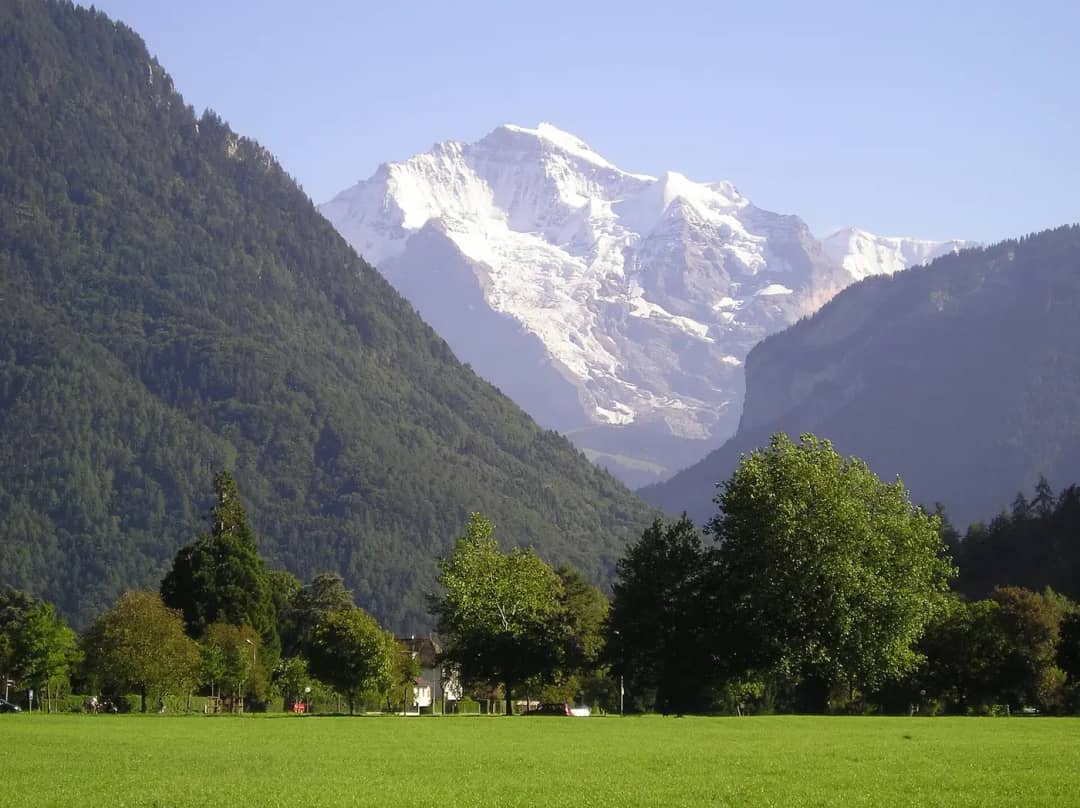
Because the colour is on the other side. The sun sets to the west, over Lake Thun, while the Eiger, Mönch and Jungfrau stand to the south and east. For a few minutes after the town falls into shade, their snow catches the last light and turns pink. That is the moment people travel for.
We asked Pierre for the mistake visitors make at sunset and gave him three options: missing the last funicular, arriving at the official time, or this one. He picked this one.
Pierre says: "Looking at the sun instead of turning round to the Jungfrau."
You see it every clear evening on the Höhematte and at Harder Kulm. Phones point west at an orange smudge behind the hills, while the Jungfrau glows behind their backs. Take the sunset photo, then turn south and wait. On the meadow, the Jungfrau sits straight down the gap of the Lütschine valley, so you cannot miss it once you look.
Insider tip: the pink does not wait for the official sunset. Watch the summits from the moment your own spot falls into shadow. On the Höhematte in mid-December that is around 15:48, while the high snow keeps its light far longer.
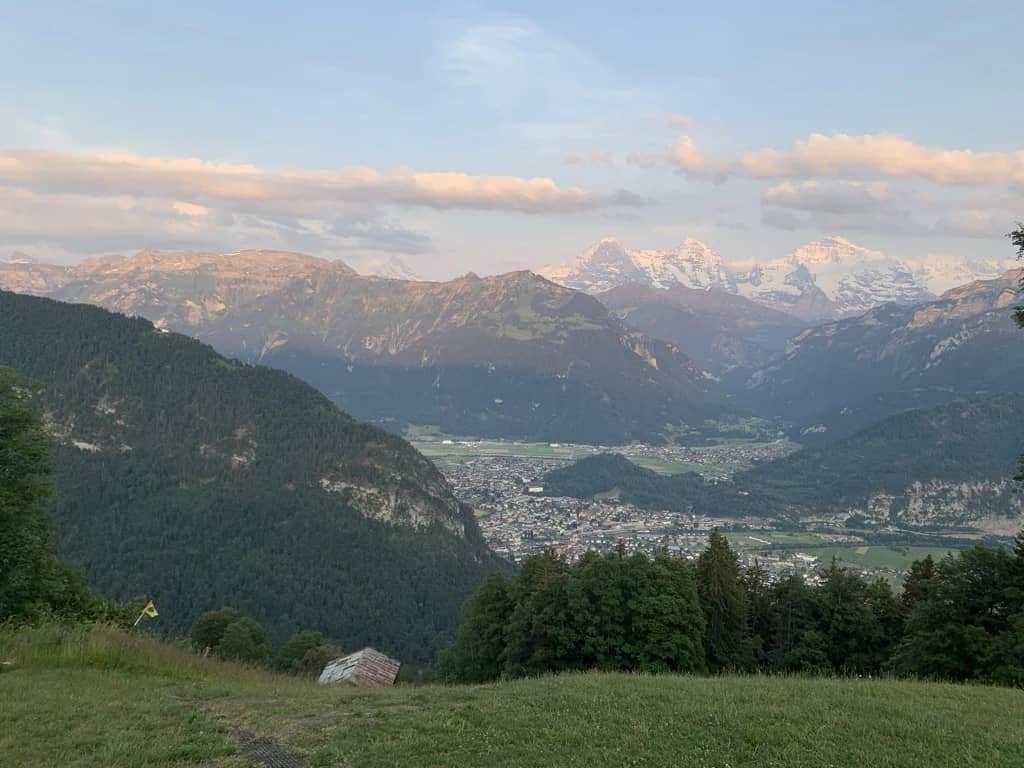
Höhematte or Harder Kulm: which sunset spot wins?
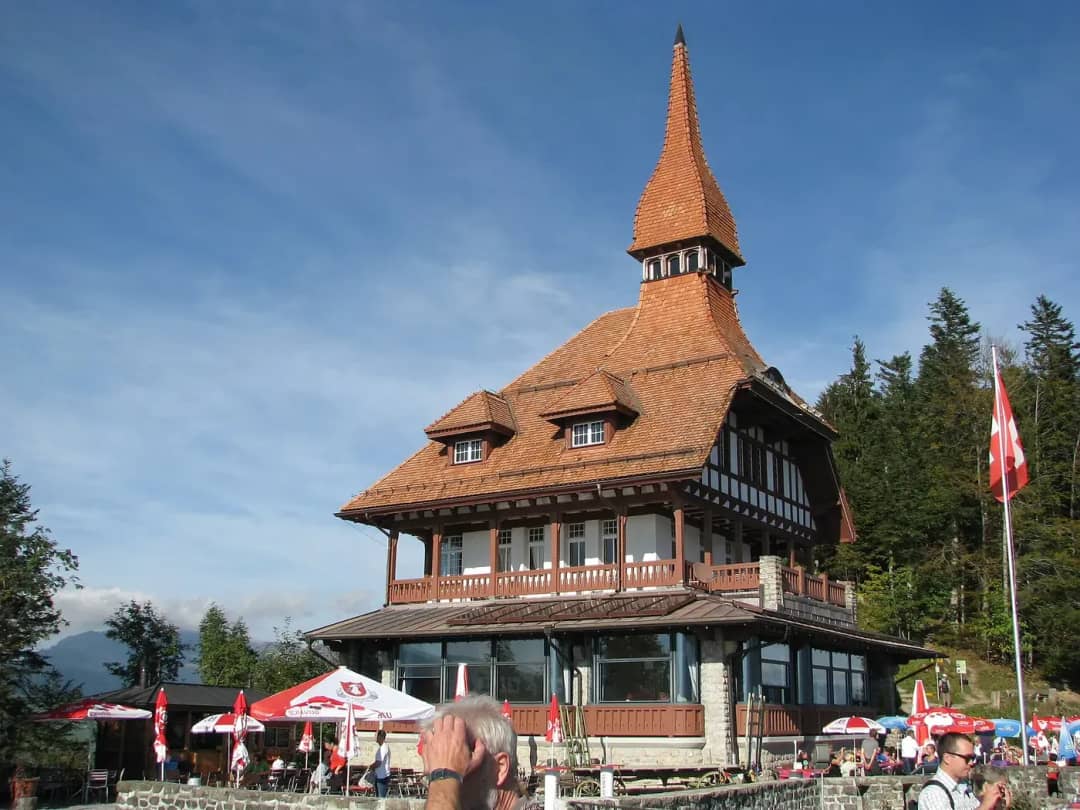
Harder Kulm in summer, the Höhematte in winter. Harder Kulm is higher, faces both lakes and keeps the sun longer: last direct ray at 16:27 on 15 December against 15:48 down in town. But the Harderbahn stops after 29 November 2026 and only runs again by late March 2027, so from December the meadow is your only easy choice.
When Harder Kulm is open, Pierre's verdict is short.
Pierre says: "Harder Kulm: higher, it's worth the ticket."
His timing advice for it, given this month: go up an hour before sunset. The funicular takes 10 minutes from its valley station, and Interlaken Ost to the summit takes 20 minutes in all on the timetable for 15 July 2027. Jungfrau Railways sells Harderbahn tickets from CHF 19 on its site, and in November 2026 an end-of-season ticket costs CHF 44 with a CHF 25 voucher for the Panorama Restaurant. The operator says its evening trips take you up in time for the sunset and bring you down to Interlaken within 10 minutes afterwards. On 15 July 2027 the last two descents leave at 21:40 and 22:10.
If you want a free viewpoint with height instead, we compared the two in Goldswil or Harder Kulm: Pierre still picks Harder Kulm.
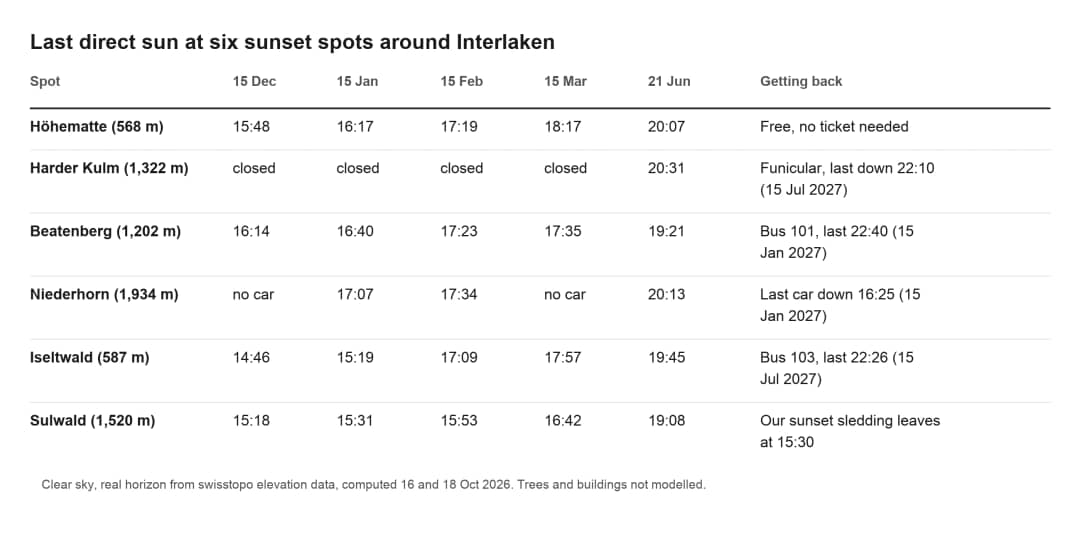
The table in words. We computed the last direct sunlight for a clear sky with the real horizon from swisstopo elevation data, on 16 and 18 October 2026. Höhematte, 568 m: 15:48 on 15 December, 16:17 on 15 January, 17:19 on 15 February, 18:17 on 15 March, 20:07 on 21 June. Harder Kulm: 16:27, 16:45, 17:30, 18:20 and 20:31, but closed from 30 November to late March. Beatenberg: 16:14, 16:40, 17:23, 17:35 and 19:21. Niederhorn: 16:27, 17:07, 17:34, 18:14 and 20:13, but with no cable car on 15 December or 15 March and the last car down at 16:25 on 15 January 2027. Iseltwald, 587 m: 14:46, 15:19, 17:09, 17:57 and 19:45. Sulwald, 1,520 m: 15:18, 15:31, 15:53, 16:42 and 19:08. Trees and buildings are not in the model, so treat each time as the latest possible.
Is Iseltwald a good place to watch the sunset on Lake Brienz?
Yes, from April to October. Iseltwald faces west down Lake Brienz towards Interlaken, and on a clear 21 June it keeps the sun until 19:45. In winter it is the worst spot in this article: the hills cut the sun at 14:46 on 15 December. Pick it for spring and summer evenings.
When we asked Pierre for his favourite corner of either lake at sunset, Bönigen, Neuhaus and Goldswil were on the list. He did not hesitate.
Pierre says: "Iseltwald."
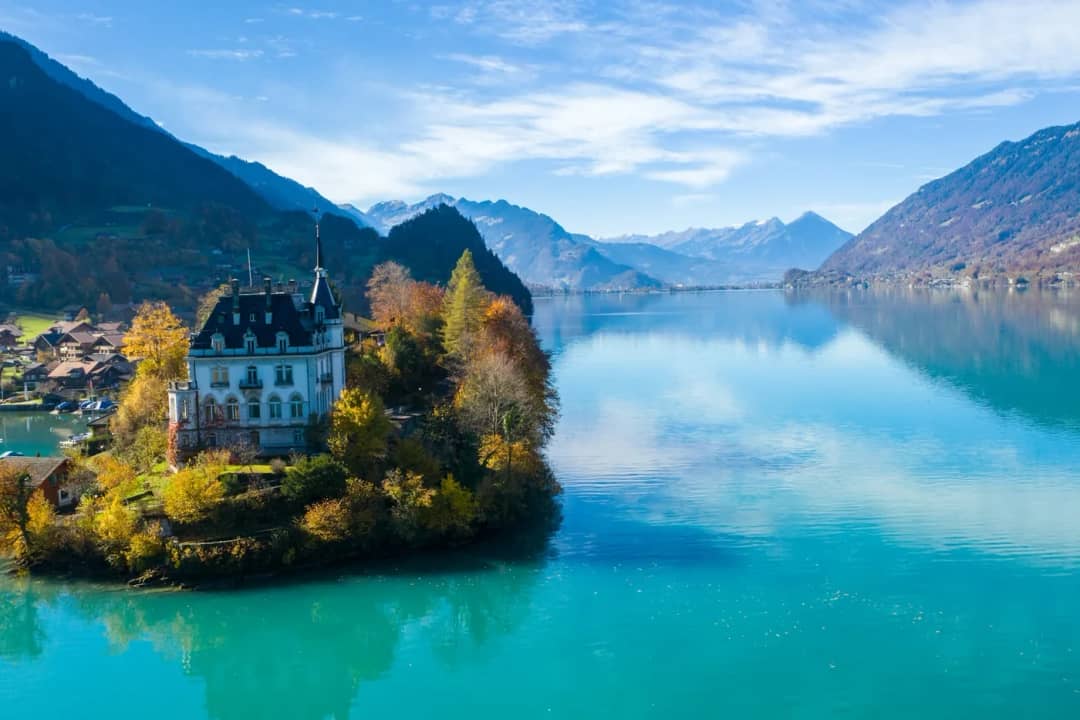
He also gave us his crowd rule for the village earlier this month: Iseltwald after 17:00. That fits the light. The day visitors who queue at the famous pier have mostly left, the lake goes still, and Schloss Seeburg on its little peninsula turns into a silhouette. If you want the pier itself, read what the CHF 5 Iseltwald pier ticket pays for first.
Bus 103 runs from Interlaken Ost to Iseltwald in 21 minutes on the timetable for 15 July 2027, with buses back at 21:29 and 22:26 that evening. On 15 April 2027 the last useful bus back leaves at 20:26.
Insider tip: in mid-April Iseltwald keeps the sun until 19:18. That is the sweet spot: late light, few people, and a bus home an hour later.
Where can you watch the sunset above the fog?
On the Niederhorn, at 1,934 m above Lake Thun, and in Pierre's own favourite, Beatenberg below it. In autumn and winter Interlaken often sits under a grey lid of fog while the slopes above are in sun. When it is grey in town, Pierre goes up.
Pierre says: "Yes, the Niederhorn." That was his answer when we asked if he goes up above the fog for the sunset.
He also told us, when ranking winter day trips, that "the view is better from the Niederhorn". The catch is the last cable car. On 15 January 2027 the summit keeps direct sun until 17:07, but the last car down leaves at 16:25. In winter, the Niederhorn gives you the golden hour, not the sunset itself. Interlaken West to the summit takes 58 minutes by bus 101 and the cable car. The timetable shows no cable car on 12 and 15 December 2026 or on 14 and 15 March 2027, so check the Niederhorn timetable before you go.
For the sunset itself, stay lower at Beatenberg, where bus 101 runs late. When we asked Pierre what a local had told him about sunsets, he answered with a scene of his own instead.
Pierre says: "The view from Beatenberg, with the mountains turned pink and the sun setting over Thun."
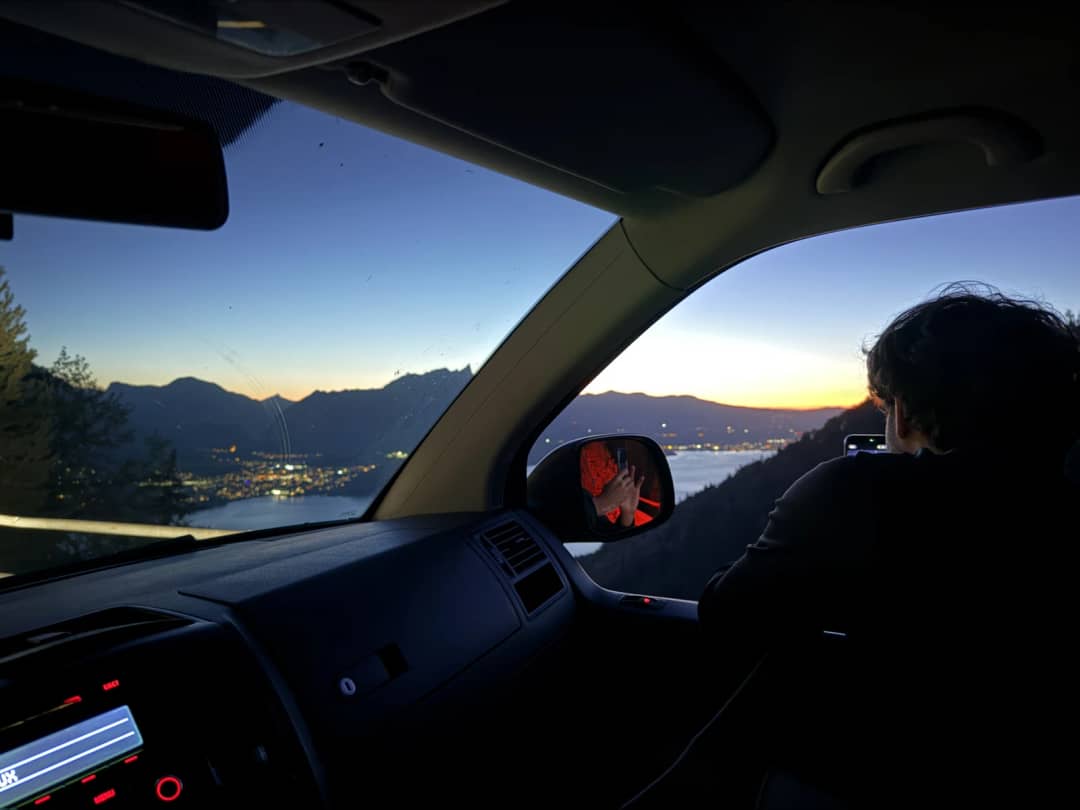
That is the one place in this article where you get both at once: the sun dropping over Lake Thun to the west and the peaks glowing across the valley. The Waldegg stop at 1,202 m keeps direct sun until 16:14 on 15 December and 16:40 on 15 January. Bus 101 takes 18 minutes from Interlaken West, and on 15 January 2027 it comes back every 30 minutes in the early evening, then hourly, the last one at 22:40. Whether Beatenberg clears the fog depends on that day's fog ceiling. The Niederhorn, 700 metres higher, gives you a better chance.
How long does the Jungfrau stay pink on a sunset sledding tour?
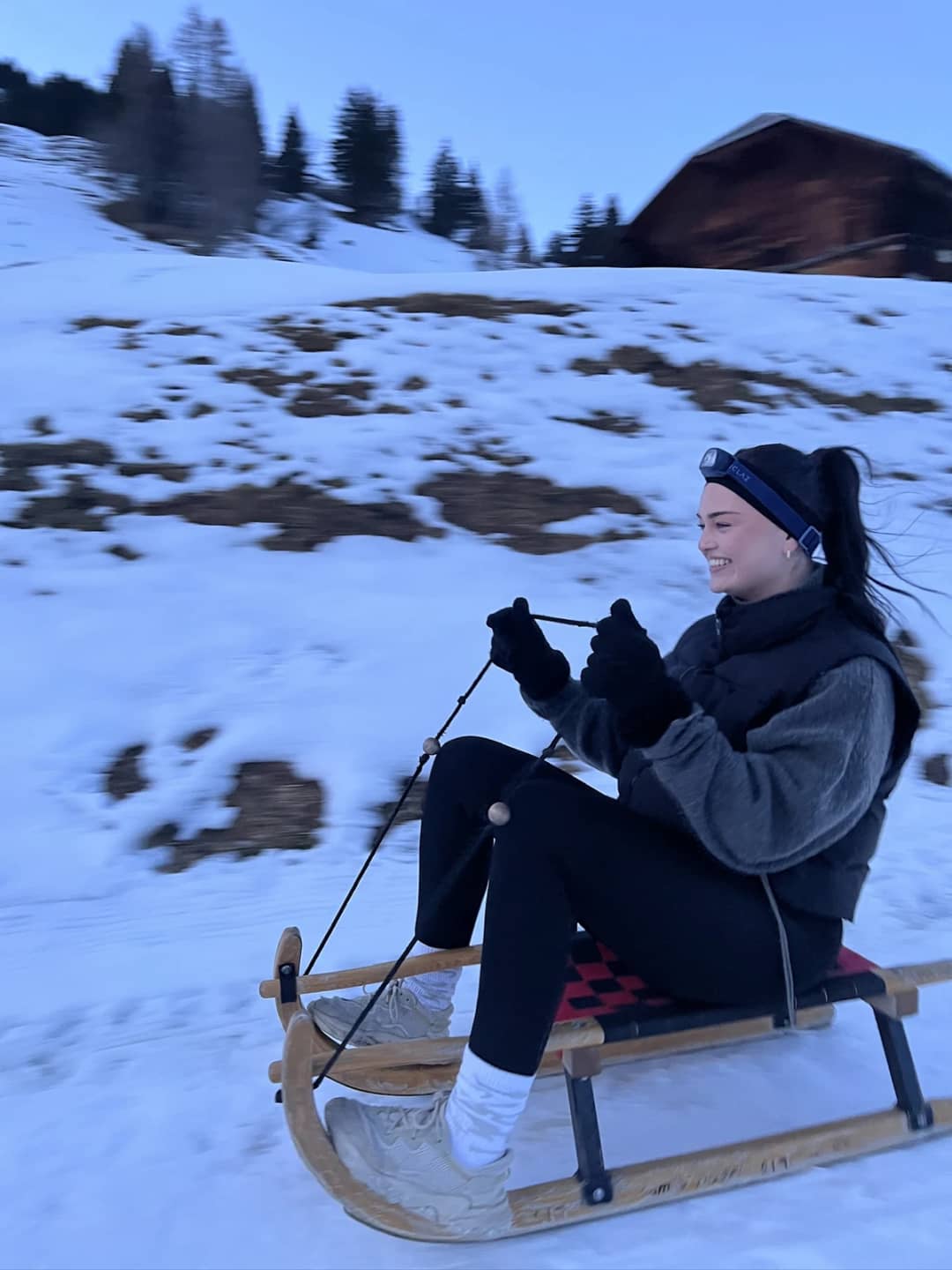
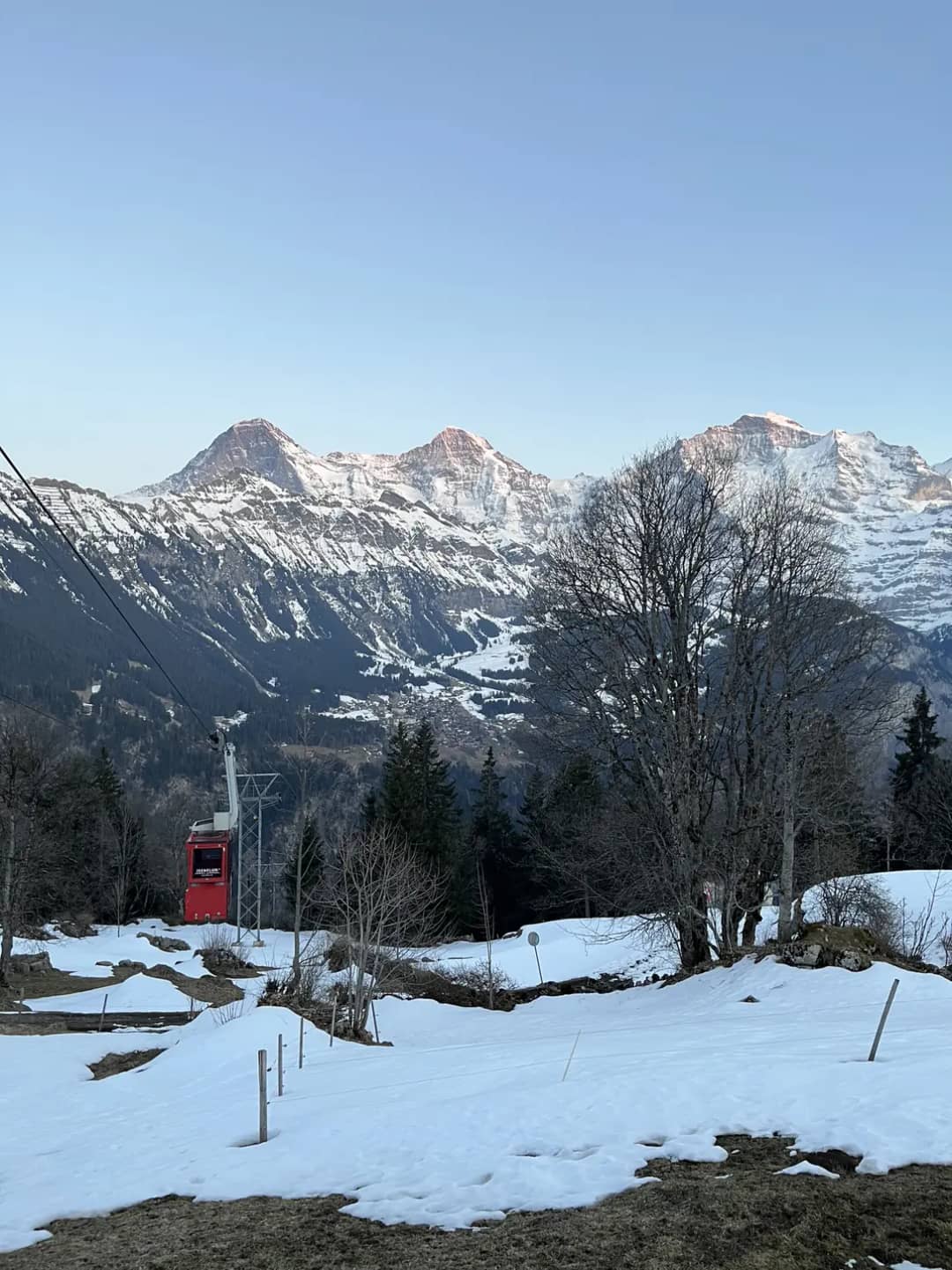
About 10 to 15 minutes after the sun leaves the sled run. That is Pierre's answer from the evenings he spends at Sulwald, above Isenfluh, where our sunset sledding starts. Sulwald loses direct sun early, at 15:18 on 15 December and 16:42 on 15 March, but the Eiger, Mönch and Jungfrau across the valley keep their light longer.
Pierre says: "10 to 15 minutes." His answer when we asked how long the Jungfrau stays pink once the sun has left Sulwald.
So the rule on the slope is the same as in town: do not start down the moment your side goes blue. Stand at the top, face the Jungfrau, and give it a quarter of an hour. Then the cold comes fast. We explain why in sunset or night sledding, along with the month-by-month light on the run.
Sulwald is 61 minutes from Interlaken Ost by public transport on the timetable for 15 January 2027. The run itself, the cable car and the snow conditions are in our guide to sledding and snowshoeing at Isenfluh and Sulwald. When the snow at Isenfluh runs short we move up to Mürren, where the Allmendhubel terrace gives the same pink summits.
Your Questions About Sunset in Interlaken
What time is sunset in Interlaken in December?
Around 16:41 on 15 December for a flat horizon, and 17:07 on 15 January. Those official times mislead in a valley town. On the Höhematte the last direct sunlight falls at 15:48 on 15 December and 16:17 on 15 January, because the hills west of Interlaken hide the sun first. Plan to be in place by about 15:30 in December. You then get the light fading on the meadow, followed by the pink on the Jungfrau while the summits still catch the sun. If you would rather see it from a sled run, our month-by-month sunset table gives the light at the top of the run for each winter month, with the time the headlamps go on.
Can you watch the sunset from Interlaken Ost?
Not well. The station sits at the eastern end of town, between the river and the slopes of the Harder, with buildings in most directions. Two better options start right there. From late March to the end of November, the Harderbahn valley station is a short walk across the Aare, and Interlaken Ost to Harder Kulm takes 20 minutes in all on the timetable for 15 July 2027. In winter, walk west along the Höheweg to the Höhematte, the free meadow in the middle of town with the open view to the Jungfrau. Either way, you are back at the station in time for the evening trains. For a winter base in town rather than up the valley, see Interlaken or Grindelwald in winter.
Can you see the sunset from a paraglider over Interlaken?
Yes, and Pierre has done it. When we asked him for his clearest flight, he described a winter sunset: "magnificent colour but very cold". At altitude, with no sun and wind on your face, the cold is the price of that colour. Pierre's broader view is that paragliding is not worth its price compared with hang gliding over the same valley, and he explains why in hang gliding vs paragliding. If you book an evening flight in winter anyway, dress as you would for a sled run: warm layers, gloves and a hat under the helmet. Your pilot will tell you whether the wind allows the late slot on the day.
Can you watch the sunset from the Niederhorn in summer?
Not by cable car. On 15 July 2027 the last cars down leave at 17:25 and 17:45, while the flat-horizon sunset is around 21:25. In summer the Niederhorn is a daytime viewpoint, and a fine one. Pierre rates its view above the Schilthorn's. For the summer sunset itself, go to Harder Kulm, where the last descents leave at 21:40 and 22:10 that same evening, or to Iseltwald on Lake Brienz, where the sun stays until 19:45 on a clear 21 June and bus 103 brings you back to Interlaken Ost. In winter the Niederhorn becomes Pierre's choice again, as a golden-hour escape from the fog before the 16:25 last car.
Pick your sunset by the month
The worry behind this question is simple: in winter everything seems to close before the sun goes down. It does not. The Höhematte costs nothing and never closes. Beatenberg has buses back until 22:40. From late March, Harder Kulm takes over, and Iseltwald is yours from April to October. Wherever you stand, turn round to the Jungfrau.
If you want the pink summits from a snowy slope, with the sled, the cable car and the fondue handled, book the Sunset Sledding and Cheese Fondue evening. CHF 139 per person, CHF 129 from 6, departure at 15:30, never more than 8 guests, sled, cable car, guide and fondue included. For more winter evenings, start with our guide to winter in Interlaken.
How we made this: based on Pierre's interview of 18 October 2026, facts, prices and timetables checked at the official sources on 18 October 2026, last-light times computed from swisstopo elevation data on 16 and 18 October 2026, written with AI assistance.
Source: Jungfrau Railways, Harder Kulm, Historical Dictionary of Switzerland, Interlaken, and our winter evenings at Sulwald, 2024-25 and 2025-26.
*Written by Pierre Vetsch, founder and head guide at Swiss Local Adventures
Tags
#interlaken-sunset#sunset-spots#alpenglow-jungfrau#harder-kulm-sunset#sunset-sledding
Sources & References
- •Jungfrau Railways: Harder Kulm
- •Jungfrau Railways: Harder Kulm end-of-season offer 2026
- •Niederhornbahn: timetable and prices
- •Historical Dictionary of Switzerland: Interlaken
- •Swiss public transport timetable (search.ch), checked 18 October 2026
- •swisstopo elevation profiles, used for the last-light calculation
- •Photo: Yiftachsam on Wikimedia Commons (public domain)
- •Photo: Manfred Wohlfahrt on Wikimedia Commons (public domain)
- •Photo: Kenwbar on Wikimedia Commons (public domain)
- •Photo: Manuel Boxler on Unsplash
- •Photos: Pierre Vetsch, Swiss Local Adventures
Share this article
Similar Articles
Continue your reading with these related articles
Interlaken
10/14/2026
10 min
Interlaken or Grindelwald in Winter: Where to Stay?
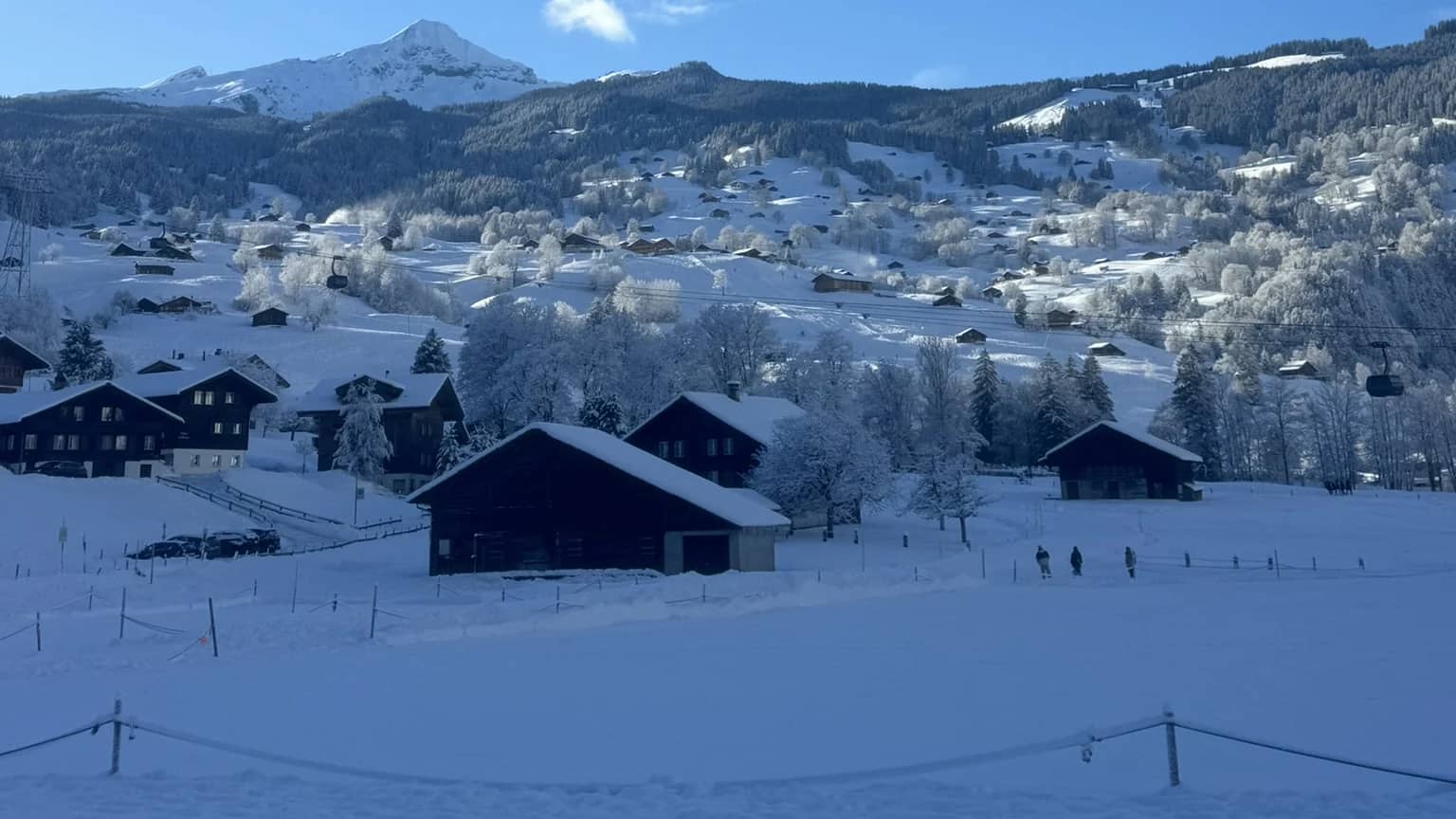
Interlaken or Grindelwald in winter? Grindelwald station gets 0 minutes of direct sun from 12 to 31 December. Where a local guide would sleep.
interlaken-or-grindelwaldwhere-to-stay-interlakengrindelwald-in-winter
By Pierre VetschRead More
Interlaken
9/24/2026
10 min
Red Deer Rut Near Interlaken: Where to Hear It
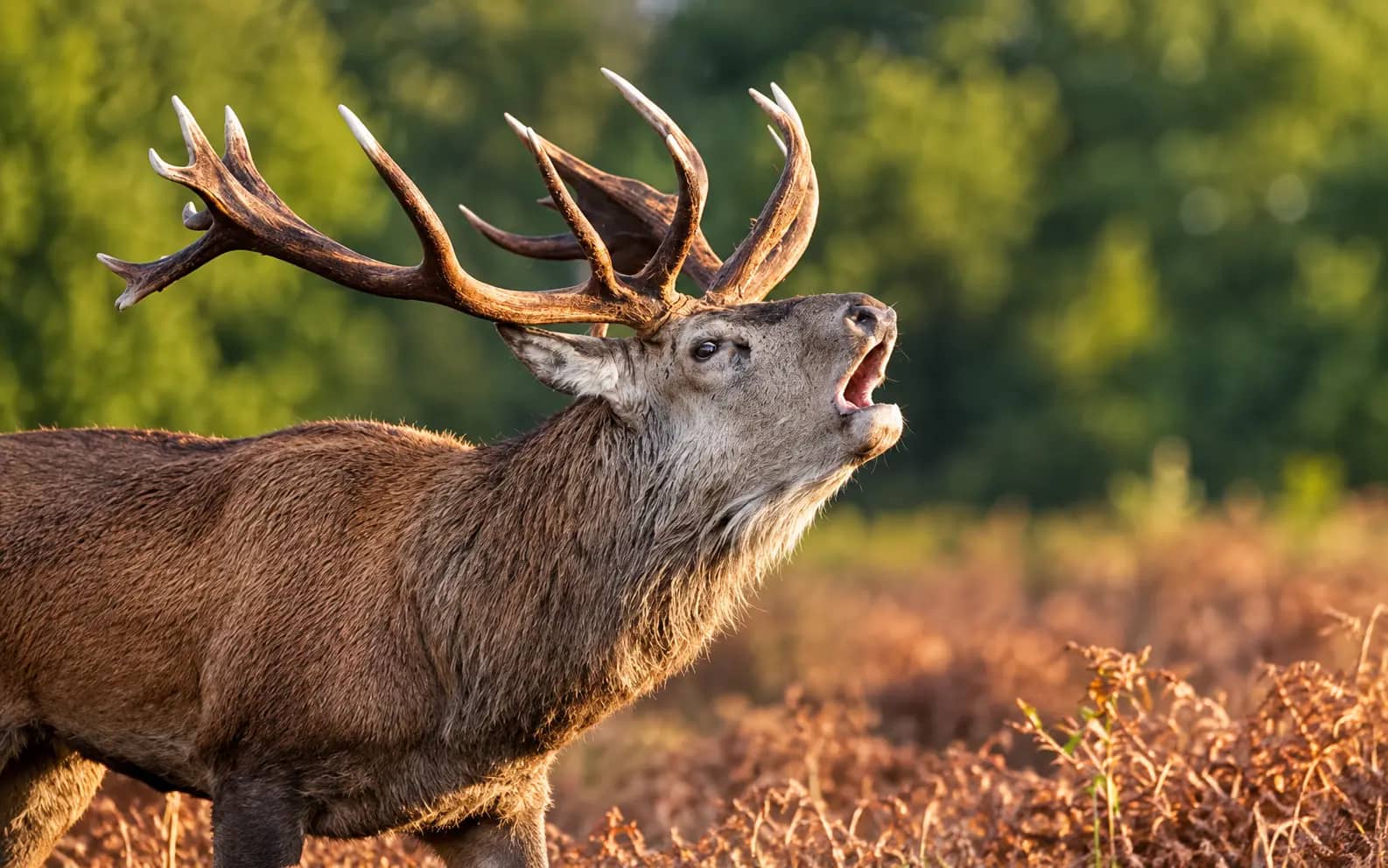
Every September, stags roar in the Justistal, 35 minutes from Interlaken, where hunting is banned. When to go, what you will see, and the rules.
red-deer-rutwildlife-watching-switzerlandautumn-in-interlaken
By Pierre VetschRead More
Interlaken
9/24/2026
10 min
Interlaken in Winter: Worth It, If You Go Up
On 12 January 2027, 6 mountain lines run near Interlaken and 3 are shut. Where a local guide goes when the town sits in fog, and why March beats December.
interlaken-in-winterwinter-without-skiingjungfrau-region-winter
By Pierre VetschRead More