Lakes, Water & Air
Winter Kayaking in Interlaken: Cold, Mist and Timing
O
Olivia Lufman
Author
March 13, 2026
11 min
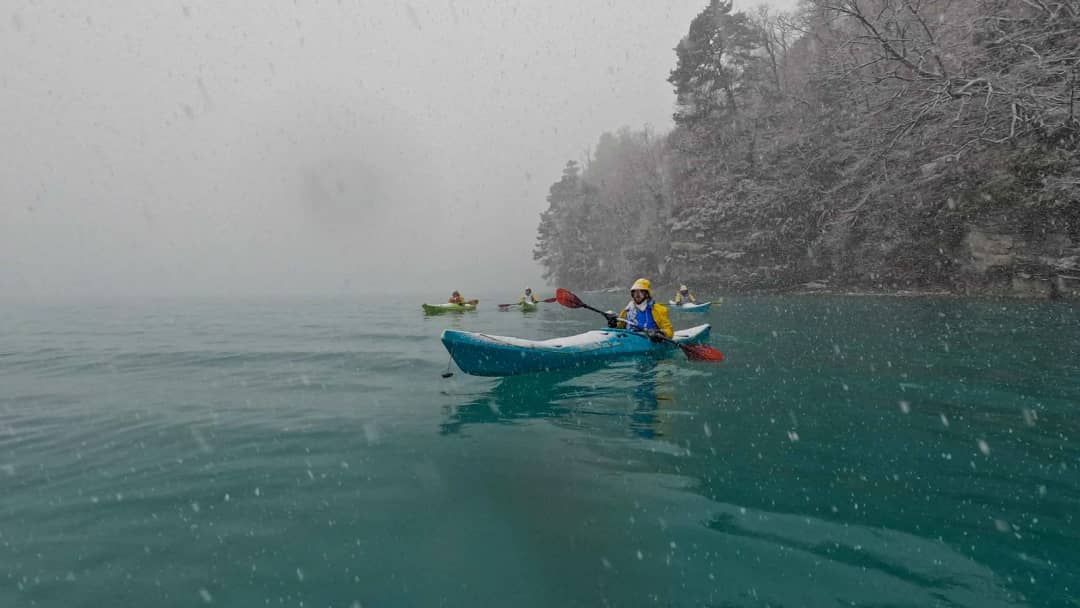
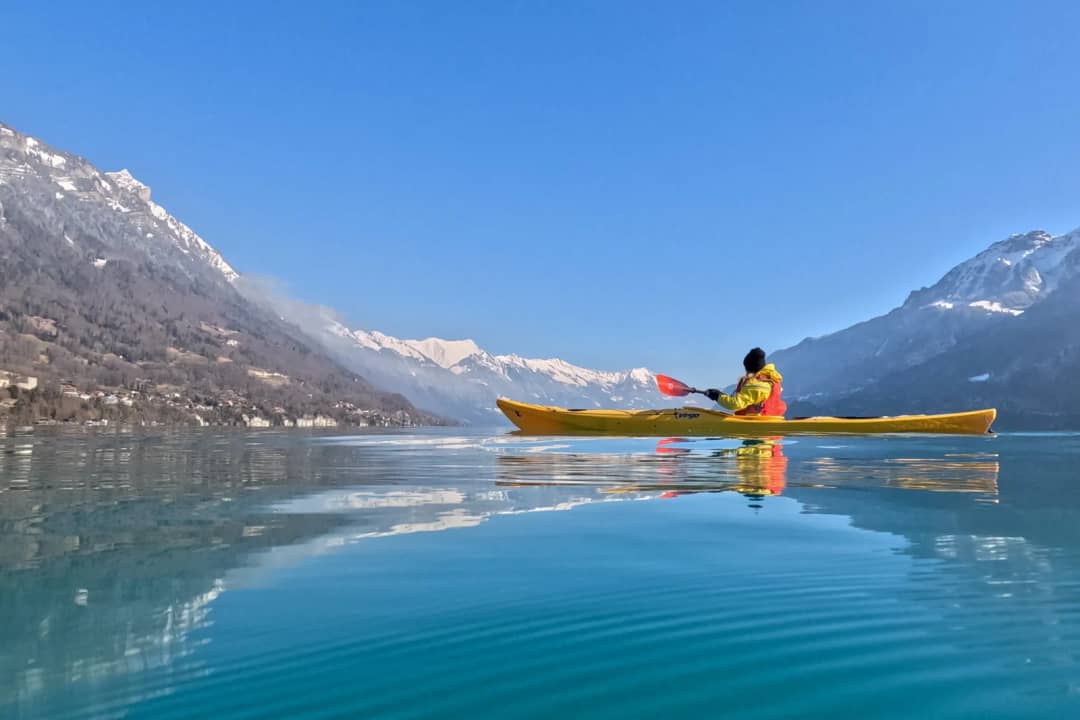
Winter kayaking in Interlaken means two hours on Lake Brienz in a sealed drysuit, on water that averages 5.4 °C in February. Pierre Vetsch has paddled it in January or February, on both morning and afternoon departures. The landscape, he says, makes you think of Alaska.
The tour runs from 1 November to 30 April from Bönigen, five minutes from Interlaken Ost by bus, and costs CHF 139 for an adult. What follows is what the booking pages leave out: how cold it really gets, what goes under the suit, which departure to pick, and who should spend the money on something else.
Can you go kayaking in Interlaken in winter?
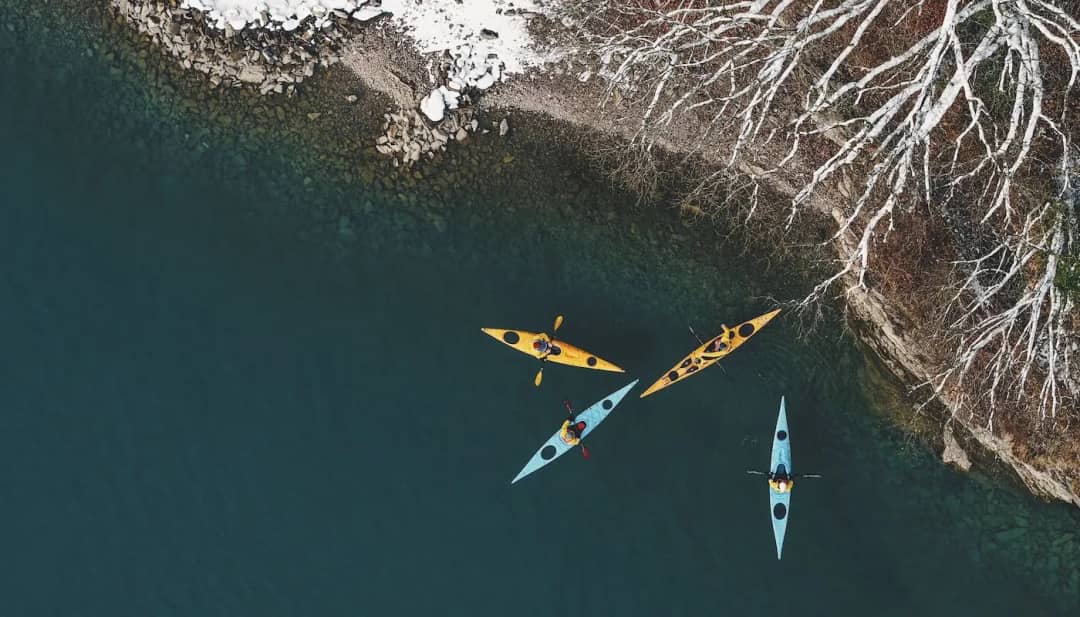
Yes. Hightide Kayak School runs a guided winter tour on Lake Brienz from 1 November to 30 April, with morning departures at 9:15, 9:20 and 9:45 and afternoon departures at 13:15, 13:20 and 13:45. You spend about two of the three hours on the water, in a group of six at most.
The base sits at Am Quai 1 in Bönigen, beside the lake. No kayaking experience is needed, and the operator says non-swimmers can come too. The boats are stable touring kayaks, not the sit-on-tops of summer, and the drysuit changes everything about the cold.
What surprises people is the mood of the lake. In summer it carries ferries, swimmers and rental pedalos. In January you share it with almost no one.
Pierre says: "Magnificent, a bit of mist, a dry cold. It makes you think of the landscapes of Alaska. You don't want to fall in the water. It's super calm."
Pierre Vetsch, founder and head guide at Swiss Local Adventures
If you want the summer version of the same shore, with its rules and swimming stops, our guide to kayaking on Lake Brienz in summer covers it.
How cold is winter kayaking on Lake Brienz?
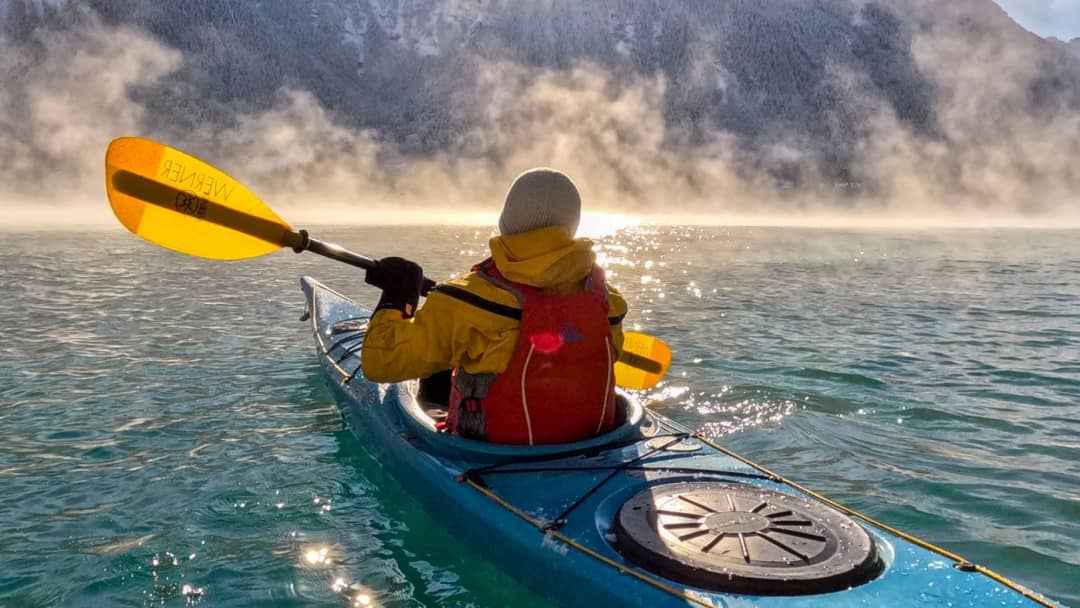
Colder in the air than in the water, and warmer inside the suit than either. The Aare leaving Lake Brienz averaged 5.7 °C in January and 5.4 °C in February over 1980 to 2024, according to the federal gauge at Ringgenberg. Morning air in Interlaken averaged -1.2 °C in January 2026.
That means the lake is often warmer than the air above it on a January morning. You still don't want to swim in it. Pierre's line, "you don't want to fall in the water", is the honest summary of 5 °C.
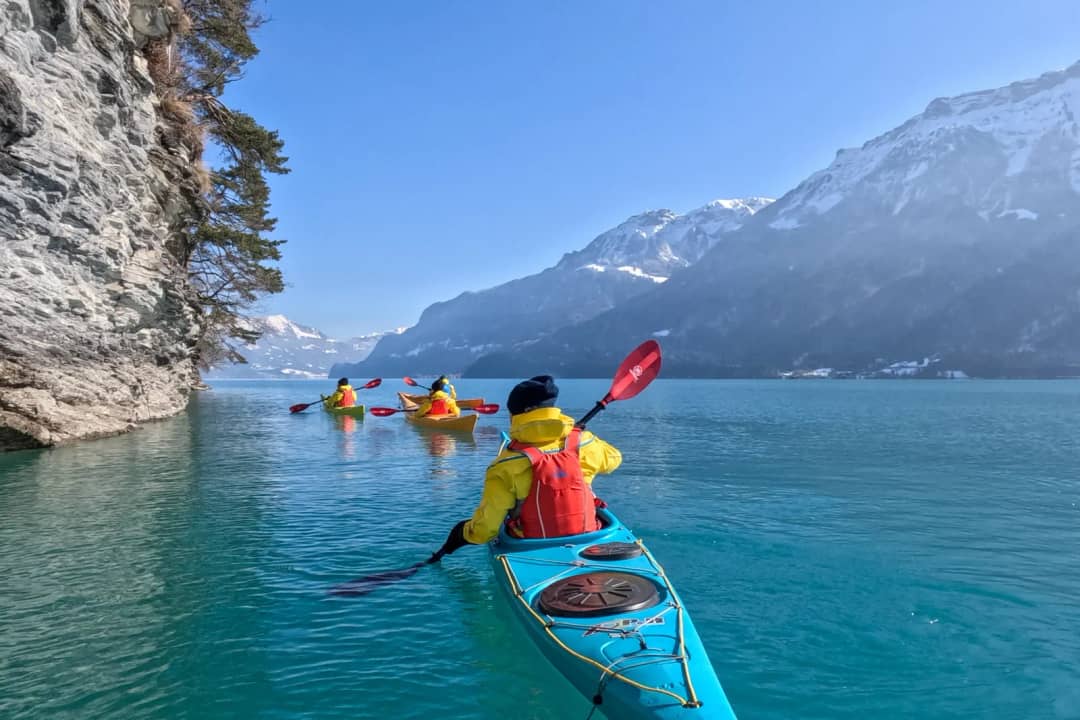
The kit is built for it. Hightide hands out Palm Bora drysuits with latex seals at the wrists and neck and integrated watertight socks, plus neoprene boots, thick socks and paddle mitts, which paddlers call poggies. Your own body heat stays trapped inside the suit.
Pierre felt the cold in one place only: his feet. The operator says its neoprene boots are big enough for several pairs of socks, so use that room.
Insider tip: Put on two pairs of thin wool socks before you leave your hotel and accept the thick pair at the base on top. Cold feet are what Pierre noticed most on the water, and the boots have the space.
A guest in December 2017 wrote on Tripadvisor that the tour ran on a very snowy day and they were never cold. That matches the drysuit's purpose: it's built to keep the weather out.
What do you wear under the drysuit?
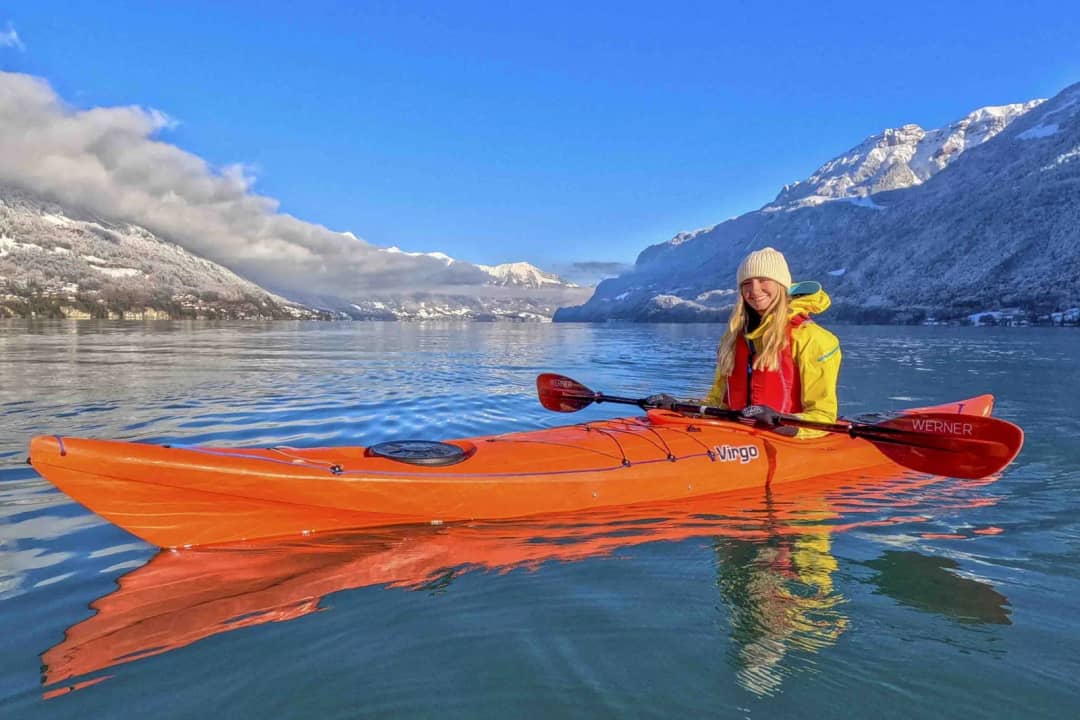
Thin, warm layers that stretch: thermal leggings or light sportswear and a long-sleeved top, merino or fleece. Hightide says you won't need a jacket or anything bulky, because the drysuit is the outer shell. Bring a warm hat, gloves for the break, sunglasses and a full change of clothes.
Skip the jeans. One Tripadvisor reviewer wore jeans and several sweaters under the suit and stayed warm, but the operator's list asks for sportswear and nothing bulky, and two hours of paddling is easier in clothes that stretch.
The same logic runs through our guide to dressing for sledding: staying dry matters more than wearing thick layers. A thin dry layer under a sealed shell beats a thick damp one.
Leave the phone in the locker. Lake Brienz drops to 260 metres and, as the operator puts it, a phone that slips in stays on the bottom. Your guide takes photos and videos and sends them for free after the tour.
Morning or afternoon tour: which is better in winter?
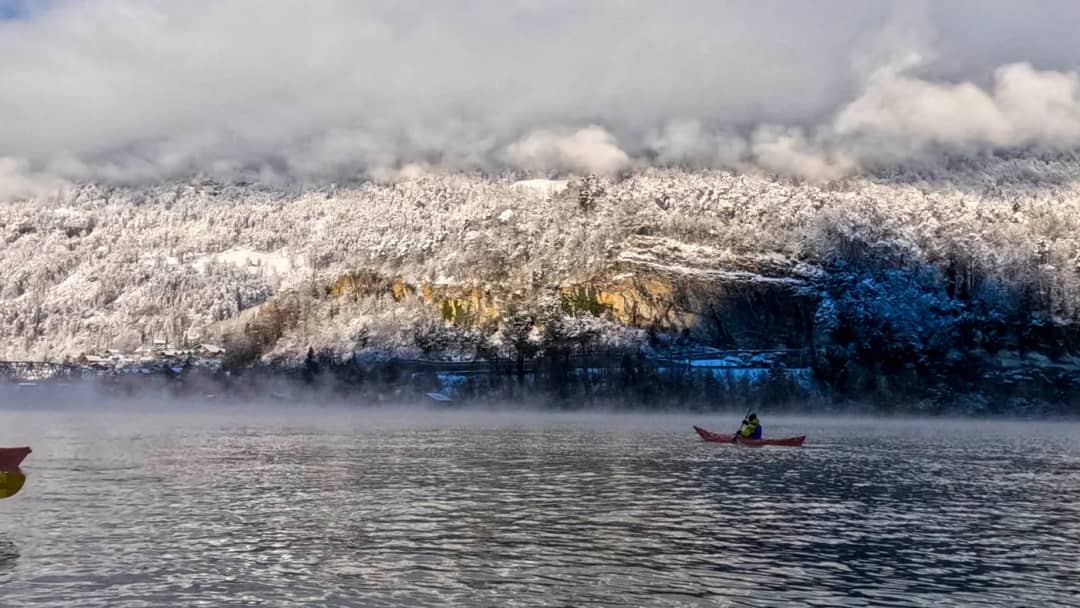
The numbers favour the afternoon, and Pierre still picks the morning. In January 2026, Interlaken averaged -1.2 °C between 9:00 and 12:00 and 2.4 °C between 13:00 and 16:00. The sun shone 5 minutes per hour in the morning window and 35 minutes in the afternoon one, according to MeteoSwiss.
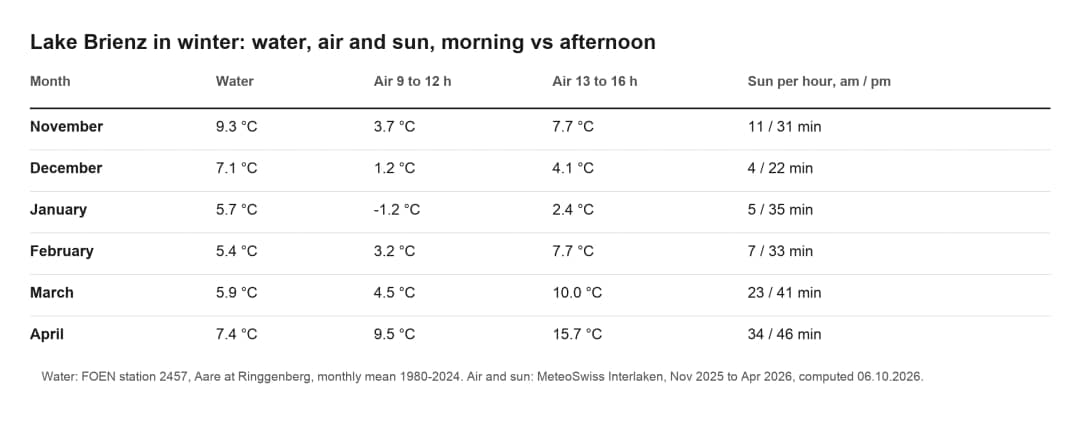
The table in words, from MeteoSwiss readings for the Interlaken station between November 2025 and April 2026, and the federal water gauge averages for 1980 to 2024. In November the water averaged 9.3 °C, the morning air 3.7 °C and the afternoon air 7.7 °C, with 11 minutes of sun per hour in the morning and 31 in the afternoon.
December: water 7.1 °C, air 1.2 °C in the morning and 4.1 °C in the afternoon, sun 4 and 22 minutes per hour. January: water 5.7 °C, air -1.2 °C and 2.4 °C, sun 5 and 35 minutes. February: water 5.4 °C, air 3.2 °C and 7.7 °C, sun 7 and 33 minutes.
March: water 5.9 °C, air 4.5 °C and 10.0 °C, sun 23 and 41 minutes. April: water 7.4 °C, air 9.5 °C and 15.7 °C, sun 34 and 46 minutes. From December to February, the valley floor barely sees the sun before noon.
That shade is also what makes the morning. Pierre paddled both slots, found the mist in the morning, and gives it the edge.
Pierre says: "Morning. Mist on the lake, calmer. But colder."
Verdict: take the 9:15 departure from December to February if you want the mist and the glassy water, and you are fine with sub-zero air. Take the 13:15 departure if you feel the cold easily, or if you want sunlight on the snow for your photos. From March, the afternoon wins on comfort and the morning loses its fog.
What do you see on the two hours?
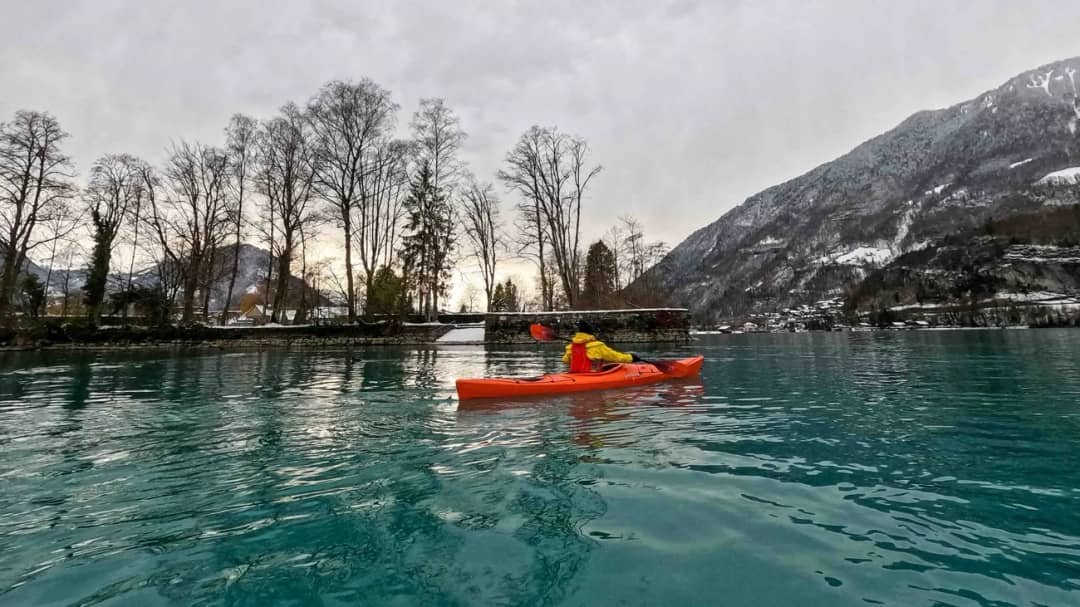
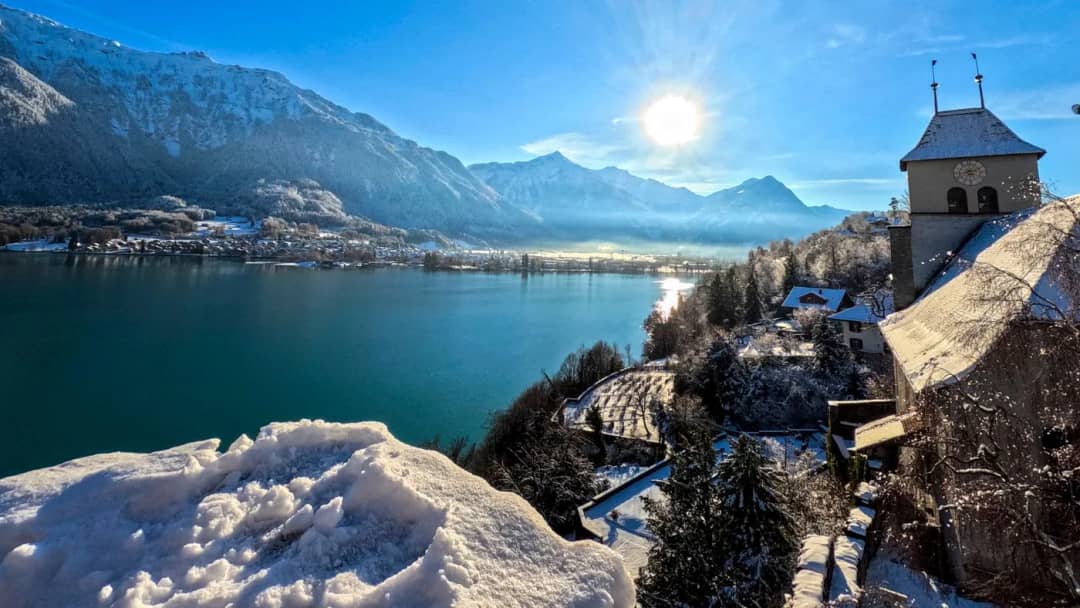
The shoreline east of Interlaken, from water level. Hightide's route runs along the shore from Bönigen, past the mouth of the Lütschine, across the outflow of the Aare and along sunbaked cliffs, with Ringgenberg's castle and church in view. The tour, Pierre says, goes to see the church at Ringgenberg.
It is worth knowing what you are looking at. The white church on the rock spur is not beside the castle ruin. It is inside it.
Fun fact: Bern built Ringgenberg's parish church in 1670 and 1671 inside the courtyard of the abandoned castle, to plans by the architect Abraham Dünz I. The builders cleared every dwelling in the courtyard and kept the ring walls, so the church stands on medieval defences. The full story is in our guide to Ringgenberg Castle Church, built inside a ruin.
Expect stops rather than distance. The operator describes a relaxed pace with frequent breaks for views, photos and rest. Reviewers from past winters on Tripadvisor mention a stop ashore with hot tea and biscuits. That is the moment the gloves on the packing list are for.
If you have time after the tour, Bönigen's old wooden houses are a short walk from the base. Our Bönigen historic house trail takes about an hour and costs nothing.
Winter kayaking or paragliding in Interlaken?
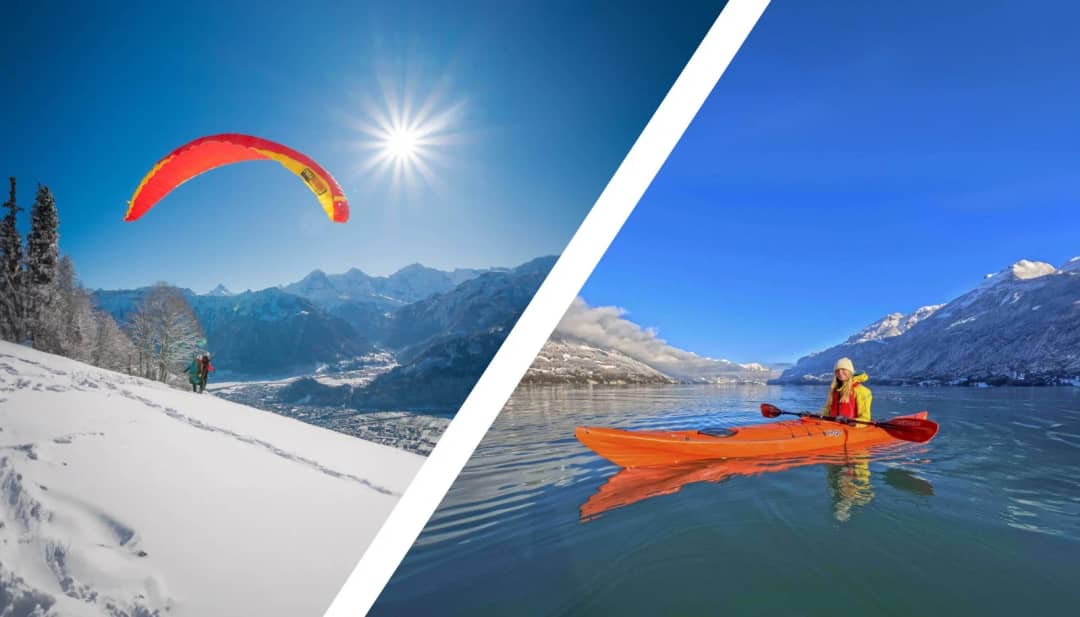
Both run in winter, and they answer different wishes. A winter tandem flight with the operator Hightide pairs with lasts 10 to 20 minutes in the air, within a 75-minute outing, from November to March. The kayak gives you two hours on the water. Pierre has done both in winter and tells clients to take the kayak.
His reasons are length and weather. The kayak tour runs in most conditions, including rain and snow. The operator only stops for thunderstorms or very strong wind. A paraglider needs flying conditions. Pierre does not run paragliding down, though.
Pierre says: "Paragliding is very good in winter too. But it's cold, and the air up there is fresh."
What tips it for him is what the lake gives back for the time you spend on it.
Pierre says: "Winter kayaking: escape the crowd. Calm, mist. It's magic."
Verdict: if you only have budget for one, take the kayak for the time it gives you and the lower risk of a weather cancellation. If you want both, Hightide sells a winter Paddle and Fly package at CHF 285, which it says is CHF 44 less than booking the two separately. For the full winter line-up, see our winter activities in Interlaken, ranked by a guide.
Who should skip winter kayaking?
Two kinds of visitor, according to Pierre: people who want adrenaline, and people who cannot sit for two hours. Hightide calls it a relaxed scenic tour, not a fitness session, so the effort is low. The sitting is what tires you, with your legs out in front and no way to stand up.
There are hard limits too. The minimum age is 12, and under-18s need a parent's or guardian's consent. Paddlers must weigh no more than 120 kg and stand no taller than 190 cm, because of the drysuit and kayak sizes.
The bigger mistake runs the other way, Pierre says. Visitors cross the kayak off their list because it is winter, and book something on land. The lake does not need snow to run. A Tripadvisor reviewer who came in late November found snowshoeing not yet open and called the winter kayak a highlight of the trip.
Winter in the valley is not only snow, either. Our honest take on whether Interlaken is worth visiting in winter explains why the best days start by going up.
Your Questions About Winter Kayaking in Interlaken
These are the questions people type before they book, and the answers come from the operator's pages, federal measurements and Pierre's time on the water.
Does Lake Brienz freeze in winter?
No. The Hightide guide who took Pierre out explained it on the water: it is not cold enough for long enough for the lake to freeze. Lake Brienz is also deep, reaching 260 metres, so there is a great deal of water to cool. At the outflow in Ringgenberg, the federal gauge gives a long-term February average of 5.4 °C, the coldest month of the year and still well above zero. That open water is why the tour can run from November to April. If you are deciding between Lake Brienz and a lake that does freeze, our winter day trips from Interlaken compares the options.
What happens if it rains or snows on the day?
The tour usually goes ahead. Hightide runs in most weather, including rain and snow, and its drysuits come with a storm hood. The operator argues that snowflakes falling on still water make the trip more special, and the Tripadvisor review from a snowy December day backs that up. What stops a tour is a thunderstorm or very strong wind. If the operator cancels, you get a full refund or a new date. If you cancel yourself, the policy shown on our tour page is free cancellation up to 96 hours before. A grey forecast on its own is not a reason to cancel.
Can beginners and non-swimmers do the winter tour?
Yes. The operator says no prior experience is needed and that the tour suits both beginners and non-swimmers. You get instructions on land before you launch, and the guide stays with the group the whole time. You wear a buoyancy aid over the drysuit, and the operator describes its kayaks as very stable and easy to paddle. What a beginner should think about is the sitting rather than the paddling. Two hours with your legs stretched out is longer than it sounds, which is why Pierre steers people who cannot sit still that long towards other activities. Groups are capped at six, so the guide has time for each paddler.
How do you get to the base in Bönigen?
By bus 103 from Interlaken Ost, direction Iseltwald, to the stop Bönigen, See, opposite the tourist office. On 14 January 2027, the timetable shows departures at 9:05 and 13:05 that arrive at 9:10 and 13:10, timed for the 9:15 and 13:15 tours. Do not take the express EXP103, which also leaves at :35 and skips Bönigen. You can also walk from Interlaken Ost along the lake path past the campsite and across the Lütschine. Drivers park on Parkstrasse, because the hotel car park is for hotel guests. These times come from the January 2027 timetable as published on 6 October 2026, so check them again in the SBB app before you go.
Is winter kayaking on Lake Brienz worth CHF 139?
Yes, if you want calm more than thrills. For CHF 139 (CHF 119 for 12 to 15 year olds) you get three hours, two of them on an empty lake, a drysuit that keeps the cold out, and photos you don't have to take yourself. Hightide's winter tour holds a 5.0 rating from 429 reviews on Tripadvisor.
The only real objection is the cold. The water averages around 5 °C, but you sit above it in a sealed suit, and the feet are the one place Pierre felt it. Wear two pairs of thin socks, pick the morning for mist or the afternoon for sun, and leave the phone on land.
If that sounds like your kind of winter day, book a seat on the winter kayak tour on Lake Brienz, six people at most, from 1 November.
How we made this: based on Pierre's interview of 6 October 2026, facts and prices checked at the official sources on 6 October 2026, written with AI assistance.
Source: Hightide Kayak School, Federal Office for the Environment, station 2457 and MeteoSwiss open data, all checked on 6 October 2026.
*Written by Olivia Lufman, your travel writer at Swiss Local Adventures
Tags
#winter-kayaking-interlaken#kayak-lake-brienz#winter-activities-interlaken#drysuit-kayaking
Sources & References
- •Hightide Kayak School, Winter Kayak Tour in Interlaken (read on 6 October 2026)
- •Hightide Kayak School, Paddle & Fly package (read on 6 October 2026)
- •Federal Office for the Environment (FOEN), station 2457 Aare Ringgenberg, water temperature 1980-2024
- •MeteoSwiss open data, Interlaken station, hourly air temperature and sunshine, Nov 2025 to Apr 2026
- •SBB timetable via timetable.search.ch, bus 103 Interlaken Ost to Bönigen See, 14 January 2027
- •Tripadvisor, Hightide Kayak School reviews, Winter Kayak Tour rated 5.0 from 429 reviews (6 October 2026)
- •Swiss Local Adventures, Ringgenberg Castle Church: Built Inside a Ruin
- •Photos: Hightide Kayak School
Share this article
Similar Articles
Continue your reading with these related articles
Lakes, Water & Air
9/12/2026
12 min
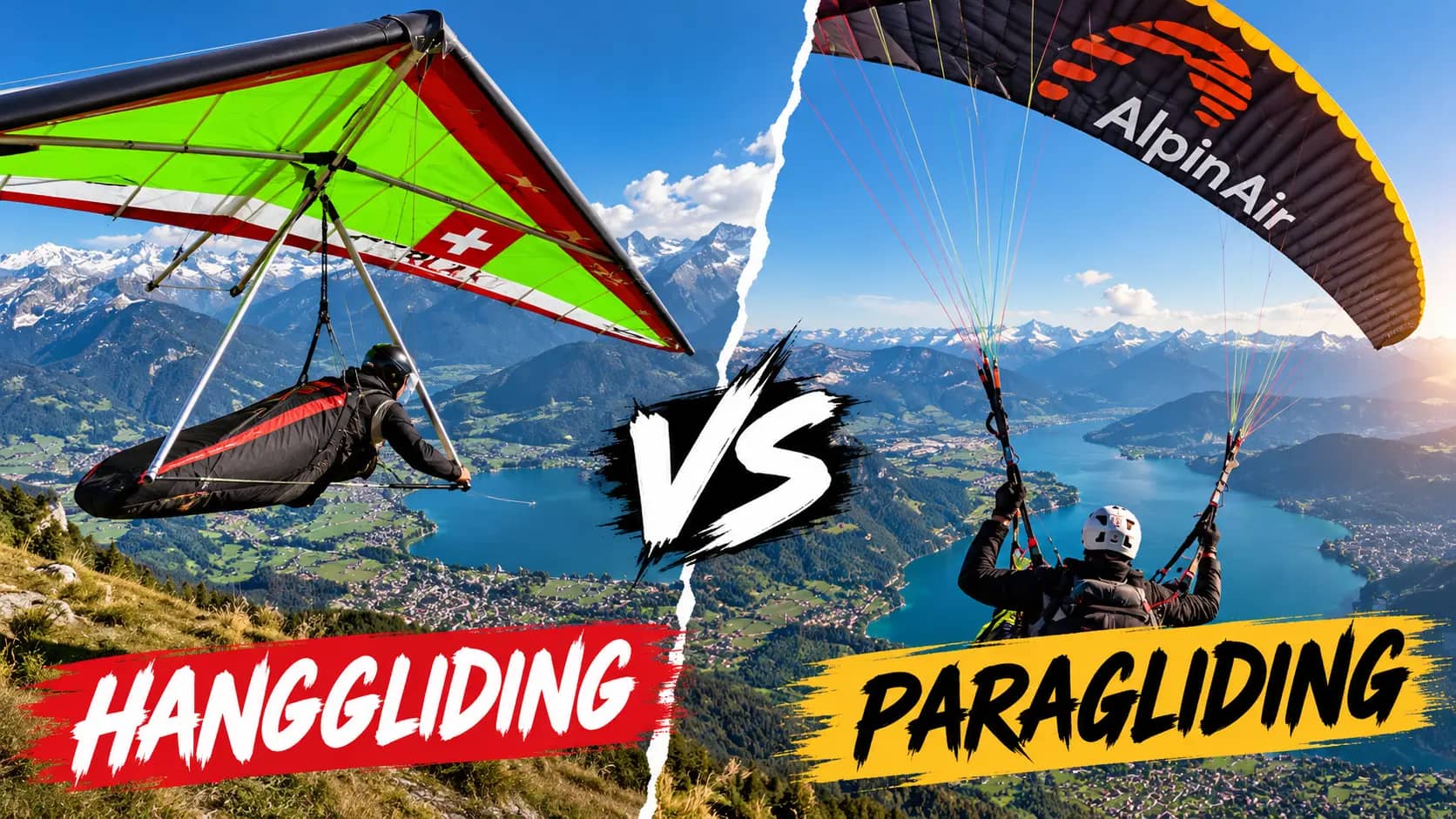
Hang Gliding or Paragliding in Interlaken?
Compare hang gliding and paragliding in Interlaken: same hill, same 10 to 20 minutes, CHF 180 to 199 against CHF 260. What the extra 61 to 80 francs buy.
tandem-hang-glidingtandem-paraglidingadventure-sports
By Timoté BailyRead More
Lakes, Water & Air
9/6/2026
13 min
Iseltwald Crash Landing on You Pier: What CHF 5 Buys
See what the CHF 5 turnstile at the Iseltwald pier actually buys you, how to get there by bus or boat, and when the Crash Landing on You crowds thin out.
korean-drama-locationsfilming-locations-switzerlandlake-brienz-villages
By Olivia LufmanRead More
Lakes, Water & Air
9/5/2026
14 min
Giessbach Falls Legend: 14 Heroes, No Nymph
Meet the 14 Bernese heroes the Giessbach falls have been named after since 1830, and learn why the popular nymph legend has no source behind it.
swiss-legendsswiss-folklorebernese-history
By Olivia LufmanRead More