Interlaken
Ringgenberg Castle Church: Built Inside a Ruin
O
Olivia Lufman
Author
September 8, 2026
15 min
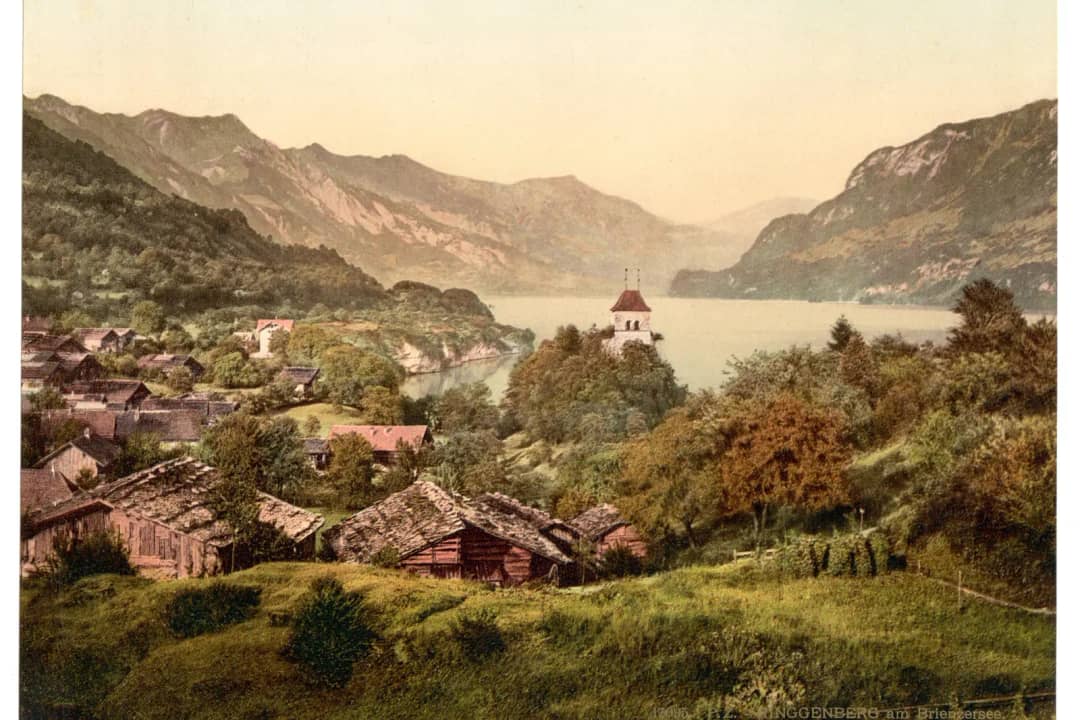
Sail out of Interlaken toward Brienz and about 26 minutes in, a rock spur pushes into the lake on the left with a stone tower on one end and a white church on the other. The two buildings share the same walls. They should not.
The tower belonged to the Freiherren von Ringgenberg, imperial bailiffs who ruled from Meiringen to the Bödeli and counted as high nobility of the Empire. One of them wrote love poetry that survives in the Codex Manesse. In 1381 their subjects rose against them, Bern took the territory, and the castle was put out of use for good.
Then, 289 years later, the same city that had ended the family built a parish church in the courtyard, tore down every living quarter to make room, and kept the tower standing beside it.
Almost nothing of that story exists in English. The detail sits in a canton of Bern archaeology flyer and in the parish's own records, both in German. Here is what happened on this rock, and how to see it for nothing.
Why is there a church inside Ringgenberg castle?
Because the old parish church stood in the wrong place. Until 1671 everyone in the parish walked up the hill to St. Peter at Goldswil, an eleventh century church on a steep spur. In 1670 and 1671 Bern built a new church inside the abandoned castle courtyard instead, to plans by the architect Abraham Dünz I, and moved the services down.
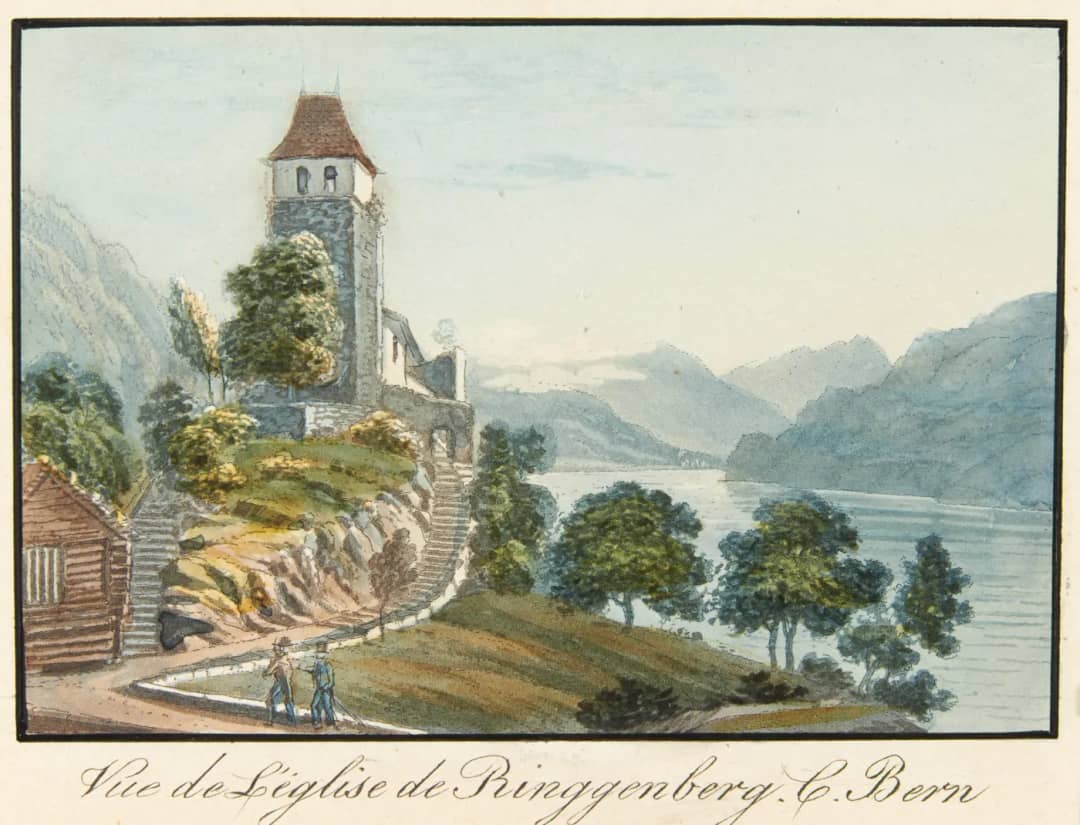
The castle had been standing empty for nearly three centuries. Its ring walls were sound, its rock was prominent, and the village had grown along the shore below it rather than around the old hilltop.
So Bern used the ruin as a foundation. The builders demolished every dwelling and service building in the courtyard, kept the ring walls, and turned the southwest defensive tower into the front tower that carries the church entrance.
The move happened in stages, which is why sources disagree about the date. Services moved in 1671. The cemetery followed from Goldswil in 1695. The minister only moved house in 1729. Some tourism pages therefore say the church moved in the 18th century, and the canton's chronology says 1671, and both are describing the same slow handover.
For the church they left behind, its Lombard bell tower and the walk up to it, that story has its own guide to the Goldswil church ruin.
Who were the lords of Ringgenberg?
Imperial bailiffs and a poet. The Vögte von Brienz administered a district reaching from the Valais to Uri, and around 1240 Freiherr Cuno von Brienz moved the family seat to a rock at Rinchenwile, today's Ringgenberg. His descendants took their name from it and ruled from Meiringen to the Bödeli.
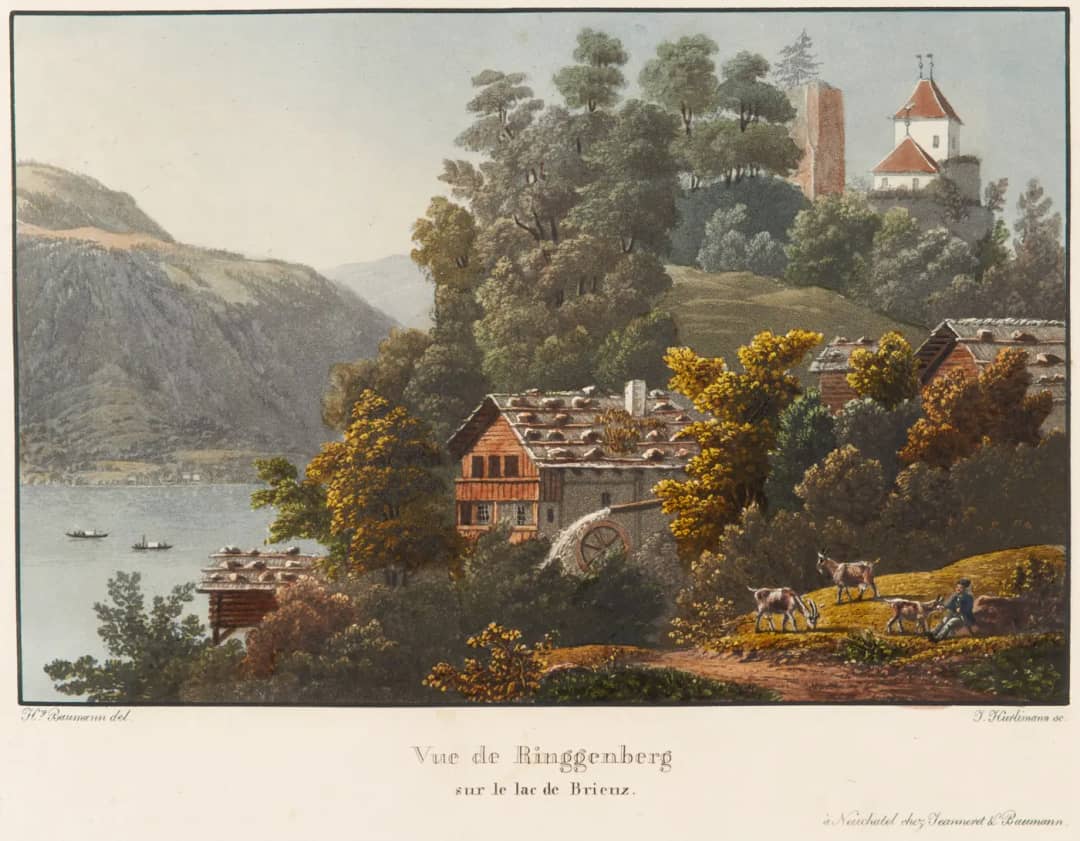
This was not local gentry. The family belonged to the high nobility of the Empire, and the rock they chose sits exactly where the Aare corridor meets the pass routes to northern Italy and central Switzerland. Choosing that spot was a political statement.
The most famous of them, Johannes von Ringgenberg, lived from about 1270 to 1350 and appears in the Codex Manesse as a successful minnesinger, painted in a tournament scene with his own arms. Seventeen of his stanzas survive in that manuscript, the single richest source of Middle High German song.
He was also a working politician. He was a follower of Emperor Henry VII and of King Ludwig the Bavarian, signed a castle rights treaty with Bern in 1308, and in 1327 and 1328 rode to Rome in Ludwig's train.
The family arms are what heralds call canting arms, a picture pun on the name: a ring and a mountain, Ring and Berg. You can still see them in a cartouche of 1911 inside the church.
What was the Ringgenberger Handel, and why did the castle burn?
A revolt that turned into a border war. In 1380 the Ringgenbergs' own subjects rose against them. Neighbouring Unterwalden intervened on territorial grounds. Bern objected, because it claimed the same ground. In 1381 the settlement known as the Ringgenberger Handel awarded the lordship to Bern and abolished the castle.
The castle was burnt and plundered in the fighting, and the last lord, Petermann von Ringgenberg, was taken away in chains. A confederate arbitration restored the lordship on paper, but the family had no money left to rebuild.
In 1386 Petermann left for Bern, and the line ended there as a territorial power. His grave slab, carrying the Ringgenberg arms and dated to about 1390 or 1391, survives in the French Church in Bern, which is the last physical trace of the family outside this rock.
One detail that keeps getting scrambled online: which canton's troops did it. Wikipedia's English article says Uri. The canton of Bern's archaeology service and the Historical Dictionary of Switzerland both say Unterwalden, today Obwalden, and note that Petermann was taken to Obwalden. The Swiss sources are the ones to trust here.
After 1381 the rock had one more military life. In the 16th century Bern reinforced the ring walls and used the site as a strongpoint, and only after that did it settle into being a ruin.
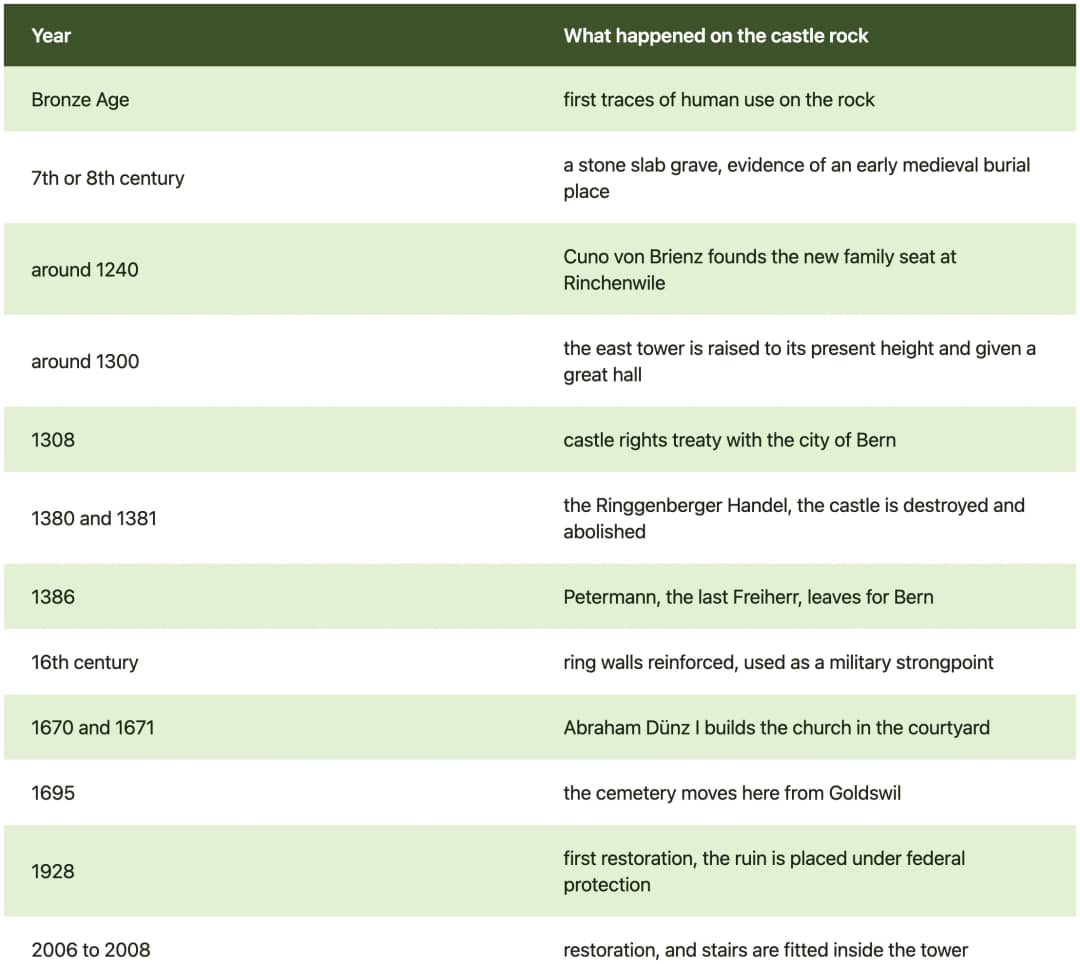
Chronology from the canton of Bern Archaeological Service flyer on the Burgruine Ringgenberg, 2017 edition, read on 26 August 2026.
What can you see on the castle rock today?
The east tower, a donjon standing 16 metres high, with stairs, a gallery and a viewing terrace open to the public since 2008. Below it, the ring walls, the courtyard now filled by the church, and a shield wall on the west side later thickened to 5.4 metres. Entry costs nothing.
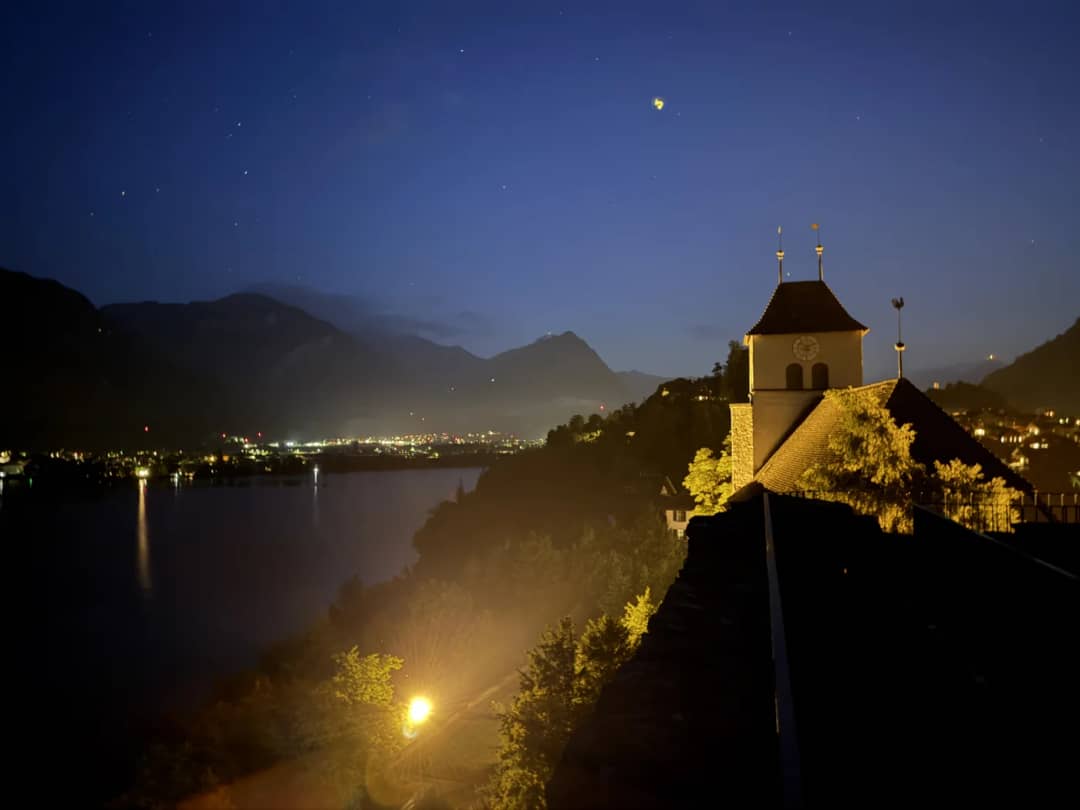
Start with the tower, because it is the oldest thing you can walk into. It was only 6 metres high when the castle was founded. Around 1300 the family raised it to its present height and fitted the top storey out as a great hall, with window seats, a raised podium running round the room and a high entrance reached by stairs and a gallery.
That hall is the reason the tower is worth the climb even without the view. It was built for feasting with a lake in the windows, which is an unusual thing to find inside a defensive tower.
"I have climbed the tower, and the view is not one to miss."
Olivia Lufman, travel writer at Swiss Local Adventures
The terrace sits at the top of the 16 metre tower, open to visitors since 2008 and free.
Now look at the south face of the tower from the courtyard. There are small cavities set into the wall. They are nesting boxes, read by archaeologists as breeding places for the decoy birds used in falconry. Courtly life on this rock left more evidence in the masonry than in the archives.
Travellers describe the climb in almost the same words every time: "sturdy metal stairs and railings to take you to the top" and "a breathtaking panorama of Lake Brienz and the surrounding mountains". The metal stairs are modern and replace the vanished original approach to the high entrance.
Two pictures are worth knowing about before you go, because they show you what you are standing in. Albrecht Kauw painted the ruin around 1660, before the church existed, and it is the oldest view we have. Gabriel Lory the elder painted it around 1828 with the church in place, from the west, exactly the angle most visitors photograph today.
Is the church itself worth going inside?
Yes, and it takes ten minutes. The interior is a Bernese sermon hall, rectangular, with large round arched windows under a hipped roof, built to the standard model of the Bernese state church where preaching and baptism sit at the centre. It holds decorative wall paintings, a carved pulpit and an organ of 1837.
The plainness is deliberate and it is the point. Set the sober reformed hall of 1671 against the courtly great hall in the tower above it, and you have two ways of using the same rock, two centuries apart, side by side. The canton calls the pair a contrasting and unmistakable ensemble.
What to look for once you are inside:
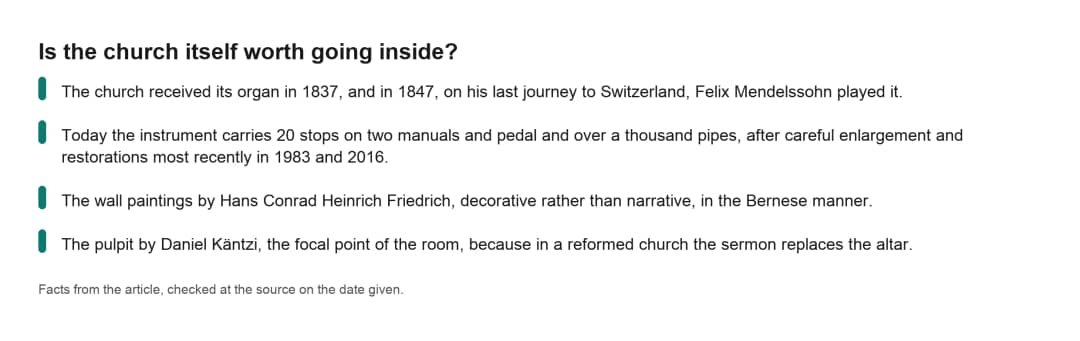
The wall paintings by Hans Conrad Heinrich Friedrich, decorative rather than narrative, in the Bernese manner.
The pulpit by Daniel Käntzi, the focal point of the room, because in a reformed church the sermon replaces the altar.
The cartouche of 1911 carrying the Ringgenberg canting arms, a ring and a mountain, put up 530 years after the family lost the rock.
The organ, which has a story worth more than the instrument.
Here is that story. The church received its organ in 1837, and in 1847, on his last journey to Switzerland, Felix Mendelssohn played it. He died that same year. Today the instrument carries 20 stops on two manuals and pedal and over a thousand pipes, after careful enlargement and restorations most recently in 1983 and 2016.
One honest caveat about the organ. The sources disagree about who built it. The parish names Johann Jakob Reusser of Unterseen. The main Bernese organ database names the Valais builders Anton Carlen father and son, gives the original instrument as 10 stops on one manual and pedal, and states that the original console and pipework no longer survive. Both agree on 1837 and on Mendelssohn in 1847. If a guide tells you the pipes Mendelssohn touched are still in the case, that is not established.
Services are held every Sunday, so time a sightseeing visit outside the service hour unless you intend to attend.
How do you get to Ringgenberg castle church, and what does it cost?
Free, and three minutes by train. Entry to the castle ruin, the tower terrace and the church costs nothing. The R70 train leaves Interlaken Ost at :33 past the hour and reaches Ringgenberg in three minutes, returning at :20. PostBus 102 covers the same trip in about ten minutes including the walk up.
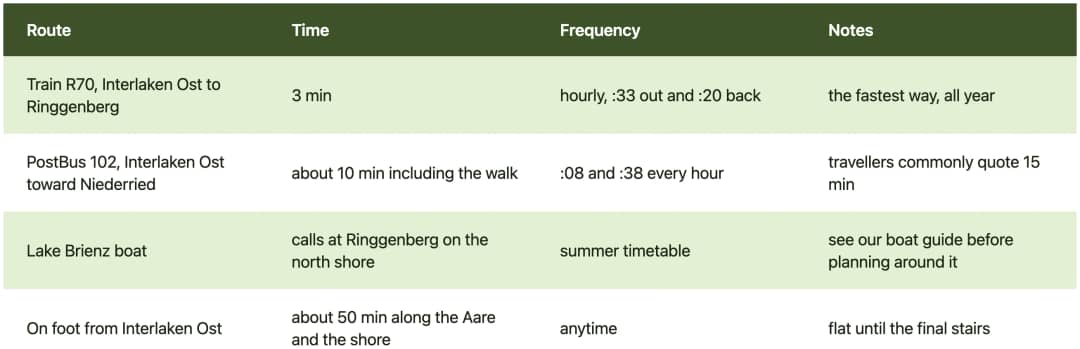
Train and bus times taken from the official Swiss public transport timetable, checked on 26 August 2026. For the boat, read our Interlaken to Brienz boat guide.
There is a car park below the castle rock in Ringgenberg, and stairs lead up from it. The parish is at Kirchgasse, 3852 Ringgenberg, telephone +41 33 822 20 53.
One warning from other visitors that is fair. "Small amount of signage in English at the site giving the history etc", which is why this article exists.
When is the castle church open, and what changes with the season?
Daily, all year, and longer in summer. The church and courtyard open in the morning and close at dusk: roughly 07.30 to 20.00 from May to September, and 07.30 to about 16.30 from October to April. The ruin, the courtyard and the view are outdoors and free, and the tower terrace is the part worth timing.
My advice is to come in the late afternoon. From May to September, Interlaken Tourismus lists the church and courtyard as open until 20.00.

What actually changes across the year:
May to September. Full opening to 20.00, which puts the tower terrace in evening light over Lake Brienz. The Sunday service is the only fixed interruption.
October to April. Closing around 16.30, so a winter visit is a daylight visit. The rock and the lake in low winter sun are the best photographic conditions of the year here.
Winter footing. The north staircase stays usable all year. The south staircase is limited in winter by snow and ice. Take the north approach between November and March.
Rain. The church interior and the tower stairs work fine in rain. The terrace does not, and the metal stairs turn slippery.
On the hours, know that two official sources give two different opening times. The Interlaken tourism board publishes 07.30 to 20.00 and 07.30 to 16.30. The Swiss church visiting register publishes 09.00 to 20.00 and 09.00 to 16.30. They agree on the closing times and differ on the morning by ninety minutes. If you are making an early trip specifically for the interior, telephone the parish first.
How much climbing does a visit involve?
Less than the photographs suggest, and there is a lift. Stairs run from the car park to the courtyard, and a lift provides barrier free access to the courtyard and the church during opening hours. The tower is a different matter: reaching the terrace means climbing modern metal staircases with railings inside the donjon.
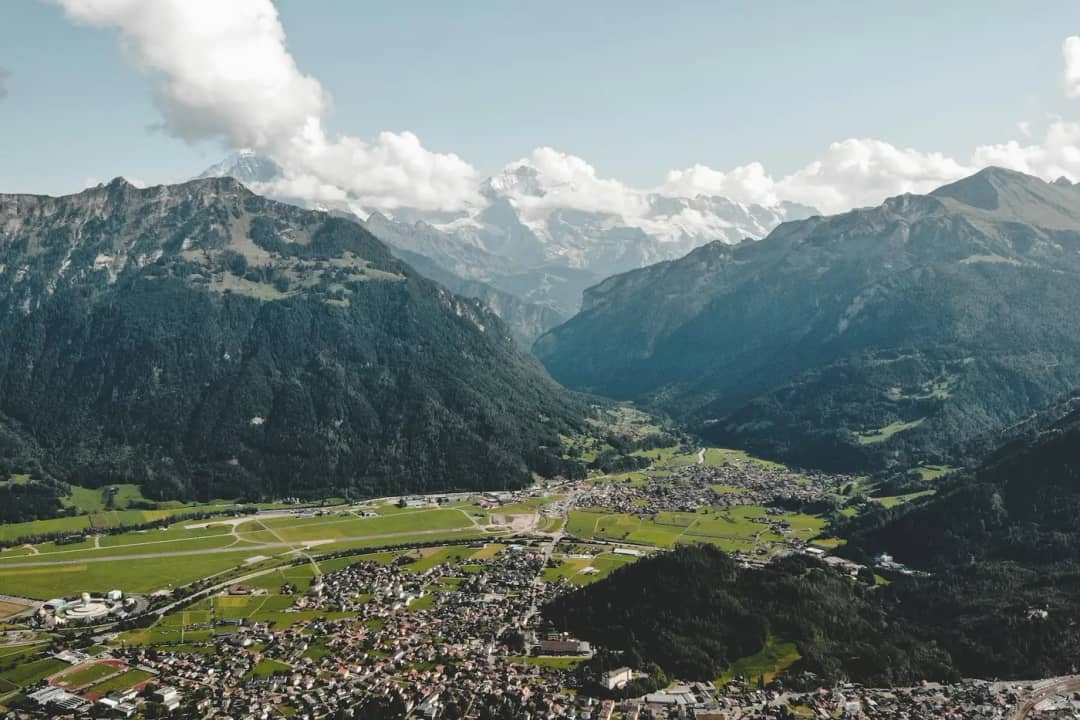
The honest breakdown:
Courtyard and church only. Stairs from the car park, or the lift. Manageable for anyone, including wheelchairs and pushchairs, during opening hours.
Tower and viewing terrace. Metal stairs and a gallery inside a 16 metre tower. Nothing technical, railings throughout, but it is a real staircase in an old building and there is no lift in the tower.
On foot from Interlaken Ost. About 50 minutes along the Aare and the lake shore, flat until the final stairs up the rock.
The loop to Goldswil. Add the 1.3 kilometre ridge path known as the Katzenpfad, which is a footpath with a steep section, and the round trip becomes a half day.
Anyone uneasy on open stairs should know the terrace is genuinely at the top of a tower on a rock spur. Visitors describe the railings as "sturdy", which they are, but the exposure is real and the platform is small.
Your questions about Ringgenberg castle church
Is Ringgenberg castle free to visit?
Yes. There is no admission charge for the castle ruin, the courtyard, the church interior or the tower viewing terrace. The site is maintained by the reformed parish of Ringgenberg together with the canton of Bern, which placed the ruin under federal protection in 1928 and restored it in 1928, 1946 to 1949 and 2006 to 2008. There is no ticket office, no shop and no guided tour on a timetable, so the only cost of the visit is getting there.
Can you go inside the tower at Ringgenberg?
Yes, since 2008. The restoration of 2006 to 2008 fitted stairs, a gallery and a viewing terrace inside the east tower, so you can climb from the courtyard to the top of a 16 metre donjon and look down the length of Lake Brienz. The staircases are modern metal with railings, replacing the vanished original approach to the tower's high entrance. On the way up you pass the level that once held the castle's great hall, built around 1300 with window seats and a raised podium.
How old is Ringgenberg castle?
The rock carried a fortified site far earlier, with traces of use in the Bronze Age and a stone slab grave from the 7th or 8th century. The castle you see was founded around 1240 by Cuno von Brienz, and rebuilt and heightened around 1300. Some sources date the first building to the 12th century in several stages, and the castle first appears in written record in 1240, which is where the divergence comes from. It stood for roughly 140 years before it was destroyed in 1381.
Who destroyed Ringgenberg castle?
The castle was burnt and abolished during the Ringgenberger Handel of 1380 and 1381, after the Ringgenbergs' subjects revolted and neighbouring Unterwalden intervened. Bern claimed the same territory, and the settlement awarded the lordship to Bern and put the castle permanently out of use. The last lord, Petermann von Ringgenberg, was taken away in chains and left for Bern in 1386. English Wikipedia attributes the raid to troops from Uri, while the canton of Bern and the Historical Dictionary of Switzerland both say Unterwalden.
Which Ringgenberg castle is this, the one near Interlaken or the one in Graubünden?
This one is in the canton of Bern, at 3852 Ringgenberg on the north shore of Lake Brienz, three minutes by train from Interlaken Ost. There is a second Ringgenberg castle ruin at Zignau in the Surselva, canton of Graubünden, and search engines mix the two constantly. If a page you are reading mentions the Vorderrhein, Disentis or Trun, you are looking at the wrong one. The Bernese Ringgenberg is the one with a baroque church built inside the courtyard.
Is Ringgenberg worth visiting from Interlaken?
For an hour, yes, and the value is unusually high because it is free and the train takes three minutes. You get a medieval high noble castle and a Protestant baroque church sharing one set of walls, a climbable tower, and a view over Lake Brienz that visitors call "breathtaking" while also calling the site "surprisingly not crowded". Combine it with the 1.3 kilometre ridge walk to the Goldswil church ruin and the Burgseeli, and you have a genuinely good half day that costs a local bus fare.
Two buildings, one rock, three centuries apart
I keep coming back to the arithmetic of this place. A family loses everything in 1381. The city that took their land builds a parish church in their courtyard in 1670. In 1911 somebody carves their coat of arms into the wall of that church, ring and mountain, 530 years after the last of them walked out.
Ruins usually tell you that something ended. This one tells you that people kept using the same rock and kept remembering who had been there first.
For more around the lake, see things to do in Interlaken and summer in Interlaken.
If you want a day around Lake Brienz that runs on stories rather than queues, message us on WhatsApp and we will build it around the hours you actually have.
Source: Burgruine Ringgenberg flyer, Archaeological Service of the Canton of Bern, Ringgenberg Castle Church, Interlaken Tourism, Burgkirche Ringgenberg, Kirchenvisite, the organ, Kirchgemeinde Ringgenberg, Ringgenberg, Historical Dictionary of Switzerland and the SBB timetable, all checked on 26 August 2026.
Written by Olivia Lufman, your travel writer at Swiss Local Adventures
Tags
#castle-church#castle-ruins#swiss-history#medieval-history#lake-brienz-day-trip#interlaken-day-trips
Sources & References
- •Archaeological Service of the Canton of Bern, Burgruine Ringgenberg flyer
- •Interlaken Tourism, Ringgenberg Castle Church
- •Kirchenvisite, Burgkirche Ringgenberg
- •Kirchgemeinde Ringgenberg, organ
- •Historical Dictionary of Switzerland, Ringgenberg
- •SBB, online timetable
- •Photo: Photochrom Print Collection on Wikimedia Commons
- •Photo: Patrick T'Kindt on Unsplash
- •Illustration: Jakob Samuel Weibel, Collection Gugelmann, Swiss National Library (public domain)
- •Illustration: Jean Henri Baumann and Johann Hürlimann, Collection Gugelmann, Swiss National Library (public domain)