Interlaken
Giessbach Falls Legend: 14 Heroes, No Nymph
O
Olivia Lufman
Author
September 5, 2026
14 min
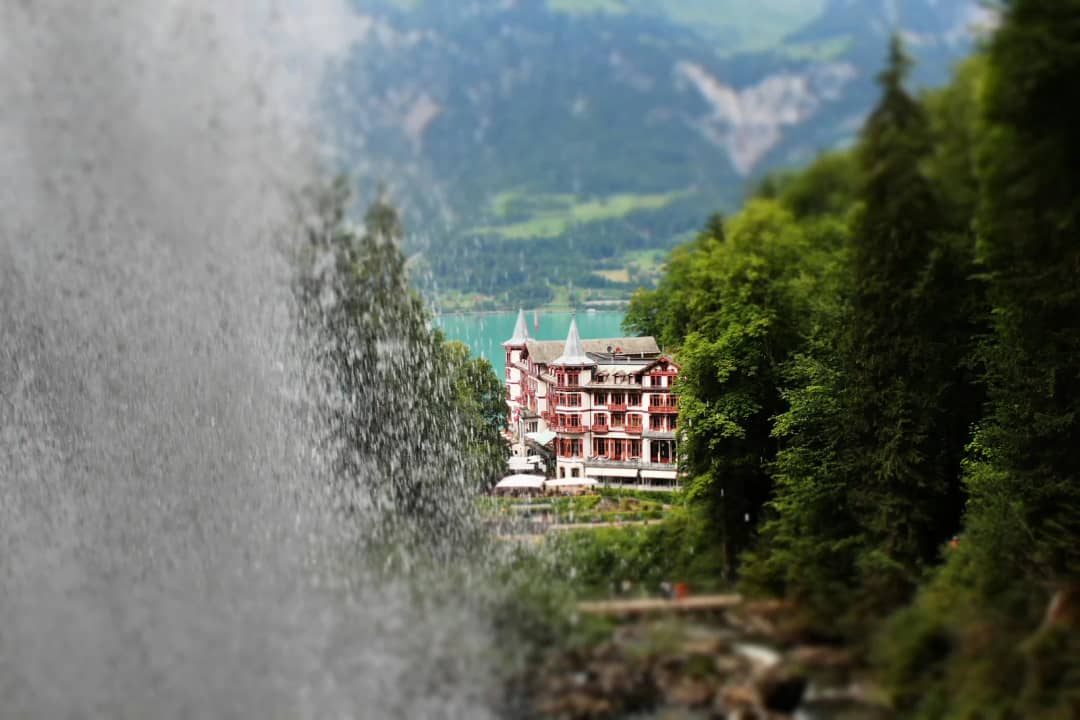
Search for the legend of the Giessbach and you will meet a nymph. She lives in the falls, her hair is as white as the spray, her eyes are as deep as Lake Brienz, and meeting her makes you forget you were ever born.
It is a lovely image. I have not been able to find a single folklore collection, parish record or nineteenth century traveller's account that contains her. She appears on tourism blogs, phrased as "Sagen erzählen von einer Nymphe", tales tell of a nymph, and the tales are never named.
The real story is stranger and it is written down. Between 1820 and 1830 a village pastor and a village schoolteacher climbed this waterfall, opened a path through it, and gave each of its fourteen steps the name of a dead Bernese soldier or statesman. Those names are still the official names. Almost nobody in the English speaking world has ever read them.
Here they are, in order, from the top of the mountain down to the lake.
Is there really a legend about the Giessbach Falls?
Not one that anyone can source. The nymph story circulating in English and German tourism writing has no named collection, no collector and no date behind it. What the Giessbach has instead is documented and much older in feel: fourteen cascades carrying the names of fourteen figures from Bernese history, given between 1820 and 1830 and never changed.
That distinction matters more than it sounds. Swiss alpine folklore is unusually well recorded. The Bernese Oberland has published collections of Sagen going back to the nineteenth century, full of dwarfs, wild men and cursed alps. When a story exists, you can normally find who wrote it down.
The nymph fails that test. She turns up in recent visitor writing, always in the same two sentences, always attributed to "tales". No collection, no informant, no village.
So I am going to do the ungenerous thing and say it plainly. The nymph is a modern piece of atmosphere, not a legend. It costs you nothing to enjoy the image while you stand in the spray. It costs the waterfall something to let it replace the real story, which is better.
Who named the fourteen Giessbach cascades?
Two men from Brienz, working in the 1820s. Johannes Kehrli, the village schoolteacher, cut a footpath from the lakeshore up to the second lowest fall and set a bench there. Daniel Wyss, the parish pastor, opened the way to the upper falls and gave all fourteen the names of what the record calls deserving Bernese heroes.
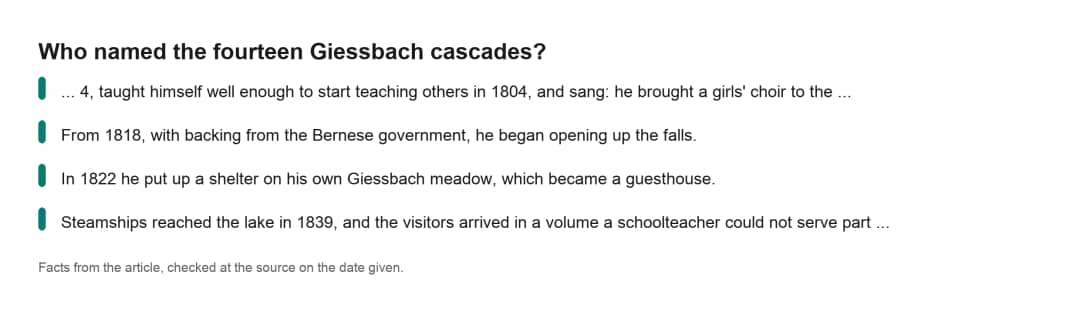
Kehrli is the one worth knowing. He was born in Brienz on 27 February 1774, taught himself well enough to start teaching others in 1804, and sang: he brought a girls' choir to the Unspunnenfest of 1805. From 1818, with backing from the Bernese government, he began opening up the falls. In 1822 he put up a shelter on his own Giessbach meadow, which became a guesthouse.
Then the numbers turned. Steamships reached the lake in 1839, and the visitors arrived in a volume a schoolteacher could not serve part time. Kehrli had already given up teaching in 1834 to run the business with his children. He died in Brienz on 13 July 1854, and his heirs sold the property the following year.
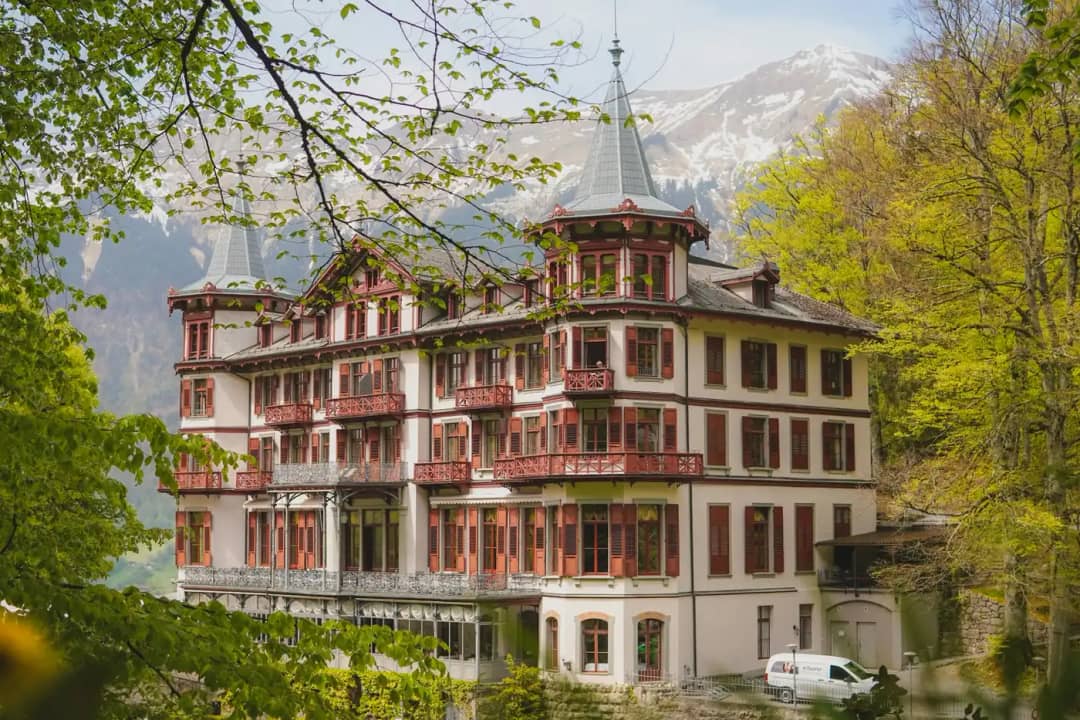
Everything that stands at the Giessbach today sits on top of that decision. The Grandhotel, the funicular, the boat pier and the paid car park all descend from one village teacher deciding that a waterfall was worth a path.
You can still eat on the terrace named after him. If you want the hotel and the 1879 funicular in detail, that is a separate visit and I have written it up in the Giessbach funicular guide.
Which Bernese heroes are the fourteen falls named after?
All fourteen, from the top of the cascade to the lake, are named after founders, magistrates and battle commanders of the old city state of Bern. The list runs from Berchtold von Zähringen, who founded Bern in 1191, down to Niklaus Friedrich von Steiger, the city's last Schultheiss, who died in 1799.
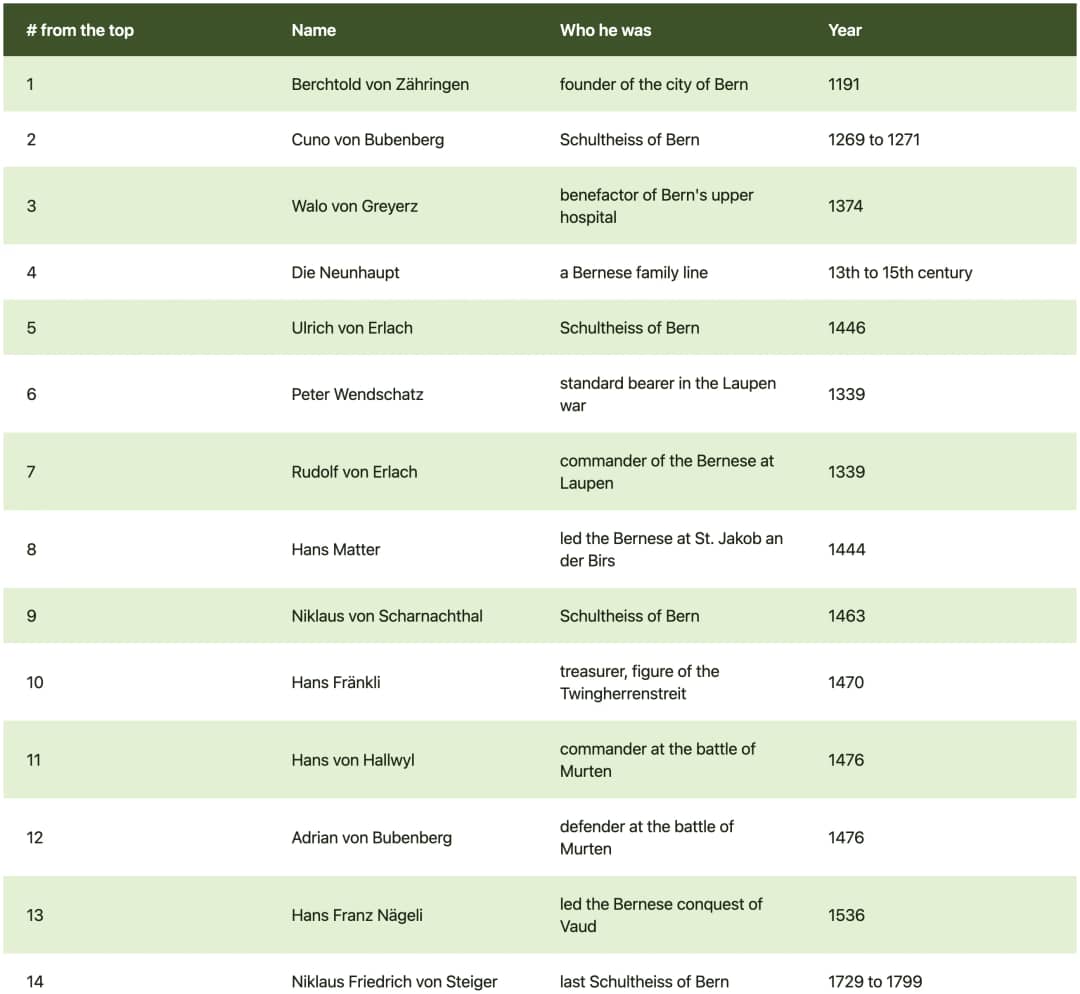
Names, roles and dates from the German Wikipedia article on the Giessbach stream, read on 25 August 2026. Order is top to bottom, as the article gives it.
Read the column of years and you will see what Wyss was doing. He was not decorating a waterfall. He was hanging six centuries of Bernese history on it in the right order, so that walking down beside the water took you forward in time, from the founding of the city in 1191 to the collapse of its old regime in 1798.
Two of the names would have made any Bernese schoolchild of 1825 sit up. Rudolf von Erlach led the outnumbered Bernese to victory at Laupen in 1339. Adrian von Bubenberg held Murten against Charles the Bold in 1476 and is still the closest thing Bern has to a national hero. Wyss put them in the middle of the list.
And the fourteenth is a quiet act of grief. Niklaus Friedrich von Steiger was the last Schultheiss of the old Bern, driven out when the French arrived in 1798. He died in exile. Naming the last cascade, the one that lands in the lake, after the last magistrate of the old republic is not a coincidence in the 1820s.
What does the name Giessbach actually mean?
It means, roughly, the pouring stream. Giessen is the German verb for to pour, and Bach is a stream, so the name describes the behaviour of the water rather than a place or a person. The stream is much older than the tourism: it rises in the high basins of the Sägistal and Faulhorn area and drains a catchment of 25.3 square kilometres.
The plain name is a clue about how this place was seen before 1818. It was not a sight. It was a stream that poured, in a canton with hundreds of them, on the wrong side of a lake with no road.
Two numbers are worth carrying with you, and they disagree, so I will give you both. The operator of the site and Switzerland Tourism both describe the falls as dropping about 400 metres over 14 steps. The German Wikipedia article on the stream gives the cascade 500 metres of height difference over the same 14 steps. Neither is careless. They are measuring from different starting points on a mountain that does not offer an obvious one.
Here is the fact that surprised me most, and that no visitor page mentions. Since 1949, part of the Giessbach has been diverted through a power station. The waterfall you photograph is genuine, and it is also, in a small and legal way, edited.
Why did a village schoolteacher build a path up a waterfall?
Because in 1818 a waterfall you could not reach was worth nothing, and Kehrli could see what was coming. Travellers were beginning to arrive on Lake Brienz, the Bernese government was willing to help, and he owned a meadow at the foot of the falls. He built the path first and the business afterwards, in that order, over four years.
The sequence in the record is almost a business plan. Path from the lakeshore to the second lowest fall, 1818. A bench at the viewpoint. A shelter on the meadow, 1822, which grows into a guesthouse. Pastor Wyss opens the upper falls and names them, 1820 to 1830, which turns a wet path into an itinerary with fourteen stations. Steamships, 1839. Kehrli leaves teaching in 1834 because the guesthouse now needs him full time.
After his death the place professionalised fast. Eduard Schmidlin managed the Giessbach from 1856 to 1870, laid out the park you still walk through, and became the first director of the boarding house built in 1858. The French hotel family Hauser bought in, and the Grandhotel went up between 1873 and 1875.
What I like about this chain is how ordinary it starts. A teacher with a meadow, a pastor with a taste for Bernese history, and a plank bench facing a waterfall.
Can you actually see all fourteen steps?
No, and no viewpoint in the park shows them all at once. The upper cascades sit far above the hotel in forest and open mountainside, and the walkable section covers the lower falls. From the boat on Lake Brienz you get the widest view of the whole ribbon, which is why the sailing is worth timing.

The part you can walk is the good part anyway. Fourteen crossings span the stream in total: eleven footbridges, two fords and the passing loop bridge of the funicular. Four of those footbridges sit at the falls themselves, and one path is cut into the rock behind a falling stage, so you stand inside the noise and look out through the water.
Visitors describe that section in almost identical words. The trail leads directly behind the waterfall, and it is cool and refreshing. One review sums up the whole site in a headline: lovely waterfall but watch the path.
What you will not find, as far as I can tell from every visitor account I read, is a sign at each cascade telling you whose name it carries. The names live in the record, not on the rock. Which is a shame, and also the reason this article exists.
If you want the widest view of the ribbon rather than the intimate one, take the Interlaken to Brienz boat and sit on the right going out. The falls pass the starboard rail for a full minute.
When should you go if you want the story rather than the crowd?
June for water, late September for quiet, and rain rather than sun. The Giessbach is fed by snowmelt and rainfall, not by a glacier, so it runs hardest in early summer and thins in a dry August. The boats and the funicular set the usable season: they run from 3 April to 6 December 2026, and the summer timetable ends on 11 October.

Month by month, this is what actually changes for someone here for the history:
April and May. High water, cold spray, an almost empty path. The park is bare and you can read the shape of the cascade through the trees, which is the best month to count the steps.
June to August. Everything open, most people. Boats leave Interlaken Ost at 9.07, 11.07, 12.07, 14.07 and 16.07 in the summer timetable, and the paddle steamer works the middle of the day from Wednesday to Sunday.
September. The compromise I would pick. Full summer hours, the crowds gone after the first week, and low light on the water in the late afternoon.
October to early December. The summer service ends on 11 October and a thinner timetable runs to 6 December, then nothing until spring.
On weather, the rule here is the opposite of the one for mountain railways. Rain improves the Giessbach. The volume rises, the spray turns theatrical, and the passage behind the water is roofed by rock. Bring a shell rather than an umbrella, because the spray arrives sideways.
How much walking does the fourteen step walk involve?
Less than the height suggests. From the boat pier to the hotel terrace the path climbs about ninety metres in fifteen minutes on a made surface. The falls loop above the hotel adds roughly a kilometre with steps, wet rock and handrails. Doing both, with time to stand and look, takes about an hour and a half.
"I have done all of it: the lake and the falls."
Olivia Lufman, travel writer at Swiss Local Adventures
That path has a long history: the schoolteacher Johannes Kehrli cut the first one from the lakeshore in 1818.

Honest breakdown, for anyone deciding whether this is a walk or an outing:
Terrace only. Flat, benched, and you already see the lower cascades. Fine for anyone who can manage a hundred metres.
Terrace to the first viewpoint. About twenty minutes, smooth surface, workable with a pushchair.
The full falls loop. A kilometre with real steps and wet stone. Sturdy shoes and both hands free.
Pier to hotel on foot. Fifteen minutes up, fifteen down, ninety metres either way.
Two hard limits worth saying out loud. The funicular is not wheelchair accessible, and the operator's own advice for wheelchair users is a taxi from Brienz station to hotel level. And the upper loop is not a pushchair route, whatever the lower path suggests.
Reviewers keep calling the climb a lovely slightly hilly walk to the top and saying the walk to the top is worth it for the views. Both are true. Just do not confuse the terrace stroll with the loop.
Your questions about the Giessbach legend
Is the Giessbach nymph legend real?
There is no evidence for it. The nymph with hair white as the spray and eyes deep as Lake Brienz appears in recent tourism writing in German and English, always attributed vaguely to "tales", and never to a named folklore collection, collector or village informant. Bernese Oberland folklore is otherwise well recorded, with published Sagen collections going back to the nineteenth century, so a genuinely traditional story would normally be traceable. The documented Giessbach tradition is different and better: fourteen cascades named after fourteen figures from Bernese history, given between 1820 and 1830 by the Brienz pastor Daniel Wyss.
Who named the Giessbach waterfalls and when?
Daniel Wyss, pastor of Brienz, named all fourteen falls after Bernese heroes between 1820 and 1830, working alongside the village schoolteacher Johannes Kehrli (1774 to 1854), who had cut the first footpath from the lakeshore in 1818 and set a bench at the second lowest fall. Kehrli opened a shelter on his Giessbach meadow in 1822 and gave up teaching in 1834 to run it full time. The two of them together turned a stream into an itinerary, which is what nineteenth century tourism actually needed.
What do the names of the Giessbach falls mean?
They trace the history of the city state of Bern in order, from the top of the mountain to the lake. The first is Berchtold von Zähringen, who founded Bern in 1191. The middle ones are battle commanders: Rudolf von Erlach at Laupen in 1339, Hans von Hallwyl and Adrian von Bubenberg at Murten in 1476. The last is Niklaus Friedrich von Steiger, the final Schultheiss of the old Bern, who died in exile in 1799. Walking down beside the water follows six centuries in the right direction.
How high are the Giessbach Falls and how many steps are there?
Fourteen steps, and the height depends on who is measuring. The site operator and Switzerland Tourism both give about 400 metres. The German Wikipedia article on the Giessbach gives 500 metres over the same fourteen steps. The stream rises in the Sägistal and Faulhorn basins and drains 25.3 square kilometres before it reaches Lake Brienz. Since 1949 part of the flow has been diverted through a power station, so the volume you see is real but not the full natural discharge.
Why is it called Giessbach?
The name comes from the German verb giessen, to pour, and Bach, a stream. It means, in effect, the pouring stream, and it describes what the water does rather than commemorating a person or a place. That plainness is a clue to how the site was regarded before 1818: it was one more torrent on the far side of a lake with no road, not yet a sight worth a path.
Can you walk behind the Giessbach Falls?
Yes. A footpath is cut into the rock behind one of the lower stages, so you can stand under the overhang and look out through the falling water at Lake Brienz. Visitors consistently describe it as cool and refreshing and say the trail leads directly behind the waterfall. In total fourteen crossings span the stream, of which eleven are footbridges, and four of those sit at the falls. The rock roof means the passage works in rain, which is also when the falls look their best.
Fourteen names worth carrying up the path
The Giessbach does not need a nymph. It has Berchtold von Zähringen at the top of the mountain and the last Schultheiss of Bern at the bottom, and six hundred years of a small republic hung between them by a pastor who thought a waterfall was a good place to keep a memory.
Take the list up with you. Count from the lake and you are walking backwards through Bernese history, one cascade at a time.
For more of the region beyond the falls, our best day trips from Interlaken and things to do in Interlaken are the place to start, and the guide to the lakes around Interlaken covers the water itself. The story of why nobody ever built on the Höhematte is another piece of local history worth ten minutes.
If you would rather have the boat, the falls and the way home worked into one day that actually connects, we can plan a private day around it, or message us on WhatsApp.
Source: Giessbach (Aare), German Wikipedia, Historical Dictionary of Switzerland, Johannes Kehrli, Historical Dictionary of Switzerland, Giessbach, Switzerland Tourism and BLS Schifffahrt Lake Brienz timetable 2026, all checked on 25 August 2026.
Written by Olivia Lufman, your travel writer at Swiss Local Adventures
Tags
#swiss-legends#swiss-folklore#bernese-history#waterfall-walks#lake-brienz-day-trip#interlaken-day-trips
Sources & References
- •Giessbach (Aare), German Wikipedia
- •Historical Dictionary of Switzerland, Johannes Kehrli
- •Historical Dictionary of Switzerland, Giessbach
- •Niklaus Friedrich von Steiger, German Wikipedia
- •Grandhotel Giessbach, history
- •Grandhotel Giessbach, waterfall
- •Switzerland Tourism, Giessbach Falls
- •BLS Schifffahrt, Lake Brienz timetable 2026
- •Photo: Daniël Drost on Unsplash
- •Photo: Nelemson Guevarra on Unsplash
- •Photo: Gio Almonte on Unsplash
Share this article
Similar Articles
Continue your reading with these related articles
Interlaken
9/12/2026
12 min
9
Hang Gliding or Paragliding in Interlaken?
Compare hang gliding and paragliding in Interlaken: same hill, same 20 minutes, CHF 170 against CHF 260. Here is what the extra 90 francs actually buys.
tandem-hang-glidingtandem-paraglidingadventure-sports
By Timoté BailyRead More
Interlaken
9/11/2026
15 min
12
Bönigen Historic House Trail: Free, 4 Min Away
Walk Bönigen's free historic house trail, four minutes by bus from Interlaken Ost, past carved wooden houses standing since 1549. Times and map inside.
historic-house-trailday-trip-brienzinterlaken-day-trips
By Pierre VetschRead More
Interlaken
9/9/2026
14 min
14
Goldswil Church Ruin Hike: A Free 680m Viewpoint
Climb to the Goldswil church ruin above Interlaken, a free eleventh century tower at 680m with the widest view over both lakes. Route and times inside.
church-ruinsmedieval-historyshort-hikes
By Timoté BailyRead More