Interlaken
Swimming in Lake Brienz: How Cold It Really Is
P
Pierre Vetsch
Author
August 24, 2026
5 min
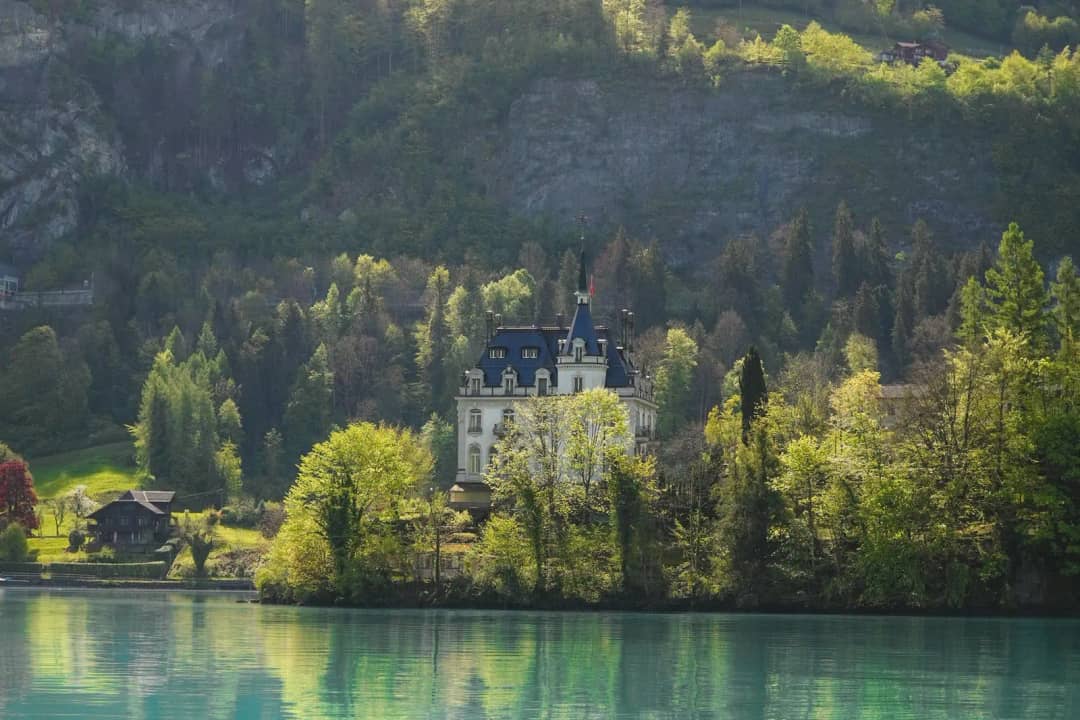
Somebody is going to tell you Lake Brienz sits between 18 and 23 degrees in summer. One of the pages ranking for this exact question says so today.
At 11:10 on 27 August 2026, the federal gauging station where the lake empties into the Aare read 16.8 °C. Over the previous 24 hours it swung between 16.1 and 19.4. That is late August, close to the warmest the lake gets all year.
This matters because Lake Brienz is not a warm lake with a cold reputation. It is a genuinely cold lake, fed by glacial melt, around 260 metres deep, and the floor drops away fast from most of the shore. It is also one of the cleanest large lakes in the country, which is the reason people swim in it anyway.
So here is where you can get in, what each place costs, what the bottom feels like, and the one stretch of shoreline you are not allowed to enter at all. Every figure below carries the date I read it.
How cold is Lake Brienz, really?
Between 16 and 19 degrees at the height of summer, and colder wherever a river comes in. The federal gauge at the lake's outflow read 16.8 °C at 11:10 on 27 August 2026, with a 24 hour maximum of 19.4 °C. Swimmers on TripAdvisor report "18 degrees on a July day", which lines up.

That number is a surface reading at one point. Two things move it around the lake.
Depth. The temperature drops sharply a short way down and a short way out. On a lake this deep the warm layer is thin, and you leave it faster than you expect when you swim away from the bank.
Rivers. The Lütschine enters at Bönigen straight from the Grindelwald and Lauterbrunnen valleys, carrying meltwater and rock flour. The water there runs colder and cloudier than the open lake. The Giessbach does the same thing on a smaller scale on the south shore.
For comparison, the heated pool at the Bönigen lido holds a constant 24 degrees. One swimmer describes it as "heated to only about 23/24 degrees, which felt tropical compared to the cold lake". That is the honest gap between the two options at the same address.
If you want the month by month picture across all five lakes near Interlaken rather than this one, our guide to the lakes around Interlaken measures them side by side. This article stays on Lake Brienz.
Where can you actually get into Lake Brienz?
Four managed places, and one of them is free. Iseltwald lido on the south shore charges nothing. Bönigen lido at the west end costs CHF 6 for an adult. Brienz lido sits at the far east end. Niederried has an open-air pool rather than a lake bath. Everything else is either private or unmanaged bank.
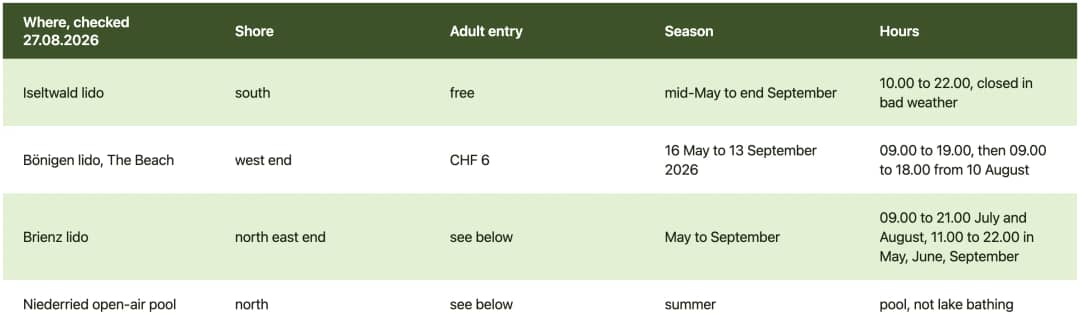
Bönigen prices and dates from strandbadboenigen.ch, Iseltwald and Brienz from the Interlaken Tourism POI records, all read on 27 August 2026.
Iseltwald is the find here. Free entry, open until 22.00, a floating platform, a paddling pool for small children, SUP and canoe rental and a bistro. It is the same village as the pier from the Korean drama, which we cover in the Iseltwald pier guide, and almost nobody who queues for that photograph walks the extra few minutes to the lido.
Bönigen is the practical one. It is two kilometres from Interlaken Ost, reachable on bus 103 to the Bönigen See stop, and it has the heated pool for the half of the family that will refuse the lake. It is also the closest bathing place to the mouth of the Lütschine, which is why the lake water there feels colder than the temperature suggests.
Brienz is the one to combine with a day out. It sits at the far end of the lake with diving platforms at 1 and 3 metres, a water trampoline and a view straight back down the water. Reaching it is a trip in itself, covered in the day trip to Brienz guide.
My own spot, away from the paid lidos, is at the end of Bönigen, on the road towards Iseltwald. Bus 103 leaves Interlaken Ost at :05 and :35 for Bönigen, a trip of four to five minutes.
Outside these, the shoreline around Iseltwald is mostly in private hands. As one guide puts it, "most of the entrances to the water around Iseltwald are private". Look for the managed lido rather than pushing through a garden.
What does it cost, and is there a cheap way in?
CHF 6 for an adult at Bönigen, CHF 4 for a child aged 6 to 15. From 17.00 an evening ticket drops to CHF 3.50 and CHF 2.50. Holders of a guest card, locals, military and pensioners pay CHF 5.50 and CHF 3.50. Iseltwald costs nothing at all.
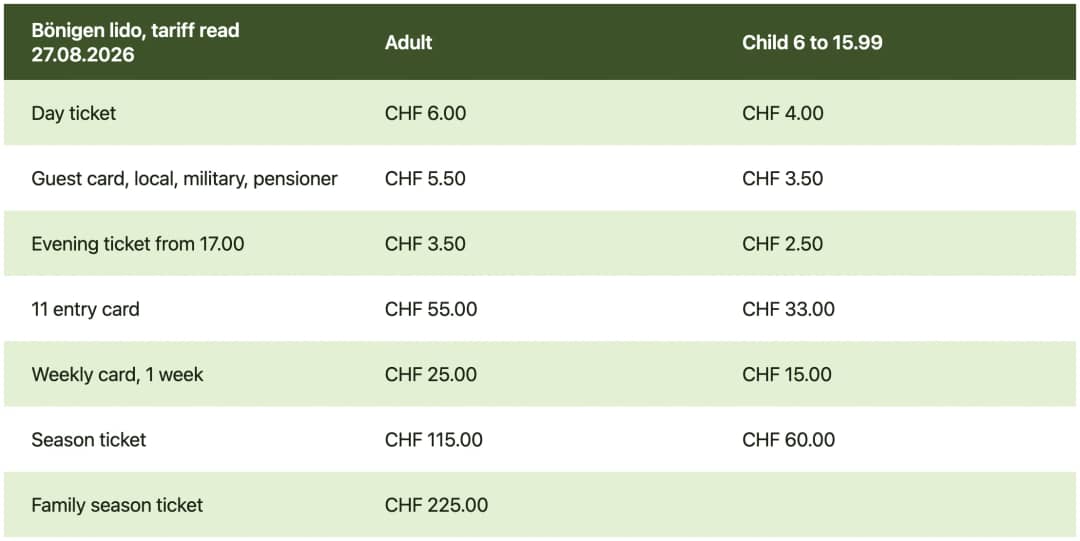
Read on strandbadboenigen.ch, 27 August 2026.
Three things worth knowing before you pay.
The guest card reduction is real. If your hotel or hostel in the Interlaken area issues a guest card, it takes fifty centimes off at Bönigen. Small, but it also unlocks bigger reductions elsewhere in the region, so ask for it at check-in.
The evening ticket is the best value on the lake. From 17.00 an adult pays CHF 3.50. In July the light on this water at six in the evening is better than at two in the afternoon, and the crowd has gone home.
At Brienz, budget a franc for the locker. Lockers cost CHF 1.00 with a CHF 4.00 deposit. Bring coins.
Where are you not allowed to swim?
Two kinds of place. Nature reserves, and marked exclusion zones. At the mouth of the Lütschine in Bönigen sits the Lütschisand nature reserve, protected since 1983, where entering the water surface and the bank vegetation is prohibited and dogs may not run loose. Closed water areas elsewhere are marked with yellow buoys.

Lütschisand protects what is left of the Lütschine delta and one of the largest populations of yellow-bellied toad in the canton of Bern. It is not a token restriction and it is right next to a busy lido, so read the signs at the west end of the beach rather than assuming the whole bank is open water.
The yellow buoys are the other rule, and they work in both directions. They mark areas closed to boats, which includes the swimmer zones, and they mark protected areas closed to everyone. Boats have to stay out of the first kind, which is precisely why staying inside them is the safe place to swim.
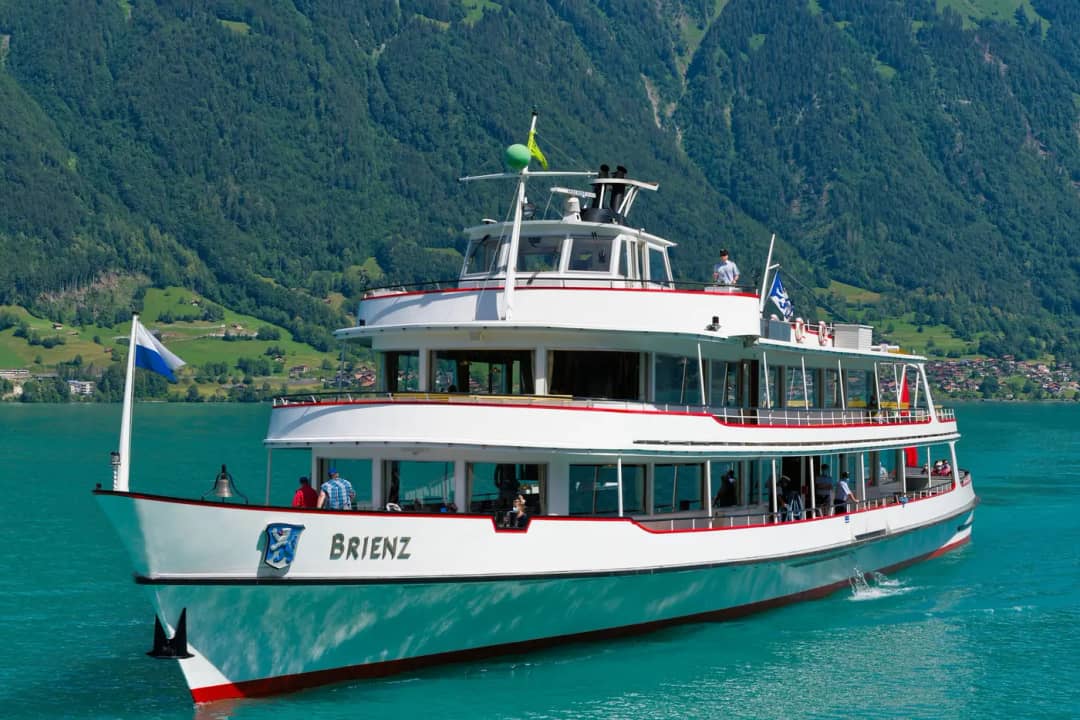
The third thing to keep clear of is not marked at all: the line the scheduled boats take. Lake Brienz carries seven piers and five sailings each way in summer, and those vessels have absolute right of way over everything else on the water. Swim parallel to the shore, not across the middle.
What is the shore like underfoot?
Stony. Every managed bathing place on this lake is shingle or pebble rather than sand. Reviewers say it plainly: "the lake beach and entry is stony" and "water shoes recommended for shingle beach". Others disagree, describing a descent that "is very gentle and doesn't require aqua shoes". Both are true, at different spots.
Here is how to read that contradiction. At the managed lidos the shingle has been graded, so the slope is gentle and you can walk in barefoot if your feet are used to it. Away from them, the same lake gives you loose cobbles and a drop.
"At my spot at the end of Bönigen: pebbles, and a gradual way in."
Pierre Vetsch, founder of Swiss Local Adventures
The wider point is depth. Lake Brienz reaches 260 metres or so and the bed falls away steeply from most of the bank instead of shelving out gradually. Within a few strokes of the shore you are over water far deeper than you can see through. That is not dangerous by itself, but it changes what a mistake costs.
Practical answer: bring water shoes for anywhere that is not a lido, and expect "mostly stone or pebble beaches with easy and safe access" at the ones that are.
When does the swimming season open and close?
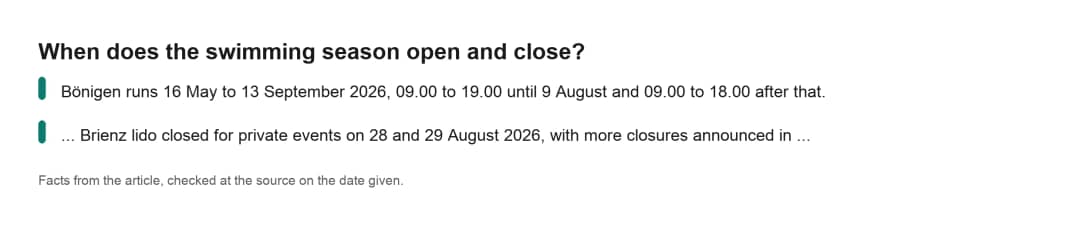
Mid-May to mid-September for the managed places. Bönigen runs 16 May to 13 September 2026, 09.00 to 18.00 until 31 May, 09.00 to 19.00 from 1 June to 9 August and 09.00 to 18.00 after that. Iseltwald runs mid-May to end September, 10.00 to 22.00, and closes in bad weather. Brienz runs May to September.
The water does not follow the same curve as the calendar. It lags the air by weeks in both directions.
June is the month people misjudge. The air is summer, the lake is not. Meltwater is still coming down the Lütschine and the Aare at volume, and the surface has not caught up.
Late July to early September is the window. That is when the reading sits in the high teens rather than the low teens, and when the sun still reaches the water late enough in the day to matter. The gauge read 16.8 °C on 27 August this year.
After the lidos close, the lake is still there and still free. What disappears is the changing room, the lifeguard and the graded entry. The bank at Bönigen and the shore path stay open all year.
From mid-September, I find the lake too cold for a normal visitor. Bönigen lido ends its season on 13 September 2026. That day at 10:50, the federal gauge read 16.9 °C.
How do you get in without a shock, and who should not?
Slowly, and never straight off a hot walk. The Swiss lifesaving society's third bathing rule is exactly this: never jump into the water overheated, because "the body needs time to adjust". On a 16.8 °C lake, cold water shock is the real hazard, not the depth under you.

The society's six rules translate roughly as follows, and every one of them applies here.
Children only go to the water accompanied, and small children stay within arm's reach.
Never enter the water after alcohol or drugs, and never on a completely full or completely empty stomach.
Never jump in while overheated.
Never jump into cloudy or unfamiliar water, because what you cannot see can hurt you.
Air mattresses and swimming aids do not belong in deep water, because they offer no safety.
Never swim long distances alone, because even the fittest body can have a bad moment.
Rule four deserves a note specific to this lake. Lake Brienz carries a heavy load of suspended sediment from the Aare and the Lütschine. That is what makes it turquoise, and it also means visibility varies enormously with the weather and the season. After heavy rain in the valleys you cannot see the bottom, which is exactly when you should not be jumping off anything.
Who should think twice: anyone who gets cold quickly, anyone swimming alone, anyone with a heart condition, and small children in the unmanaged stretches. None of that is a reason to skip the lake. It is a reason to use a lido, where the entry is graded and somebody is watching.
Your questions about swimming in Lake Brienz
Is Lake Brienz clean enough to swim in?
Yes, and unusually so. Eawag, the federal water research institute, describes it as naturally very nutrient-poor: phosphorus inputs rose less there by the mid 1980s than in any other large Swiss lake, and it stayed oligotrophic. Swimmers describe "the crystal clear lake water" as the reason they come. The cloudiness you sometimes see is mineral, not pollution: it is glacial rock flour carried in by the Aare and the Lütschine, and it is the same suspension that gives the lake its colour.
Can you swim right by Interlaken Ost station?
Not in Lake Brienz itself. The station sits on the Aare between the two lakes, about two kilometres from the nearest bathing place on Lake Brienz, which is Bönigen. Take bus 103 to the Bönigen See stop and walk from there, or walk the shore path in roughly half an hour. If you want water within a few minutes of the station you are looking at the river and Lake Thun instead, which our guide to the lakes around Interlaken covers.
How deep is Lake Brienz?
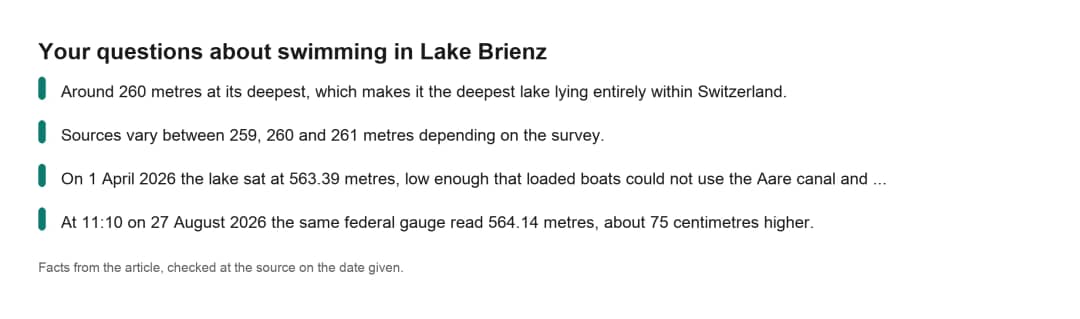
Around 260 metres at its deepest, which makes it the deepest lake lying entirely within Switzerland. Sources vary between 259, 260 and 261 metres depending on the survey. The number that matters for a swimmer is not the maximum but the gradient: the bed drops away steeply close to the bank on most of this shoreline rather than shelving out, so deep water starts near. It also means the lake never freezes, because that volume holds too much heat.
Does the lake level change how much beach there is?
Yes, and it moved noticeably this year. On 1 April 2026 the lake sat at 563.39 metres, low enough that loaded boats could not use the Aare canal and the scheduled sailings started from Bönigen instead of Interlaken Ost. On 13 September 2026 BLS listed the boats on both lakes as running to timetable. At 11:10 on 27 August 2026 the same federal gauge read 564.14 metres, about 75 centimetres higher. A low lake means more exposed shingle and a longer walk to swimmable depth. A high one means the opposite.
Can you swim on a kayak tour?
Yes, and the guides build it in. Reviewers on the Lake Brienz kayak tours describe stopping at "a cute little cove" to swim, and one guide "took us to spots where we could swim in the lake". If you want to reach water with no path to it, that is the way to do it, and the kayaking on Lake Brienz guide covers what it costs and what the rules are.
Swim it, but read the gauge first
Lake Brienz rewards people who arrive with the right expectation. 16.8 degrees on the best week of the year is not a Mediterranean bay, and pretending otherwise is how visitors end up standing on the shingle at Bönigen arguing with their children.
Go to Iseltwald if you want it free, Bönigen if you want a heated pool as a backup, Brienz if you want diving boards and a view down the whole lake. Take the evening ticket. Get in slowly.
For the rest of a summer week, see our best day trips from Interlaken, things to do in Interlaken and summer in Interlaken.
If you are planning a few days here and want to know what genuinely fits around a swim, message us on WhatsApp and we will give you the honest version.
Source: Aare Ringgenberg gauging station, Swiss Federal Office for the Environment, Brienzersee Ringgenberg gauging station, FOEN, Strandbad Bönigen tariff, Lidos and open-air pools, Interlaken Tourism, Naturschutzgebiet Lütschisand, Canton of Bern, Eawag fact sheet on phosphorus in Lake Brienz, and the bathing rules of the Swiss Life Saving Society, all checked on 27 August 2026.
Written by Pierre Vetsch, founder of Swiss Local Adventures
Tags
#lake-swimming#lake-brienz-beaches#free-swimming-spots#swiss-lidos#interlaken-lakes#lake-brienz-day-trip
Sources & References
- •FOEN, Aare Ringgenberg gauging station (temperature)
- •FOEN, Brienzersee Ringgenberg gauging station (lake level)
- •Strandbad Bönigen, prices
- •Interlaken Tourism, Strandbad Iseltwald
- •Interlaken Tourism, Strandbad Brienz
- •Interlaken Tourism, lidos and open-air pools
- •Canton of Bern, Naturschutzgebiet Lütschisand
- •Kantonspolizei Bern, Vorschriften auf Binnengewässern
- •SLRG, bathing rules
- •BLS Schifffahrt, boats on Lake Brienz depart from Bönigen
- •Eawag, phosphorus in Lake Brienz fact sheet
- •Photo: Gio Almonte on Unsplash
- •Photo: Jean-Paul Wettstein on Pexels
Share this article
Similar Articles
Continue your reading with these related articles
Interlaken
9/12/2026
12 min
9
Hang Gliding or Paragliding in Interlaken?
Compare hang gliding and paragliding in Interlaken: same hill, same 20 minutes, CHF 170 against CHF 260. Here is what the extra 90 francs actually buys.
tandem-hang-glidingtandem-paraglidingadventure-sports
By Timoté BailyRead More
Interlaken
9/11/2026
15 min
12
Bönigen Historic House Trail: Free, 4 Min Away
Walk Bönigen's free historic house trail, four minutes by bus from Interlaken Ost, past carved wooden houses standing since 1549. Times and map inside.
historic-house-trailday-trip-brienzinterlaken-day-trips
By Pierre VetschRead More
Interlaken
9/9/2026
14 min
14
Goldswil Church Ruin Hike: A Free 680m Viewpoint
Climb to the Goldswil church ruin above Interlaken, a free eleventh century tower at 680m with the widest view over both lakes. Route and times inside.
church-ruinsmedieval-historyshort-hikes
By Timoté BailyRead More