Winter
Snowshoeing in Interlaken: 12 Marked Trails Compared
P
Pierre Vetsch
Author
March 11, 2026
14 min
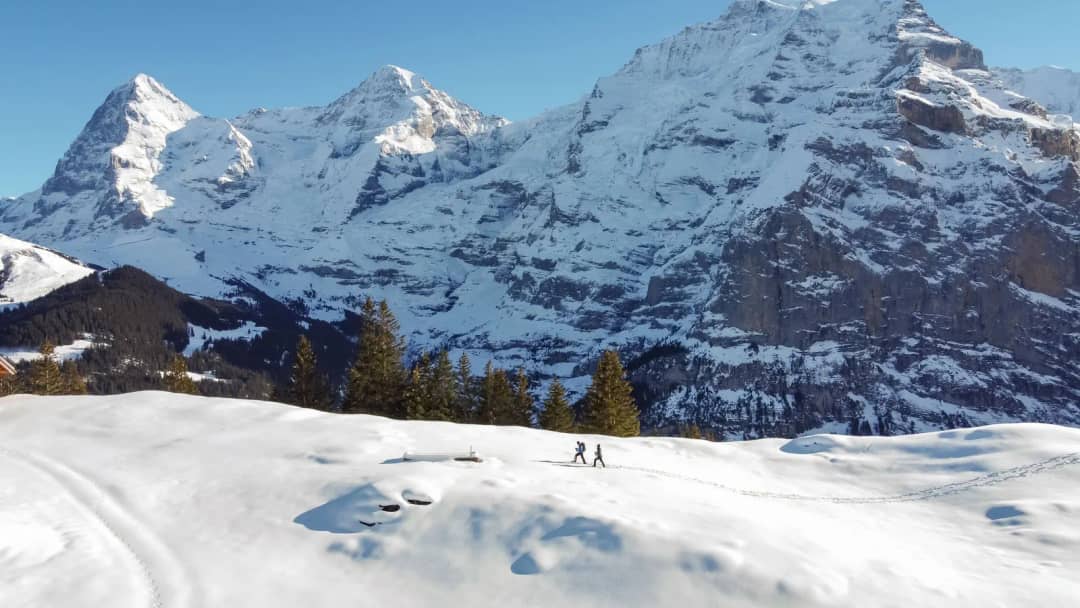
Snowshoeing in Interlaken starts with a ride up, because snow on the valley floor is rare and melts fast. Above the town, 12 marked snowshoe trails sit less than 70 minutes away by public transport, from a 2 km forest loop above Isenfluh to a 10.7 km crossing above Lake Thun. Ask my guests afterwards what stayed with them, and they name the silence in the forest.
I guide snowshoe groups on the Sulwald Trail above Isenfluh, and I have walked most of the other trails in this guide. For a first time on your own, I send people to the Chänelegg loop in Mürren. The trail I tell beginners to leave alone is the longest one, the crossing from Vorsass to Habkern.
Every length, time and timetable below was checked at the federal trail data, the operators and the Swiss timetable on 30 September 2026.
Where can you go snowshoeing near Interlaken?
Two newer guides go deeper on the choice: snowshoeing or cross-country skiing for a first winter day, and whether a snowshoe morning is worth it at all.
On 12 marked trails in eight areas: Isenfluh, Mürren, Wengen, Grindelwald, the Niederhorn, Habkern, Saxeten and the Axalp. Ten of them appear in the federal snowshoe route data, which comes from SchweizMobil. The Lobhorn Trail and the crossing from Vorsass to Habkern come from the Isenfluh and Niederhorn operators.
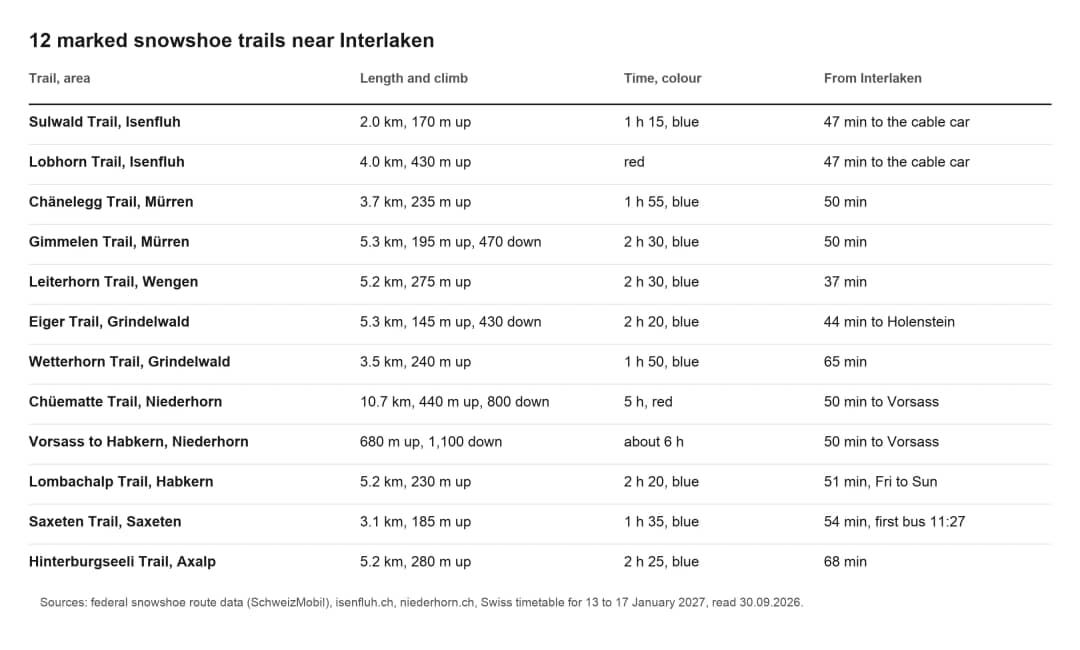
Federal data and operators read on 30 September 2026. Journeys on the Swiss timetable for Wednesday 13 January 2027, Lombachalp for Friday 15 to Sunday 17 January 2027.
The table in words. Above Isenfluh, the blue Sulwald Trail loops for 2.0 km with 170 metres of climbing in about 1 hour 15, and the red Lobhorn Trail climbs 430 metres over 4.0 km. In Mürren, the blue Chänelegg loop covers 3.7 km with 235 metres in about 1 hour 55, and the blue Gimmelen Trail runs 5.3 km to Gimmelwald, 195 metres up and 470 down, in about 2 hours 30. Wengen's blue Leiterhorn loop covers 5.2 km with 275 metres in about 2 hours 30.
Above Grindelwald, the blue Eiger Trail runs 5.3 km from Holenstein to Brandegg, 145 metres up and 430 down, in about 2 hours 20, and the blue Wetterhorn loop covers 3.5 km with 240 metres in about 1 hour 50. On the Niederhorn, the red Chüematte Trail runs 10.7 km from Vorsass to Waldegg, 440 metres up and 800 down, in about 5 hours, and the crossing to Habkern climbs 680 metres and descends 1,100 in about 6 hours. The blue loops of the Lombachalp (5.2 km, 230 metres, 2 hours 20) and Saxeten (3.1 km, 185 metres, 1 hour 35) and the blue Hinterburgseeli trail from the Axalp (5.2 km there and back, 280 metres, 2 hours 25) complete the list.
All seven Grindelwald trails, with start points, lengths, times and rental prices, are compared in snowshoeing in Grindelwald.
On the timetable for 13 January 2027, Interlaken Ost to Wengen takes 37 minutes, to Holenstein 44, to the Isenfluh cable car 47, to Mürren 50, to the Hotel Wetterhorn 65 and to the Axalp 68. From Interlaken West, Vorsass takes 50 minutes, the Lombachalp 51 and Saxeten 54.
The colour is the difficulty. The Isenfluh cable car cooperative defines blue as suitable for beginners, with easy terrain, no traverses and no steep passages; red asks for some snowshoe experience, sure feet and a head for heights. Where an operator and the federal data disagree, the table keeps the federal figure and the trail's section gives both. For the region beyond snowshoes, start with our best day trips from Interlaken.
Which snowshoe trail is best for a first time?
The Chänelegg Trail in Mürren. It is a blue loop that starts and ends in the village. The Jungfrau railways describe it as a trail from Mürren to the Allmiboden and back, between 1,843 and 1,630 metres, and give it about 2 hours.
Asked where someone should go for a first snowshoe hike without a guide, I answer in two words.
Pierre says: "Mürren, Chänelegg."
Pierre Vetsch, founder and head guide at Swiss Local Adventures
A loop brings you back to where you started, so you have no connection to find at the far end. On 13 January 2027, the 09:04 from Interlaken Ost reaches Mürren at 09:54, by train, cable car to Grütschalp and train again. Mürren has no road, so read how to get to Mürren before you plan the day.
The shorter option is the loop I use with my own groups.
Pierre says: "The blue Sulwald Trail, the easy loop over the Mederalp."
Pierre
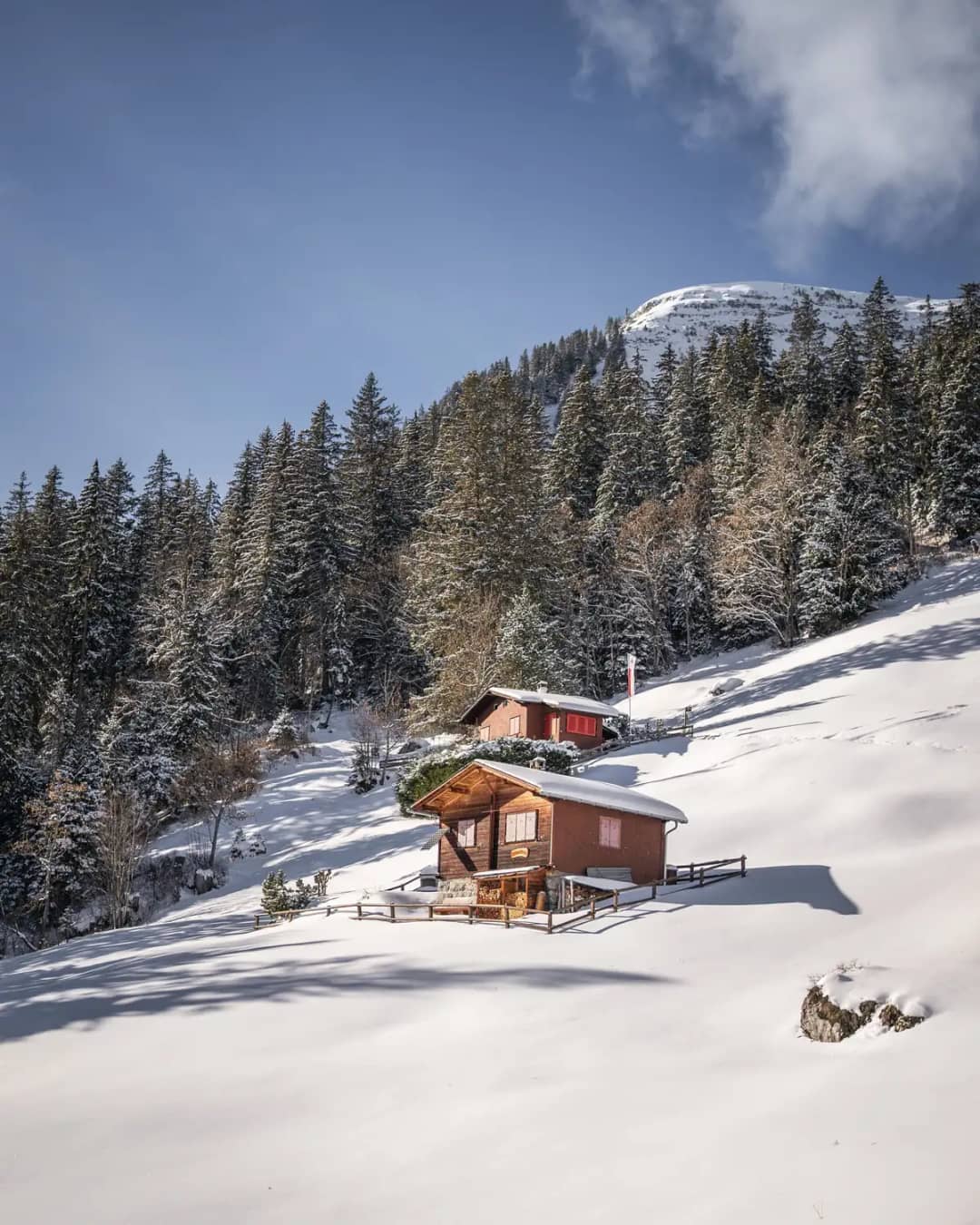
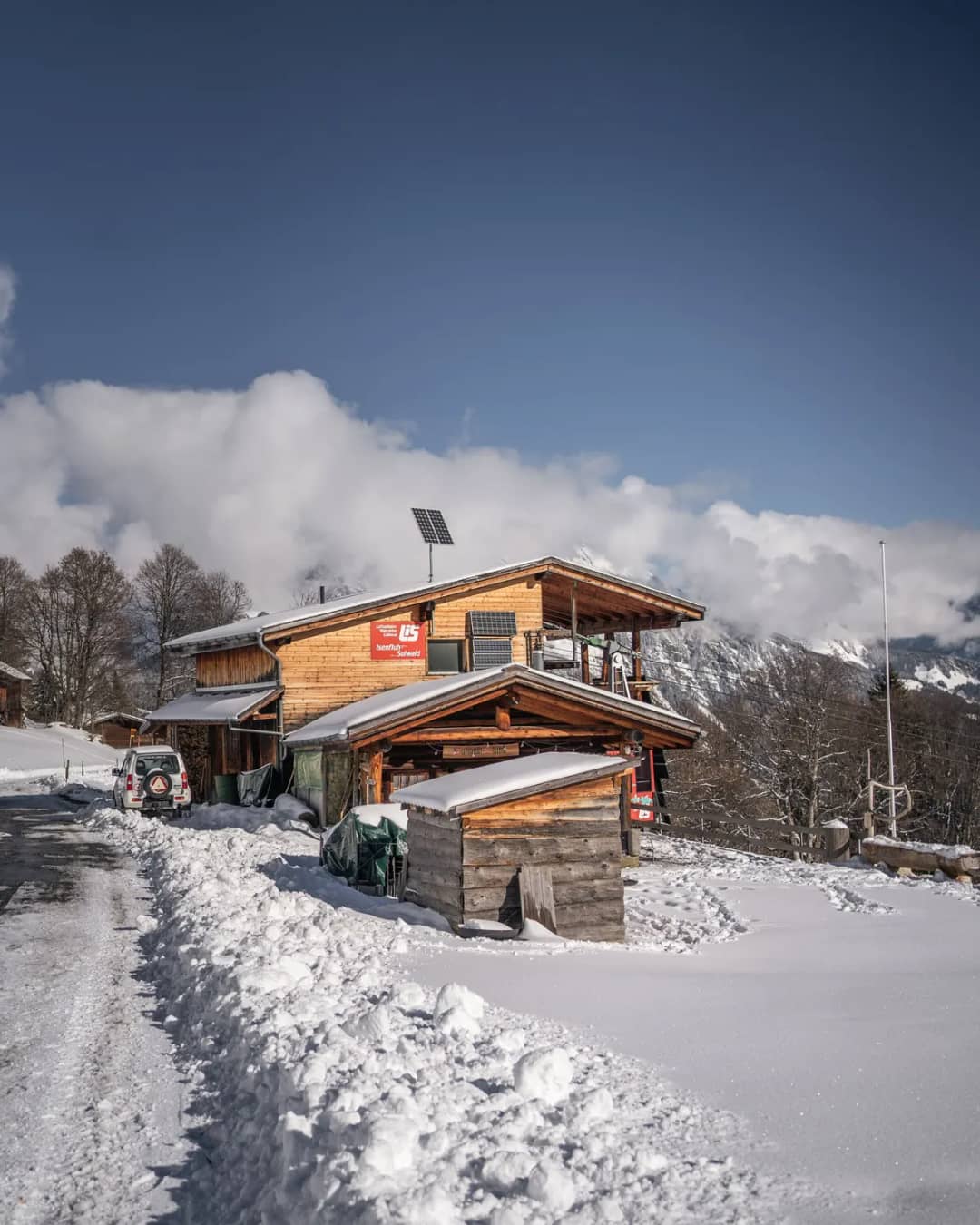
The federal data give it 2.0 km; the operator's flyer says 2.5 km, for the same 170 metres of climbing. The cable car cooperative writes that, with enough snow, you can walk it without danger. That condition matters: Sulwald sits at 1,520 metres, while the Mürren loop runs between 1,630 and 1,843. The cabin, the fares and the bus are in our guide to Isenfluh and Sulwald.
Mürren or Grindelwald: which Jungfrau trail?
Mürren for a first loop, Grindelwald for a longer day in front of the Eiger North Face. I have walked the Chänelegg in Mürren, Holenstein to Brandegg above Grindelwald, and the Leiterhorn in Wengen. They suit different days.
The Eiger Trail, as SchweizMobil names it, runs from Holenstein to Brandegg. The Jungfrau railways list it from 1,624 to 1,288 metres in about 2 hours 15, and they name it after the view of the Eiger North Face. You reach Holenstein in 44 minutes by train and gondola, and at Brandegg the train takes you back down to Grindelwald.
The Chänelegg loop is shorter and brings you back to Mürren, the safer choice when you do not know your pace on snowshoes yet. Grindelwald has a loop too, the Wetterhorn Trail from the Hotel Wetterhorn, 65 minutes from Interlaken by train and bus 121.
Insider tip: The Gimmelen Trail from Mürren to Gimmelwald loses 470 metres. At the bottom, the cable car takes you down to Stechelberg, and bus 141 brings you to Lauterbrunnen. Check that connection before you set off.
Wengen's Leiterhorn loop is the closest to Interlaken, 37 minutes by train. If you have not chosen a base yet, Wengen or Mürren compares the two villages. The Jungfrau railways' Winter Hiking and Sledging Pass starts at CHF 61, for one to seven days, from 21 November 2026 to 25 April 2027. As its name says, it serves sledders too, and the runs are compared in sledding in Interlaken.
The verdict: first time on snowshoes, the Chänelegg loop in Mürren. Second day, Holenstein to Brandegg.
Fun fact: The village where the Chänelegg loop starts is where alpine ski racing was born. In 1922, Sir Arnold Lunn officiated the first slalom race in the history of alpine skiing behind the Hotel Jungfrau in Mürren, and in 1931 the village hosted the first Alpine World Championships in slalom and downhill.
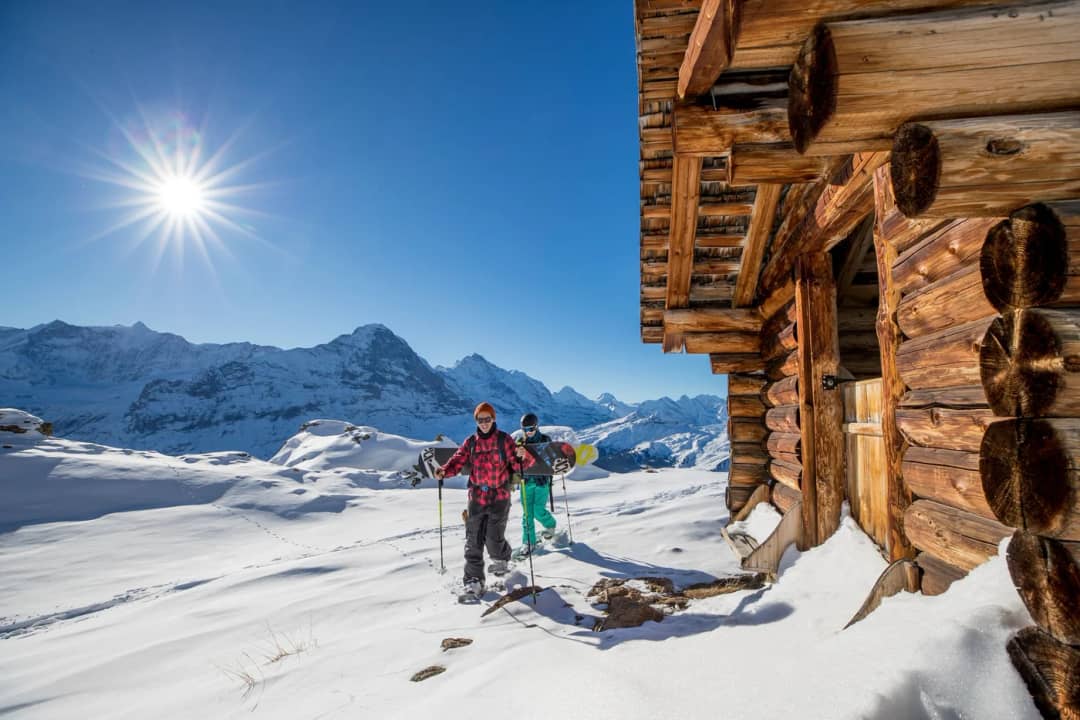
What about the lake side: Niederhorn, Habkern, Axalp and Saxeten?
Four quieter areas, each with a catch. I have walked all four. The Niederhorn has the longest trails. The Lombachalp has the thinnest bus service: Friday, Saturday and Sunday only. The Axalp has the longest journey: 68 minutes from Interlaken Ost. Saxeten has the latest first bus: 11:27 from Interlaken West.
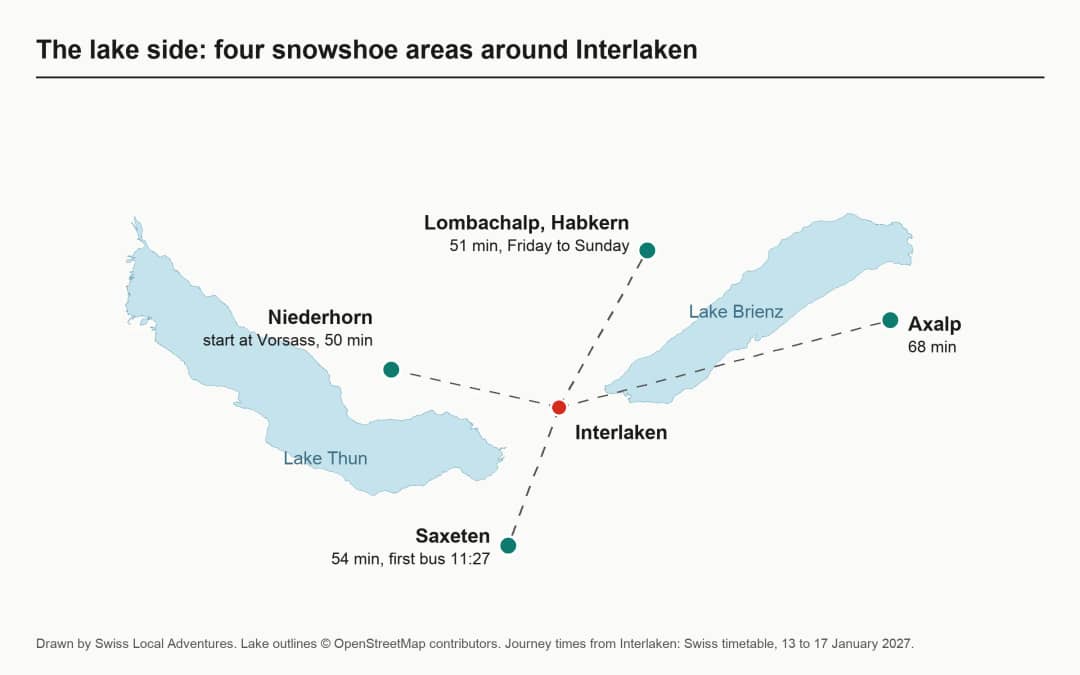
The Niederhorn. Two signposted trails leave Vorsass, the middle station. One is the longest signposted snowshoe trail in the canton of Bern, according to the cableway: Vorsass to Habkern over the Grünenbergpass. The other runs to Waldegg. The crossing to Habkern is the one I tell beginners to leave alone: about 6 hours, with 680 metres of climbing and 1,100 of descent.
The federal data rate the Chüematte Trail to Waldegg red, at 10.7 km and about 5 hours. The Niederhorn cableway gives the same route 2 to 3 hours, 200 metres up and 500 down. The sources disagree, so plan for the longer one. From Waldegg, bus 101 takes you back to Interlaken West in 28 minutes.
The Lombachalp above Habkern. The catch is the bus. For the week of 11 to 17 January 2027, the timetable shows buses 106 and 107 from Interlaken West at 09:04 on Friday, Saturday and Sunday only. From Monday to Thursday it finds no bus that reaches the trail.
The Axalp. Three signposted trails start at the Axalp-Sportbahnen bus stop above Brienz. The operator lists Hinterburgseeli and back at 4.6 km, Teiffental at 5.8 km and Totzweg at 6.2 km. Our summer walk to the same lake is in the Hinterburgseeli hike.
Saxeten, the fourth, is a short blue loop close to town, but on 13 January 2027 the first bus after 9 o'clock leaves Interlaken West at 11:27, with a change in Wilderswil.
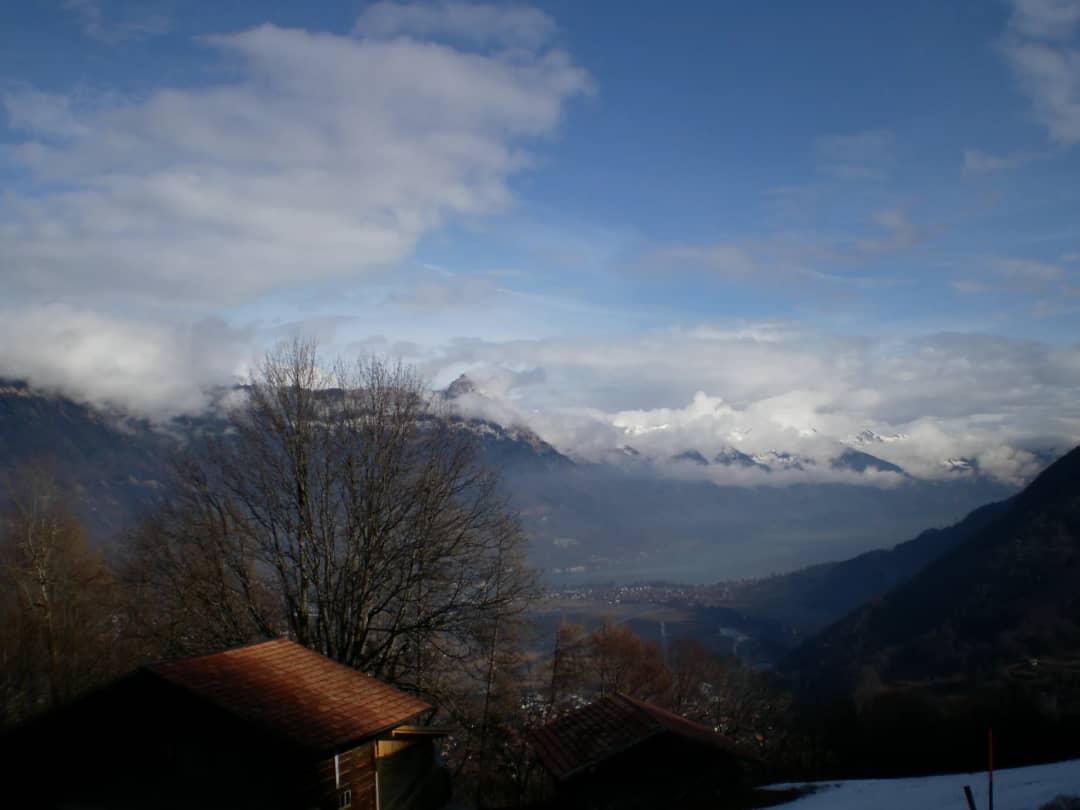
Is snowshoeing safe, and can you go without a guide?
Yes on an open, marked trail, if you follow the rules. Off the trail, only with avalanche training and equipment. The Swiss accident prevention office, the BFU, counts on average two deaths a year among snowshoers in Switzerland. It writes that most serious accidents are avalanches away from the pink-signposted routes, and that operators secure those routes against avalanches.
A marked trail is still not a groomed path, and the Jungfrau railways state that you use their trails at your own responsibility and risk. The BFU gives five main tips:
use the pink-signposted snowshoe routes;
plan enough time and do not overreach;
check the snow and the weather;
do not go alone;
drink, eat and rest regularly.
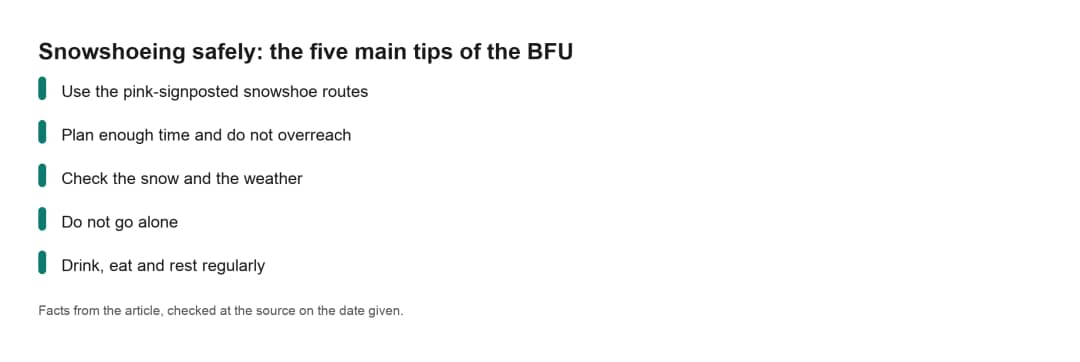
It adds: stay on the route and do not follow other people's tracks. Away from the routes, you need an avalanche transceiver, a probe, a shovel and the practice to use them. The BFU snowshoe advice has the full list. The Isenfluh flyer adds rules for the animals: avoid forest edges and young plantations, give wildlife room, keep dogs on a lead.
So can you go without a guide? Yes, on an open marked trail, with company, after checking the conditions. The trouble usually starts before the trail.
Insider tip: Asked about the mistake I see in people who come on their own, I say they do not find out where they are and where they are going. Before you leave, know the trail's colour, its length, how you get back and when the last lift or bus leaves.
For the real risks on a snowshoe day, with Swiss accident figures and what I check before going up, read is snowshoeing dangerous.
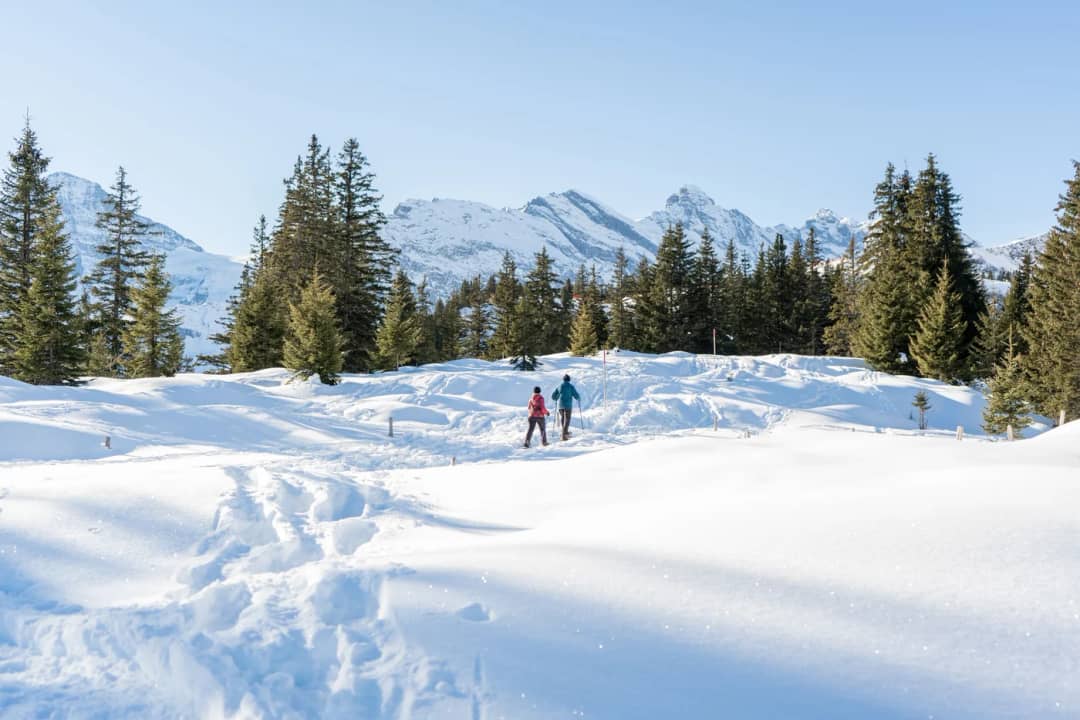
Where can you rent snowshoes, and what should you wear?
Rent in Interlaken before you leave, or on site at the Axalp. Swiss Alpine Guides in Matten, next to Interlaken, lists snowshoes at CHF 15 and poles at CHF 5 for the first day, with rentals all year round. At the Axalp, the operator sends you to the Sportshop Axalp, +41 33 951 25 40, with no published price.
Plan around Isenfluh: its cable car rents sleds, and its price list shows no snowshoes. The Niederhorn evening tours include snowshoes and poles, and so do ours.
What to wear. The BFU lists snowshoes, sturdy warm shoes, weatherproof warm clothes, poles, food, a small first-aid kit with a rescue blanket and a charged phone. Add gloves, a beanie, sunglasses and sun cream.
A guest on another operator's snowshoe tour warned, on TripAdvisor in February 2026, against too many layers on a sunny day. You climb, you warm up, and the jacket that felt right at the bus stop is too much after the first climb. Wear layers you can take off and carry. Ski pants, shoes and the midday temperatures of last winter are in Pierre's guide on what to wear snowshoeing.
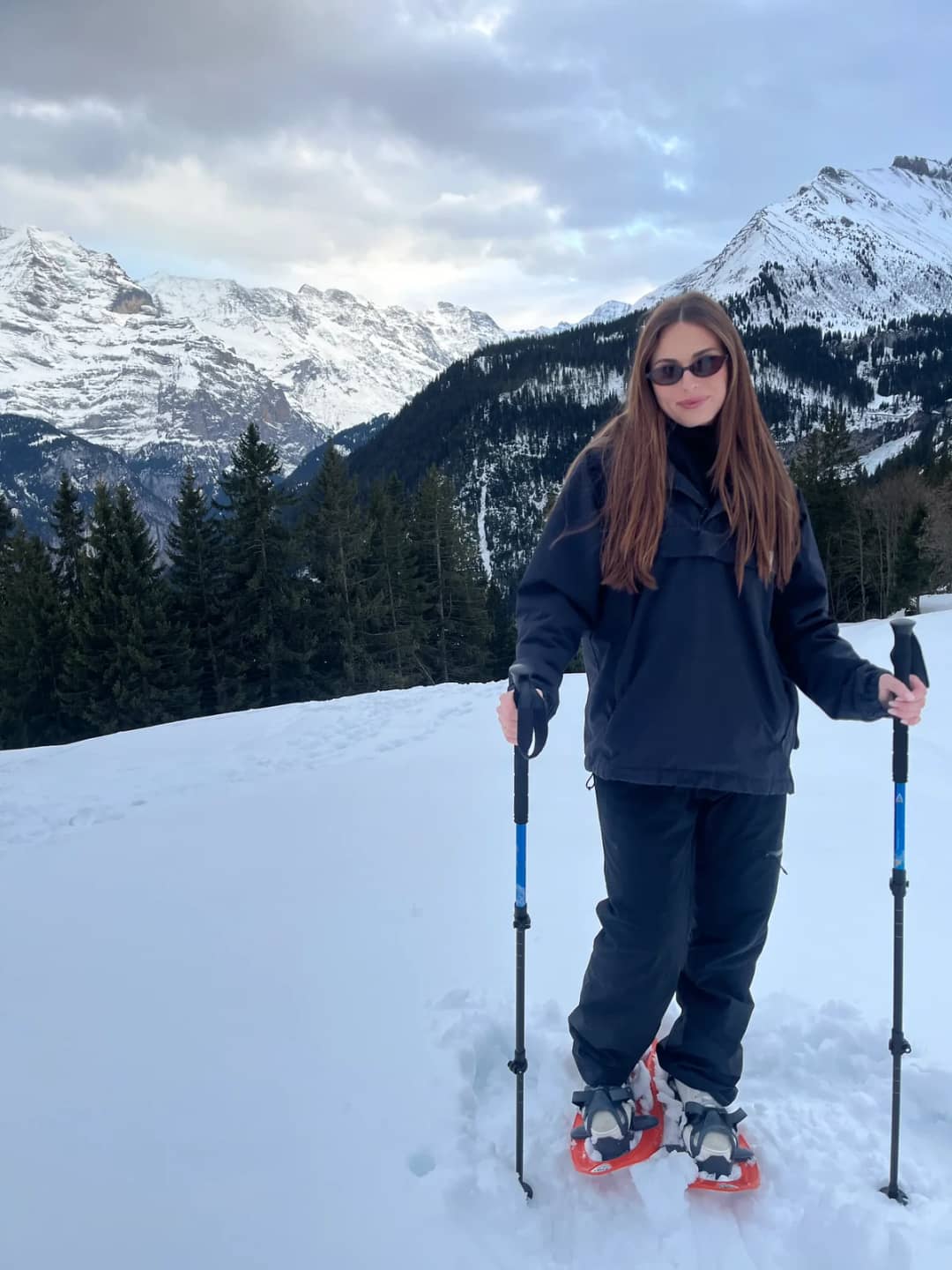
When is the snowshoe season, and what if there is no snow or fog?
Our snowshoe tours run from mid-December to April, depending on the snow, and March is my pick. The Jungfrau railways sell their winter pass from 21 November 2026 to 25 April 2027. Whether the town itself deserves a winter trip is answered in Interlaken in winter.
Asked which month I would choose for winter here, I give the same answer every time.
Pierre says: "March. Fewer people, more sun, and snow."
Snow. In Interlaken itself it is rare and melts fast. Low starts suffer first: Sulwald sits at 1,520 metres, the Chänelegg loop reaches 1,843. Check the operator's trail status on the morning you go; on 30 September, the Niederhorn page showed both its trails as "Not accessible". At Isenfluh, the employee at the cable car tells me the state of the trail before I take a group up.
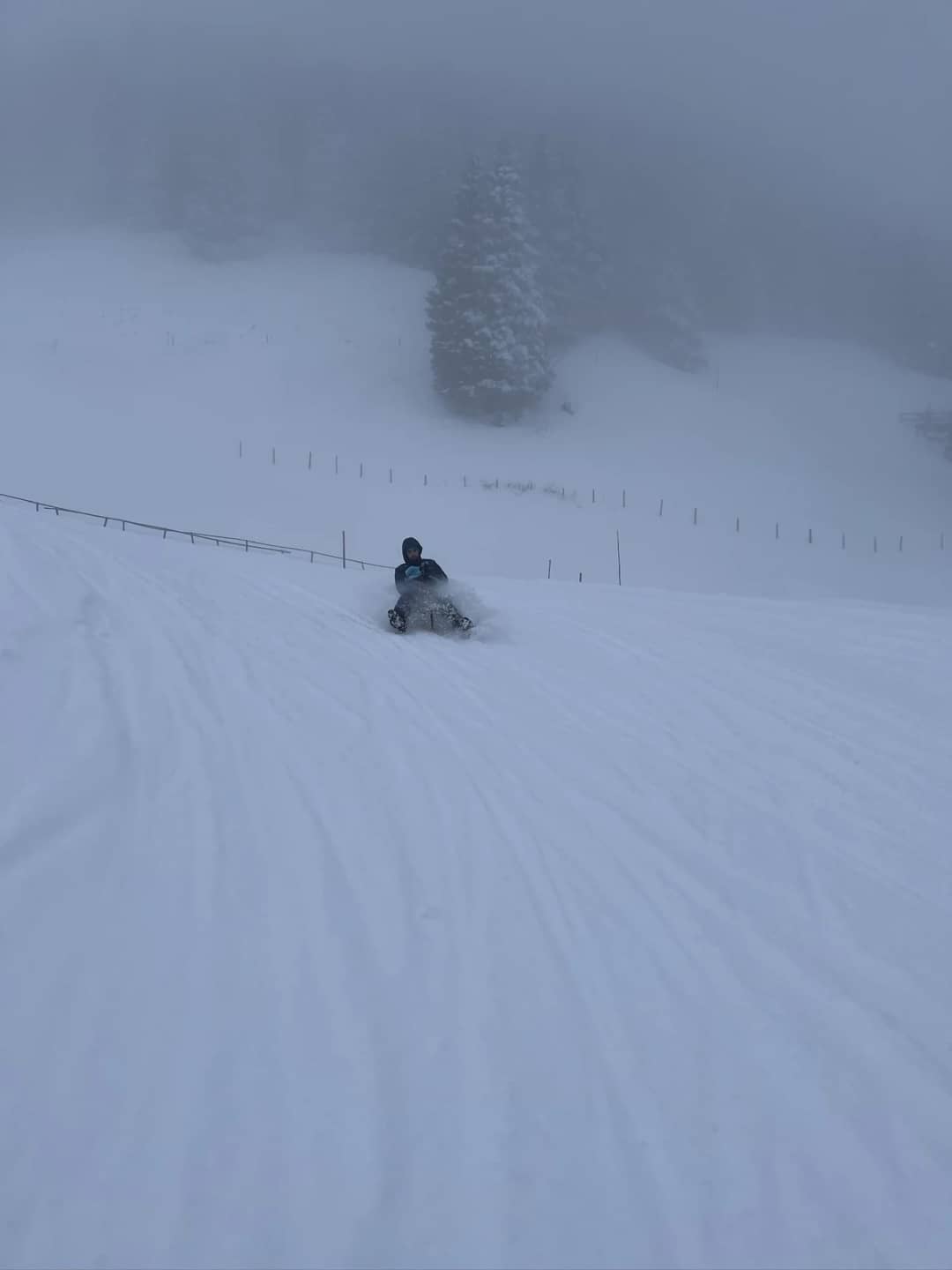
Fog. A guest on another operator's tour wrote on TripAdvisor, in January 2023, that the fog took away the views they expected. Asked where I go on a foggy winter day, I answer with two names.
Pierre says: "Schilthorn or Niederhorn."
The Niederhorn and the Axalp both show a webcam on their websites. Look before you buy a ticket.
Your Questions About Snowshoeing in Interlaken
Short answers first: our tour takes children from 10, you walk 2 to 3 km an hour, the Niederhorn runs guided evening walks on Fridays and Saturdays, and for a first-timer the climbing is harder than the technique.
Can children go snowshoeing near Interlaken?
Yes, on the blue trails, if they can walk for an hour or two in snow. On our Snowshoe Tour with Swiss Cheese Fondue, the minimum age is 10, and children under 15 come with an adult. On your own, choose a short loop that brings you back to the start: the Sulwald Trail climbs 170 metres, the Saxeten Trail 185. The Chüematte Trail on the Niederhorn is another matter: the federal data rate it red, at 10.7 km with 800 metres of descent. The Isenfluh operator defines blue as terrain for beginners with no traverses and no steep passages. Agree on a turning point before you set off.
How long does a snowshoe hike take?
Plan on 2 to 3 km an hour. The Isenfluh and Axalp operators both give that rule of thumb, and both say the real time depends on the snow, the state of the trail and your fitness. The federal data turn it into a time per trail: about 1 hour 15 for the Sulwald Trail, 1 hour 55 for the Chänelegg loop and 5 hours for the Chüematte Trail. Add 37 to 68 minutes each way from Interlaken to the start. A guest on another operator's tour found the walk a little quick, in February 2025 on TripAdvisor. If you want a long day on snowshoes, choose a longer trail.
Can you go snowshoeing at night near Interlaken?
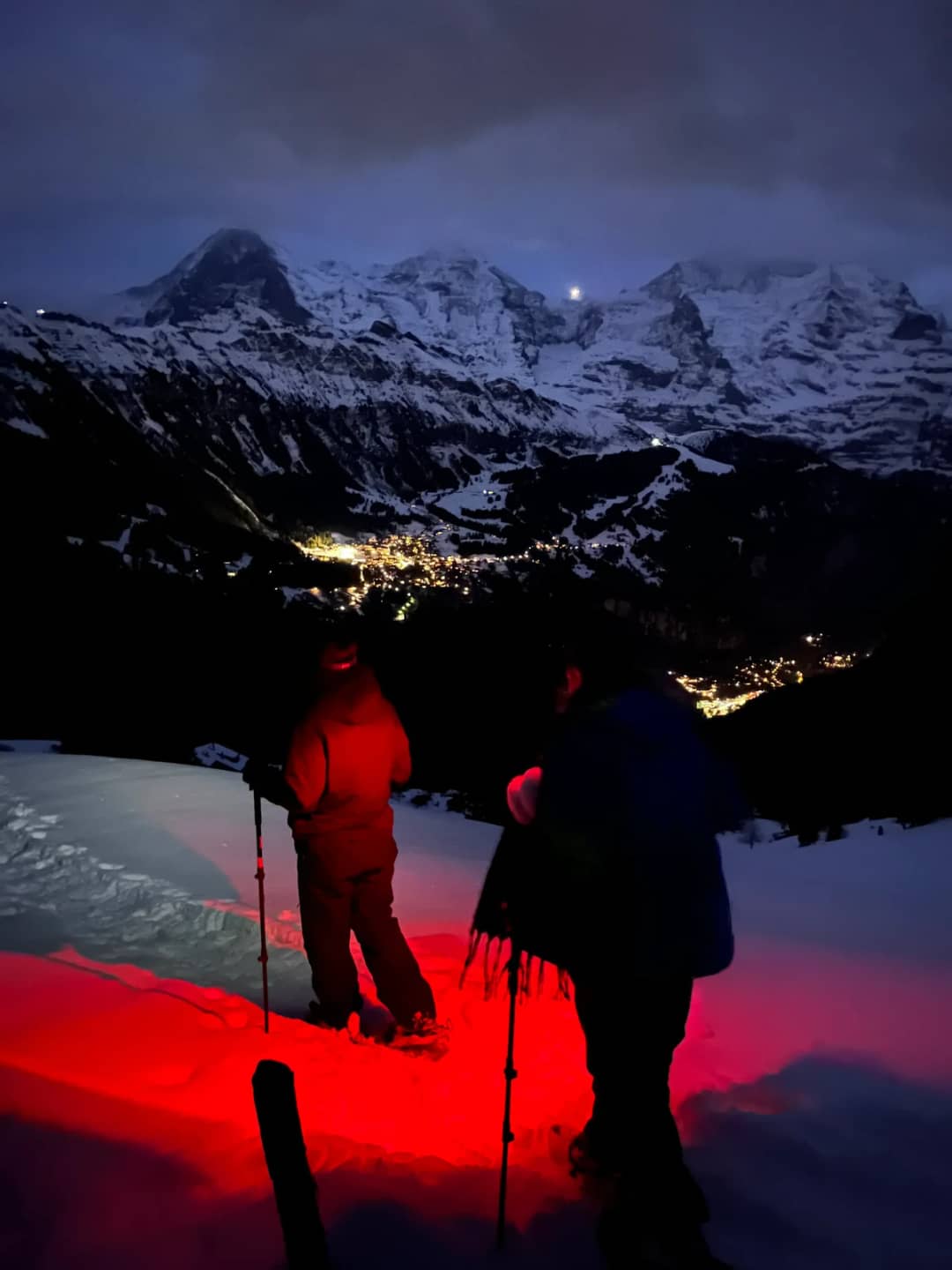
Yes, on the Niederhorn. On Friday and Saturday evenings, the Vorsass mountain restaurant runs guided snowshoe walks that start at 17:00 and last about 2 hours with a mulled wine stop, then serves a fondue. The cableway lists CHF 72 from Beatenbucht and CHF 65 from Beatenberg, with the lift, snowshoes, poles, mulled wine and fondue included, drinks extra. It needs at least 12 people booked three days ahead, and a headlamp is mandatory and not included. The dates for winter 2026-27 were not published when we checked on 30 September 2026. On your own, stay off the trails after dark.
Is snowshoeing hard for a beginner?
The technique is easy, the climbing less so. A guest on another operator's snowshoe tour called it more moderate than easy for anyone not used to climbing at altitude, and a first-timer on the same tour wrote that the snowshoes were easy to use. Both are right. The Isenfluh operator's definition of blue asks for no prior knowledge, so the effort comes from the metres you climb: 170 on the Sulwald Trail, 235 on the Chänelegg loop, 440 on the Chüematte Trail. If you walk regularly, a two-hour blue trail suits you. If you do not, start with the shortest loop and use the poles on every climb. Teona explains where the effort really comes from in how hard snowshoeing really is.
Snowshoe with a local guide
The hard part of snowshoeing here is the planning: which trail has snow, how you get there and back, and whether it suits your group. On our tour, that part is ours.
We meet at 10:00, drive you to Isenfluh and ride the cable car up to Sulwald. You try the snowshoes in front of the restaurant, then walk the blue Sulwald Trail with a local guide, about an hour of walking, and we stay on the marked trail.
The restaurant at Sulwald then serves the fondue, with one drink included, and the cable car takes you back down. Snowshoes and poles are provided, and the group stays at eight guests or fewer, from age 10, under-15s with an adult. Without winter clothes, you can rent a jacket, trousers and gloves, subject to availability, if you ask by email before the day. If the weather stops us, we offer another date, another activity or a full refund.
The tour page lists four hours, Thursday to Sunday, from mid-December to April. If you want the quiet forest loop with the fondue at the end, join the Snowshoe Tour with Swiss Cheese Fondue.
How we made this: based on Pierre's interviews of 24, 28 and 30 September 2026, facts and prices checked at the official sources on 30 September 2026, written with AI assistance.
Source: SchweizMobil snowshoe routes on the federal geoportal, the Jungfrau railways, Niederhorn, Axalp and Isenfluh operators, the Swiss timetable for 13 to 17 January 2027, and guided snowshoe tours at Sulwald with Swiss Local Adventures, 2025-2026.
*Written by Pierre Vetsch, founder and head guide at Swiss Local Adventures
Tags
#snowshoeing-interlaken#snowshoe-trails-jungfrau-region#winter-activities-interlaken#snowshoeing-for-beginners#guided-snowshoe-tour
Sources & References
- •Federal Roads Office, snowshoe routes (SchweizMobil data), read 30.09.2026
- •Luftseilbahn Isenfluh-Sulwald, snowshoe trail flyer, read 30.09.2026
- •Jungfrau Railways, winter hiking, read 30.09.2026
- •Niederhorn cableway, snowshoeing, read 30.09.2026
- •Sportbahnen Axalp, snowshoeing, read 30.09.2026
- •BFU, Schneeschuhwandern, read 30.09.2026
- •Swiss Alpine Guides, rentals, read 30.09.2026
- •Swiss public transport timetable, 13 to 17 January 2027, read 30.09.2026
- •Photos: Jungfrau Region Tourismus AG (CC0), including David Birri and Dennis Menoia; Swiss Local Adventures
- •Map: drawn by Swiss Local Adventures, lake outlines © OpenStreetMap contributors
- •Photo: Yiftachsam on Wikimedia Commons (public domain)
- •Jungfrau Region Tourismus, History of Mürren
Share this article
Similar Articles
Continue your reading with these related articles
Winter
10/29/2026
8 min
Can You Ski at Jungfraujoch? No, Here Is Where You Can
Can you ski at Jungfraujoch? No: no piste leaves the 3,454 m station in winter. Skiers add it for CHF 63 with a 3-day pass, or ski the 211 km below it.
ski-jungfraujochjungfraujoch-winterjungfrau-ski-pass
By Pierre VetschRead More
Winter
10/29/2026
15 min
Jungfrau Ski Pass: What It Covers and Where to Buy
Jungfrau ski pass explained: CHF 79 a day covers 211 km of pistes and the train from Interlaken Ost. Prices, half-days, Top Ticket and where to buy it.
jungfrau-ski-passski-pass-prices-jungfrauskiing-near-interlaken
By Pierre VetschRead More
Winter
10/28/2026
6 min
Ski Clothes Rental in Interlaken: Where and How Much
Ski clothes rental in Interlaken: a jacket costs CHF 16 a day and trousers CHF 15 in Grindelwald, and on our winter tours CHF 5 an item. Four addresses.
ski-clothes-rental-interlakenwhat-to-wear-winter-interlakenski-rental-interlaken
By Pierre VetschRead More