Winter
Snowshoeing vs Cross-Country Skiing: Which to Pick?
P
Pierre Vetsch
Author
October 26, 2026
15 min
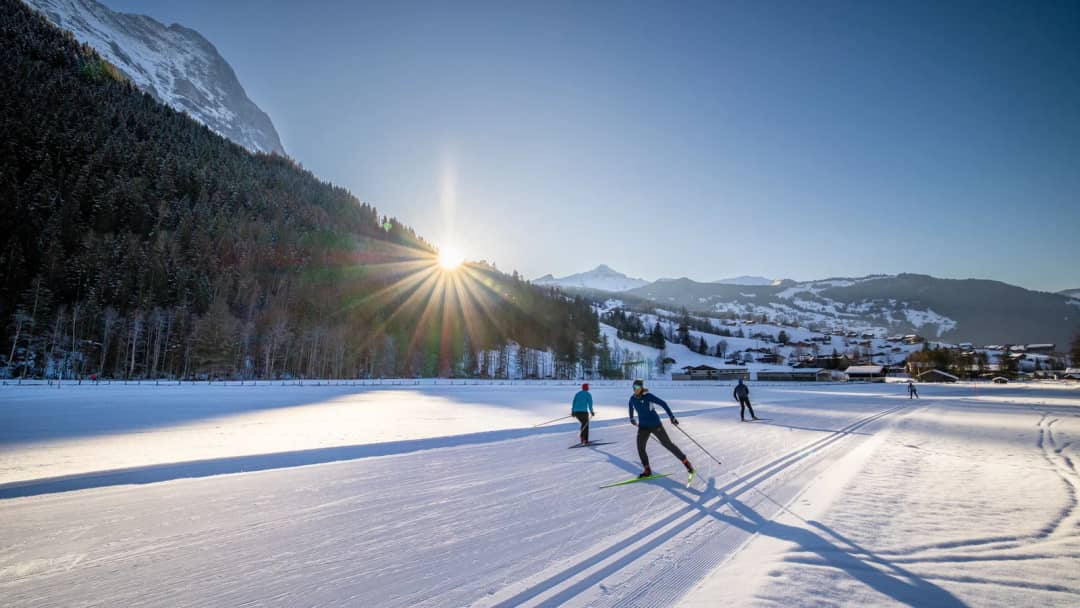
Snowshoeing vs cross-country skiing is a choice I settle in one sentence for guests who ask: for a first winter day near Interlaken, take the snowshoes. I say that as someone trained as a ski instructor who still fell on his first cross-country loipe in Austria, on the first small descent. Snowshoes get a beginner walking at ease in 10 to 15 minutes. Cross-country skis get a beginner a lesson, then a season. Below are the numbers behind that opinion: effort from the Compendium of Physical Activities, prices read at Isenfluh and Grindelwald on 26 October 2026, and the places where you can do each one within an hour of Interlaken Ost.
Which is easier for a beginner, snowshoeing or cross-country skiing?
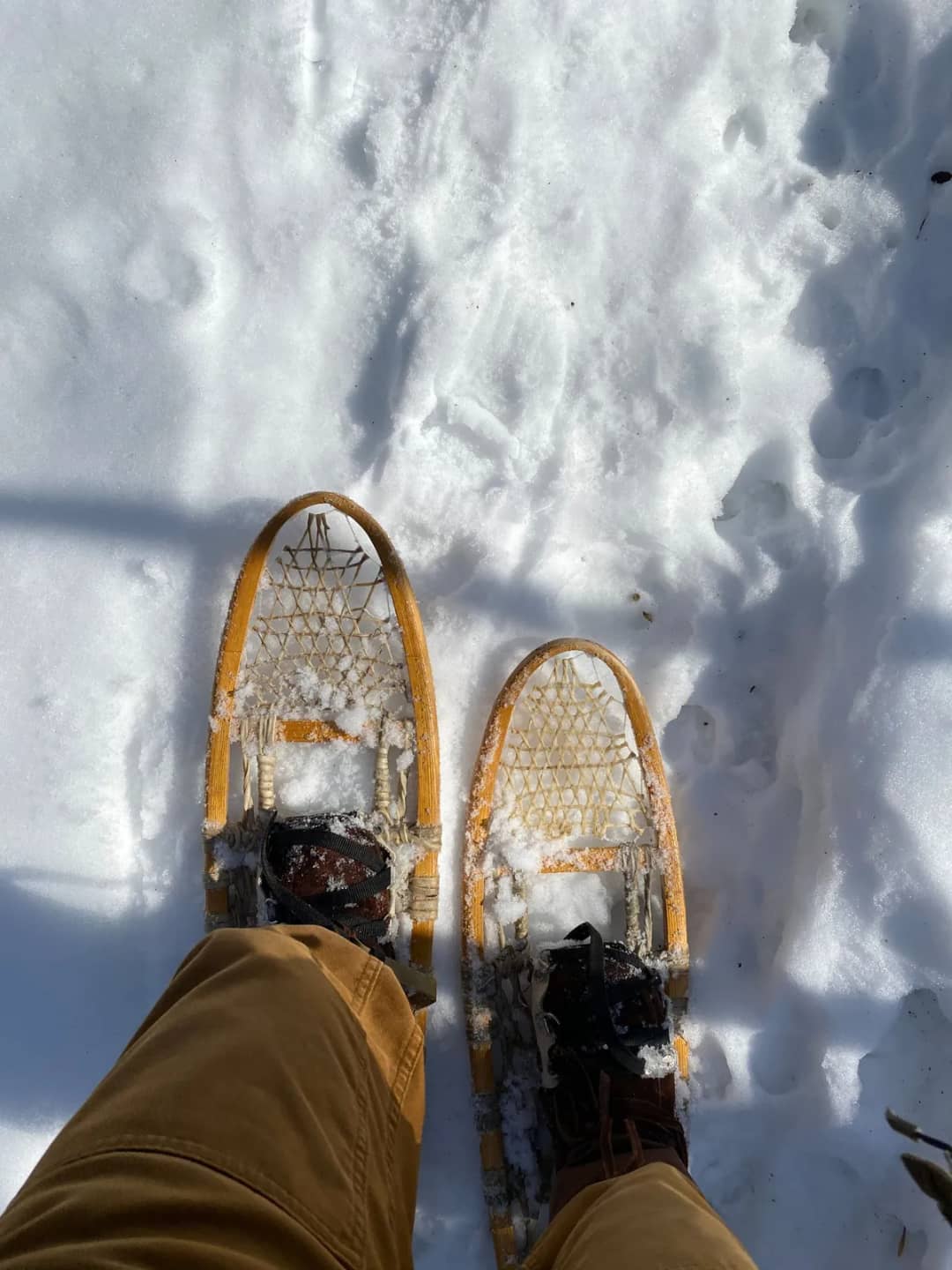
Snowshoeing is easier, and it is not close. On snowshoes you walk, with your feet a little wider than usual, and the only technique is to let the shoe land flat. On cross-country skis you have to glide on a free heel, push with poles, and slow down on skis with no edges. That last part is where most first days end.
The gap shows in how fast people settle. On the blue Sulwald Trail above Isenfluh, where Pierre Vetsch guides our snowshoe mornings, a beginner walks normally after 10 to 15 minutes, and the most common mistake is simply feet placed too close together, so one shoe steps on the other. The full method is in our guide on how to snowshoe as a beginner.
Cross-country skiing has no equivalent shortcut. The classic technique needs a kick, a glide and a weight shift from one ski to the other, and the skating technique needs more balance still. A ski instructor told Pierre, when he asked about trying it: take a lesson first. He did not, and the next section tells you how that went.
Pierre Vetsch, founder and head guide, says: when a guest asks whether to spend a first winter day on snowshoes or on cross-country skis, his answer is "snowshoes, without hesitation". Not because skiing is bad, but because a beginner on snowshoes spends the morning looking at the mountains, and a beginner on skinny skis spends it looking at his feet.
Which one tires you out more?
Cross-country skiing burns more per hour at the pace people actually ski, but fresh snow turns snowshoeing into the harder workout. The 2024 Compendium of Physical Activities rates moderate snowshoeing at 5.3 METs, vigorous snowshoeing at 10.0, and cross-country skiing at 6.8 when slow, 8.5 at a moderate speed and 11.3 when brisk.
A MET is a multiple of the energy you spend sitting still, so 8.5 METs means roughly eight and a half times your resting rate. For comparison, the same compendium puts moderate downhill skiing at 6.3 METs and slow hiking at 3.8. On a groomed trail, snowshoeing sits between a hike and a ski day; on a loipe, cross-country skiing sits above both, which is why it has a reputation as the fittest sport on snow.
The number that matters on a real morning is the snow under your feet. Asked what tires a guest more in one hour, snowshoeing off the track in fresh snow or cross-country skiing on the loipe, Pierre picks the fresh snow. On the Sulwald loop, the moment the group breathes hardest is always off the track, in fresh snow, never on the packed trail. Our article on whether snowshoeing is hard goes through that in detail, knees included.
Fun fact: the Compendium of Physical Activities, maintained by researchers at Arizona State University and partners, lists cross-country skiing at 16.0 METs for elite racers at 12 to 16 mph, the same bracket as competitive speed skating. Nobody on the Grindelwald loipe is doing that, and you do not need to.
Where can you snowshoe or cross-country ski near Interlaken?
Snowshoeing happens on marked trails above the valleys, cross-country skiing on groomed loipes on the valley floor. From Interlaken Ost, the Swiss timetable for 15 January 2027 gives 43 minutes to the Isenfluh cable car and 36 minutes to Grindelwald, so both are a morning trip, and both are reachable without a car.
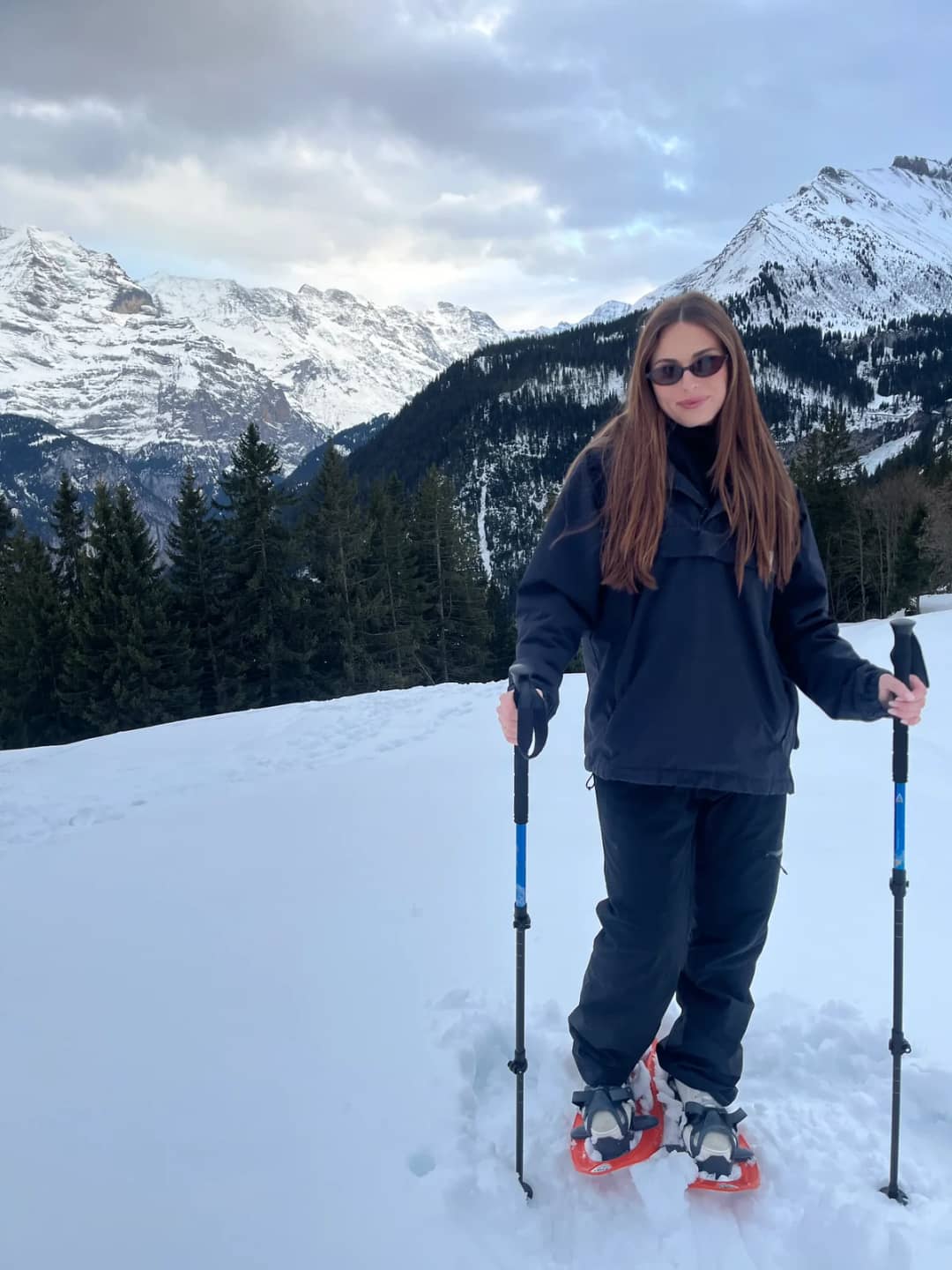
For snowshoes, our snowshoe trails around Interlaken guide lists 12 marked trails in eight areas. The one we use with guests is the blue Sulwald Trail above Isenfluh, about an hour of walking with 170 m of climb, reached by the small red cable car from Isenfluh. Mürren's Chänelegg Trail is where Pierre went on his own first snowshoe outing, and it is the one he names for a first solo day.
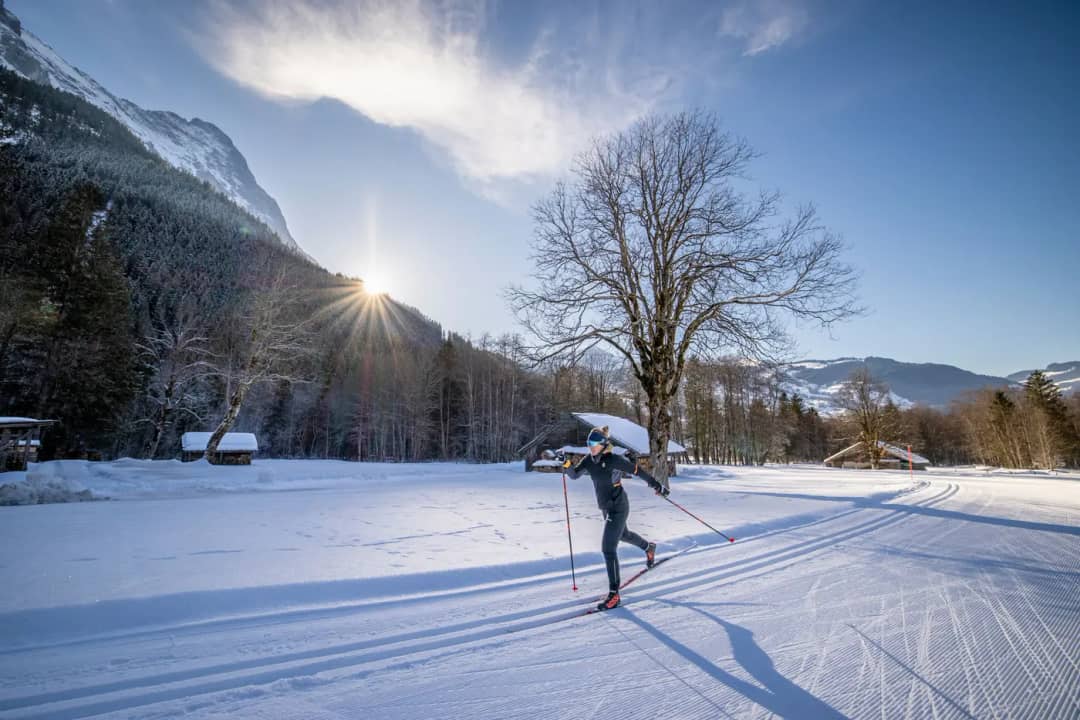
For cross-country skis, Pierre sends guests to the Grindelwald loipe, in the valley below the Eiger: 9 km of classic track and 10.5 km of skating lane, according to Grindelwald Tourism, with a small cloakroom at the Aspi golf club, no showers, and daytime use only, since there is no lit night loipe. Lauterbrunnen Tourism also lists a classic and skating loipe on the valley floor between the cliffs, without publishing its length. On 26 October 2026, the Grindelwald page still reads "closed, end of season" and announces the 2026/27 winter, so check it before you go.
Insider tip: the Grindelwald loipe is flat enough for a beginner, but it is still a loipe, with the brake-free descents that caught Pierre out. If you want a first glide with a safety net, Grindelwald lists cross-country schools and the Swiss Ski School next to the sports shops, and a one-hour lesson there costs less than a day of falling.
What does a day of each cost near Interlaken?
Snowshoeing costs CHF 16 for the Isenfluh cable car return plus CHF 15 for snowshoes; cross-country skiing costs CHF 10 for a Grindelwald day pass plus ski rental, which the shops price on site. Both are among the cheapest ways to spend a winter day in the region, and both are far below a ski pass.
Here is the comparison as read on 26 October 2026, with every number repeated in the text below the table.
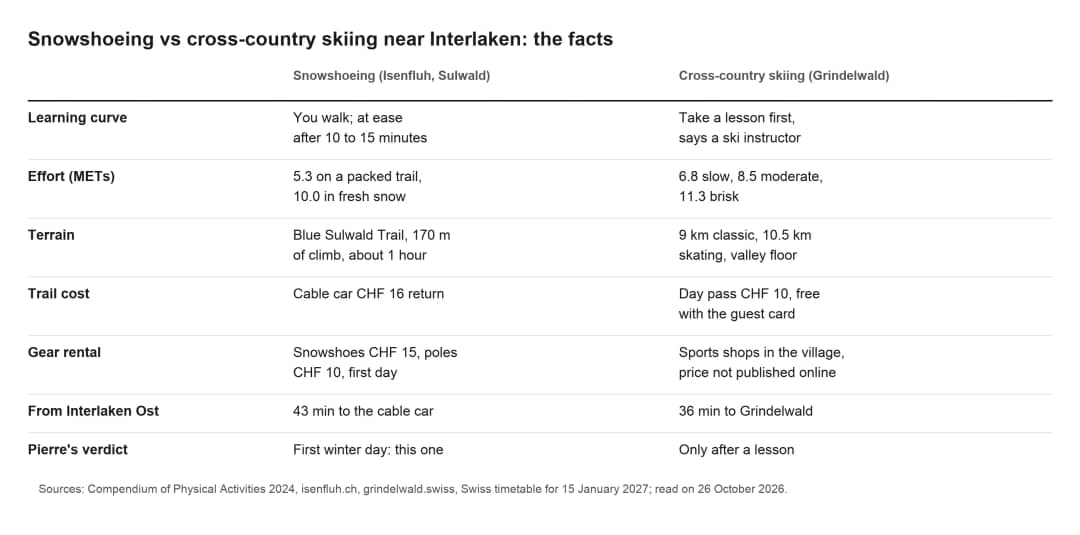
On the snowshoe side, the Isenfluh cable car charges CHF 10 single and CHF 16 return for an adult, CHF 5 and CHF 8 for a child, and group rates from six people, prices from its website on 26 October 2026. The cable car rents sleds for CHF 7 and a Velogemel for CHF 8, but no snowshoes, so rent in Interlaken: Swiss Alpine Guides in Matten lists snowshoes at CHF 15 and poles at CHF 10 for the first day, read the same day. The full packing list is in our guide to what to wear snowshoeing.
On the ski side, Grindelwald Tourism sells a loipe day pass for CHF 10, a week for CHF 35, a Grindelwald season pass for CHF 50, and the Swiss cross-country pass for CHF 160, valid on the 160 loipe organisations that Loipen Schweiz lists, with one franc per pass going to youth skiing. With the Grindelwald guest card, which hotels issue to overnight guests, the loipe is free. Rental of skis, boots and poles happens at the village sports shops, and none of them publishes a cross-country price on the tourism page, so count on asking.
Pierre says: his own snowshoe mornings cost CHF 129 per person, CHF 119 from six, and when a guest hesitates at the price he lists what is inside: the transport from Interlaken, the cable car, the snowshoes and poles, the guide, and the fondue at the top. Most people do the sum themselves and stop hesitating.
What happened when Pierre tried cross-country skiing?
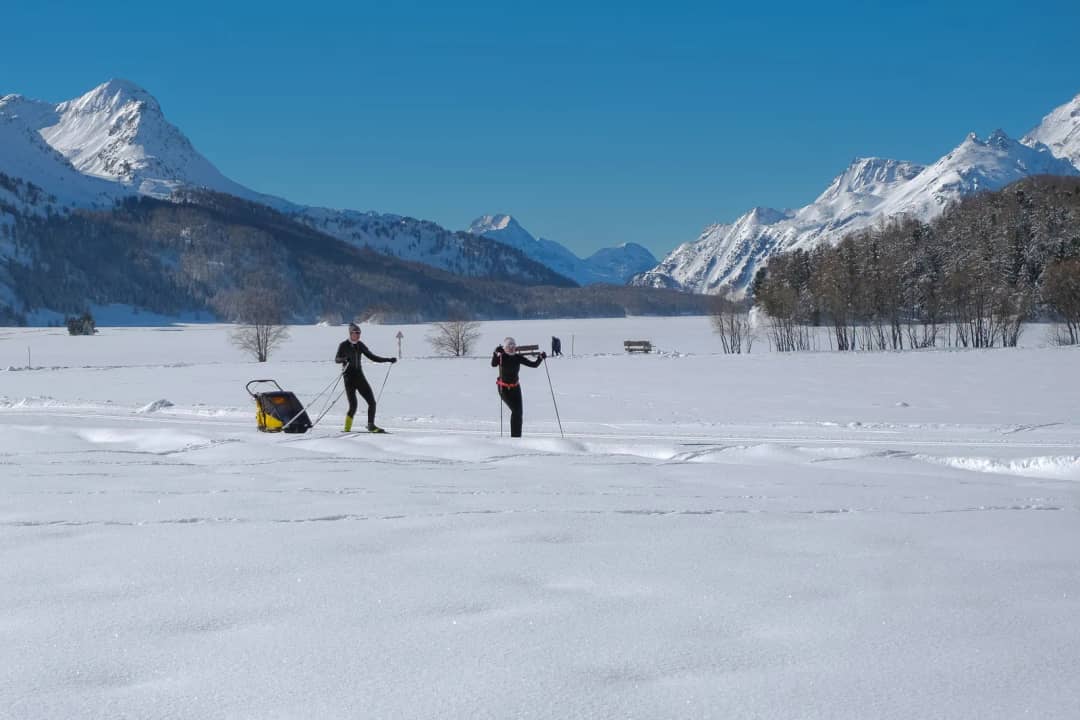
He fell on the first descent. Pierre Vetsch is a ski instructor by training, Austrian Landesskilehrer, and he assumed that alpine skills would carry over to a loipe in Austria. They did not. The skis felt too narrow to hold a line, there are no edges to brake with, and on the first small drop he went down.
That fall is the most useful thing in this article, because it is exactly the mistake he sees visitors make with the choice. Asked what people get wrong between the two sports, his answer is that they think cross-country skiing is easy: "skiing on the flat", so they skip the lesson and spend the hour on the ground. The flat is not the problem. The gentle descent at the end of the flat is.
A ski instructor had told him to take a lesson first. Our own pages on skiing near Interlaken say the same about alpine skiing for a reason: in Switzerland, a first day with an instructor is cheaper than a first day with a physiotherapist. On snowshoes, by contrast, Pierre counts zero falls per guided outing on the Sulwald loop, across an entire winter.
Pierre says: the one line he keeps from that day in Austria is the instructor's. "Take a lesson first." He would say it to any guest who wants to try cross-country skiing in Grindelwald, and he would say it before they rent the skis, not after.
Snowshoeing vs cross-country skiing: the verdict for a first winter day
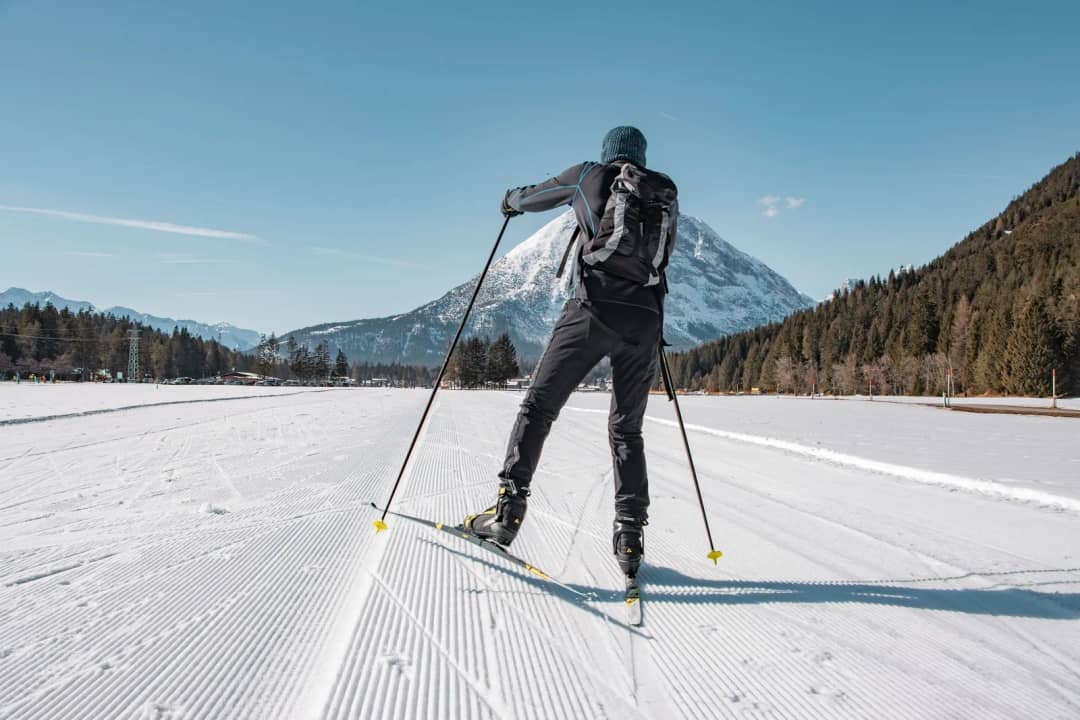
Snowshoeing wins for a first day, cross-country skiing wins for a second winter. If you have one morning near Interlaken, no experience, and you want to be in the mountains rather than on a valley loop, rent snowshoes or join a guided loop. If you live here, or come every year, cross-country skiing is the better long game: faster, fitter, and the Grindelwald loipe costs CHF 10 a day.
Three facts settle it for a beginner. First, time to comfort: 10 to 15 minutes on snowshoes against a lesson on skis. Second, where you go: snowshoe trails climb to places like Sulwald and the Chänelegg with the Eiger in view, while loipes stay on the valley floor by design. Third, risk: a snowshoe fall is a sit-down in soft snow, and we do not see them on the blue trail; a cross-country fall happens at speed on a hard track.
The honest case for skis is also real. On a groomed loipe you cover 9 km in the time a snowshoe group covers three, the workout is bigger at any pace above a stroll, and once the glide clicks it is the most elegant way to move on snow. That click rarely comes on day one. Our guide to winter activities in Interlaken ranks both among the ways to spend a day without a ski pass.
Insider tip: if the loipe tempts you, do it as the second half of a stay. Snowshoe first, so you have a mountain morning in the bank, then book a one-hour cross-country lesson in Grindelwald and buy the CHF 10 day pass afterwards, not before. If the lesson shows you are not a glider, you have lost an hour, not a day.
What if there is little snow, or you want both?
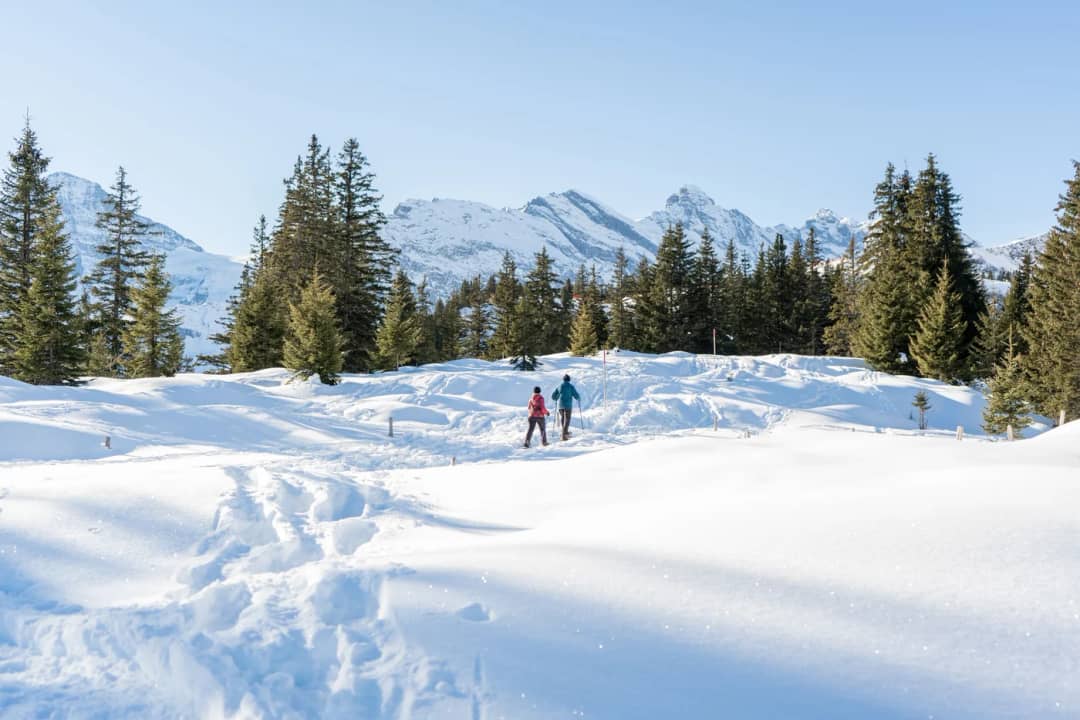
Little snow hurts cross-country skiing first, because a loipe needs a groomed base, while a snowshoe trail works on a few days of fresh snow. Pierre's rule is to check the day before: Sulwald tells him how much fresh snow fell, and Peter at the Isenfluh cabin gives him the temperature at the top, the state of the snow and the wind.
For skis, Grindelwald Tourism publishes a cross-country trail report on the same page as the passes, and the loipe was marked "closed, end of season" on 26 October 2026, waiting for the 2026/27 opening. In an early December with a thin base, that report decides your morning. For snowshoes, the risk is reversed: too little snow on the trail means ice and stones under the shoe, which is why our guide to snowshoe safety names "not enough snow" as the real hazard above Isenfluh, not avalanches.
Doing both in one day is possible on paper, Isenfluh in the morning and Grindelwald in the afternoon, but December daylight ends around five and the two valleys sit on different train lines from Interlaken Ost. Two days, one sport each, is the version that works. Pierre's month for the quietest trails and the most sun is March, when the snow at Sulwald is still deep and the valley loipes are often already soft by noon.
Pierre says: his own weather calls on the Sulwald loop have only ever been for wind and rain, never for avalanche risk, because the blue trail stays on safe ground. The morning he turned back was a fog day, when the markers disappear. Snowshoes forgive a lot; they do not forgive not seeing the next pole.

Your Questions About Snowshoeing and Cross-Country Skiing
Which burns more calories, snowshoeing or cross-country skiing?
Cross-country skiing, at the speeds most people hold. The 2024 Compendium of Physical Activities puts moderate cross-country skiing at 8.5 METs against 5.3 METs for moderate snowshoeing, so an hour on the loipe costs roughly 60 percent more energy than an hour on a packed snowshoe trail. The order flips in fresh snow: vigorous snowshoeing off the track rates 10.0 METs, above the moderate ski figure. For a 70 kg person, 5.3 METs is about 370 kcal an hour and 8.5 METs about 600, using the standard formula of METs times weight in kilos per hour. Treat these as orders of magnitude, not a diet plan, because the slope, the snow and your pace move them by a third either way.
Can you cross-country ski without lessons?
You can, and most people who try it this way spend the first hour falling, which is what happened to Pierre in Austria despite his alpine training. The flat parts are manageable after a few hundred metres; the descents are not, because cross-country skis have no metal edges and the heel is free. Grindelwald lists cross-country schools next to its loipe and sells the CHF 10 day pass at the Aspi cloakroom, so the practical order is lesson, then pass. If you have budget for one of the two, take the lesson and ask the school about trying their skis during it. A ski instructor gave Pierre exactly that advice, and he regrets not following it.
Do you need a guide to go snowshoeing near Interlaken?
No, not on an open, marked trail like the blue Sulwald Trail or the Chänelegg above Mürren, as long as you go with company and check the conditions. The cable car cooperative at Isenfluh grades blue trails as suitable for beginners, with no traverses and no steep passages. What a guide adds is the local check that morning, the equipment, the route on a day when the markers are hard to see, and the fondue. Our pillar on snowshoeing near Interlaken explains how to read the trail colours and when a red trail stops being a beginner's walk.
Is cross-country skiing or snowshoeing better for knees?
Both are gentler on the knees than downhill skiing or running, and snowshoeing is the gentler of the two for a beginner. On a loipe the knees work through the glide and take the shock of a fall at speed; on snowshoes the shoe lands flat and the snow absorbs the step. In a full winter of guided mornings on the Sulwald loop, Pierre hears a knee complaint on the descent rarely, and the fix is the one from our beginner's guide: knees bent, weight back, small steps. If you already have a knee issue, poles help on both sports, and the snowshoe trail lets you set your own pace in a way a groomed track with other skiers behind you does not.
Pick the one you can do on day one
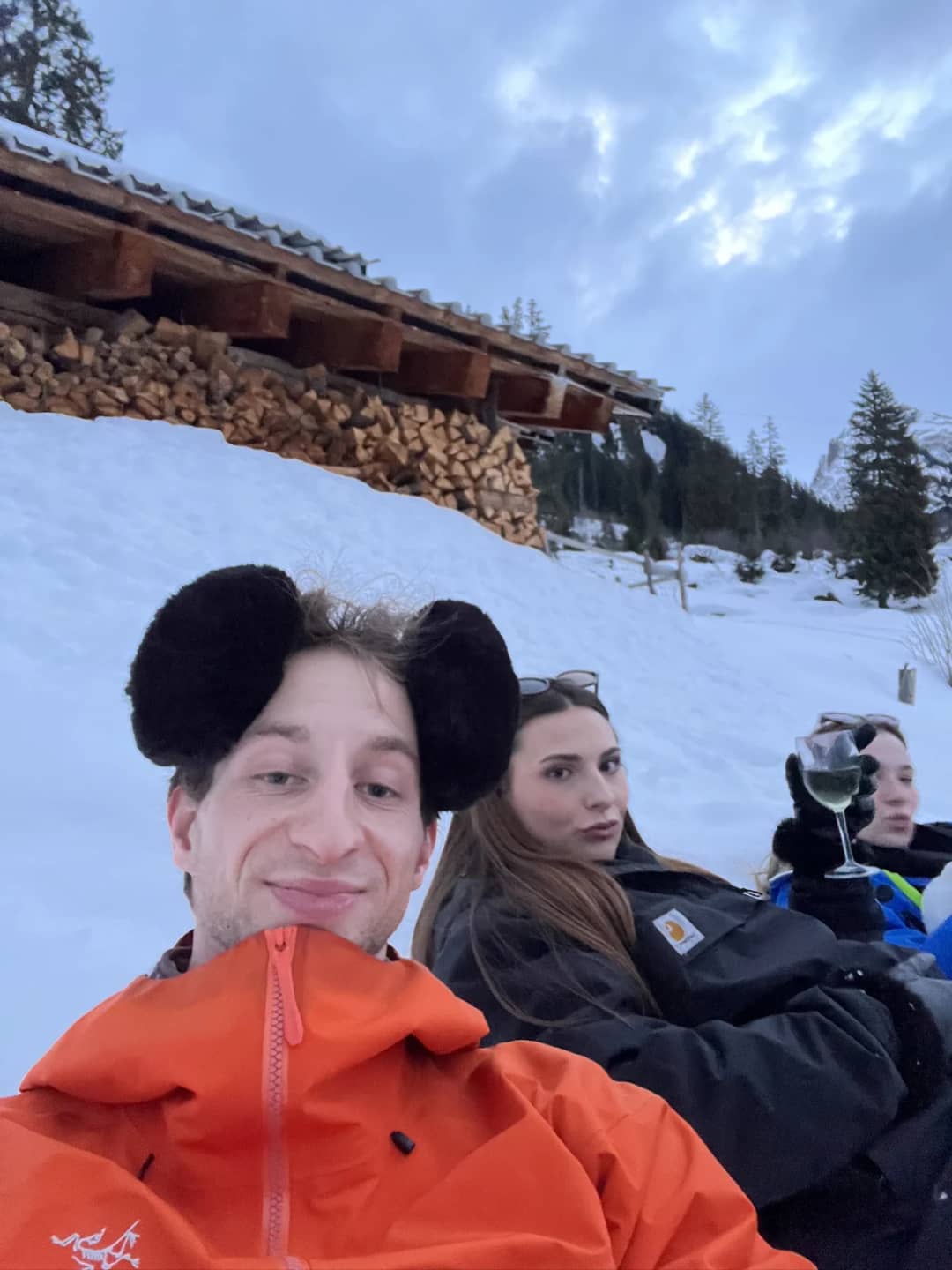
The usual worry at this point is that snowshoeing is the lesser choice, the one for people who cannot ski. On the Sulwald loop that worry lasts about ten minutes, until the group walks into the forest and stops talking. The moment guests mention afterwards is the silence, and then the fondue at the top. Cross-country skiing will still be there next winter, with a lesson booked first.
If you want that first morning done properly, with the cable car, the snowshoes and poles, a guide who has checked the snow that day, and a fondue at the top, join our snowshoe tour with Swiss cheese fondue from Interlaken, eight guests at most, from 10 years old.
How we made this: based on Pierre's interview of 26 October 2026, facts and prices checked at the official sources on 26 October 2026, written with AI assistance.
Source: Grindelwald Tourism, cross-country skiing, Loipen Schweiz, Swiss cross-country pass, Compendium of Physical Activities, winter activities, and guided snowshoe mornings at Sulwald with Swiss Local Adventures, 2025-2026.
*Written by Pierre Vetsch, founder and head guide at Swiss Local Adventures
Tags
#snowshoeing-vs-cross-country-skiing#snowshoeing-interlaken#cross-country-skiing-grindelwald#winter-activities-interlaken#snowshoeing-for-beginners
Sources & References
- •Grindelwald Tourism, cross-country skiing (loipe, passes, trail report, read 26 October 2026)
- •Loipen Schweiz, Swiss cross-country pass CHF 160 (read 26 October 2026)
- •Lauterbrunnen Tourism, cross-country skiing (read 26 October 2026)
- •Compendium of Physical Activities 2024, winter activities (MET values, read 26 October 2026)
- •Compendium of Physical Activities 2024, walking (hiking MET values, read 26 October 2026)
- •Isenfluh-Sulwald cable car, prices (read 26 October 2026)
- •Swiss Alpine Guides, Matten, rental prices (read 26 October 2026)
- •Swiss timetable, Interlaken Ost to Grindelwald and to Isenfluh, 15 January 2027
- •Snowshoe Tour with Swiss Cheese Fondue, Swiss Local Adventures (read 26 October 2026)
- •Photos: David Birri / Jungfrau Region Tourismus (CC0), Grindelwald loipe and cross-country skier
- •Photo: Jungfrau Region Tourismus AG (CC0), Chänelegg Trail, Mürren
- •Photo: Tobi & Chris on Pexels, cross-country skiing in Tirol
- •Photo: Alexandru MnM on Pexels, cross-country skiers in Switzerland
- •Other photos: Swiss Local Adventures, Sulwald and Isenfluh, winter 2025-2026
Share this article
Similar Articles
Continue your reading with these related articles
Winter
10/26/2026
8 min
Is Snowshoeing Worth It? An Interlaken Guide Answers
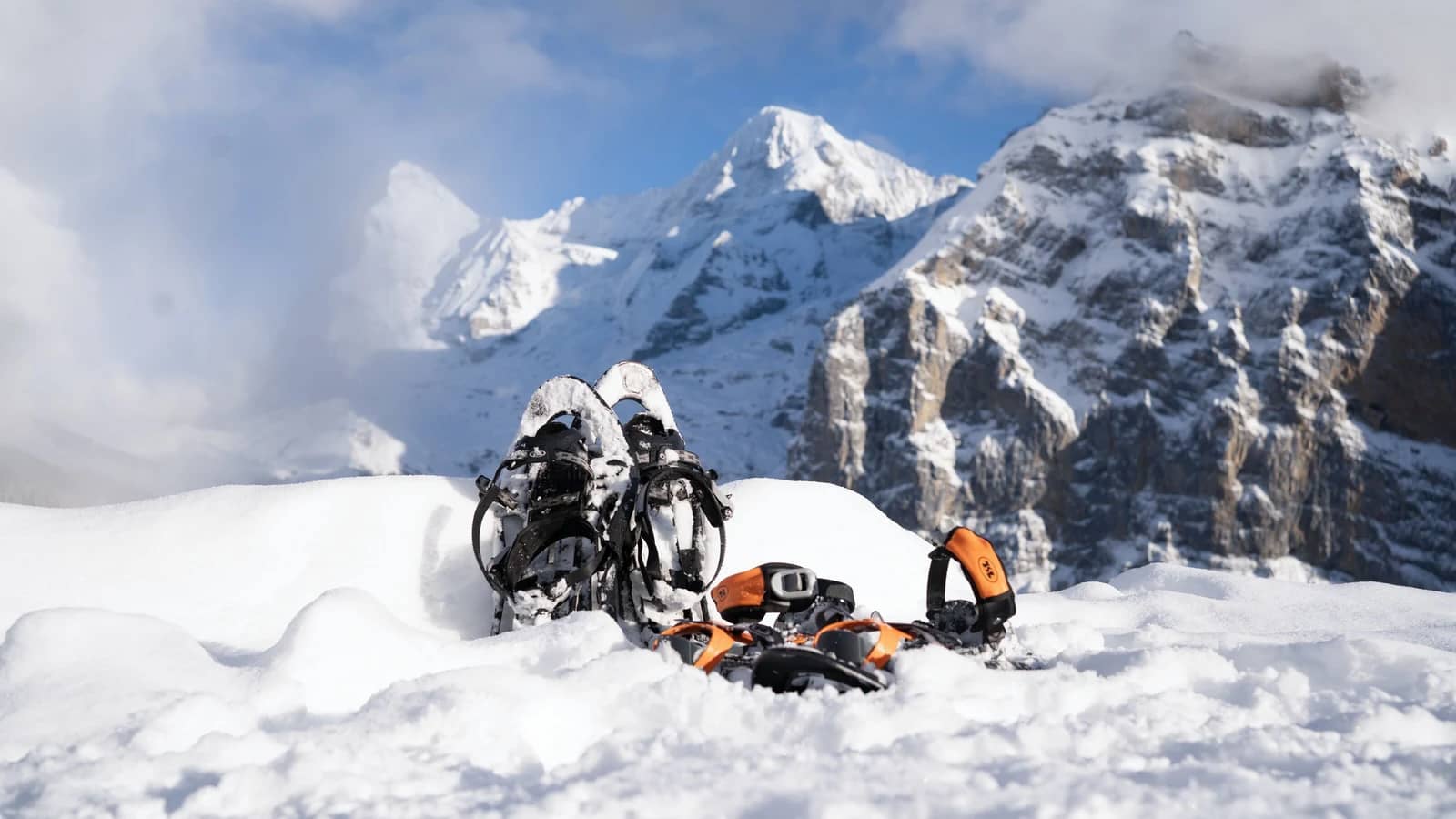
Is snowshoeing worth it? Yes if you like walking: a guide explains what CHF 129 buys above Isenfluh, who should skip it, and when guests say it paid off.
is-snowshoeing-worth-itsnowshoeing-interlakenguided-snowshoe-tour
By Pierre VetschRead More
Winter
10/25/2026
6 min
What Is a Velogemel? Grindelwald's Snow Bike
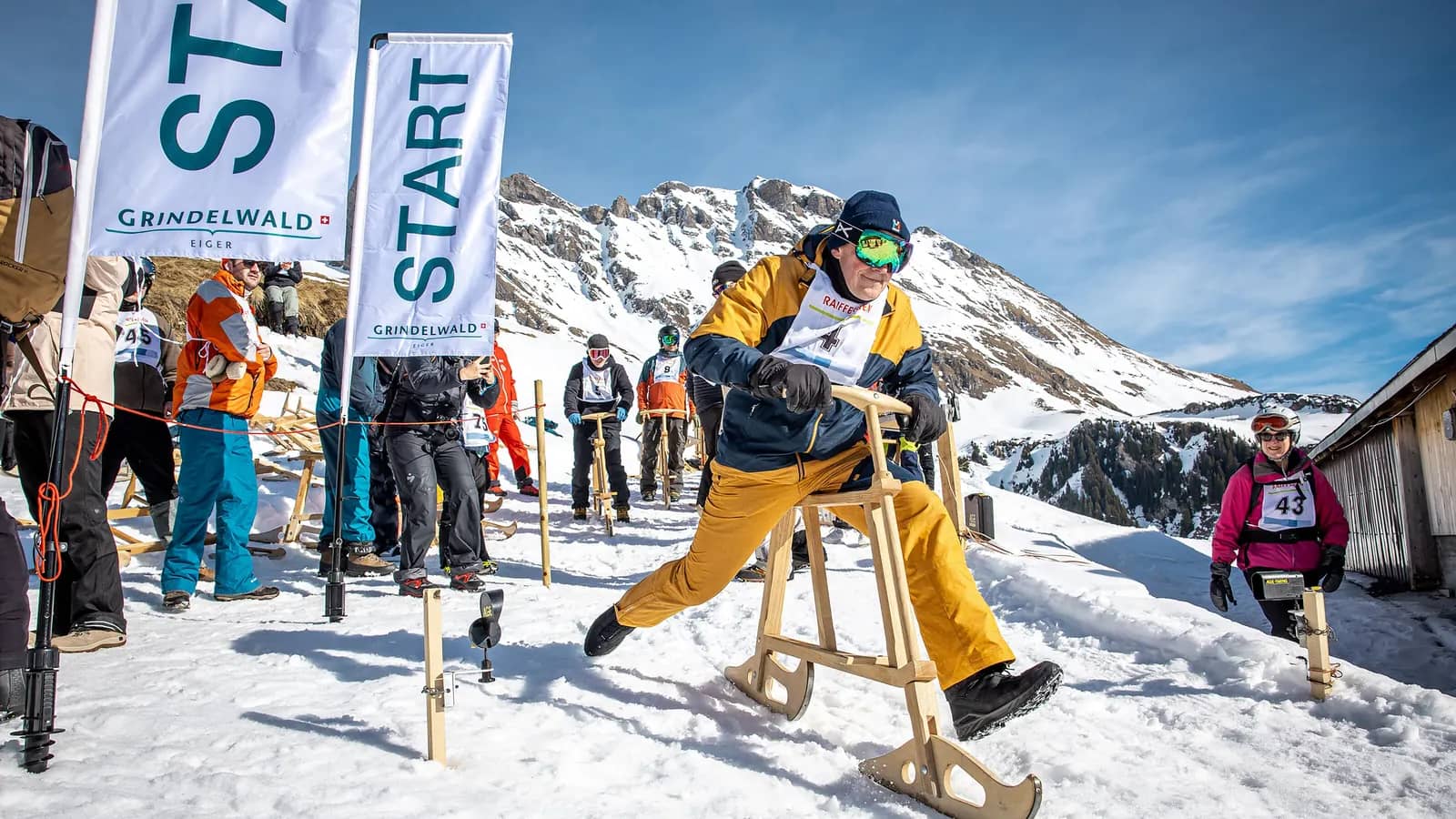
A Velogemel is a wooden snow bike invented in Grindelwald in 1911. Rent one for CHF 8 at Isenfluh, learn how it rides, and see the race on 7 February 2027.
velogemelvelogemel-grindelwaldswiss-snow-bike
By Pierre VetschRead More
Winter
10/25/2026
16 min
Best Sledding in Switzerland: A Guide's Honest Ranking
The best sledding in Switzerland, ranked by a local guide: 10 runs from 2 to 11 km, which ones he has ridden, which to skip. Checked 25 October 2026.
best-sledding-switzerlandlongest-sled-run-switzerlandsled-runs-jungfrau-region
By Pierre VetschRead More