Interlaken
Giessbach Falls Funicular: CHF 14 or Free on Foot
P
Pierre Vetsch
Author
September 4, 2026
17 min
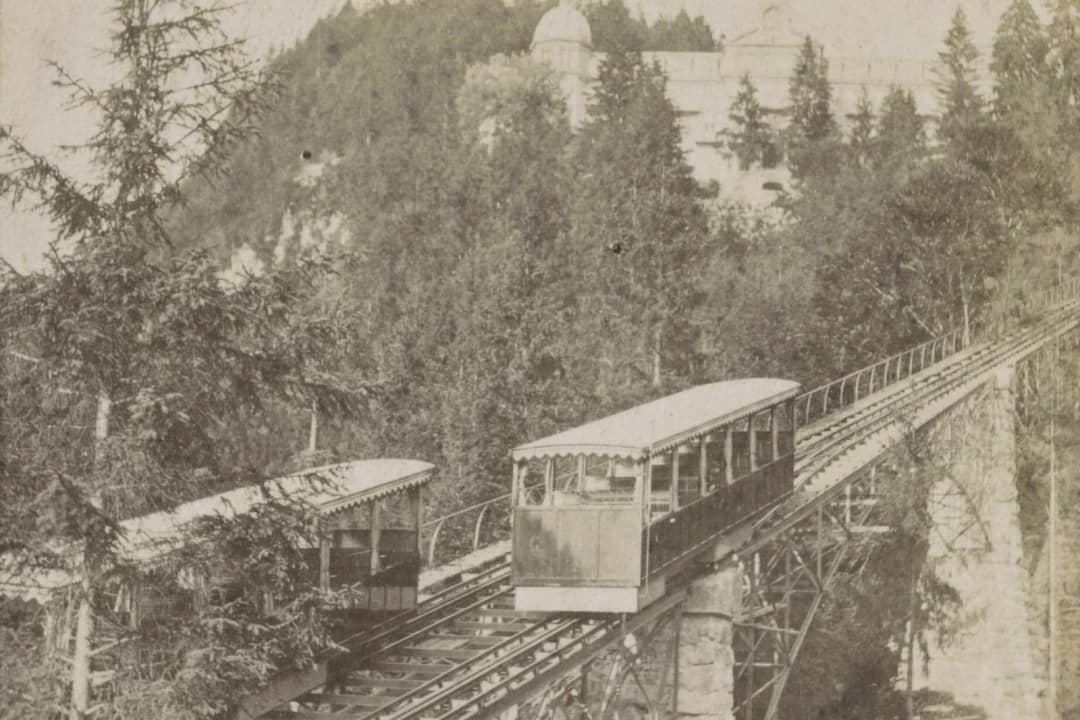
Almost every English page about Giessbach tells you the funicular costs five francs. The 2026 price sheet says CHF 7 one way and CHF 14 return, and the same sheet lists ten travel passes that are not valid on it. The Swiss Travel Pass is one of them.
That is the kind of gap this article exists to close. Giessbach is a waterfall that drops in 14 stages over about 400 metres into Lake Brienz, with a Belle Epoque hotel parked in front of it and Switzerland's oldest working funicular crawling up beside the water. The boat gets you there. Everything after the jetty is a series of small decisions that either cost you money or cost you the last sailing home.
Should you ride the Giessbach funicular or walk up?
Ride it up, walk it down. That is what I advise. The climb from the jetty to the hotel takes about fifteen minutes on a path that gains roughly ninety metres, and the same path takes you past the lower cascades. Paying CHF 7 for the ascent saves your legs for the falls loop, and the descent on foot is free, quicker than waiting, and better looking.
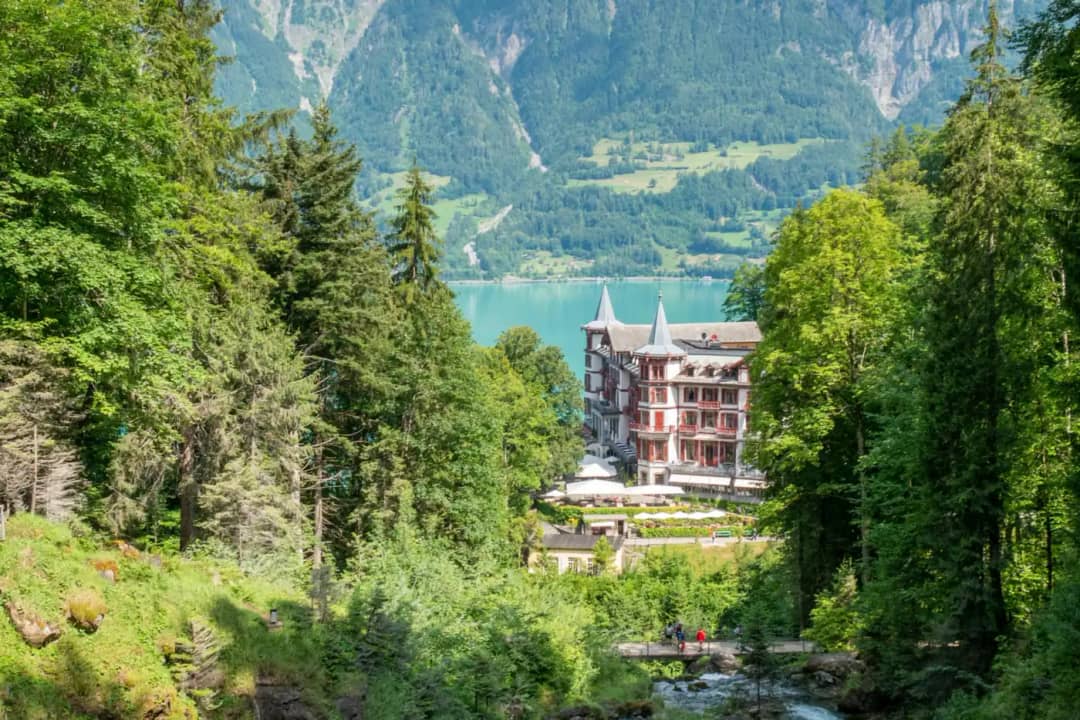
The reason this works is that the two directions are not equivalent. Going up, you are climbing away from the lake with the falls above you and mostly out of sight behind trees. Going down, the lake opens in front of you the whole way and you set your own pace.
There is a second reason, less romantic. The funicular runs to a timetable with gaps in it, and one of those gaps is a lunch break of about forty five minutes. If you arrive at the top wanting to leave at 11.30, you are walking whether you planned to or not.
If someone in the group cannot manage steps, buy the return and ignore all of the above. CHF 14 for two rides on an 1879 machine is not the place to economise.
What does the Giessbach funicular cost in 2026?
Adults pay CHF 7 one way and CHF 14 return. Children aged 6 to 16 pay CHF 3.50 and CHF 7. Children under 6 and dogs travel free, and so do overnight guests of the Grandhotel. A bicycle costs CHF 7 one way, and e-bikes are not carried at all.
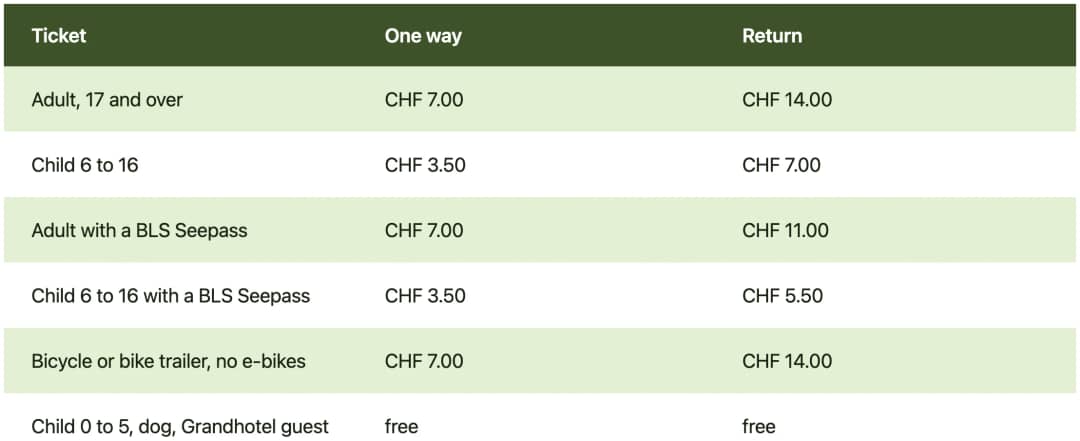
All prices from the operator's own 2026 timetable and price sheet, checked on giessbach.ch on 24 August 2026.
Now the part that catches people at the kiosk. The same sheet names the passes that are not valid: the GA travelcard, the Half Fare travelcard, the Day Pass, the Swiss Travel Pass, the Swiss Card, FVP, the Junior travelcard, the Grandchild travelcard, the Eurail Pass and the Jungfrau Travel Pass.
Read that list again if you built your week around a Swiss Travel Pass. The boat to Giessbach is covered by it. The four minutes of funicular at the end are not, and there is no reduction either. Groups of eleven or more get a special rate, but only with a reservation placed at least two days ahead on +41 33 952 25 98.
You can buy at the machine or from the kiosk staff at either station, or online in advance. The forum advice about needing cash is out of date, and so is every page still printing CHF 5.
When does the funicular run, and which boat can you catch back?
In summer, 23 May to 11 October 2026, the funicular works from 10.00 to 18.00 with a break late morning. Ten of the descents connect to a scheduled boat. The last descent of the day is 17.40 for the 17.51 sailing to Interlaken Ost, and the last ascent at 17.55 has no funicular coming back down after it.
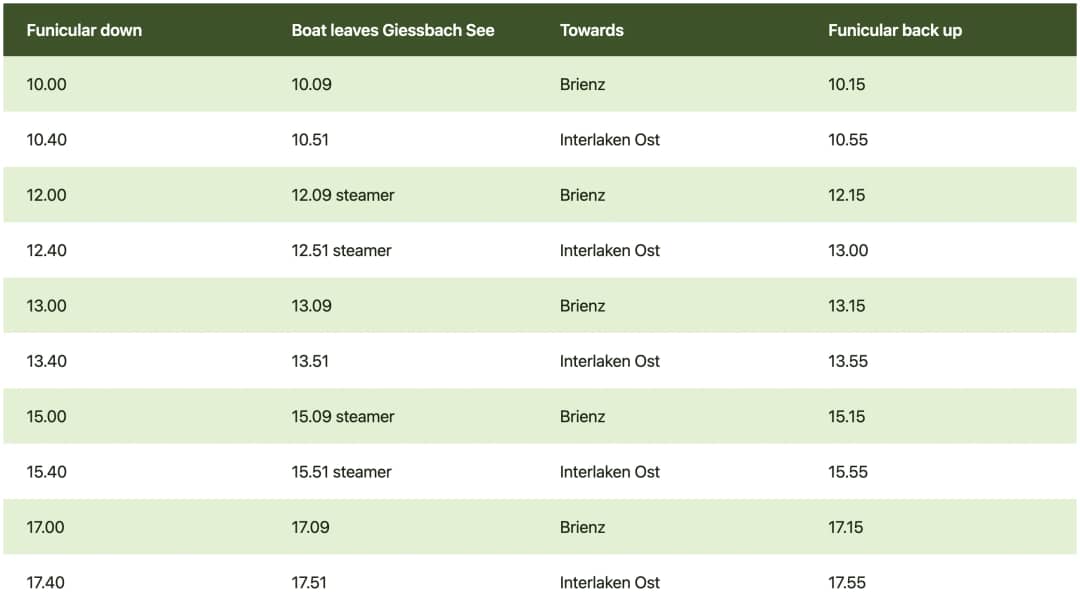
Summer timetable 23.05 to 11.10.2026, read off the operator's own sheet on 24 August 2026. Extra runs at 10.20, 13.20, 14.20, 15.20, 16.20 and 17.20 are printed with an asterisk and the sheet states they operate only during high demand.
Three things this table tells you that no other page does.
Six of the 22 printed descents are conditional. Every asterisked run exists only if enough people are waiting. Plan on the ten above and treat the rest as luck.
There is a hole in the middle of the morning. After the 11.00 descent and the 11.15 ascent the machine stops until 12.00. Arriving on the 10.09 gives you two clear hours; arriving later gives you a wait.
The last ascent is a trap. The 17.55 goes up and nothing comes down after it. Take it only if you are eating at the hotel or walking down in the dusk.
The operator says it plainly on the sheet: at busy times waiting can build up and the connection to the boat cannot be guaranteed. Be at the top station ten minutes early, not two.
Outside summer the service thins to almost nothing. From 12 to 25 October 2026 it runs daily, then 28 October to 6 December on Wednesday to Sunday only, with two boat connections each way: down at 12.45 for the 12.56 to Brienz, down at 13.25 for the 13.34 to Interlaken, then 15.50 and a final 16.20. In spring, 3 April to 22 May, the hours are 11.00 to 17.00.
One contradiction worth knowing about, because it sits on the operator's own website. The arrival page says the funicular and the boats do not run in winter. The 2026 timetable sheet lists service to 6 December. Both are true at different moments: the season closes on 6 December and nothing runs again until the spring timetable.
How do you reach Giessbach Falls without a car?
By boat, and it is not close. The BLS boat from Interlaken Ost takes about an hour to Giessbach See, and from Brienz about eleven minutes. In summer five sailings a day serve the jetty in each direction. The alternative is a PostBus to the road junction and a fifteen minute climb.
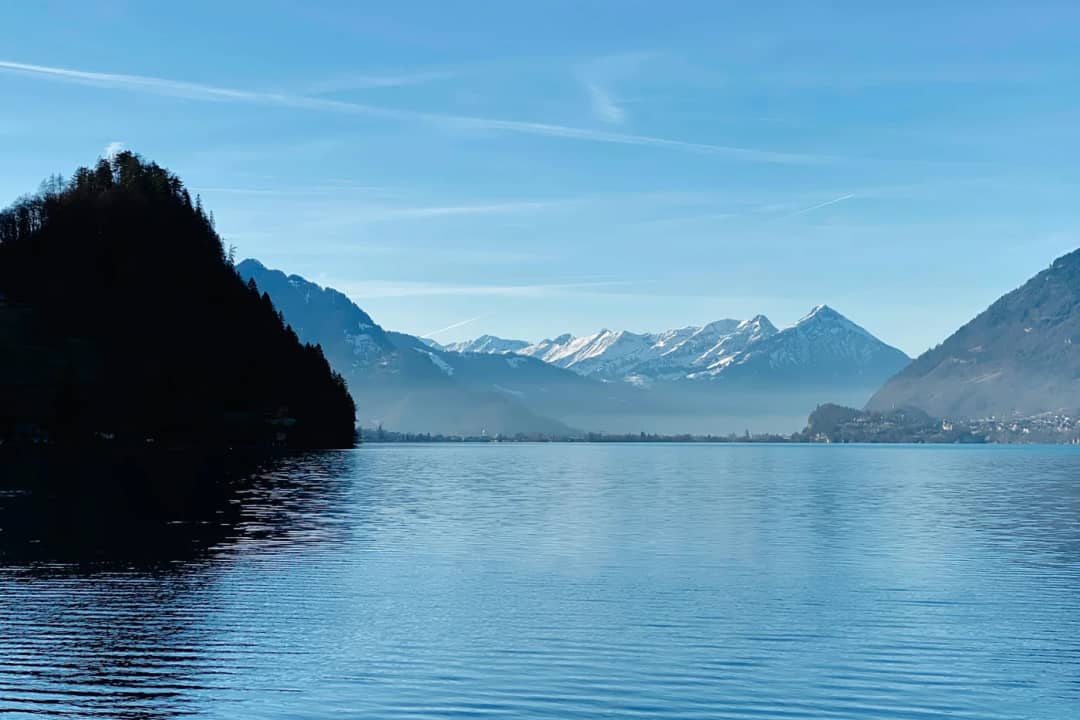
The boat is the obvious answer and the one every review reaches for. One poster on the Rick Steves forum, asked how to get there with limited mobility, answered simply that the easiest is by boat.
The bus deserves a paragraph because it works when the boats do not. The PostBus towards Axalp stops at Giessbach Junction, on the main road well below the site, and from there the hotel's own arrival page describes a fifteen minute walk uphill past the waterfalls. It is a real option in November and a poor one with luggage.
Two more routes that surprise people:
By car. The road comes off the A8 at the Brienz Giessbach exit. Day visitors have to buy an online ticket for the Giessbach Nature Park, CHF 15 in summer and CHF 10 in winter, and the site warns that only a limited number of paid day spaces exist. Five 11 kW charging points sit in the car park.
The hotel shuttle. It leaves Brienz station at 9.40, 14.40 and 16.40 and it is free, but only for overnight guests, and only if you reserve 24 hours ahead on +41 33 952 25 25.
For wheelchairs there is one answer and the operator gives it himself: the funicular is not accessible, so take a taxi from Brienz station up to the hotel level.
What is the free path up to the falls actually like?
It is a proper climb, not a stroll. From the jetty to the hotel terrace the path gains about ninety metres in fifteen minutes, on made-up surface with steps and a handrail where it needs one. Above the hotel a loop of roughly a kilometre crosses the cascades, and one section passes behind the falling water.

The behind-the-water section is the thing people remember. It reads like a gimmick and it is not: the path cuts into the rock behind one of the fourteen stages, so you stand inside the noise looking out through the sheet of water at the lake. A family blogger put the appeal exactly right, calling it a path that runs behind the water, so you don't get wet. On a warm day you get wet anyway from the spray, which is the point.
I was there on 25 July 2026 with Ismael, who guided that tour. The passage behind the falls was open, and the steps were dry. From the jetty the path climbs about 90 metres, from 571 to 661 metres, by the Swiss funicular register.
Where the loop earns its reputation is the middle third, between the second and third bridge, where the path leaves the trees and you get the falls, the hotel roof and the lake in one frame. That is the photograph everyone comes for and most people take it from the terrace instead, three hundred metres too low.
The lower part of the walk, from the funicular top station to the first viewpoint, is paved or smooth gravel and easy with a stroller according to parents who have done it. The upper loop is not. There is a small playground and a grass bank at hotel level, which is where families with a toddler should stop and stay.
Why does a Belle Epoque grand hotel stand in front of a waterfall?
Because a Swiss hotel dynasty built one there in the 1870s and the Swiss public refused to let it be demolished a century later. The Grandhotel Giessbach went up in 1873 and 1874 to plans by the architect Horace Edouard Davinet and opened in 1875. It closed in 1979, faced a demolition application in 1981, and was bought in 1983 by the campaigner Franz Weber.
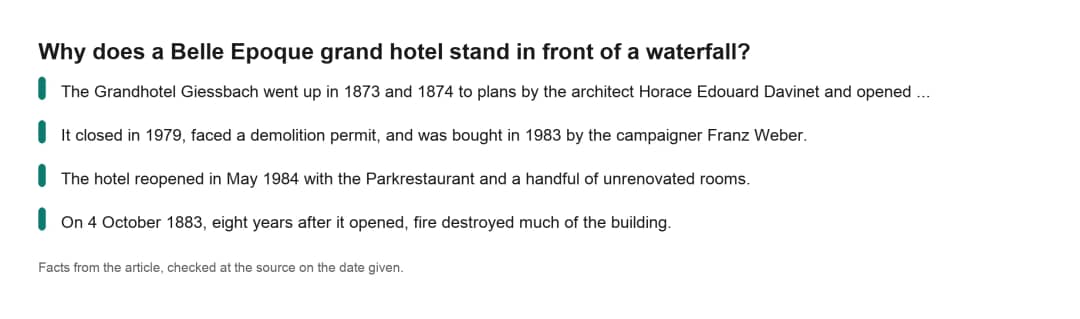
The detail that makes the story land is what Weber did with it. He raised the money by public subscription and put the property, all 22 hectares of it, into a foundation with a name that says everything: Stiftung Giessbach dem Schweizervolk, the Giessbach Foundation for the Swiss People. The hotel reopened in May 1984 with the Parkrestaurant and a handful of unrenovated rooms. It is still run under the foundation, by Parkhotel Giessbach AG.
There was an earlier near-death too. On 4 October 1883, eight years after it opened, fire destroyed much of the building. It reopened in July 1884 rebuilt in Swiss timber style with a completely different roof, and with the first electric lights the site had seen.
Two footnotes for people who like their history recent. The hotel turned 150 in 2025. And in spring 2026 Martin Scorsese shot scenes for What Happens at Night here with Leonardo DiCaprio and Jennifer Lawrence over four days, as reported by SWI swissinfo.ch.
The funicular is the same story in miniature. It opened on 21 July 1879, built by Maschinenfabrik Aarau under Niklaus Riggenbach with Roman Abt as engineer, and it was the first funicular in the world with a passing loop, the mechanism you can watch working at the midpoint. Water ballast drove it until 1912, a Bell water turbine until 1948, and an electric motor after that. It carried 98,305 passengers in 2024.
Its two numbers are worth pinning down. The track is 346 metres long and the climb is 90 metres, from 571 metres at the jetty to 661 metres at the hotel, according to the Swiss funicular register. Each car holds 40 people.
"On our 25 July tour, what marked the guests most was the Grandhotel terrace."
Pierre Vetsch, founder of Swiss Local Adventures
Where can a day visitor eat at Giessbach?
On the Kehrli Terrace, and realistically only there. It opens 1 May to 30 September 2026, daily 11.00 to 17.30, with food served 11.30 to 17.15, no reservation needed and usually space for people who just turn up. The Parkrestaurant serves dinner only. The bistro is small and books out.
That timing matters more than it looks. Food stops at 17.15 and the last funicular down leaves at 17.40. If you arrive on the 15.09 boat you have a comfortable window. If you arrive on the 17.09 you have missed lunch and you are catching the last car down.
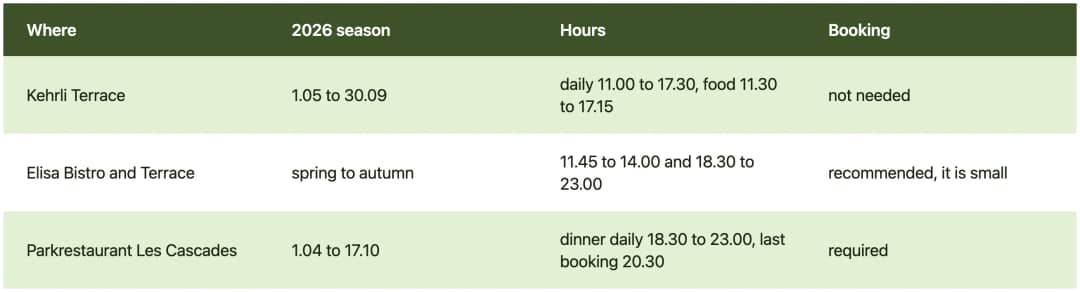
Checked on giessbach.ch on 24 August 2026.
The number to keep in your phone is +41 33 952 25 25. Two hours of notice from the boat is usually enough to sort out a table, and in heavy rain the terrace menu moves indoors to the Parkrestaurant from 13.45.
There is also a combined ticket if you want the whole thing arranged. BLS sells Giessbach Time Travel: return boat from Interlaken Ost, return funicular and a three course lunch at the Grandhotel, from CHF 80 with a Half Fare Card in second class and up to CHF 136.80 in first, valid daily 3 April to 11 October 2026, up to nine people, lunch reserved separately.
When should you go, and what closes when?
June to late September, and if you can pick a day, pick a Saturday in June. The falls are fed by snowmelt and rain rather than by a glacier, so they run hard in early summer and thin out in a dry August. The site's usable season is set by the funicular and the boats, not by the weather.

Month by month, this is what actually changes:
April and May. Boats from 3 April, funicular from 3 April on the 11.00 to 17.00 spring timetable, terrace from 1 May. High water, cold spray, nobody there.
June to August. Everything open, the 10.00 to 18.00 timetable, and the paddle steamer Lötschberg on the 12.09, 12.51, 15.09 and 15.51 sailings from Wednesday to Sunday.
September. The best compromise. Full summer hours, the terrace open to the 30th, the steamer to the 27th, and the crowds gone from the second week.
October. It unwinds fast. Terrace shuts 1 October, the summer boat and funicular timetable ends 11 October, the hotel restaurants close 17 October, daily funicular service ends 25 October.
November to early December. Wednesday to Sunday, two boat connections each way, and a waterfall with nobody on the path. Then nothing until the spring timetable.
On the weather, the useful rule is the opposite of the one for mountain railways. Rain improves Giessbach. The volume goes up, the spray gets theatrical, the path is engineered for wet stone and the behind-the-water section is roofed by rock. Bring a shell, not an umbrella, because the spray comes sideways.
One thing worth planning a whole evening around. The falls are illuminated at night, and there is exactly one way for a day visitor to see it and still get home. On Saturdays from 23 May to 29 August 2026, excluding 1 August, the steamer runs an evening round cruise: leave Interlaken Ost at 19.07, reach Giessbach at 20.09, go up on the 20.15 funicular, come down on the 20.40, and take the 20.51 back to arrive at 21.53. It gives you twenty five minutes at the top, in the dark, with the falls lit.
How much walking does Giessbach involve?
Less than you fear and more than the funicular suggests. With the funicular both ways and a look from the terrace, you walk ten flat minutes and nothing else. Add the lower viewpoint and it is twenty minutes on gravel. Do the full loop over the cascades and back down to the jetty and you are looking at an hour and a half with real steps.

Here is the honest breakdown:
Terrace only, funicular both ways. Flat, benches, a bar. Fine for anyone who can walk a hundred metres.
Terrace to the first viewpoint and back. About twenty minutes, paved or smooth gravel, manageable with a pushchair.
The full falls loop. Roughly a kilometre with steps, wet rock and a handrail. Sturdy shoes, no smooth soles, and both hands free.
Jetty to hotel on foot. Fifteen minutes up, ninety metres of climb. Fifteen minutes down too, because the surface does not let you run.
Two hard limits. The funicular is not wheelchair accessible, full stop, and the answer for a wheelchair is a taxi from Brienz station. And the falls loop above the hotel is not a pushchair route, whatever the lower path suggests. Park the pushchair at the playground by the terrace and carry the toddler, or split the group.
Most visitors want two to four hours here including the boat. That is right. Ninety minutes is enough only if you skip either the loop or lunch.
Your questions about the Giessbach funicular
Is the Giessbach funicular included in the Swiss Travel Pass?
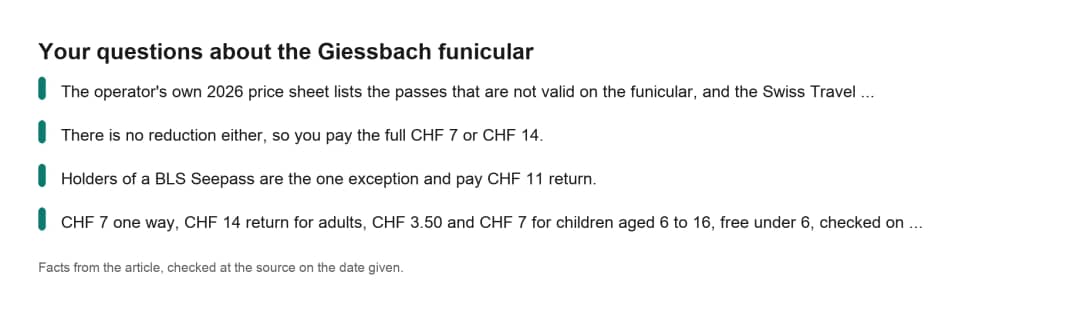
No. The operator's own 2026 price sheet lists the passes that are not valid on the funicular, and the Swiss Travel Pass is on it, along with the GA travelcard, the Half Fare travelcard, the Day Pass, the Swiss Card, the Junior travelcard, the Eurail Pass and the Jungfrau Travel Pass. There is no reduction either, so you pay the full CHF 7 or CHF 14. The boat to Giessbach See is covered by the Swiss Travel Pass, which is why so many people assume the funicular is too. Holders of a BLS Seepass are the one exception and pay CHF 11 return.
How much is the Giessbach funicular and can you pay by card?
CHF 7 one way, CHF 14 return for adults, CHF 3.50 and CHF 7 for children aged 6 to 16, free under 6, checked on 24 August 2026. Forum posts saying CHF 5 in cash only are years out of date. You can buy online in advance, at the ticket machine at either station, or from the kiosk staff. Every English page I found while writing this still printed the old price, so budget from the operator's sheet rather than from a blog.
Can you walk to Giessbach Falls instead of taking the funicular?
Yes, and it is a good walk. The path from the Giessbach See jetty to the hotel takes about fifteen minutes and climbs roughly ninety metres on a made surface with steps. Above the hotel a loop of about a kilometre crosses the cascades and passes behind one of them. The falls themselves cost nothing to visit if you arrive by boat or on foot. Arrive by car and you pay the Nature Park day ticket, CHF 15 in summer.
Will the funicular get me back down in time for my boat?
Usually, but the operator will not promise it. The sheet says that at busy times queues build up and the connection to the boat cannot be guaranteed, and recommends being at the station early. In summer the connecting descents are 10.00, 10.40, 12.00, 12.40, 13.00, 13.40, 15.00, 15.40, 17.00 and 17.40, each timed nine to eleven minutes before a sailing. The safety net is your legs: the footpath down takes fifteen minutes, so if the queue looks long, walk.
How long should you spend at Giessbach Falls?
Two to four hours including the boat, and the timetable does the deciding for you. Sailings from Interlaken Ost in summer put you at the jetty at 10.09, 12.09, 13.09, 15.09 and 17.09, and the returns leave at 10.51, 12.51, 13.51, 15.51 and 17.51. That gives natural stays of either about forty minutes, which is the terrace and nothing else, or two hours and forty minutes, which is the loop and lunch. Aim for the second.
Is Giessbach worth it with young children?
Yes, with one adjustment. The funicular ride is the hit of the day for most children, the lower path is paved or smooth gravel and easy with a stroller, and there is a playground and a grass bank at hotel level. Parents report the short trail taking about thirty minutes with little kids walking slow. The full loop over the cascades has steps and wet rock and is not a pushchair route. Do the lower path, keep the loop for a carrier or older legs.
The stop I never skip on Lake Brienz
Giessbach is the best value stop on this lake and the easiest to get slightly wrong. It comes down to three numbers: CHF 14 for the funicular that no pass covers, 17.40 for the last car down in summer, and 17.15 for the last plate of food.
For the rest of the lake, the guide to the lakes around Interlaken covers where to swim, and our best day trips from Interlaken puts Giessbach next to the other outings. For a local's short list, see things to do in Interlaken and summer in Interlaken.
If you want the lake done properly, with the sailings, the funicular and lunch already worked out around your train home, we can plan a private day around it, or message me on WhatsApp.
Source: Grandhotel Giessbach 2026 timetable and price sheet, Giessbach arrival and restaurants, Standseilbahnen.ch technical register, Fondation Franz Weber and BLS Schifffahrt, all checked on 24 August 2026.
Written by Pierre Vetsch, founder of Swiss Local Adventures
Tags
#funicular-railways#swiss-waterfalls#historic-hotels#waterfall-walks#lake-brienz-day-trip#interlaken-day-trips
Sources & References
- •Grandhotel Giessbach, timetable and prices 2026
- •Grandhotel Giessbach, arrival
- •Grandhotel Giessbach, history
- •Grandhotel Giessbach, Kehrli Terrace
- •Grandhotel Giessbach, waterfall
- •Standseilbahnen.ch, Giessbachbahn
- •Fondation Franz Weber, Grandhotel Giessbach
- •BLS Schifffahrt, Lake Brienz timetable 2026
- •BLS Schifffahrt, combined ticket Giessbach Time Travel
- •SWI swissinfo.ch, Scorsese in the Bernese Oberland
- •Photo: Rijksmuseum on Wikimedia Commons
- •Photo: Raphael Assouline on Unsplash
- •Photo: David Yap on Unsplash
Share this article
Similar Articles
Continue your reading with these related articles
Interlaken
9/12/2026
12 min
9
Hang Gliding or Paragliding in Interlaken?
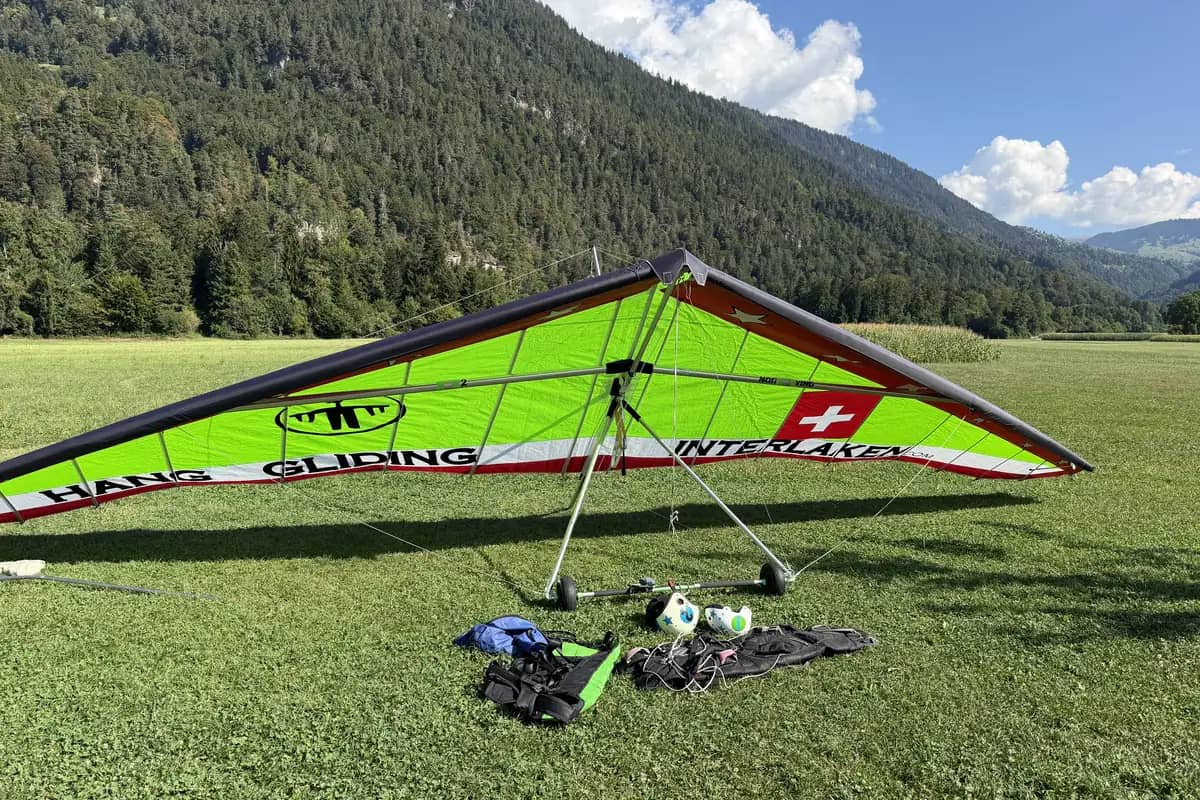
Compare hang gliding and paragliding in Interlaken: same hill, same 20 minutes, CHF 170 against CHF 260. Here is what the extra 90 francs actually buys.
tandem-hang-glidingtandem-paraglidingadventure-sports
By Timoté BailyRead More
Interlaken
9/11/2026
15 min
12
Bönigen Historic House Trail: Free, 4 Min Away
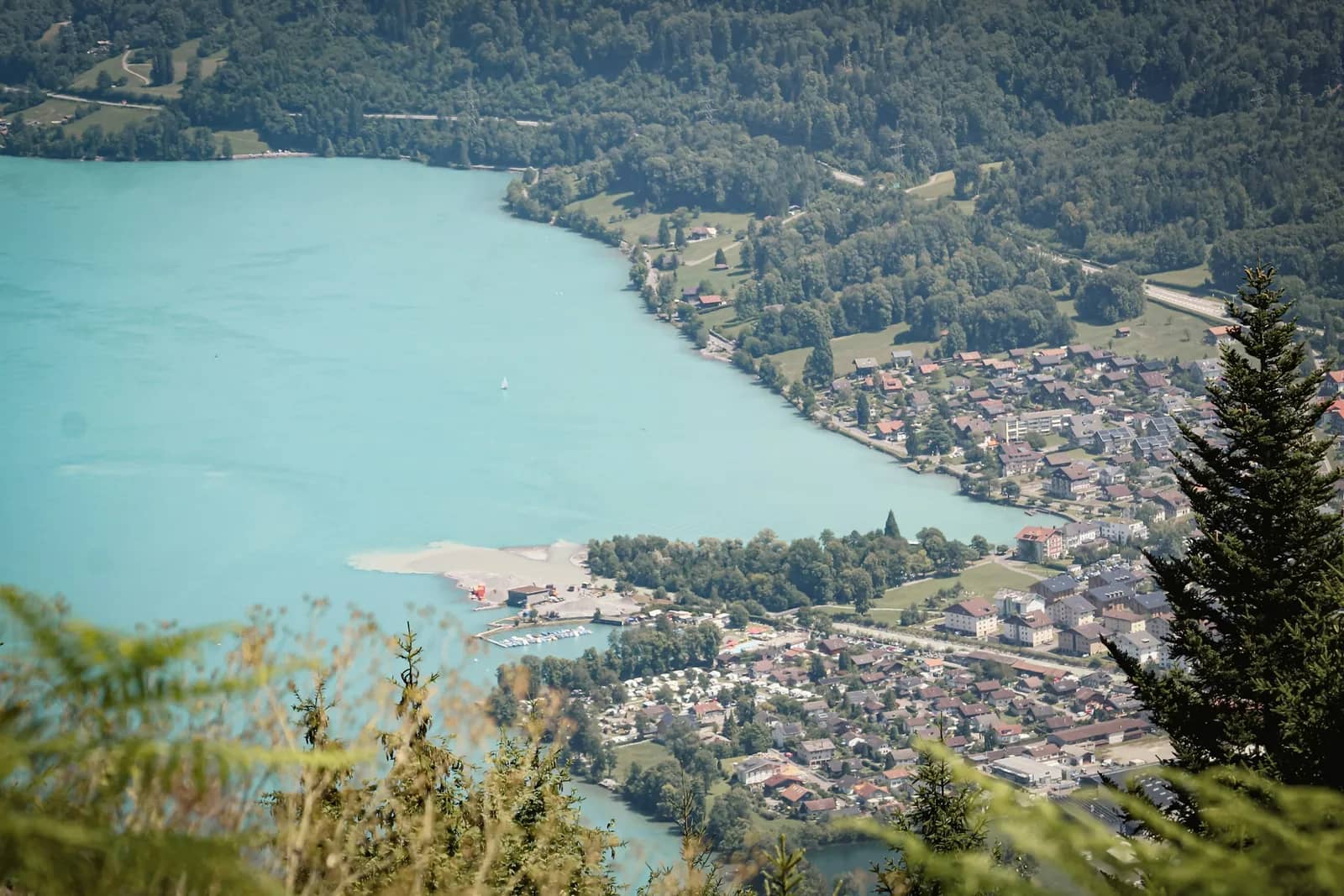
Walk Bönigen's free historic house trail, four minutes by bus from Interlaken Ost, past carved wooden houses standing since 1549. Times and map inside.
historic-house-trailday-trip-brienzinterlaken-day-trips
By Pierre VetschRead More
Interlaken
9/9/2026
14 min
14
Goldswil Church Ruin Hike: A Free 680m Viewpoint
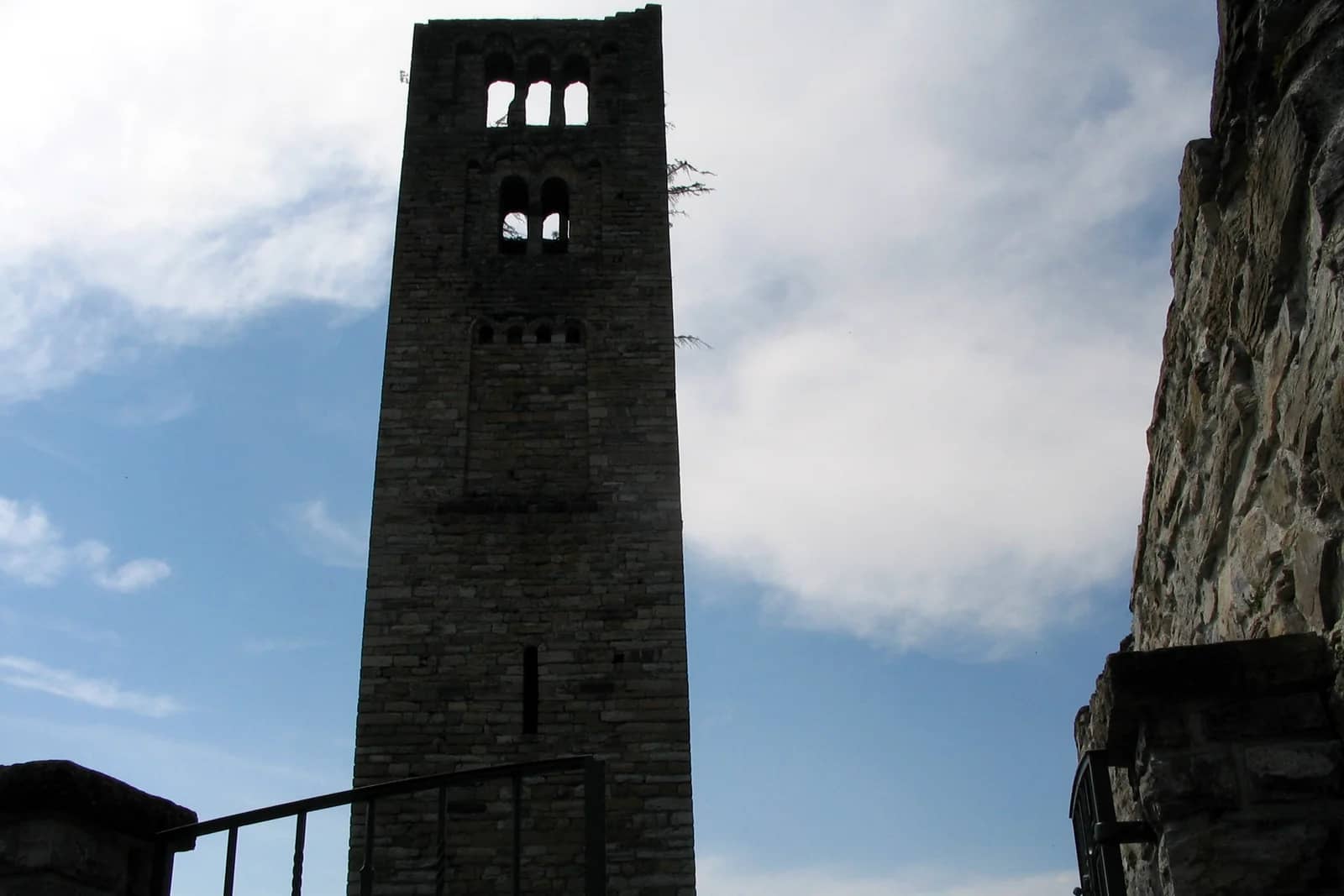
Climb to the Goldswil church ruin above Interlaken, a free eleventh century tower at 680m with the widest view over both lakes. Route and times inside.
church-ruinsmedieval-historyshort-hikes
By Timoté BailyRead More