Interlaken
Day Trip to Lauterbrunnen: Which Falls Run
P
Pierre Vetsch
Author
September 20, 2026
13 min
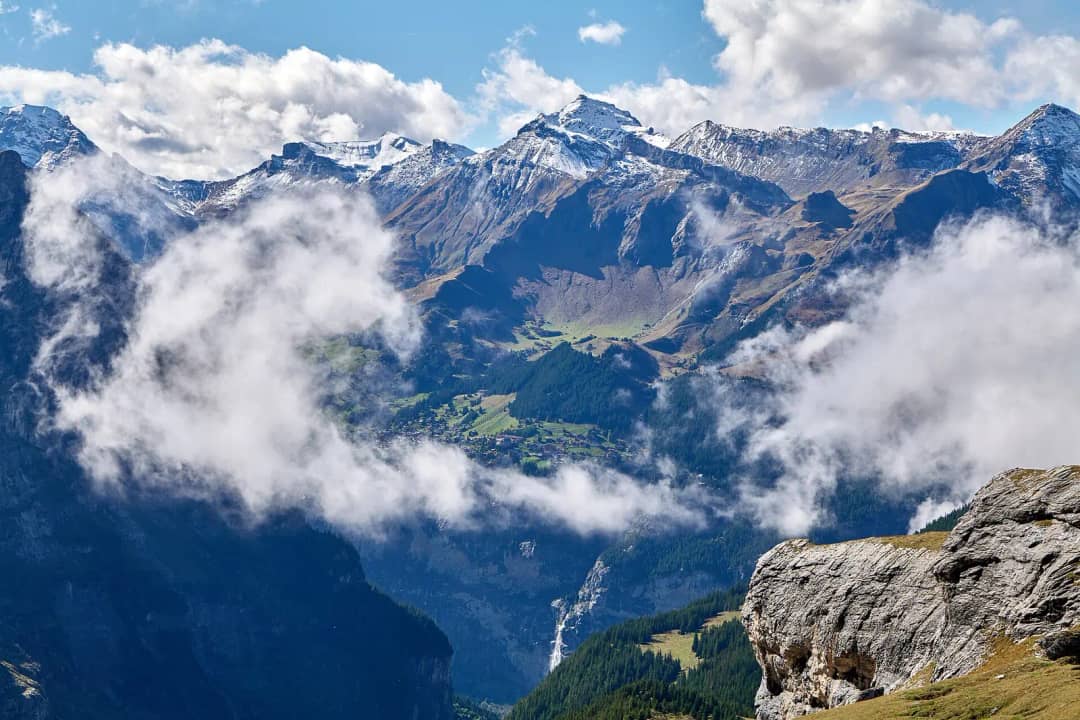
On 6 August 2026 I walked up to the Staubbach gallery with guests and there was no water. People were queueing to stand behind a waterfall that had stopped. Three kilometres further up the same valley, the Trümmelbach was tearing through the rock at the top of its season.
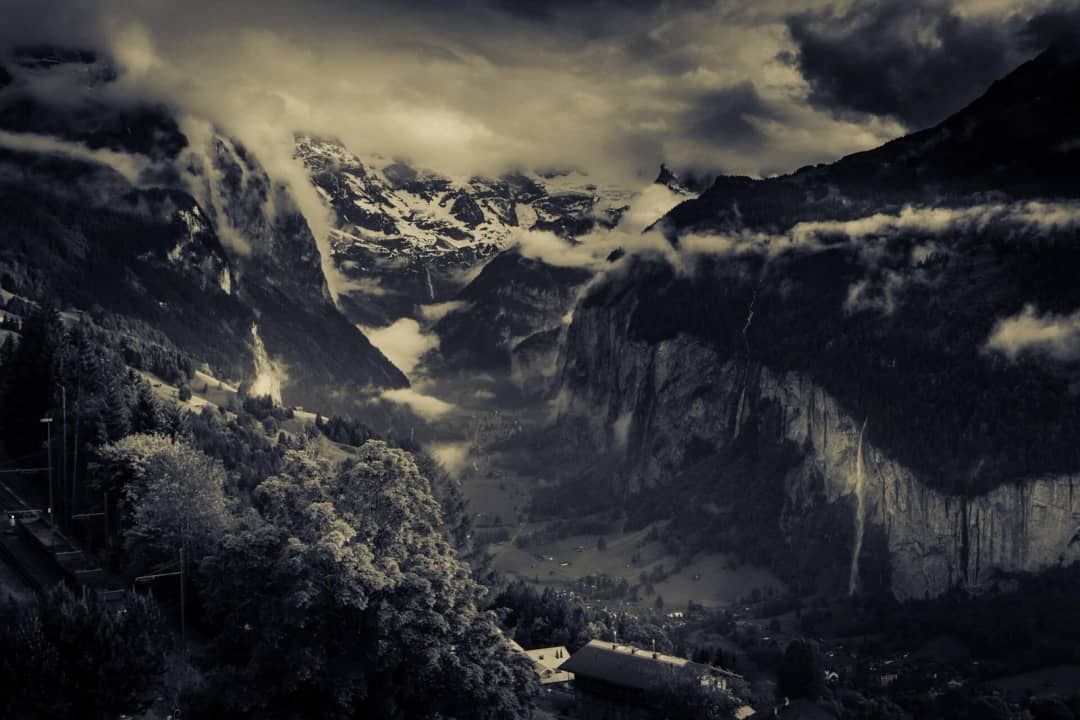
Lauterbrunnen has two famous waterfalls and they run on opposite clocks. No itinerary I have read says so. The Staubbach is fed by snowmelt off a small catchment above the cliff, so it peaks in late spring and can thin to nothing by late summer. The Trümmelbach drains the Eiger, the Mönch and the Jungfrau, so it is loudest exactly when the Staubbach fails, with up to 20,000 litres a second moving inside the mountain.
Get that one fact right and the day works. Get it wrong and you spend the afternoon photographing a dry cliff and queueing for the privilege.
How do you get from Interlaken to Lauterbrunnen?
Trains leave Interlaken Ost for Lauterbrunnen at :04 and :34 past each hour and take 22 minutes, with no change of train. From the station forecourt, bus 141 leaves at :05 and :35, reaching the Trümmelbach Falls in 10 minutes and Stechelberg in 12. I read those times on the federal timetable on 20 September 2026.
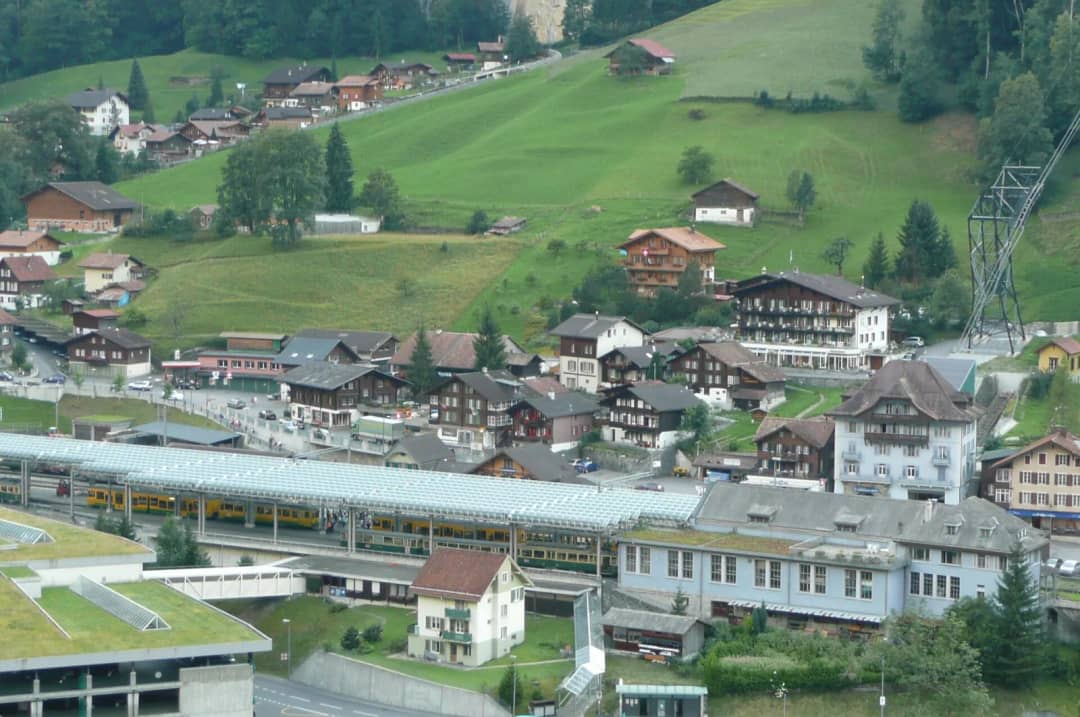
The train is the simple part. The bus is what most planning pages skip, and it decides your afternoon. The Trümmelbach is about 3 km up the valley from the village, and bus 141 runs twice an hour. Miss one and you have lost half an hour standing in a car park, or you walk it. A single ticket costs CHF 7.80, the fare I read on the SBB site on 20 September 2026.
If you are still choosing between valleys, the best day trips from Interlaken page sets Lauterbrunnen against Grindelwald, Brienz and Meiringen. This article assumes you have already picked Lauterbrunnen and want the day itself to work.
Staubbach or Trümmelbach: which one should you actually see?
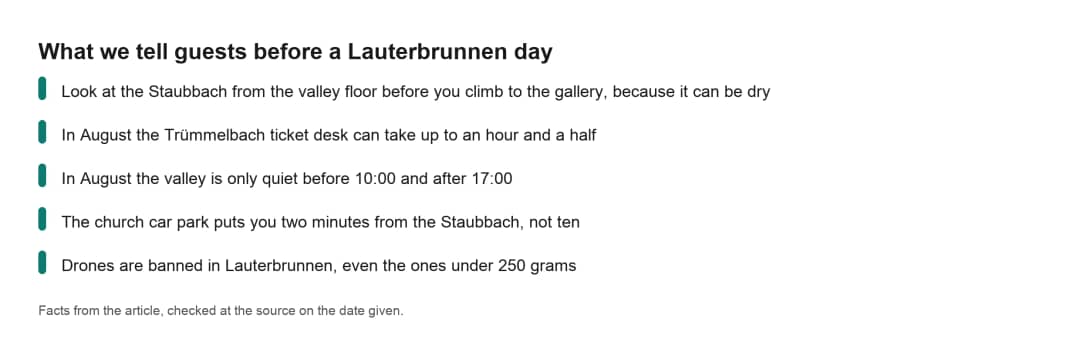
Both, if you come in May or June. In August, put your time into the Trümmelbach and treat the Staubbach as a photograph from the valley floor. The Staubbach runs on snowmelt and can be dry in late summer. The Trümmelbach runs on glacier melt and is at its loudest in exactly those weeks.
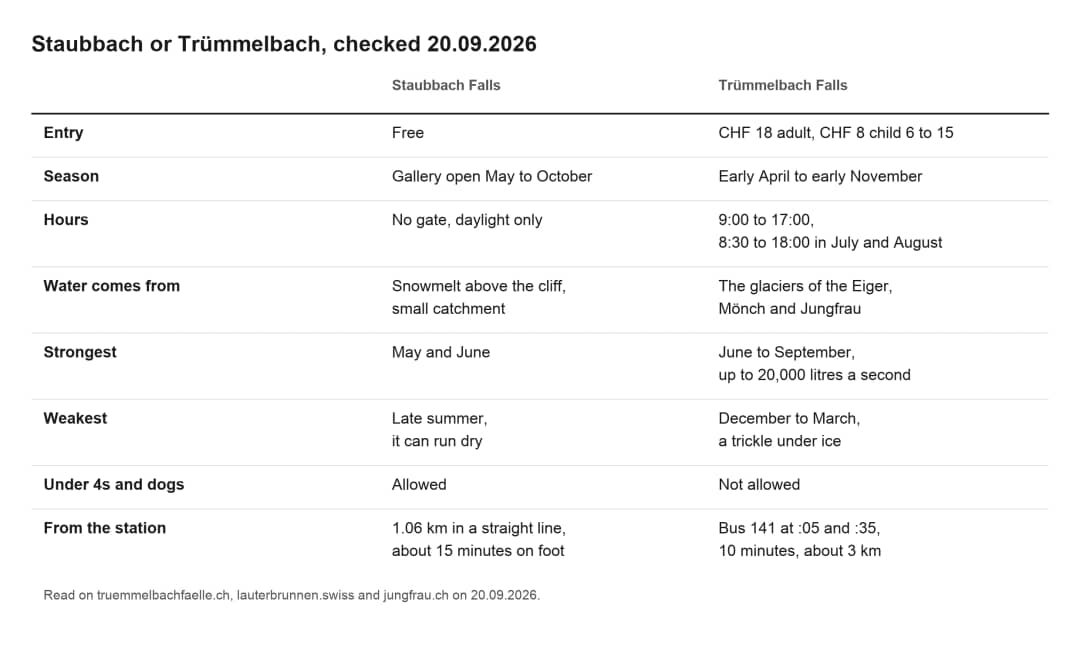
That is the verdict. Most itineraries treat the two as interchangeable and put the Staubbach first, because it is the one on the postcards. In the second half of August the postcard is often an empty cliff with a wet stain down it.
Pierre says: "Never sell the Staubbach as the highlight of the day without looking at the flow from the valley that morning."
Pierre Vetsch, founder and head guide at Swiss Local Adventures
You can do that check yourself in ten seconds. The falls are visible from the main street of the village. If there is a white column, climb to the gallery. If there is a thin grey thread, save the climb and go up the valley.
What is it actually like inside the Trümmelbach Falls?
A tunnel lift carries you up inside the mountain and you walk back down past ten glacier waterfalls on stairs and galleries cut into the rock. It is around 10 °C, everything is wet and very loud, and the route is one way with handrails throughout. Allow about an hour.
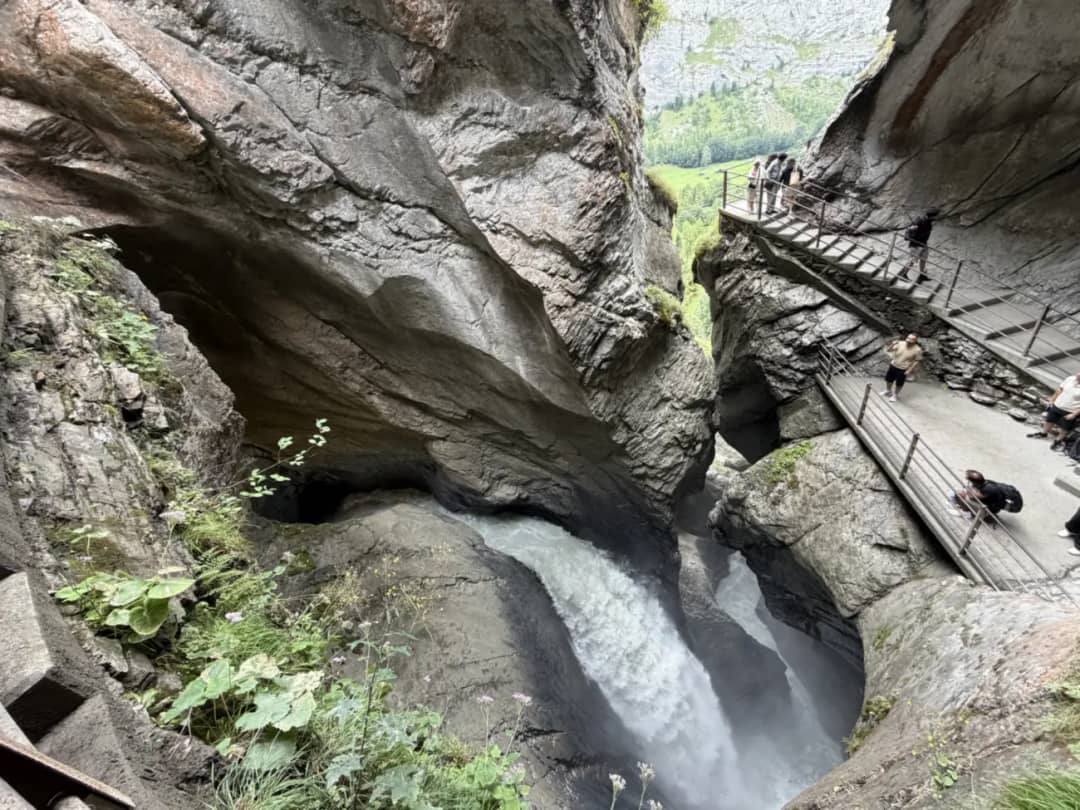
The operator puts the catchment at 24 square kilometres, about half of it under snow and ice, draining the Eiger at 3,970 m, the Mönch at 4,099 m and the Jungfrau at 4,158 m. All of that water leaves the mountain through a slot you can touch. Entry is CHF 18 for an adult and CHF 8 for a child aged 6 to 15, and there are no group rates. The operator sells nothing online, but the desk took a card when we were there on 6 August 2026. Opening runs from early April to early November, 9:00 to 17:00, and 8:30 to 18:00 in July and August (Trümmelbachfälle).
Two restrictions catch families out, and almost nobody publishes them. Babies and small children up to the age of four are not allowed in, and neither are dogs. The operator calls both an increased safety risk inside the facility. If you are travelling with a toddler or a dog, one adult waits outside, or you skip it.
Fun fact: the name is not about how the falls look, it is about how they sound. Trümmelbach is Trommelbach, the drum brook. The operator writes that every fall except the lowest stayed hidden and unreachable inside the mountain until the first access was cut in 1877.
The queue is the real cost. We did the Staubbach gallery and the Trümmelbach on the same day, 6 August 2026, and the desk was taking up to an hour and a half, a longer wait than the visit itself. Arrive at opening, or come back in the late afternoon, and tell the people you are with in advance so the wait does not become the story of the day.
Is the Staubbach gallery open, and does it cost anything?
The gallery is free and there is no gate. It is open from May to October and closed the rest of the year. The falls drop 297 metres from the cliff above the village, and a path climbs to a rock gallery where you stand behind the water, when there is water to stand behind.
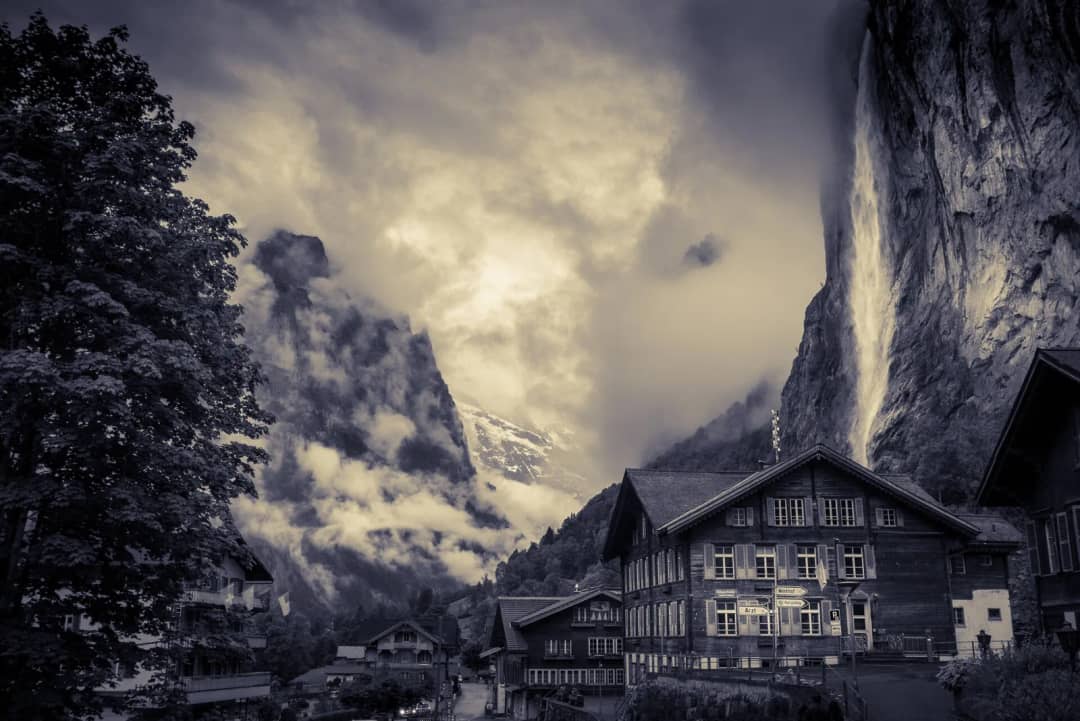
The walk is longer than the usual claim. From Lauterbrunnen station to the foot of the falls is 1.06 km in a straight line, measured from the coordinates the federal gazetteer publishes for both points, read on 20 September 2026. Pages that say ten minutes are assuming you walk fast and take the shortest line. Fifteen is honest when the path is clear. On a busy day the climb plus the queue to pass behind the water turns it into thirty, and the gallery is a rock staircase on top of that.
It is worth the climb in the right month. Goethe came in 1779 and wrote his Song of the Spirits over the Waters after seeing it, and Tolkien walked this valley in 1911, which is the part your teenagers will care about. The valley claims 72 waterfalls in total, most of them thin seasonal threads you will only notice after rain.
Mürren or Wengen for the afternoon?
Mürren if you want the Eiger, Mönch and Jungfrau straight ahead of you and a car-free street with nothing to do. Wengen if you want a larger village, more places to eat, and a train rather than a cable car. From Stechelberg, the return ticket to Mürren is CHF 23.60 for an adult.
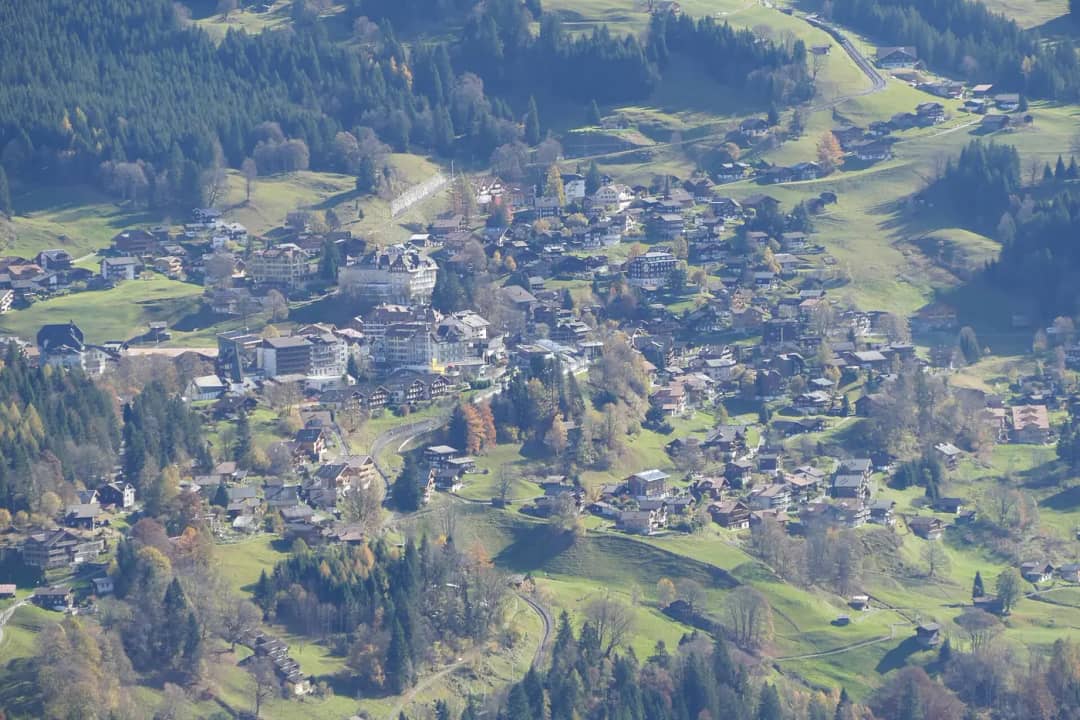
Pierre says: "Mürren for a family with teenagers. Wengen is the quieter of the two."
Pierre Vetsch, founder and head guide at Swiss Local Adventures
That surprises people, because Wengen is the bigger village. Where you already are decides it more often than preference does. Wengen sits on the east side and is reached by the rack railway from Lauterbrunnen station, 11 minutes, departures at :00 and :30. Mürren sits on the west side above Stechelberg, so you take bus 141 to the valley station and then the cable car, and Schilthornbahn publishes the fares.
My preference is Mürren, and specifically Mürren walked rather than ridden. Cross the village on foot, then take the service road down to Gimmelwald, about 45 minutes and 275 metres of descent on our own route notes of 5 August 2026, and ride the cable car back to Stechelberg from there. It is the one way of doing it where you never retrace a step and the only climbing you do is sitting down.
If your day is really about water rather than villages, the lakes around Interlaken is the better companion piece to this one.
What does a day in Lauterbrunnen cost, and where do you park?
The train from Interlaken Ost is CHF 7.80 one way. The Staubbach is free, the Trümmelbach is CHF 18 for an adult and CHF 8 for a child aged 6 to 15, and Stechelberg to Mürren and back is CHF 23.60. If you drive, parking runs from CHF 1.50 to CHF 6.00 an hour.
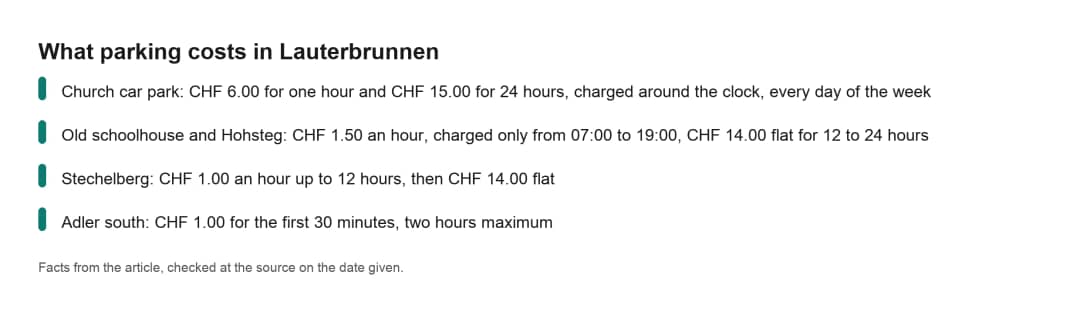
Those figures come from the municipal parking ordinance, reference 732.211.1, published by the commune of Lauterbrunnen and read on 20 September 2026. Nobody quotes it, and the gap between the car parks is large. Six francs for the first hour at the church against one franc fifty at the old schoolhouse is a four fold difference for a five minute walk.
The church car park still has an argument. It puts you two minutes from the Staubbach, not ten, which matters if you have someone in the group who does not walk far. Pay the six francs on purpose.
Insider tip: the old schoolhouse and Hohsteg car parks are only charged from 07:00 to 19:00. Arrive before seven, or come back to the car after seven, and the parking costs nothing at all.
For what the rest of a day in the region costs, the budget section of our things to do in Interlaken guide is the honest version.
When should you go, and how fit do you need to be?
Come in May or June for both waterfalls at full flow, or in September for a quieter valley with the Trümmelbach still fed by glacier melt. Neither site needs hiking fitness. Both are stairs, handrails and wet stone, and you come out damp rather than soaked.
The operator publishes the flow calendar for the Trümmelbach and it is the clearest seasonal guide in the valley. From December to March only a trickle moves under a shell of ice. After frosty nights in April and October it is a few dozen litres a second. During the snowmelt from April to June, then during the glacier melt from June to September, and after heavy or thundery rain, it reaches the full 20,000 litres a second.
The hour matters as much as the month. In August the valley is only quiet before 10:00 and after 17:00. Between those two times the coaches own the road, the car parks and the path to the Staubbach.
Pierre says: "The mistake is not walking in the valley. People stop at the Staubbach and leave."
Pierre Vetsch, founder and head guide at Swiss Local Adventures
On the physical side, the Trümmelbach is a lift up and a walk down, one signed route, impossible to lose. The Staubbach gallery is a rock staircase, wet, with handrails, and the spray depends on the wind. No poles, no boots, no change of clothes. A windproof layer and a towel left in the car cover it, which is what we do on tour: the guide carries the solution so the guest carries nothing.
If it is pouring and you would rather be somewhere the rain improves things, a day trip to Meiringen from Interlaken puts you inside the Aare Gorge instead, and a day trip to Brienz gives you a boat and a village.
Your Questions About a Lauterbrunnen Day Trip
Five questions come up on almost every Lauterbrunnen day, and the answers below are the ones we give guests in the van. I checked every price, hour and rule at the source on 20 September 2026, so check them again if you read this a season later.
Can you fly a drone in Lauterbrunnen?
No. Jungfrau Region Tourismus states that drones are prohibited in Lauterbrunnen, in the Rosenlaui valley and on the Jungfraujoch, and it names drones under 250 grams too. The reason given is the heavily used and very narrow airspace over the valley floor, which carries paragliders, base jumpers, helicopters and cable cars in a corridor barely a kilometre wide. Nature reserves elsewhere in the region are separate no fly zones again. If the shot you have in your head is the drone shot from social media, it was either flown illegally or flown before the ban.
Can you do Lauterbrunnen and Grindelwald in one day?
You can, and most people who try it remember the travelling rather than the places. The two valleys are separated by the Männlichen ridge and linked by rail through Zweilütschinen, so a combined day is two half days with a transfer in the middle and no time for either the Trümmelbach or a cable car. If you only have one day, pick one valley. Our best day trips from Interlaken page compares the two directly and explains which suits which kind of traveller.
What do you do in Lauterbrunnen if it rains?
Go to the Trümmelbach, and go early. It is the one attraction in the valley that rain improves rather than ruins, because the falls are inside the mountain and heavy rain pushes the flow up. You will get wet from the spray whatever the weather, so rain changes very little about the experience and a great deal about the crowds. The Staubbach gallery in rain is less pleasant, the rock staircase is slippery and the view out of the valley disappears. Save it for another day.
Can you take a toddler or a dog to the Trümmelbach Falls?
No. The operator does not allow babies and small children up to the age of four inside, and dogs are not allowed either, both on safety grounds. This is the single most common surprise at the ticket desk and it is not posted on most third party pages. The Staubbach has no such restriction, it is a free path with no gate, so a family splitting up for an hour usually sends one adult and the older children into the Trümmelbach while the rest walk to the Staubbach and back.
Is the Trümmelbach worth CHF 18?
In summer, yes, and it is the best value entry ticket in the valley. Ten waterfalls inside a mountain, a lift cut through rock, and an hour out of the weather for the price of two coffees in Interlaken. In April or late October the answer changes, because the flow drops to a few dozen litres a second and you are paying to look at wet rock. In this valley the date matters more than the ticket.
Plan your Lauterbrunnen day with a local
The people who get this valley right are the ones who know which week they are in. If you would rather not work out the flow, the bus times and the car parks yourself, we build the day around what is actually running on the morning you arrive, in a group of no more than eight people.
Design your own private day in the valley and we will tell you honestly whether to climb to the gallery or drive past it.
Source: Trümmelbachfälle, Schilthornbahn, Jungfrau Region Tourismus, and a day in the valley with guests on 6 August 2026.
Written by Pierre Vetsch, founder and head guide at Swiss Local Adventures
Tags
#day-trip-interlaken#lauterbrunnen-valley#trummelbach-falls#staubbach-falls#swiss-waterfalls
Sources & References
- •Trümmelbachfälle, hours, season, prices and catchment, read 20.09.2026
- •Lauterbrunnen Tourismus, Staubbach 297 metres and 72 waterfalls, read 20.09.2026
- •jungfrau.ch, Staubbach gallery open May to October, read 20.09.2026
- •Schilthornbahn, fares Stechelberg to Mürren, read 20.09.2026
- •Einwohnergemeinde Lauterbrunnen, Verordnung über die Parkgebühren 732.211.1, read 20.09.2026
- •Jungfrau Region Tourismus, drone rules, read 20.09.2026
- •Federal timetable, train and bus times queried 20.09.2026
- •swisstopo gazetteer, coordinates of Staubbachfall and Lauterbrunnen Bahnhof, queried 20.09.2026
- •Photo: Leonhard Lenz, CC0, Wikimedia Commons
- •Photo: Rahimsa Images, public domain, Wikimedia Commons
- •Photo: Mark Peters, CC0, Wikimedia Commons
- •Photo: Parchaco, CC0, Wikimedia Commons
- •Photos: Swiss Local Adventures, Lauterbrunnen valley, 6 August 2026
Share this article
Similar Articles
Continue your reading with these related articles
Interlaken
9/18/2026
11 min
7
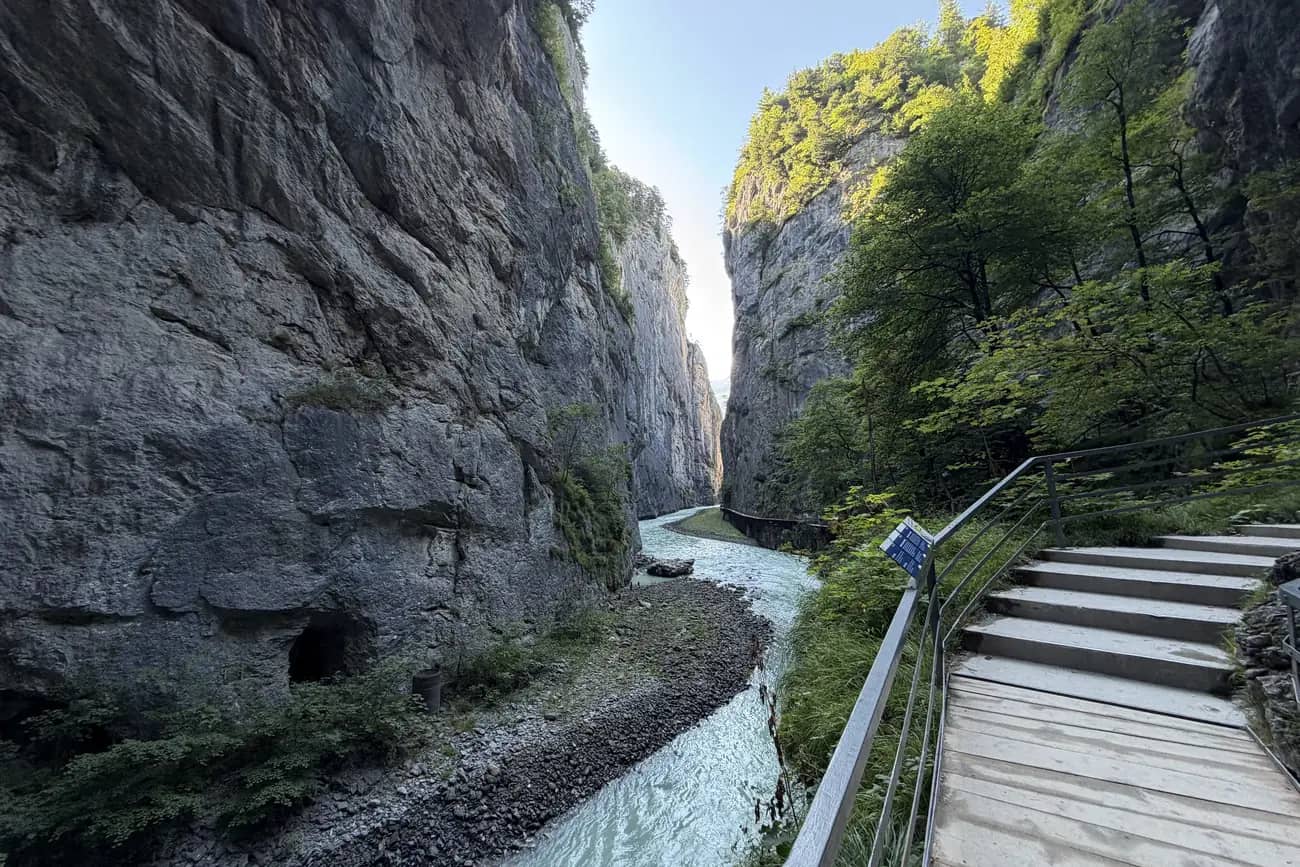
Inside the Aare Gorge: What You See on the Walk
Inside the Aare Gorge: 1,400 metres of walkways and tunnels, 200 metres deep, 1 to 2 metres wide in places. What you see, how it formed, when to go.
aare-gorge-walkgorges-near-interlakenswiss-alps-geology
By Pierre VetschRead More
Interlaken
9/16/2026
12 min
15
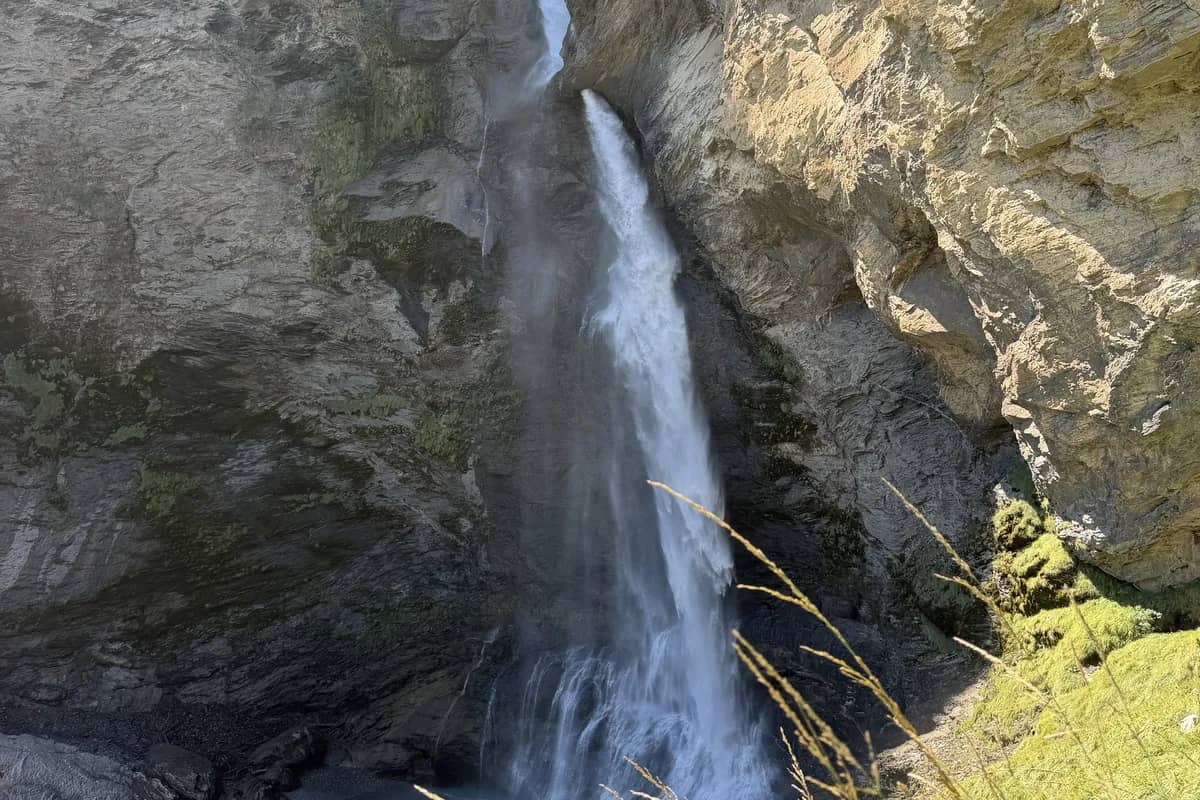
Reichenbach Falls Sherlock Holmes: Find the Star
The white star, the 1957 plaque and the 850 litres a second: what you see at the Reichenbach Falls where Holmes fell. Funicular until 4 October.
sherlock-holmes-switzerlandreichenbach-falls-funicularliterary-travel-switzerland
By Pierre VetschRead More
Interlaken
9/15/2026
12 min
15
Day Trip to Meiringen from Interlaken: Gorge First
Day trip to Meiringen from Interlaken: 31 min by train, the Aare Gorge for CHF 13, the Holmes funicular until 4 October, in the right order.
meiringen-day-tripaare-gorge-walkreichenbach-falls-funicular
By Pierre VetschRead More