Interlaken
Brienz Landslide? You Booked the Other Brienz
P
Pierre Vetsch
Author
September 1, 2026
14 min
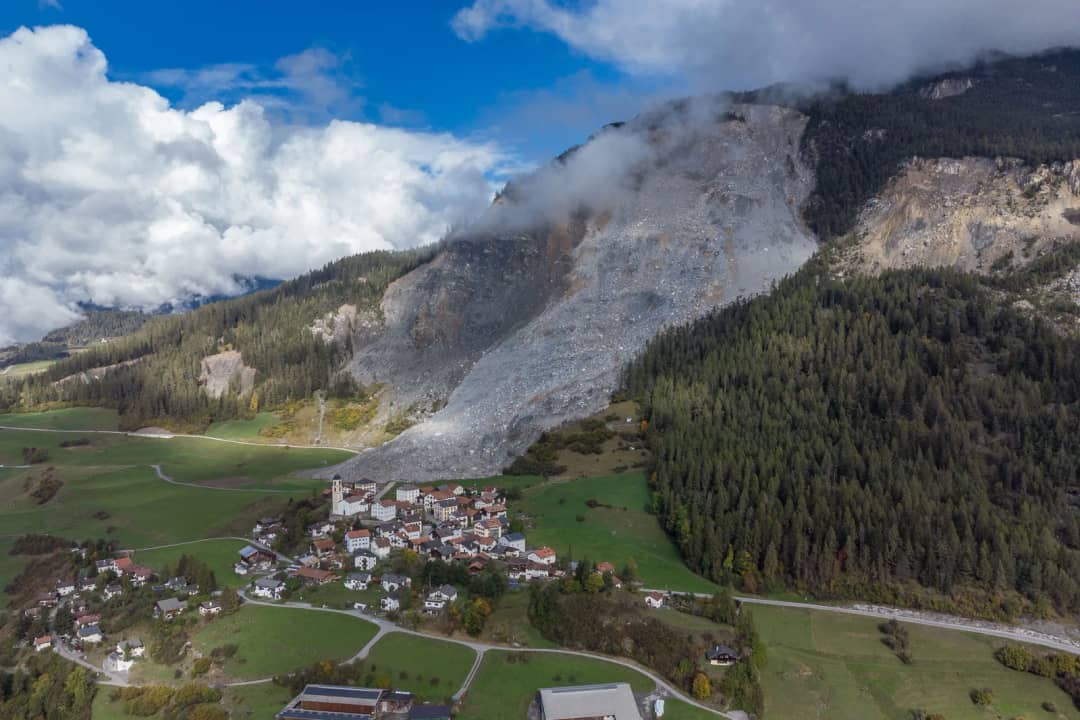
Search "Brienz landslide" today and you will get ten news stories about a Swiss village slowly sliding downhill, an evacuation, an entry ban and a resettlement programme. On 30 August 2026, every single result on the first page of that exact search was about the same place.
None of them was about the Brienz you booked.
There are two villages called Brienz in Switzerland, and they are 119 kilometres apart in a straight line, in different cantons, with different languages, different postcodes and a population ratio of about thirty-three to one. The one in the news is Brienz/Brinzauls in Graubünden, home to just under a hundred people. The one with the turquoise lake, the woodcarvers and the steam railway is Brienz in the canton of Bern, and it has 3,264 residents and no landslide.
If you have a hotel booking with the postcode 3855 on it, you can stop worrying now. If you would like to understand what is actually happening in the other one, and why the confusion is so hard to shake off, read on.
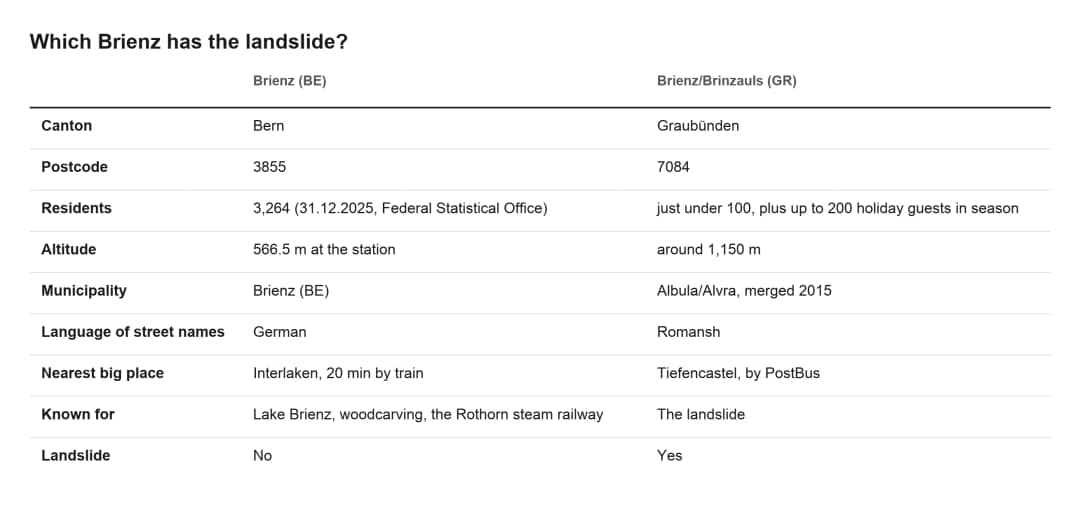
Which Brienz has the landslide?
Brienz/Brinzauls, in the canton of Graubünden, 132 kilometres east of Interlaken Ost in a straight line. It sits at roughly 1,150 m on a sunny terrace beside the road from Lenzerheide to Davos, and it has been part of the merged municipality of Albula/Alvra since 2015. It has just under 100 inhabitants.
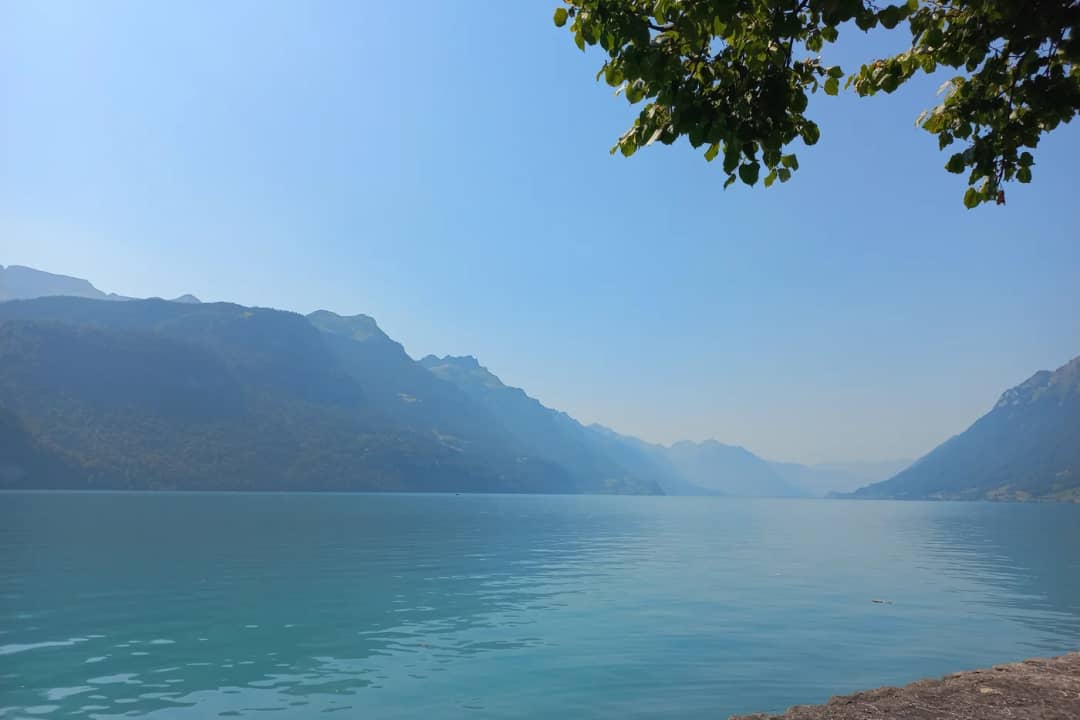
The Brienz you are far more likely to have booked is Brienz in the canton of Bern, on the north shore of Lake Brienz, twenty minutes by train from Interlaken. It is the woodcarving village, the one with the steam rack railway up the Brienzer Rothorn, and the one every Interlaken itinerary passes through. For time on the water itself, see our guide to the lakes around Interlaken.
They share a name and nothing else. The Graubünden village even carries a second name, Brinzauls, which is its Romansh form, and its streets are called Voia Principala and Voia da Brinzauls rather than Hauptstrasse and Brunngasse.
How far apart are the two Brienz villages?
118.7 kilometres in a straight line, measured between the two village points in the Swiss federal place-name register on 30 August 2026. By public transport the gap is far more dramatic than the map suggests, because there is no direct link at all between them.
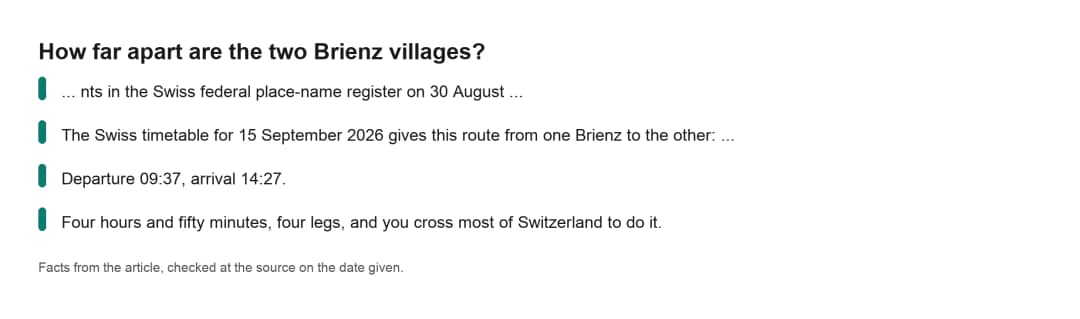
The Swiss timetable for 15 September 2026 gives this route from one Brienz to the other:
Brienz to Interlaken Ost on the express train, Interlaken Ost to Zürich HB on the IC 81, Zürich HB to Chur on the IC 3, then a short walk to the bus station and PostBus 182 up to Brienz/Brinzauls.
Departure 09:37, arrival 14:27. Four hours and fifty minutes, four legs, and you cross most of Switzerland to do it.
That is the cleanest possible answer to anyone who is still not sure the two places are different.
How can you tell in ten seconds which Brienz you are looking at?
Look at the postcode. 3855 is the lake. 7084 is the landslide. Everything else follows from that, and the postcode sits on every hotel confirmation, every rental agreement and every restaurant listing in Switzerland. If you have no postcode to hand, the canton code and the street names give you the same answer in about the same time.
If you do not have a postcode in front of you, three more tells work just as fast.
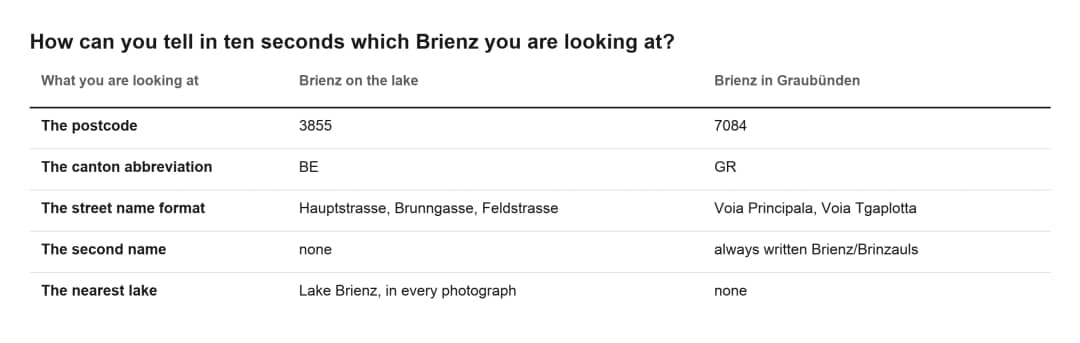
The most reliable of these is the double name. Swiss authorities almost never write the Graubünden village as plain "Brienz". Officially it is Brienz/Brinzauls, with the slash, and if you see that slash you are looking at the wrong village for your holiday. International news outlets drop the second half, which is precisely where the confusion is manufactured.
Is Brienz on Lake Brienz safe to visit?
Yes. There is no landslide threatening Brienz BE, no evacuation, no entry ban and no restriction of any kind on visiting the village, the lake or the mountain above it. The trains run, the hotels are open, and it is one of the busiest day trip destinations in the Bernese Oberland. For ideas on a summer visit, see what locals do in Interlaken in summer.
"If you are about to cancel a stay in Brienz on the lake, check your booking first."
Pierre Vetsch, founder of Swiss Local Adventures
By public transport, Brienz/Brinzauls is 4 hours 50 minutes from Interlaken at best. That is the Swiss timetable for 15 September 2026.
I will be straight with you about one thing, though, because you may run into it and it deserves an honest answer rather than a silence.
Brienz BE had a serious night of its own on 12 August 2024. A violent thunderstorm sent the Milibach, the stream on the west side of the village, over its banks. According to the cantonal police, around 70 people were evacuated from their homes and two were injured. Nobody died.
That was two years ago. Around 400 individuals, companies and organisations offered help at the time, and a flood protection scheme for the Milibach is now in planning with a public consultation notice published in August 2026.
The one visible legacy for a visitor is a hiking trail. The path from Brienz up the Milibach gorge towards Planalp was destroyed that night, two bridges were swept away, and it is closed until further notice with an official diversion in place. If you were planning to walk up the mountain, that matters. For other outdoor options, see our guide to the best outdoor adventures in Interlaken.
For everything else in the village, nothing about your visit changes. Our honest local guide to Interlaken covers what to do in the area.
What is actually happening in Brienz/Brinzauls right now?
The village is moving downhill, and right now it is moving very slowly. The whole terrace has probably been sliding since the last ice age, at a few centimetres a year for most of the past century. It accelerated sharply over the past twenty years, and a drainage tunnel built under the slope since 2024 has now slowed it dramatically.
The commune publishes measured speeds by sector in a monthly bulletin. Here is the 135th bulletin, dated 14 August 2026, which is the most recent set of figures available.
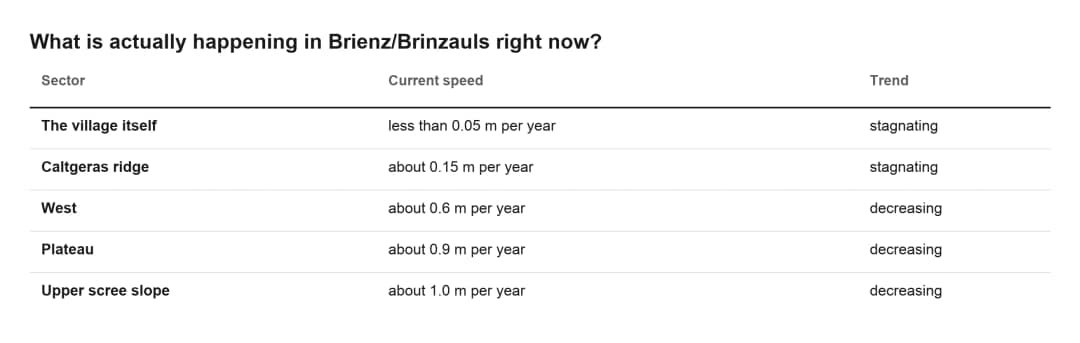
The village is measuring under five centimetres a year, which the bulletin calls a very low level, stagnating or slightly decreasing since mid-July. For scale, the commune's own general description of the slide, written before the tunnel took effect, still puts the movement at around one metre a year. The overview text is out of date, not the bulletin.
The reason is underground. A drainage tunnel has been driven into the slope, and by mid-August 2026 the east arm was fully excavated, the west arm had under 100 metres left, and 37 drainage bores had been drilled into the rock and the sliding mass, about a third of the number planned. Around 730 litres of water a minute now drain out of those bores into the tunnel. The water table has been lowered by more than 50 metres in two areas northwest of the village and by about 25 metres to the north.
The evacuation was ordered on 12 November 2024, residents had to leave by 17 November, and they were able to return in January 2026, after 62 weeks. A preventive resettlement project is running alongside all of this: 41 parties with just under 100 dwelling units have registered, and as of the 27th public information meeting on 20 August 2026, twelve of them have taken concrete steps to move.
It is a village of a hundred people deciding whether to leave the houses they grew up in. That is worth saying plainly before anyone treats it as a curiosity.
Can you visit Brienz/Brinzauls, and should you?
The village is reachable and it is not sealed off. The stop called Brienz/Brinzauls Dorf is served by PostBus line 183 between Lenzerheide and Davos, roughly once an hour in each direction. But the landslide area behind and above the village is under a general entry ban, and I would gently suggest that a village in the middle of a resettlement is not a sightseeing destination.
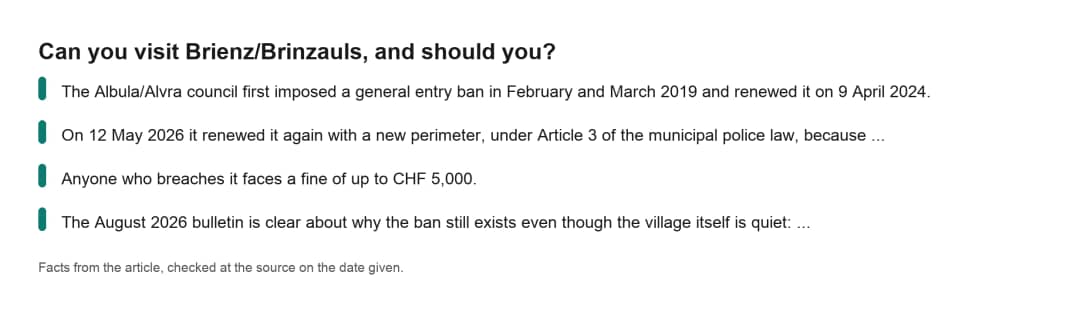
The ban is not advisory. The Albula/Alvra council first imposed a general entry ban in February and March 2019 and renewed it on 9 April 2024. On 12 May 2026 it renewed it again with a new perimeter, under Article 3 of the municipal police law, because of acute rock and block fall danger. Anyone who breaches it faces a fine of up to CHF 5,000.
The August 2026 bulletin is clear about why the ban still exists even though the village itself is quiet: falling blocks and splinter stones inside the closed perimeter can still be dangerous, and the marked danger zones must not be entered under any circumstances.
If you have a genuine reason to go, the commune runs a hotline on +41 79 936 39 39 and publishes its bulletins openly. If your interest is the landslide itself, the bulletins and the recorded public information livestreams tell the story far better than standing at a barrier would, and they do it without turning somebody's home into a viewing platform.
Why do search engines keep sending you to the wrong Brienz?
Because "Brienz" alone is ambiguous even inside Switzerland's own systems, and international headlines strip away the one word that would settle it. The Graubünden village is officially called Brienz/Brinzauls, with a slash, and almost nobody writing in English keeps the second half.
The Swiss public transport timetable API, queried with the departure point "Brienz BE", spelling out the canton abbreviation for the Bernese Oberland, returns a route starting from Brienz/Brinzauls GR, Belfort, a bus stop in Graubünden. The canton code does not save it. Checked again on 13 September 2026.
Asked to complete the word "Brienz", the same system returns this order: Brienz railway station, Brienz West railway station, Brienz/Brinzauls GR Vazerol, then Brienz BE Bahnhof, then Brienz/Brinzauls GR Spisagger. A Graubünden bus stop ranked above the bus stop at the Bernese Oberland village's own station.
If Switzerland's own timetable does that, an international news desk writing "the Swiss village of Brienz" was never going to do better. Add that the Graubünden village is officially Brienz/Brinzauls and almost every English-language report calls it simply Brienz, and the confusion becomes structural rather than accidental.
I have watched someone mix up the two Brienz villages right in front of me. The postcodes settle it: 3855 is Brienz on Lake Brienz, and 7084 is Brienz/Brinzauls in Graubünden.
The fix on your side is the same one every time: check for the slash, and check for 3855.
Your questions about the two Brienz villages
Is the Brienz near Interlaken the one with the landslide?
No. The village near Interlaken is Brienz in the canton of Bern, postcode 3855, on the northern shore of Lake Brienz, about twenty minutes by train from Interlaken Ost. It has 3,264 residents and no landslide. The village in the news is Brienz/Brinzauls in the canton of Graubünden, postcode 7084, 119 kilometres away in a straight line and nearly five hours away by public transport. The two are unrelated apart from the name.
Is it safe to travel to Brienz, Switzerland?
Yes, if you mean Brienz on Lake Brienz. There are no restrictions of any kind on visiting the village, the lake, Ballenberg or the Brienzer Rothorn. The village did suffer a serious debris flow on 12 August 2024 in which 70 people were evacuated and two were injured, with no deaths. The only lasting consequence for visitors is one closed hiking trail up the Milibach gorge, which has an official diversion.
Why was Brienz in Switzerland evacuated?
Brienz/Brinzauls in Graubünden was evacuated in November 2024, by order of 12 November, because about 1.2 million cubic metres of rock debris above the village threatened to come down as a fast debris flow. The residents were able to return in January 2026 after 62 weeks away. The slide area above and behind the village remains under a general entry ban carrying a fine of up to CHF 5,000, but the village itself is now measuring less than five centimetres of movement a year.
How many places in Switzerland are called Brienz?
Two settlements, plus a lake. Brienz in the canton of Bern gives its name to Lake Brienz. Brienz/Brinzauls in Graubünden is a former municipality now part of Albula/Alvra. When a Swiss source writes the name with a slash, as Brienz/Brinzauls, it means the Graubünden one.
Is the Brienzer Rothorn affected by any landslide?
No. The Brienzer Rothorn is the mountain above Brienz BE, and its steam railway runs its normal season from 6 June to 25 October 2026. The 2024 storm destroyed the hiking path through the Milibach gorge on the lower part of that mountain, which is closed until further notice with an official diversion. The railway was repaired after the 2024 storm and runs normally, and the summit and the mountain hotel are unaffected.
How do I check which Brienz my hotel is in?
Look for the postcode on the booking confirmation. 3855 means Brienz on Lake Brienz. 7084 means Brienz/Brinzauls in Graubünden. You can also check the canton abbreviation, BE against GR, and the street name: the Bernese village has Hauptstrasse and Brunngasse, the Graubünden village has Voia Principala and Voia Tgaplotta.
The short version, if you skipped to the end
Two villages, one name, 119 kilometres of Switzerland between them. Yours is almost certainly the one on the turquoise lake with the woodcarvers and the steam train, and nothing about it is closed, evacuated or at risk. The other one is a hundred people in Graubünden working out whether to rebuild or to move, and it deserves to be read about rather than driven past.

If you have a Brienz booking and you want a straight answer about it, or you want to know what is worth doing there once you arrive, send us a message on WhatsApp and we will sort it out in a minute.
The Brienz on the lake is not the one that is sliding, and the lake that takes its name is worth seeing up close: our Summer Kayak tour puts you on the turquoise water of Lake Brienz.
Source: Gemeinde Albula/Alvra, Info Brienzer Rutsch, its 135th and 136th information bulletins of 14 and 21 August 2026, its published entry ban of 12 May 2026, Gemeinde Brienz BE and its Milibach event information, and the Swiss federal place-name and elevation services at geo.admin.ch, all read on 30 August 2026, with journey times from timetable.search.ch.
Written by Pierre Vetsch, founder of Swiss Local Adventures
Tags
#switzerland-travel-planning#interlaken-day-trips#swiss-villages#swiss-landslide#swiss-travel-safety
Sources & References
- •Albula/Alvra municipality: Info Brienzer Rutsch
- •Albula/Alvra: 135th information bulletin (14.08.2026)
- •Albula/Alvra: 136th information bulletin (21.08.2026)
- •Albula/Alvra: 77th information bulletin (12.11.2024)
- •Albula/Alvra: 127th information bulletin (22.01.2026)
- •Albula/Alvra: entry ban publication (06.06.2024)
- •Albula/Alvra: entry ban publication (12.05.2026)
- •Albula/Alvra: history
- •Brienz municipality: Milibach storm information
- •Brienz municipality: Milibach flood protection project
- •Bern cantonal police: release of 13.08.2024
- •Federal Statistical Office: STATPOP by municipality
- •Federal geoportal geo.admin.ch
- •Swiss public timetable
- •Brienz Rothorn Bahn: history
- •Photo: Clemenspool on Wikimedia Commons
- •Photo: Laurier on Wikimedia Commons