Interlaken
Inside the Aare Gorge: What You See on the Walk
P
Pierre Vetsch
Author
September 18, 2026
11 min
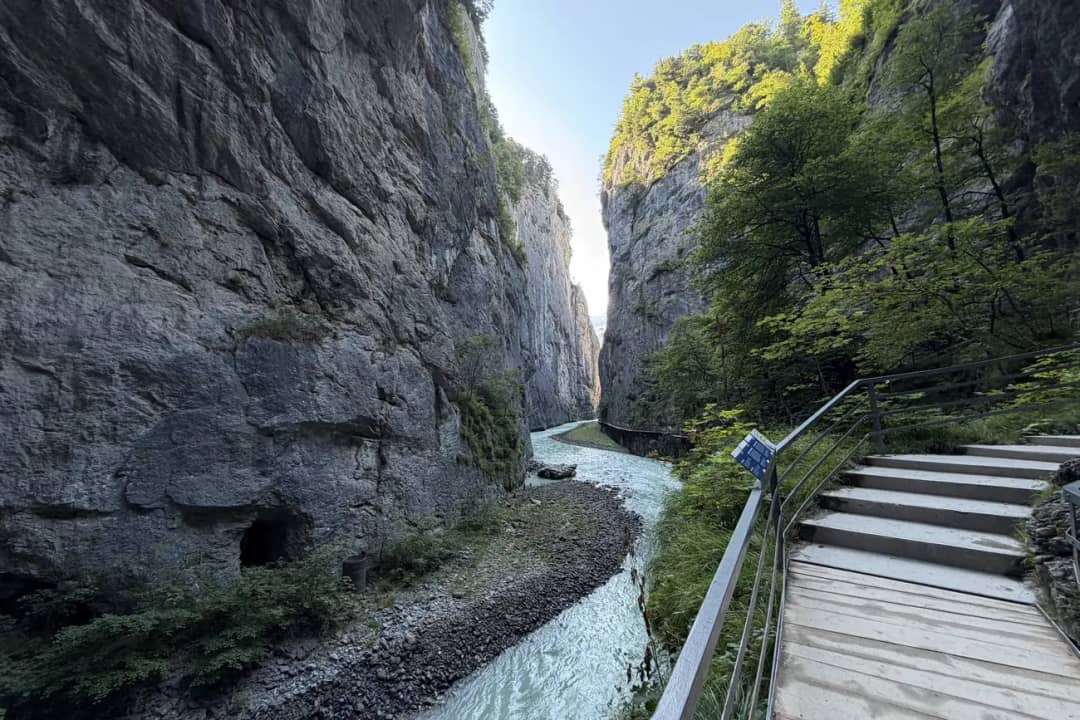
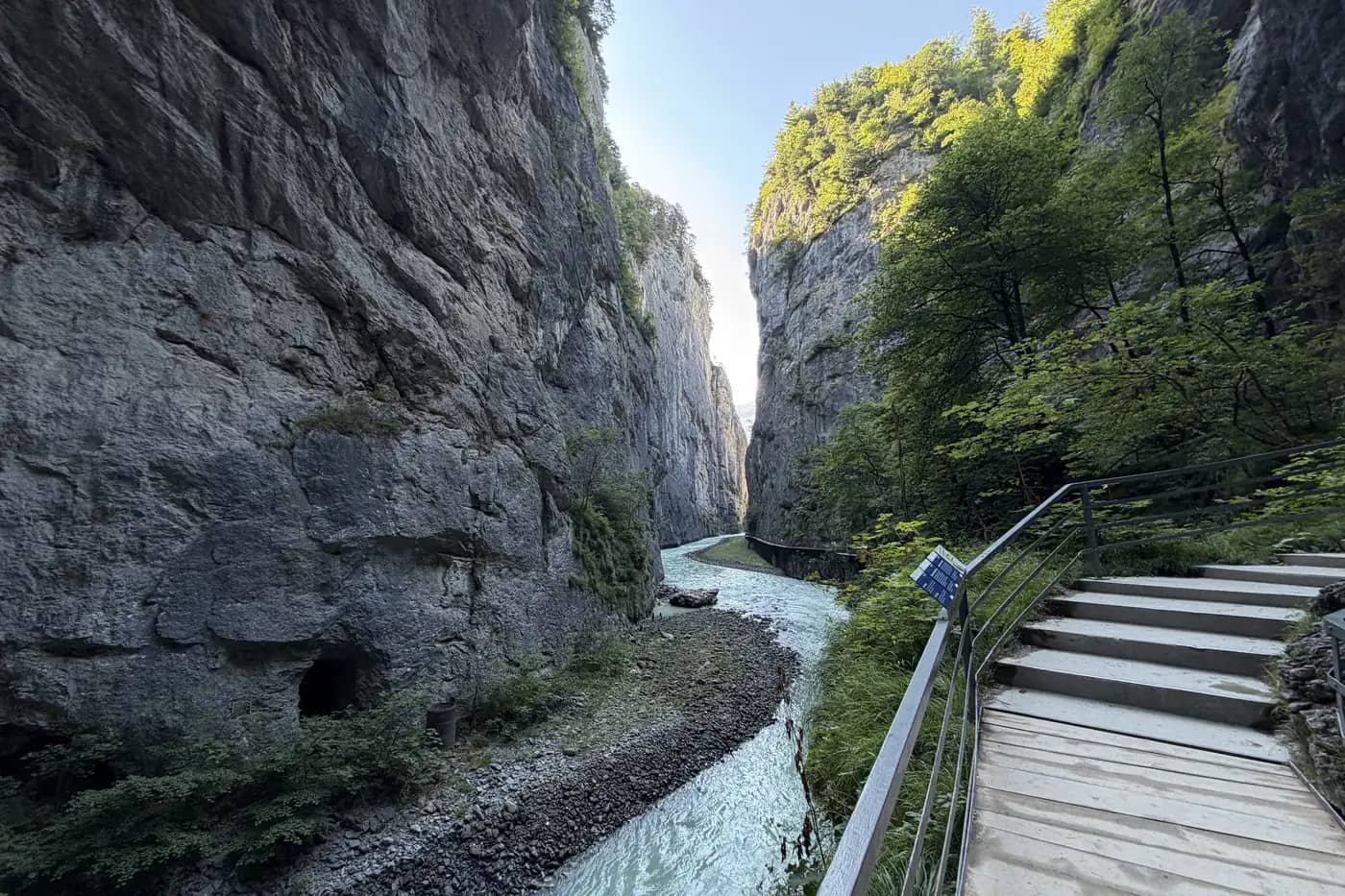
A river did this with nothing but meltwater and time. Between Meiringen and Innertkirchen, the Aare has sawn a slot 200 metres deep into a wall of limestone, and in places the two sides stand only 1 or 2 metres apart. You walk through it on a ledge bolted to the rock, with the water roaring under your feet.
I take guests through the Aare Gorge on my Meiringen tours. On 8 August 2026, I took my first photo inside at 10:00 and my second at 10:10. Below you will find what you see on the walk, how the gorge formed, why people once feared a creature in it, and when it looks its best before it closes on 1 November 2026.
What do you actually see inside the Aare Gorge?
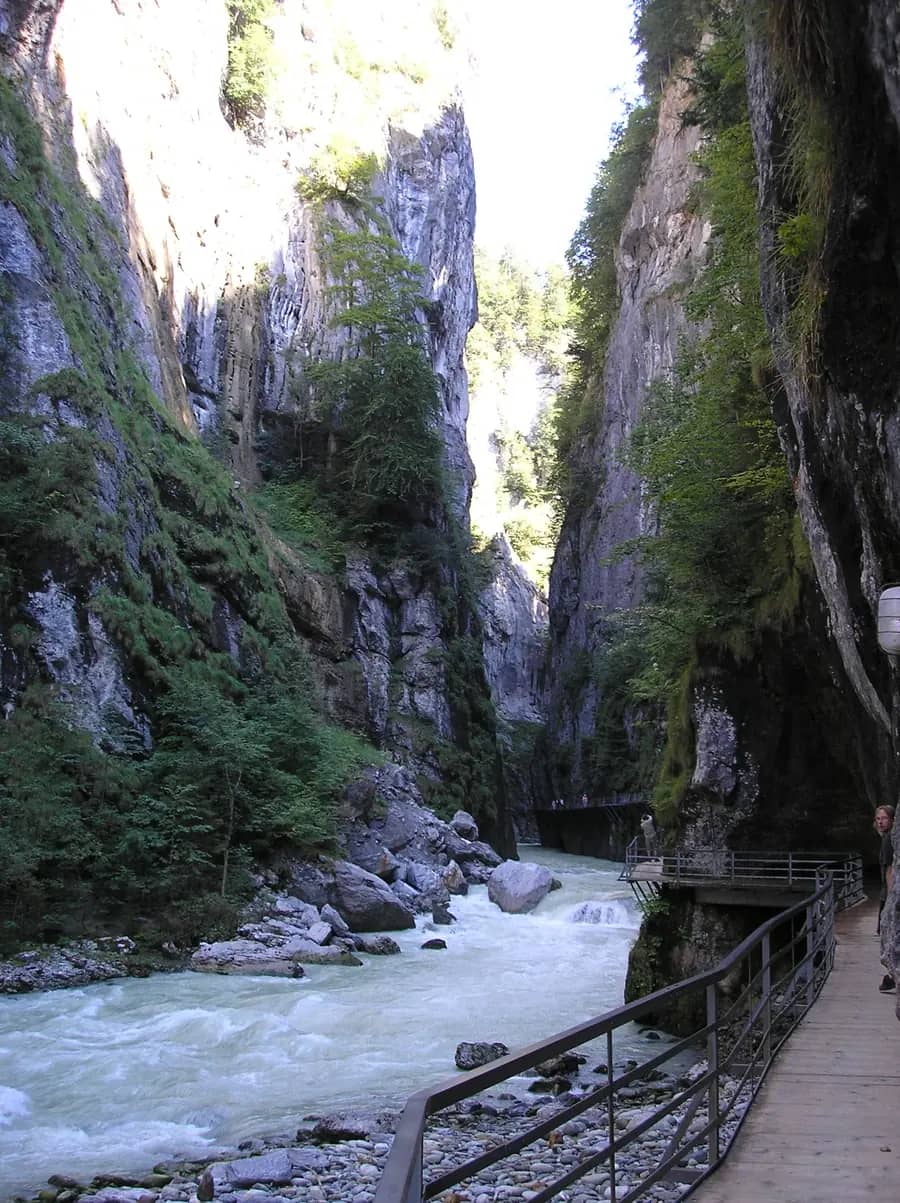
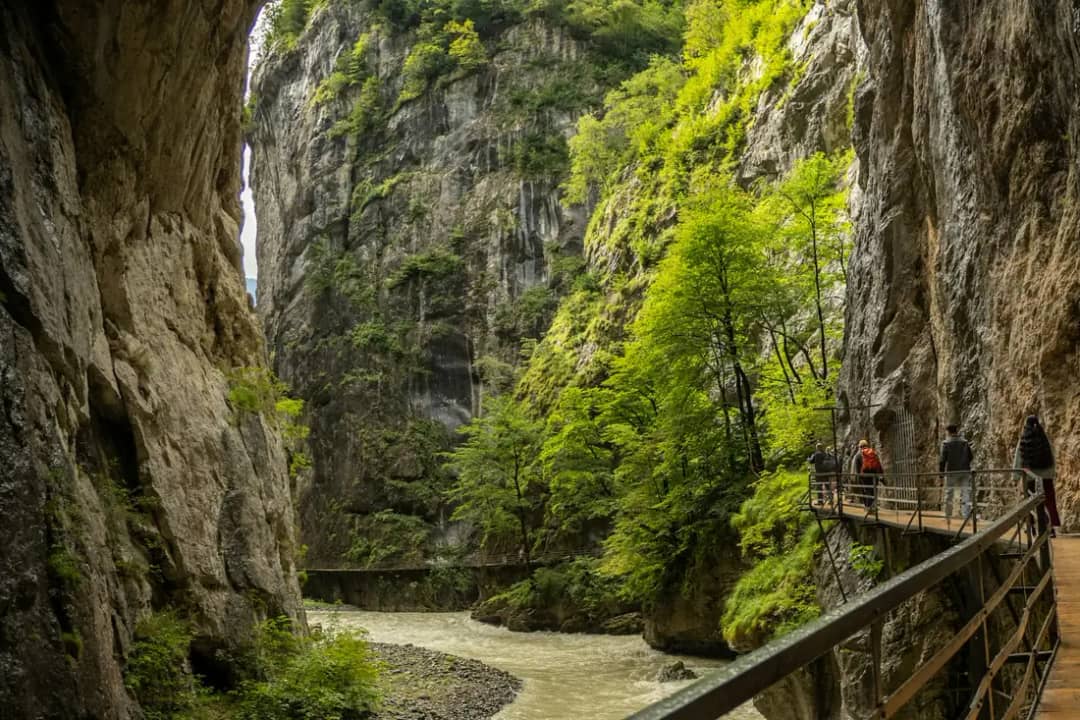
You see a gorge 1,400 metres long and 200 metres deep, according to its operator, with walls that close in to 1 or 2 metres in places. The path follows the Aare through tunnels and along wooden walkways. The water runs milky turquoise, the rock is smooth and grey, and a strip of sky sits far above you.
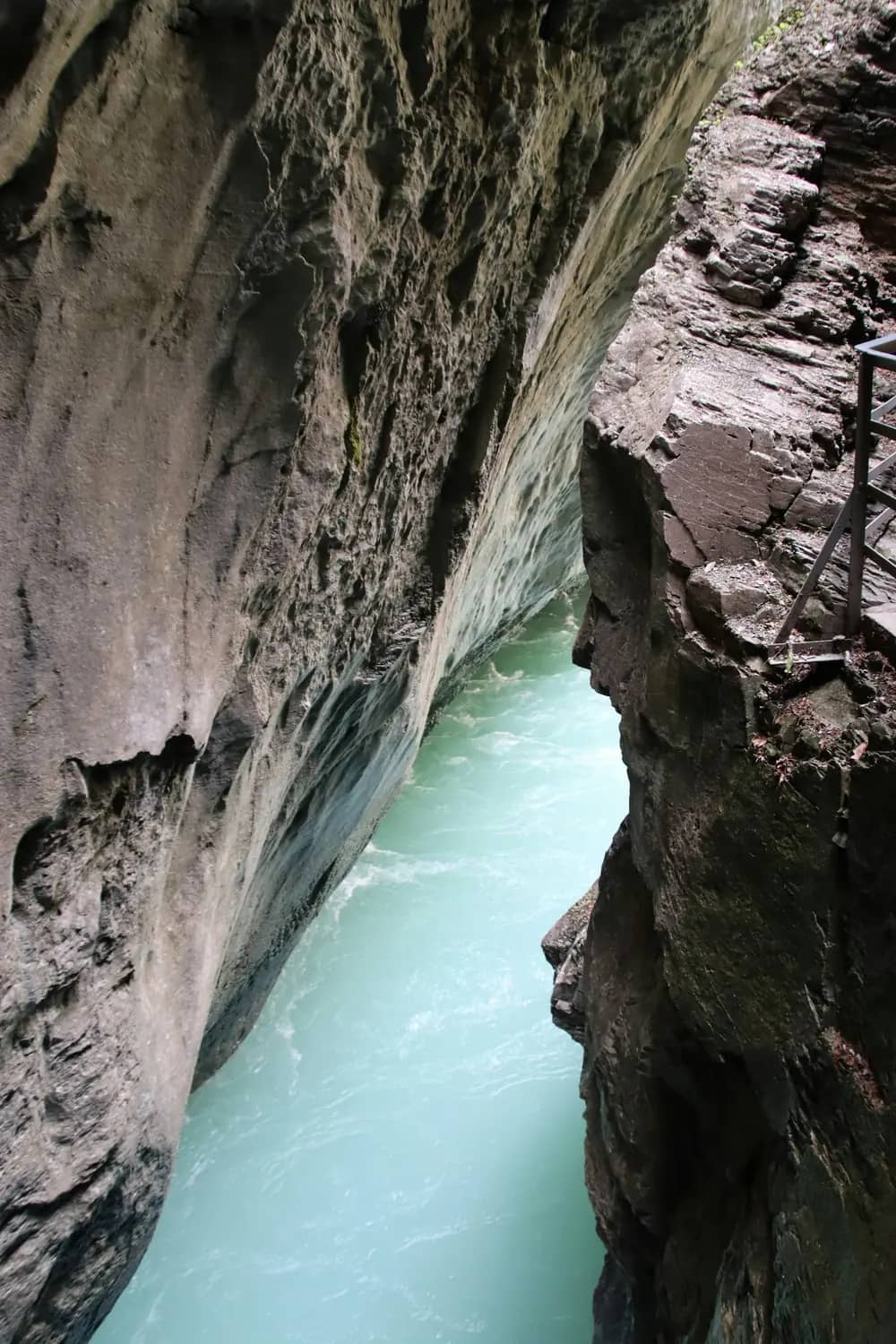
The colour comes from glacier water, as the operator calls it. Glacier water carries fine rock flour, the same that turns the lakes of the region turquoise. We explain that colour in our guide to the lakes around Interlaken.
Look at the walls, not only at the river. The operator points to glacier mills, round hollows that swirling water and stones drilled into the limestone, and to the shapes the water polished into the rock.
The walk runs from the west entrance on the Meiringen side to the east entrance on the Innertkirchen side. The operator gives about 45 minutes for the whole way through.
How did the Aare cut a gorge 200 metres deep?
The gorge runs through the Kirchet, a bar of hard limestone that separates the lower Haslital from the upper valley. The rock formed on a sea floor about 130 to 60 million years ago. Ice age glaciers ground it down but could not remove it, so meltwater cut through it instead, again and again.
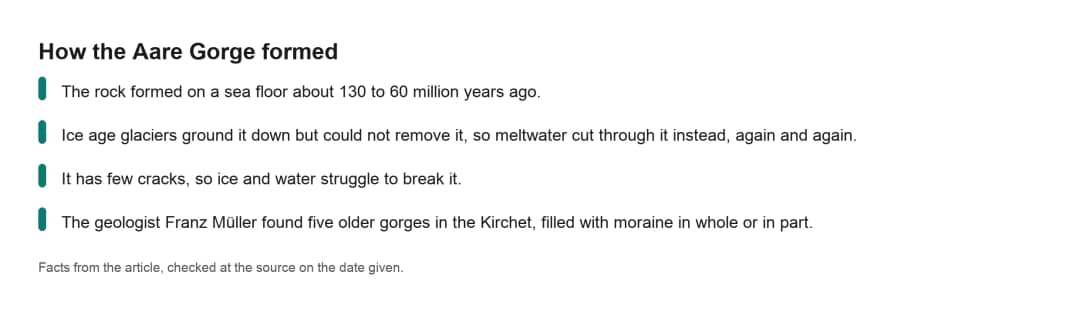
The operator's geology page explains why this rock resisted. The limestone of the Kirchet stayed where it formed and was hardly folded when the Alps rose, about 15 million years ago. It has few cracks, so ice and water struggle to break it.
The gorge you walk through is not the first one. Each time a glacier pulled back, its meltwater cut a gorge. The next glacier filled that gorge with moraine, and the following melt cut a new one in the rock rather than clearing the old one.
Fun fact: The geologist Franz Müller found five older gorges in the Kirchet, filled with moraine in whole or in part. One of them, the Lautere Schlauche, starts at the car park of the west entrance and runs more or less parallel to the gorge you visit. No one has managed to date them.
What are the walkways and tunnels like?
The path is partly asphalt and partly gravel. Inside the gorge it passes through tunnels cut in the rock and runs along a wooden walkway on steel girders. It is 1 to 2 metres wide and secured with railings the whole way, and the operator calls the walk easy and safe for every age.
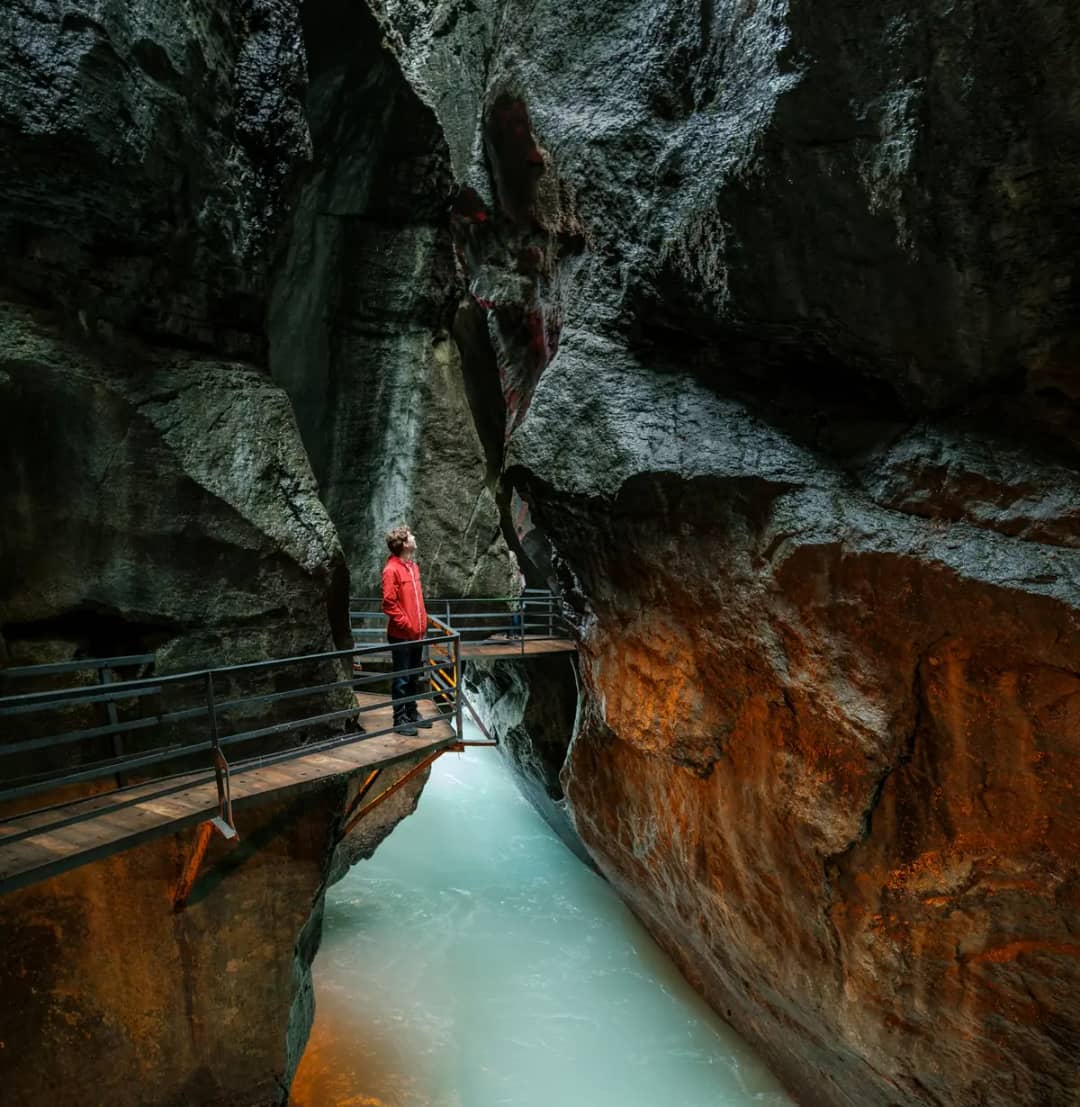
Between the tunnels, the walkway hangs over the water, and you look straight down into the current.
From the west entrance to the middle of the gorge, the path is built for simple wheelchairs and narrow strollers. Past the middle, the operator no longer promises it. Dogs are welcome on a lead.
The walk is flat for the most part. The one real climb waits outside the gorge at the far end: the operator puts the Aareschlucht Ost train stop about 10 minutes from the east entrance, on a footpath with steps.
How cold, wet and crowded is it inside?
Cold and wet, even in August. When I walked it on 8 August 2026, it was about 10 °C inside and everything dripped. The walkway is narrow, so in high summer you squeeze past people coming the other way. Bring a warm layer.
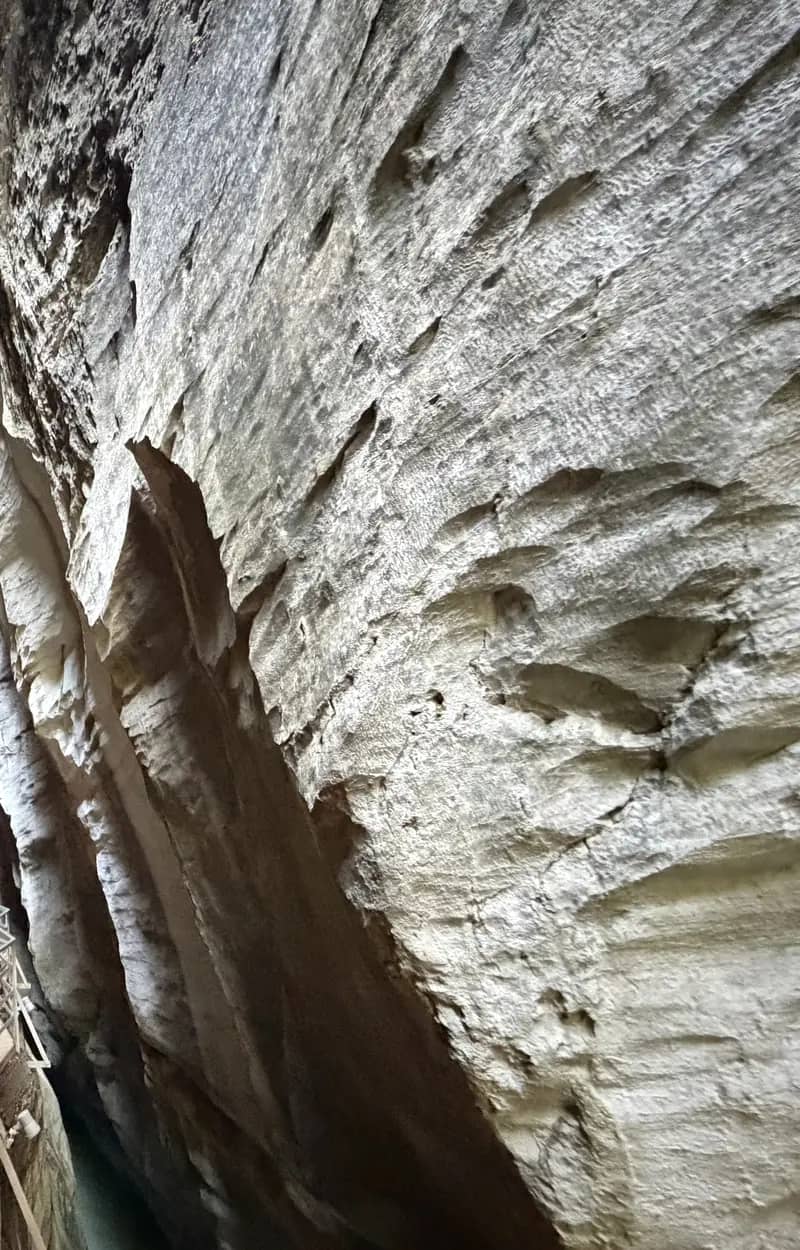
Visitors write the same thing in their reviews: wet and cold inside, and a jacket helps. Several advise going early, because coach parties arrive later in the day.
Here is what I tell guests before we walk in.
Why start the day with the gorge?
Pierre says: "Gorge first, Reichenbach second, Meiringen last. The cold and the damp at the start, the viewpoint in the sun after, something sweet to finish."
Pierre Vetsch, founder and head guide at Swiss Local Adventures
The gorge opens at 8:30, half an hour before the Reichenbach funicular. That early slot is also your best chance of a quieter walkway.
Insider tip: My phone had no signal inside the gorge on 8 August 2026. If your group splits up, agree on a meeting point at the exit before you walk in.
Who opened the gorge to visitors, and what is the Tatzelwurm?
A village opened it. On 28 September 1887, the canton of Bern gave the community of Willigen a concession for a gallery and footpath through the gorge, and twelve men financed the work. Before that, only three side gorges were accessible, and one of them let you reach the Aare near the middle.
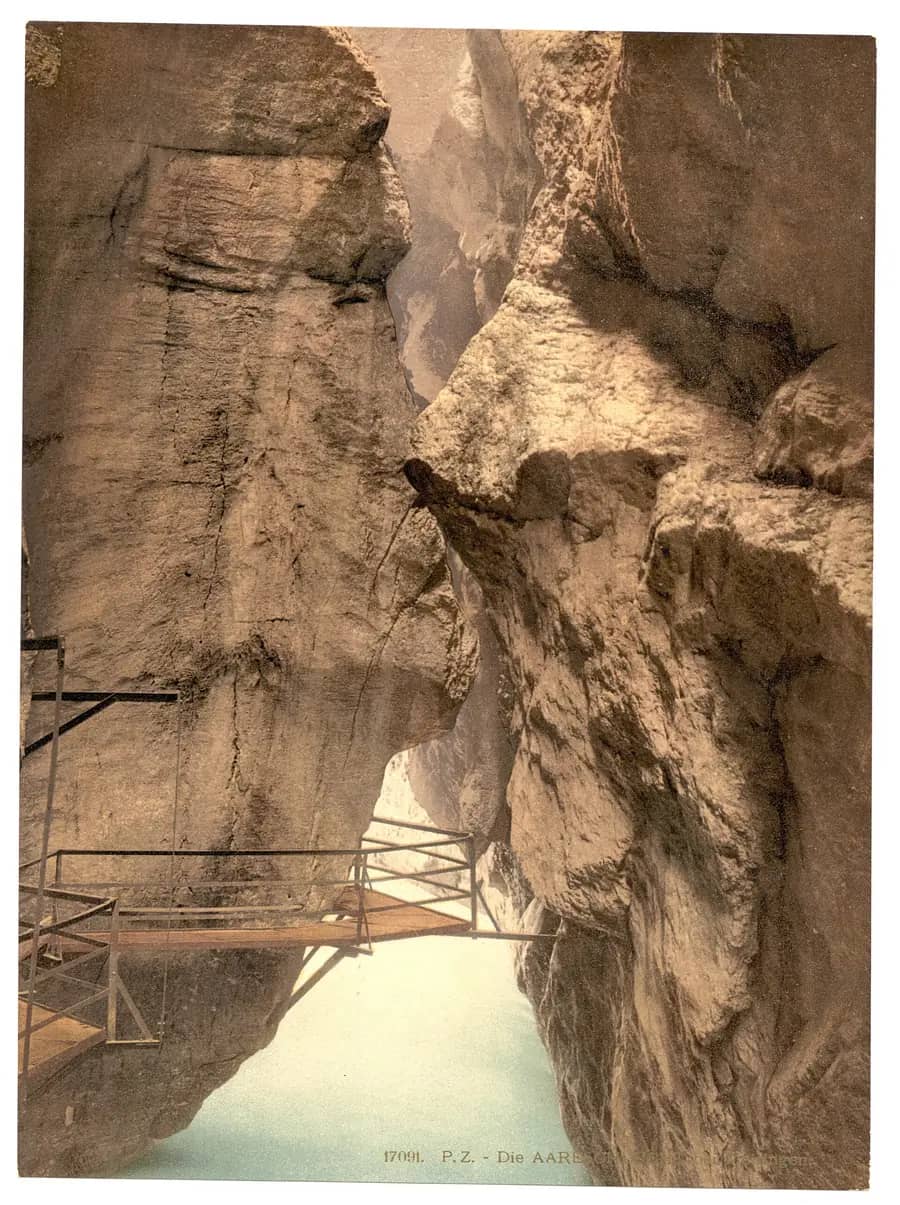
The three side gorges have names that describe them: the Trochene Lamm, the dry one, the Lautere Schlauche and the Finstere Schlauche, the dark one. The concession text of 1887 already names the Finstere Schlauche as the end point of the path. The rest of the gorge was reachable only by water.
A gorge no one could enter made room for stories. In spring 1935, according to the operator, a Berlin photographer named Balkin came back to Meiringen shaken. Over a schnapps at the Hotel Bär, he described an animal about 80 centimetres long, like a very thick snake with front legs, brown with spots, and a fearsome whistle.
The innkeeper's answer, as the operator tells it:
"Perhaps you have come across the Tatzelwurm? Here we usually call it the Stollenwurm."
The innkeeper of the Hotel Bär in Meiringen, spring 1935, as told by the Aare Gorge operator
Balkin sent his blurry photo to a Berlin illustrated paper, and the Haslital made the headlines. Today, children look for a hidden Tatzelwurm family along the walk.
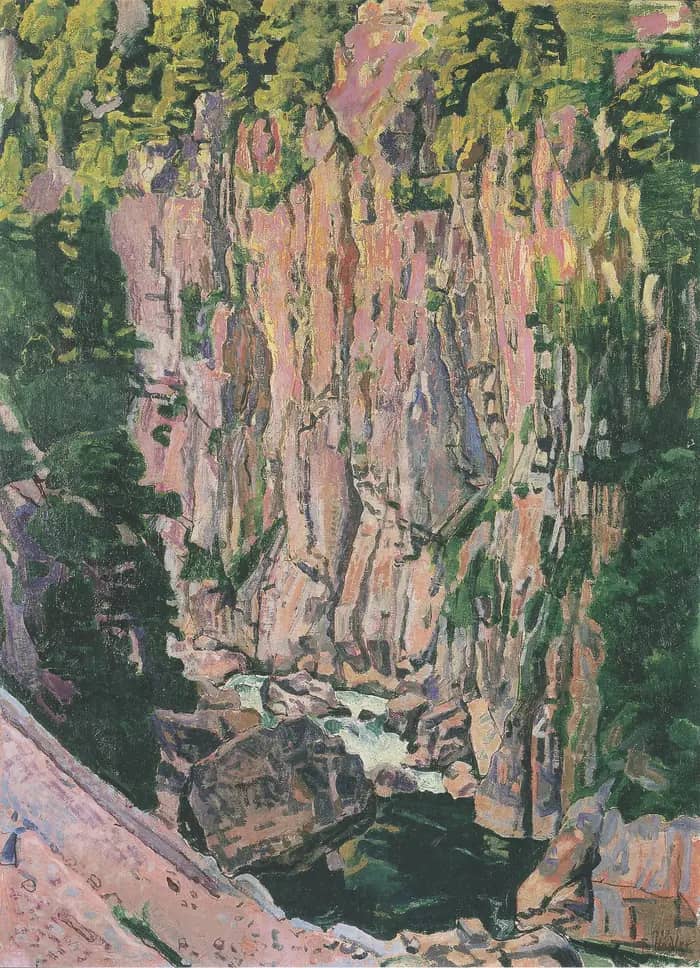
Painters came for the rock itself. Ferdinand Hodler painted the gorge in 1907, twenty years after the concession of 1887.
Sunshine or rain: when does the Aare Gorge look best?
Go on a grey or rainy day. Rain makes the mountain viewpoints pointless but improves the gorge: the operator describes it as mystical in the rain, with at times bigger masses of water. On a hot day, it works the other way round, as the coolest place in the valley. Either way, the gorge wins.
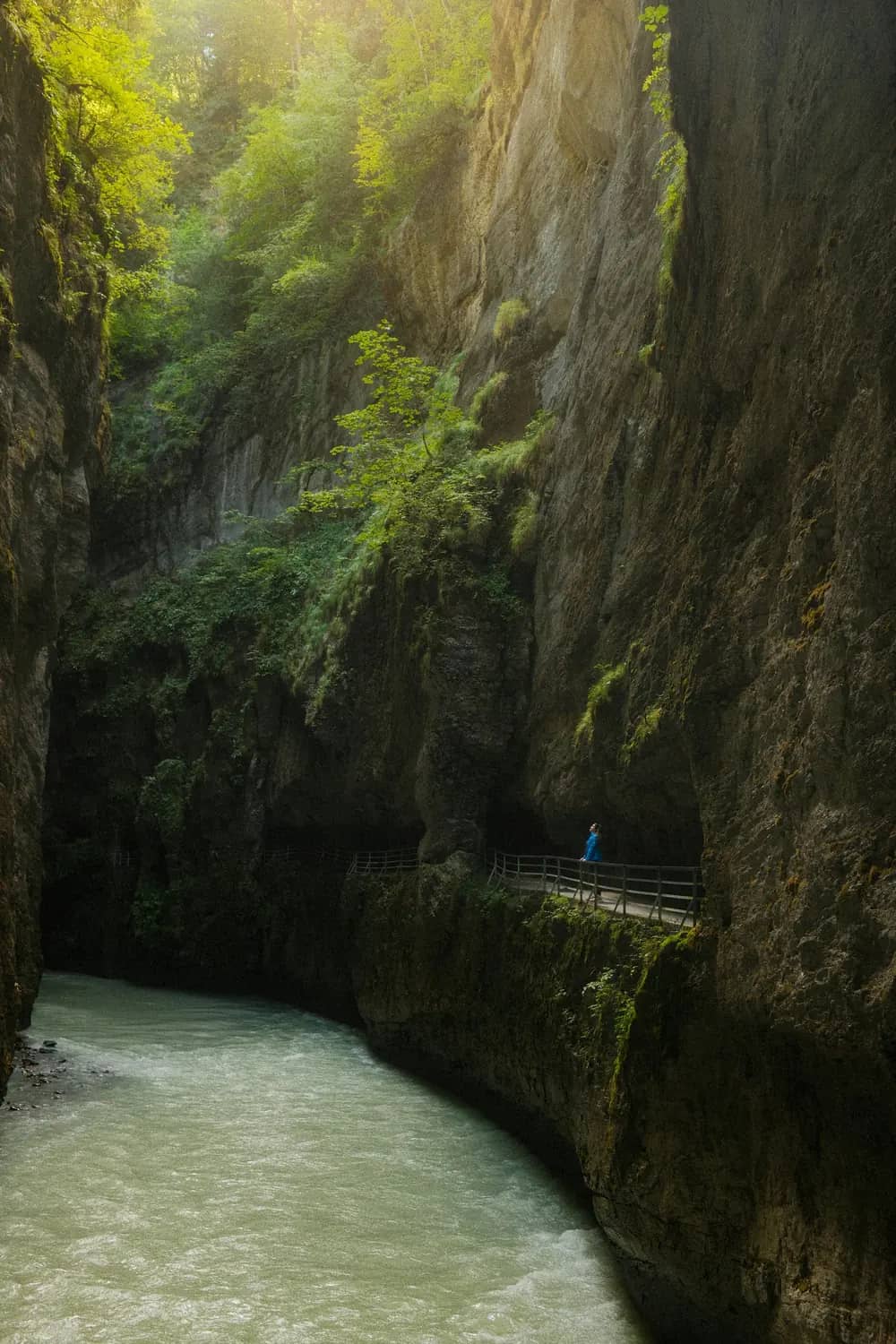
My verdict, based on what the operator publishes and what I saw on 8 August: keep the Aare Gorge for the day the weather cancels your mountain plans. A cloudy summit shows you nothing. The gorge shows you more water.
In sunshine, the light only reaches the bottom in places. You walk in shade and look up at bright rock. In rain, you get wet anyway, because the walls drip on the sunniest day.
Visitors add one warning: the walkway can be slippery when wet. Wear shoes with grip in any weather.
When is the gorge open in 2026, and what does it cost?
The west entrance opens from 3 April to 1 November 2026 and the east entrance from 9 May. Adults pay CHF 13, children aged 6 to 15 pay CHF 8 and children under 6 go free. You cannot book: you pay at the entrance. The train back along the gorge is included.
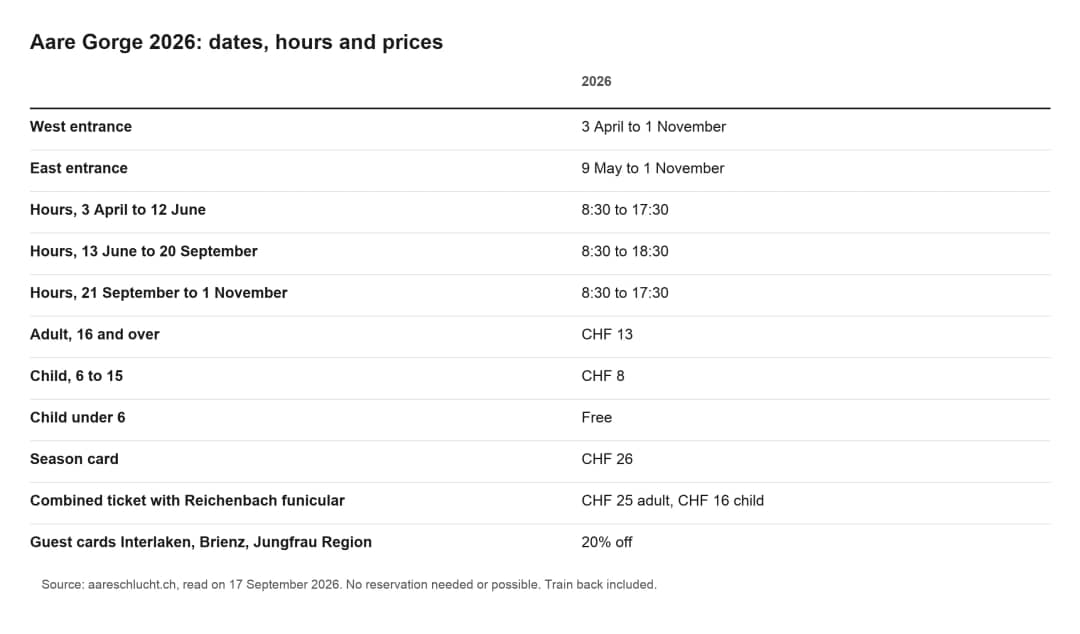
From 21 September to 1 November 2026, the gorge opens from 8:30 to 17:30. You can walk it end to end only while both entrances are open. Guest cards from Interlaken, Brienz and the Jungfrau Region give 20% off.
Two extras are worth knowing. A season card costs CHF 26, twice a single adult ticket. The combined ticket with the Reichenbach funicular costs CHF 25 for adults. Our Reichenbach Falls and Sherlock Holmes guide covers that second stop.
On Friday and Saturday evenings from 3 July to 29 August 2026, the gorge stayed lit until 22:00, from the west entrance to the big gravel and sand banks and back. That season is over for this year.
I paid CHF 13 in cash at the west entrance on 8 August 2026. Some visitors report that only Swiss francs were accepted, so carry some.
Your questions about the Aare Gorge
Travellers ask five things before they go: how long the walk takes, how cold it is, whether it opens in winter, whether it is worth the trip, and how to get there without a car. The short answers: about 45 minutes, around 10 °C, no, yes, and by train in 43 minutes from Interlaken.
How long does it take to walk through the Aare Gorge?
About 45 minutes from one entrance to the other, according to the operator, for a gorge 1,400 metres long. On 8 August 2026, our visit took about an hour. Add time for the way back. The zb train from Aareschlucht Ost to Meiringen is included in your ticket, and on 19 September 2026 the 10:05 train reached Meiringen at 10:13. You can also walk back over the Lammi on a signposted path of about an hour. If you only walk in from the west and turn around, plan the same time again for the return.
How cold is it inside the Aare Gorge?
Colder than outside, whatever the season. The operator describes a constantly cool temperature, and on 8 August 2026 it was about 10 °C inside, with water dripping from every wall. In high summer, that is a relief. In April or October, it can feel raw. Bring a warm layer and a rain jacket even on a sunny day, because the drips come from the rock, not the sky. Visitors say the same in reviews: wet and cold inside. Shoes with grip matter more than a heavy coat, because the walkway stays wet.
Is the Aare Gorge open in winter?
No. The 2026 season runs from 3 April to 1 November at the west entrance and from 9 May to 1 November at the east entrance. After 1 November, the gorge closes for the winter. One reviewer notes that the Aare sometimes floods in the cold months and makes the gorge too dangerous. If you visit the Haslital in winter, look at our guide to the best winter day trips from Interlaken instead. From 21 September, the gorge closes at 17:30, so autumn visitors should arrive by mid-afternoon to have time for the full walk.
Is the Aare Gorge worth it?
Yes, and it is one of the cheaper sights of the region at CHF 13 for an adult, with the train back included. You get a 200-metre-deep gorge, tunnels and walkways in about 45 minutes, in any weather. Reviewers say the most spectacular part lies close to the Meiringen end, so even a short walk in from the west entrance shows you the best of it. It is worth less if you hate crowds and arrive at noon in August: go at 8:30. For a full Meiringen day, pair it with the falls, as our day trip to Meiringen explains.
How do you get to the Aare Gorge from Interlaken without a car?
Take the train from Interlaken Ost to Meiringen, then the zb train to the Aareschlucht West stop. On Saturday 19 September 2026, the 09:04 train from Interlaken Ost connected in Meiringen and reached Aareschlucht West at 09:47, 43 minutes in all. The 08:33 train with a walk from Meiringen station arrived at 09:26, in 53 minutes. From the Aareschlucht West stop, the operator puts the west entrance about 10 minutes on foot. By car, the west entrance has free parking for cars and coaches.
Walk it before 1 November
The Aare Gorge packs a lot into 45 minutes: a 1,400-metre cut through rock that took several ice ages to make, a creature story from 1935 and a river the colour of glacier water. Nothing on the walk is hard, and the train brings you back.
The hard part is the calendar. The gorge closes at 17:30 from 21 September and shuts for the winter after 1 November. Go early, and bring a warm layer and some Swiss francs.
The gorge fits a morning, and the valley fills the rest of the day. Our guide to the best day trips from Interlaken puts Meiringen next to the others.
I walked the gorge with guests on 8 August 2026, gorge first, falls second. If you would rather not juggle trains, tickets and closing times, you can plan a private day around Meiringen with us, from the Aare Gorge to the Reichenbach Falls.
Source: Aareschlucht AG, Naturwunder, Aareschlucht AG, Geologie, and a private tour through the Aare Gorge on 8 August 2026.
Written by Pierre Vetsch, founder and head guide at Swiss Local Adventures
Tags
#aare-gorge-walk#gorges-near-interlaken#swiss-alps-geology#meiringen-day-trip#haslital-day-trip
Sources & References
- •Aareschlucht AG, Naturwunder (1,400 m long, 200 m deep, 1-2 m wide, 45 minutes; read 17.09.2026)
- •Aareschlucht AG, Geologie (Kirchet limestone, Franz Müller, five older gorges)
- •Aareschlucht AG, Wegbeschrieb (path, tunnels, wheelchairs, walk times)
- •Aareschlucht AG, Geschichte (concession of 28 September 1887)
- •Aareschlucht AG, Nostalgie (the three side gorges)
- •Aareschlucht AG, Tatzelwurm (spring 1935, Hotel Bär)
- •Aareschlucht AG, Informationen (2026 prices, season, hours, evening lighting; read 17.09.2026)
- •Timetable queried on 17.09.2026 for Saturday 19.09.2026, timetable.search.ch
- •Photos: Pierre Vetsch, Swiss Local Adventures, private tour of 8 August 2026 (featured image and narrow walkway)
- •Photo: Mehrsa on Unsplash (turquoise river)
- •Photo: Patrick Robert Doyle on Unsplash (rock tunnel)
- •Photo: Karsten Winegeart on Unsplash (sun and shade)
- •Photo: Thivanika Uthayakumaran on Unsplash (walkers at the west end)
- •Photochrom Print Collection, Library of Congress, 1890-1900, public domain, via Wikimedia Commons
- •Ferdinand Hodler, Aareschlucht, 1907, public domain, via Wikimedia Commons
- •Photo: Razdan1974, Aareschlucht 2007, public domain, via Wikimedia Commons
Share this article
Similar Articles
Continue your reading with these related articles
Interlaken
9/16/2026
12 min
5
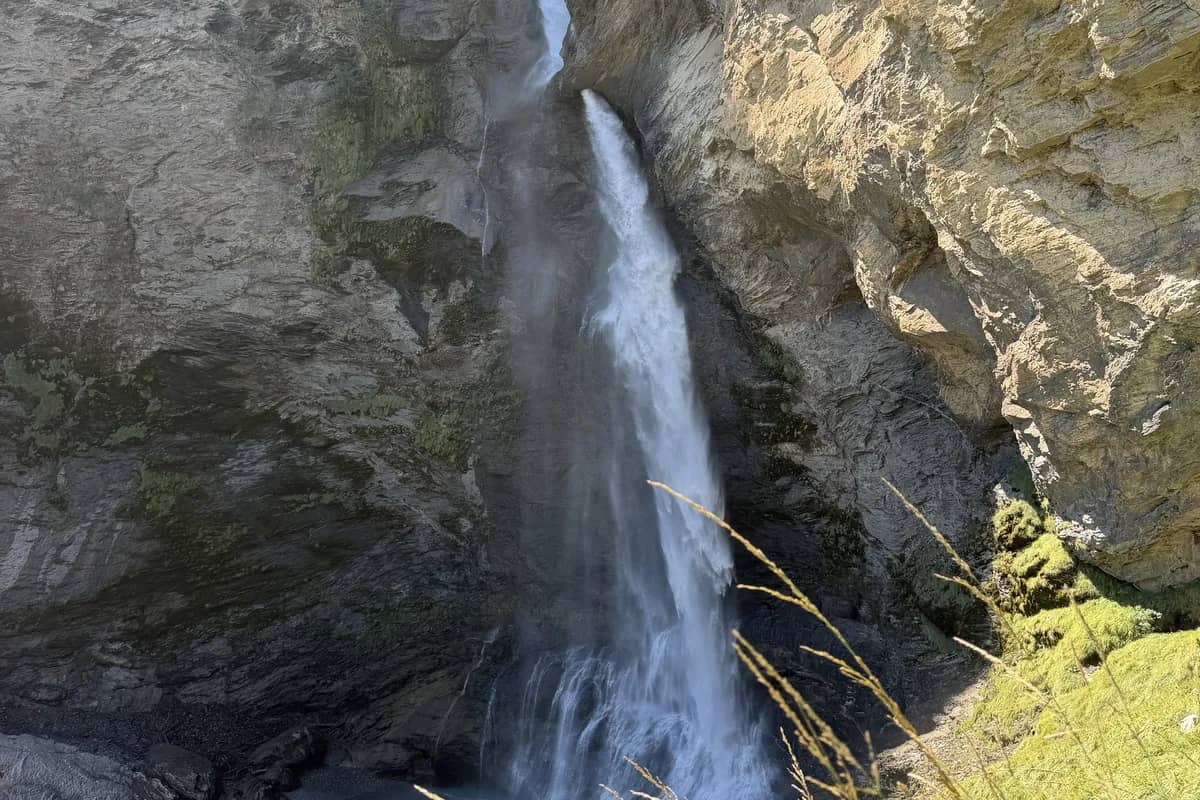
Reichenbach Falls Sherlock Holmes: Find the Star
The white star, the 1957 plaque and the 850 litres a second: what you see at the Reichenbach Falls where Holmes fell. Funicular until 4 October.
sherlock-holmes-switzerlandreichenbach-falls-funicularliterary-travel-switzerland
By Pierre VetschRead More
Interlaken
9/15/2026
12 min
6
Day Trip to Meiringen from Interlaken: Gorge First
Day trip to Meiringen from Interlaken: 31 min by train, the Aare Gorge for CHF 13, the Holmes funicular until 4 October, in the right order.
meiringen-day-tripaare-gorge-walkreichenbach-falls-funicular
By Pierre VetschRead More
Interlaken
9/14/2026
10 min
15
Hinterburgseeli Hike: Catch the 17:14 Bus Down
Hinterburgseeli hike from Axalp: 6 km, 400 m of climbing, 37 min by bus from Brienz. Snow months, swim rules and the last bus down.
hinterburgseeli-hikehiking-lake-brienzwoodcarving-trail
By Timoté BailyRead More