Interlaken
Oeschinensee : le plus beau lac de montagne de Suisse
P
Pierre, Swiss Local Adventures
Auteur
8 juin 2026
8 min
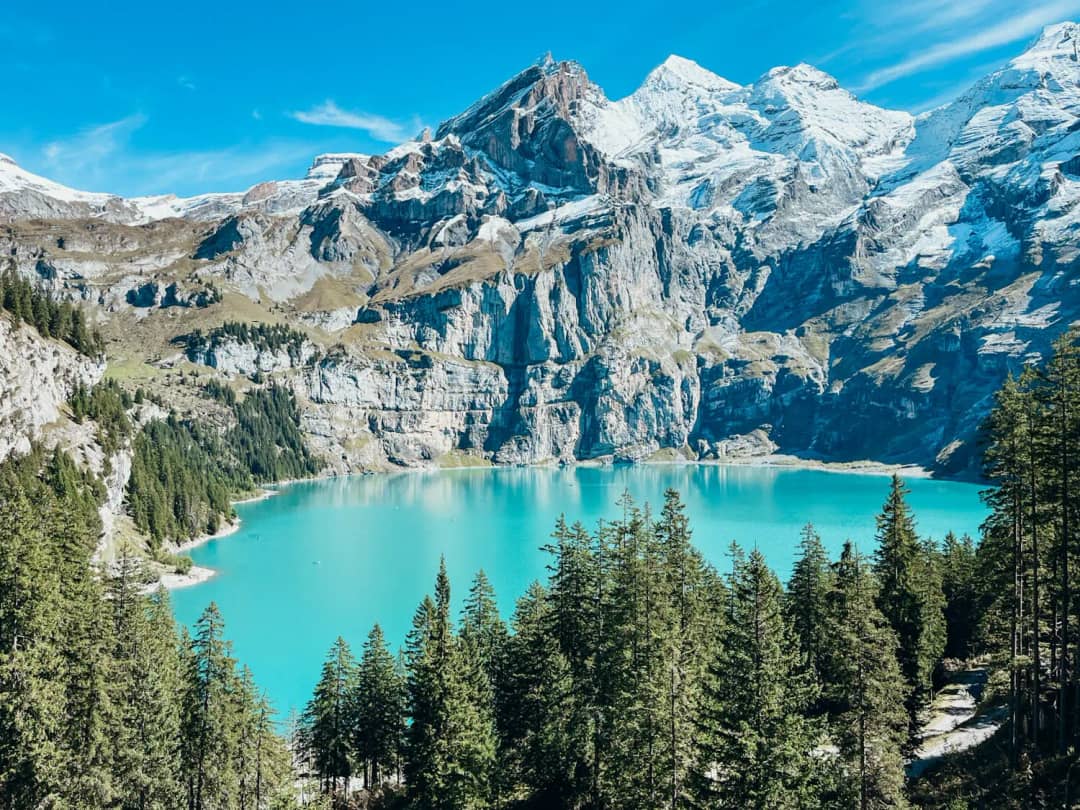
L'Oeschinensee n'est pas juste un lac. Voici pourquoi il a cette allure.
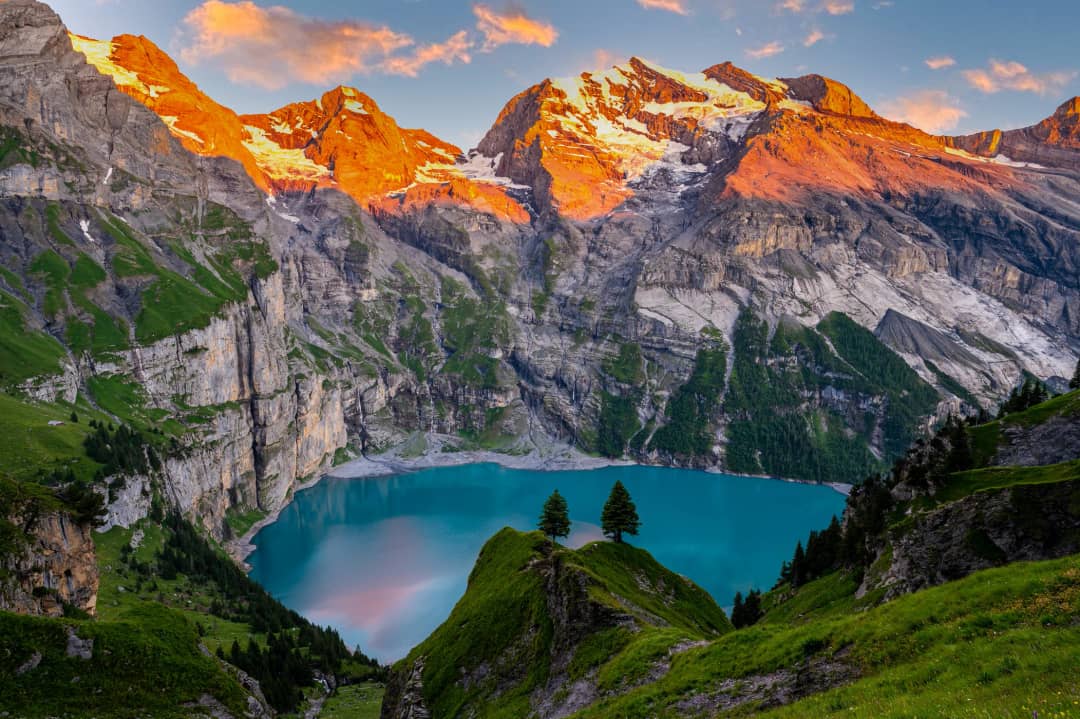
Vous le voyez avant de vous y attendre. La télécabine dépasse le dernier bosquet de conifères sombres, et soudain il n'y a plus rien entre vous et une paroi si haute qu'elle semble se pencher vers vous. Puis votre regard descend. Sous la falaise, sous l'alpage, sous les chalets de bois éparpillés, le lac apparaît. Pas bleu. Pas tout à fait vert. Quelque chose entre les deux que votre cerveau met un instant à classer, une couleur qui a l'air voulue, comme si quelqu'un avait mélangé la juste dose de pigment dans une immense vasque naturelle avant de la laisser là, à découvrir.
C'est votre première vision de l'Oeschinensee. Un lac qui vous fait arrêter de parler.
Les voyageurs qui arrivent dans ce coin de l'Oberland bernois décrivent souvent le moment de l'arrivée de la même façon : inattendu, alors qu'on s'y attendait complètement. Vous avez vu les photos. Vous savez que c'est beau. Et pourtant, l'échelle et la couleur vous prennent de court. Les parois qui entourent la cuvette montent à plus de 1000 mètres au-dessus de l'eau. Les matins calmes, l'eau est presque parfaitement immobile. Le silence est total, à part le bruit des cascades lointaines qui tombent des parois en minces fils blancs.
Parmi les lacs de Suisse, l'Oeschinensee est dans une catégorie à part. Régulièrement élu plus beau lac de montagne du pays, il mérite ce titre chaque jour.
Pourquoi l'eau a cette couleur
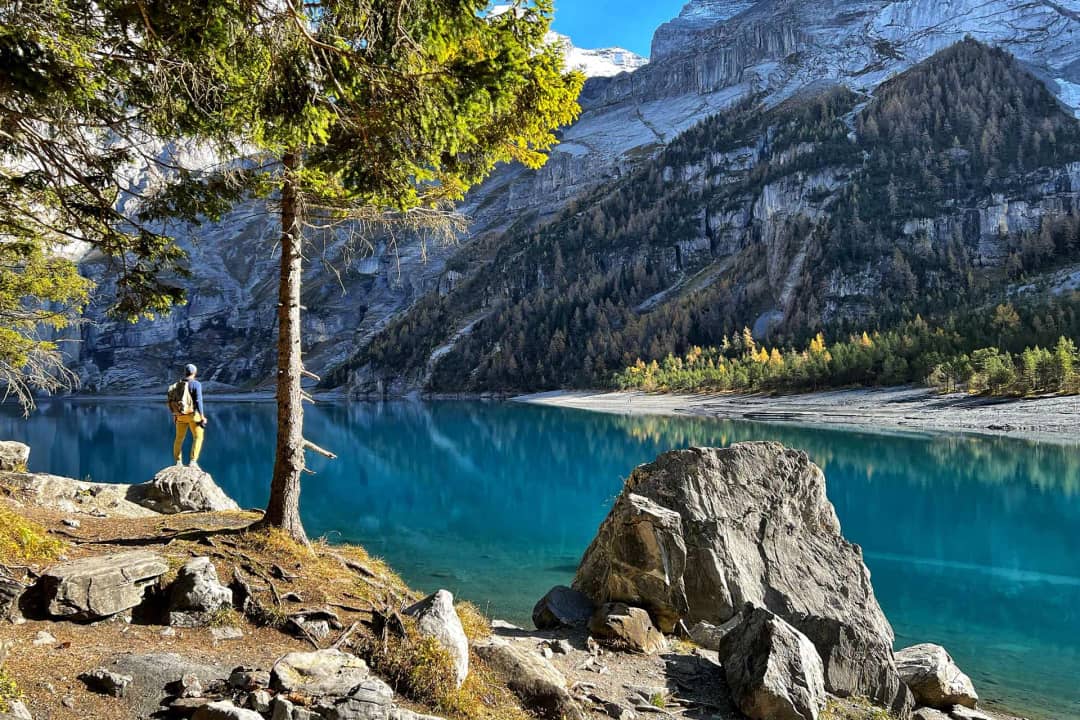
La plupart des gens qui voient l'Oeschinensee pour la première fois pensent que le turquoise est un effet de lumière ou le reflet du ciel. J'ai pensé la même chose la première fois. Ce n'est pas le cas. La réponse est dans l'eau elle-même, et la comprendre rend l'expérience plus forte, pas moins.
Le lac se trouve à 1578 mètres d'altitude, alimenté surtout par la fonte des neiges et les eaux glaciaires des sommets au-dessus. Quand la glace et la neige raclent lentement le calcaire et la roche cristalline, elles pulvérisent la pierre en une poudre extrêmement fine appelée farine glaciaire. Ces particules, larges de quelques micromètres seulement, restent en suspension dans toute la colonne d'eau au lieu de couler. Quand la lumière du soleil entre dans le lac et frappe ces particules, elles diffusent les longueurs d'onde courtes, les bleus et les verts, et absorbent les rouges et les orangés. Ce que vous voyez depuis la rive ou depuis la télécabine, c'est le résultat de millions de collisions minuscules entre la lumière et la poussière de roche : une couleur qui vit entre le jade et le glacier, et qui change selon l'angle du soleil et la profondeur sous vos pieds.
Par un matin calme de début juillet, quand la fonte est à son maximum et que l'eau est chargée de farine glaciaire fraîche, la couleur atteint son intensité la plus forte. Fin septembre, quand l'eau de fonte ralentit, le lac s'éclaircit un peu et devient d'un bleu plus profond. Les deux versions valent le déplacement. C'est le même lac dans deux humeurs.
Une remarque honnête : la couleur dépend du soleil. Les jours couverts, le lac vire à un gris-bleu discret plutôt qu'au turquoise éclatant de la plupart des photos en ligne. Si le ciel est lourd à votre arrivée, la sortie vaut quand même la peine, elle sera simplement différente de ce que vous avez vu sur Instagram.
Un lac qui a mis des millénaires à se former
Les glaciers ont creusé la vallée pendant la dernière glaciation et, lorsque la glace s'est retirée il y a des milliers d'années, les parois et les arêtes du massif de la Blüemlisalp sont restées. Mais l'Oeschinensee lui-même est plus jeune que la vallée qui l'abrite. Il y a environ 3200 ans, une série d'éboulements massifs s'est détachée du flanc nord du Doldenhorn au-dessus de Kandersteg, libérant des débris d'un volume total de plus de 100 millions de mètres cubes. Ce matériel a formé un barrage naturel en travers du fond de la vallée, et le lac s'est rempli derrière. Le barrage reste perméable, ce qui explique que le lac n'ait aucun écoulement de surface visible : l'eau s'infiltre lentement à travers la roche vers les sources qui alimentent la vallée en contrebas.
Les parois alentour, qui dépassent 3600 mètres au Blüemlisalphorn, agissent comme un bassin de réception permanent pour les précipitations et la fonte des neiges.
Le paysage autour de l'Oeschinensee, avec la région de la Jungfrau qui commence juste derrière la crête à l'est, fait partie du site du patrimoine mondial de l'UNESCO Alpes suisses Jungfrau-Aletsch, l'une des plus grandes régions glaciaires des Alpes. L'UNESCO a reconnu ce territoire en 2001, et une extension en 2007 a élargi la zone protégée vers l'ouest, en direction de Kandersteg. Ce que l'UNESCO protège ici n'est pas seulement un décor. C'est l'une des archives scientifiques les plus importantes de la glaciation alpine sur Terre, un paysage façonné par des forces qui ont commencé avant l'histoire humaine et qui travaillent encore aujourd'hui, plus lentement.
Pour le village de Kandersteg au pied de la vallée, l'Oeschinensee a toujours été le fait qui organise la vie : le repère qui a mis le village sur les cartes, la ressource en eau qui a nourri l'agriculture, la muraille qui a décidé quels chemins vers la montagne étaient possibles et lesquels ne l'étaient pas.
Comment y aller depuis Interlaken
L'Oeschinensee se trouve au-dessus de Kandersteg, à environ 45 à 60 minutes d'Interlaken selon la correspondance.
Le plus direct est le train. Interlaken West et Interlaken Ost proposent tous deux des liaisons régulières vers Spiez, où vous changez pour la ligne du Lötschberg en direction du sud vers Kandersteg. Le trajet jusqu'à Kandersteg dure environ 45 minutes au total et traverse quelques-uns des plus beaux paysages de vallée de l'Oberland bernois, la Kander visible presque tout du long, les montagnes qui se resserrent à mesure que la vallée se rétrécit.
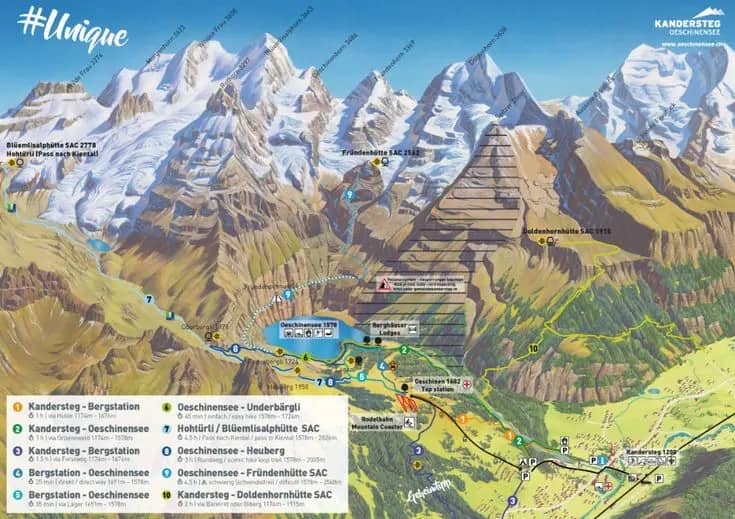
Depuis la gare de Kandersteg, la télécabine de l'Oeschinensee fonctionne toute l'année. La montée dure six minutes et vous épargne environ 500 mètres de dénivelé. De la gare à la station de départ, comptez dix minutes à pied. Si vous préférez monter à pied, un sentier balisé depuis le village gagne la même altitude en environ 45 minutes, à travers la forêt puis l'alpage ouvert, les parois se dévoilant peu à peu au-dessus des arbres.
Depuis la station supérieure, il faut cinq minutes de marche plate sur un chemin de gravier jusqu'au bord du lac. Le lac apparaît sur la droite quand le chemin passe le dernier virage, et c'est là que se prennent la plupart des photos. Autorisez-vous à vous arrêter. Cela le mérite.
Les familles avec de jeunes enfants trouveront le chemin plat de la station supérieure au lac facile et très gérable. La zone de baignade de la rive nord et les barques fonctionnent bien avec des enfants. Prenez des chaussures de marche ou des chaussures de randonnée légères, le sentier de la rive sud est caillouteux par endroits. Les sandales suffisent au bord du lac, mais rendent le tour du lac inconfortable.
Le Swiss Travel Pass couvre le train jusqu'à Kandersteg ; la télécabine accorde 50% de réduction aux détenteurs du Swiss Travel Pass.
À noter : le Berner Oberland Pass n'est plus accepté à la télécabine de l'Oeschinensee depuis 2026.
Du 20 juin au 20 septembre, les billets de télécabine doivent être réservés à l'avance sur oeschinensee.skiperformance.com ; les créneaux partent vite le week-end et les billets au guichet sont souvent introuvables dès la fin de matinée. Réservez la veille au plus tard. La télécabine coûte CHF 36 aller-retour en intersaison (de mai au 14 juin et du 22 septembre au 8 novembre) et CHF 40 en pleine saison (du 15 juin au 21 septembre).
Si vous venez d'Interlaken dans le cadre d'une journée plus longue dans l'Oberland bernois, associer une matinée au village de Kandersteg et une fin d'après-midi au lac donne un rythme généreux plutôt que pressé.
Que faire au lac
La baignade. La température de l'eau de l'Oeschinensee reste froide presque toute la saison, en général entre 15 et 19 degrés Celsius en surface pendant les semaines les plus chaudes de l'été. Ce n'est pas la baignade tiède d'une rivière de plaine. C'est froid, propre, froid de glacier, un froid qui traverse la peau et transforme votre respiration en quelque chose de plus lent et de plus attentif. La plupart des gens ont le souffle coupé la première fois. Presque tous sont contents de l'avoir fait. La première fois que j'ai amené un groupe ici, un gars du Texas s'est arrêté au bord du ponton, a regardé l'eau, a regardé les parois, et n'a pas dit un mot pendant deux bonnes minutes. Personne ne l'a interrompu. Ce silence en dit plus sur l'Oeschinensee que tout ce que je pourrais vous raconter d'avance. La clarté de l'eau est saisissante : vous voyez les pierres du fond par trois mètres de profondeur sans effort, chacune distincte, comme si l'eau n'était pas là. Il y a une petite zone de baignade sur la rive nord près du restaurant, avec de l'herbe pour s'allonger et un ponton en bois. Venez le matin si vous voulez le lac pour vous.
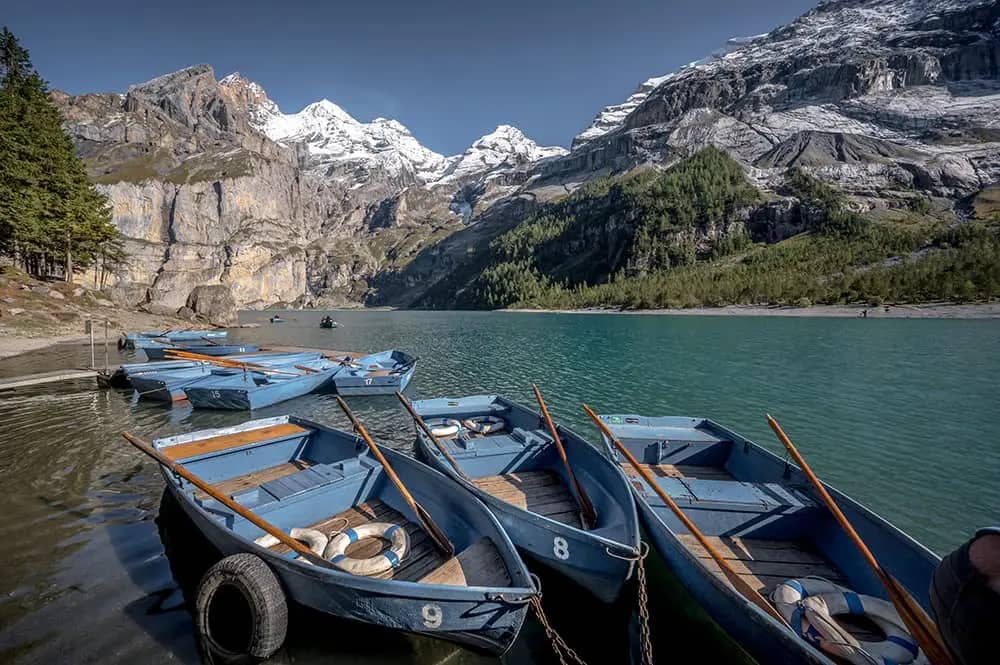
Les barques. Des barques en bois se louent au bord du lac de la fin du printemps au début de l'automne. Une barque pour deux ou trois personnes se loue à l'heure et permet de traverser jusqu'à la rive opposée, où les parois plongent directement dans l'eau et où l'échelle des falaises devient physique d'une manière que le bord du lac ne transmet pas. Depuis l'eau, en regardant vers la station de télécabine, on voit tout le bassin d'un seul coup, et le silence qui se rassemble entre la roche et la surface n'a pas d'équivalent dans la région.
Le tour du lac. Un sentier bien balisé fait le tour du lac en environ 1.5 heure à allure tranquille. La rive nord est plus ouverte, avec des vues de prairie vers les parois. La rive sud longe l'eau de plus près, dans une végétation plus dense, avec des passages où vous pouvez toucher la surface depuis le chemin. Le fond du lac, à l'opposé de la télécabine, est la partie la plus calme. Peu de visiteurs font le tour complet, si bien que la rive sud est souvent vide même quand la rive nord est fréquentée.
La montée à la cabane Blüemlisalp. Pour qui veut monter plus haut, un sentier balisé continue depuis l'extrémité est du lac par une série de lacets raides jusqu'à la cabane Blüemlisalp, à 2834 mètres. Cette montée demande environ 2.5 à 3 heures depuis le lac et représente un dénivelé important sur un terrain alpin rugueux. La récompense est la vue plongeante sur l'Oeschinensee, avec tout le système de falaises déployé sous vous et le lac réduit à un bijou turquoise serti dans le calcaire gris. La cabane sert à manger et à boire et propose un dortoir pour ceux qui veulent se réveiller en altitude et voir le soleil toucher les sommets. En début de saison, tant que les névés ne sont pas fondus, les crampons sont nécessaires.
La via ferrata de l'Oeschinensee. Un itinéraire équipé longe une partie des parois au-dessus de la rive nord. Il demande baudrier et casque et convient à des marcheurs en forme qui n'ont pas le vertige, même sans expérience d'escalade. Le matériel se loue à Kandersteg.
Manger au lac
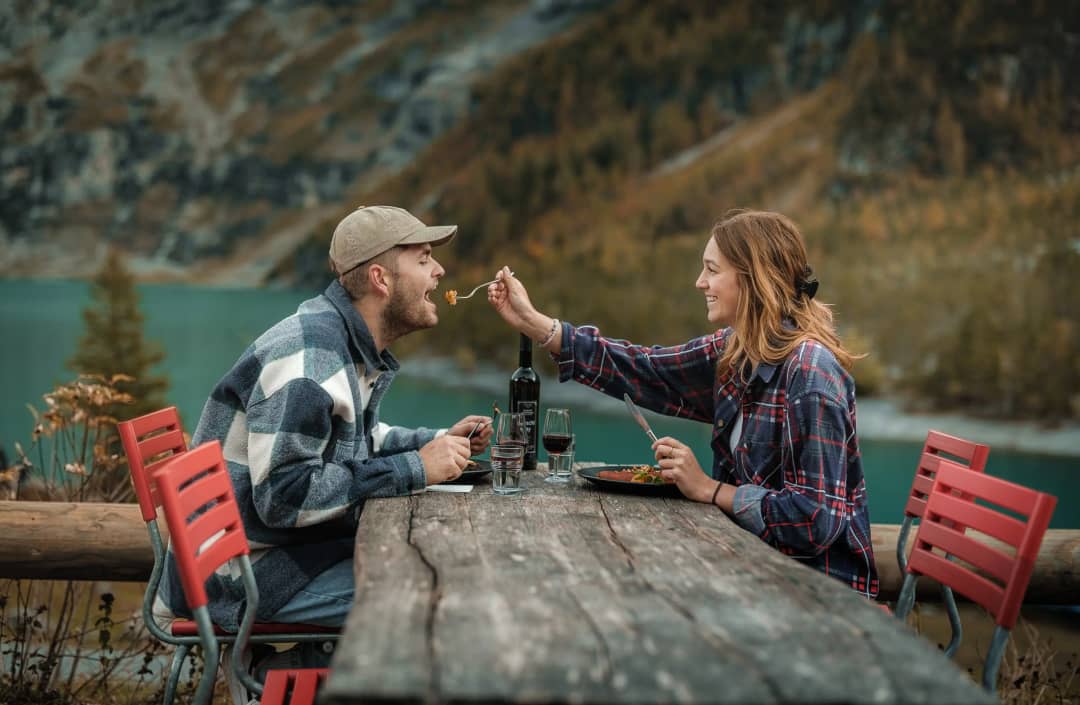
Le Restaurant Oeschinensee, construit dans le style chalet traditionnel et posé directement au bord de l'eau, nourrit les visiteurs depuis le 19e siècle. La carte est alpine suisse : rösti, fondue au fromage, saucisse, soupe. La terrasse fait face au lac et aux parois, ce qui fait que la plupart des clients passent autant de temps à regarder en l'air qu'à manger. Le service est efficace aux heures de pointe et plus détendu en intersaison. Le restaurant est la seule option de restauration au lac, donc si vous prévoyez une journée entière, organisez-vous autour ou emportez votre pique-nique.
L'eau du robinet ici, comme partout à Kandersteg, est de l'eau de source de montagne. Potable, froide et propre. Remplissez une bouteille avant de monter et vous n'aurez pas besoin d'acheter de l'eau au lac.
Un détail à connaître avant de monter : le Restaurant Oeschinensee n'accepte que les espèces, francs suisses ou euros. Les cartes ne sont pas acceptées au lac.
Comptez environ CHF 60-80 par personne pour une journée complète : télécabine aller-retour (CHF 36-40), repas au restaurant (CHF 20-30), location de barque si vous en voulez une (CHF 20-25/heure).
Quand venir
Printemps (mai, début juin) : la fonte est à son plus spectaculaire, les cascades jaillissent de chaque pli de la paroi, et les fleurs le long du chemin depuis la télécabine sont à leur apogée. Le lac est au turquoise le plus intense dans les semaines où l'eau de fonte est la plus abondante. Une visite au petit matin fin mai peut donner l'impression d'avoir le lac pour soi. Les températures sont fraîches, prenez une couche pour la matinée.
Juillet et août : haute saison. Le lac est le plus fréquenté entre 10 h du matin et 3 h de l'après-midi, quand arrivent les excursionnistes d'Interlaken et de Berne par les trains de midi. Les conditions de baignade sont les meilleures. Les barques tournent à plein. Familles, couples, classes, randonneurs et photographes partagent le même chemin de rive. Si vous arrivez avant 9 h du matin ou après 4 h de l'après-midi, la foule s'allège nettement.
Septembre : de l'avis local, le plus beau mois. La lumière s'adoucit. Les mélèzes des pentes commencent à jaunir, et fin septembre les parois sont traversées de couleurs d'automne sur le calcaire gris. L'air est plus net et les reflets sur l'eau plus propres. La fréquentation baisse d'environ la moitié par rapport à août. Le restaurant ferme plus tôt, prévoyez en conséquence.
Octobre : la télécabine tourne à horaire réduit et certaines installations ferment pour la saison. Le lac est froid, la lumière est basse et les parois sont très silencieuses. Pour les photographes et pour ceux qui cherchent la solitude, c'est le mois.
Peut-on se baigner dans l'Oeschinensee ?
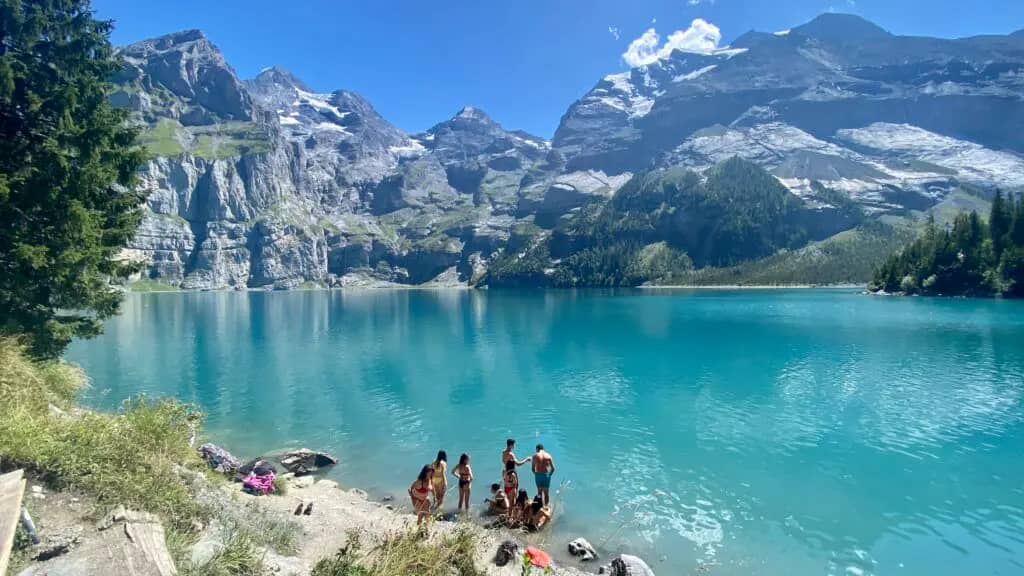
Oui. La baignade est autorisée et vivement encouragée. Il n'y a pas de surveillance, ce qui est la norme pour les lacs de montagne suisses. La profondeur augmente vite vers le milieu du lac, les nageurs peu à l'aise restent donc près de la rive nord, moins profonde. L'eau est propre et sans danger. Le choc thermique est réel et mérite qu'on s'y prépare : respirez un coup avant d'entrer, avancez lentement plutôt que de sauter, et laissez 30 secondes à votre corps pour s'adapter. Ensuite, le froid devient presque agréable, une conscience du corps entier qui vous rend plus présent que presque tout le reste dans les Alpes.
Le ponton de baignade près du restaurant offre l'accès le plus simple. L'herbe sous la station de télécabine laisse de la place pour les linges et les sacs. Ni l'un ni l'autre n'ont de cabines, venez donc préparé.
Après le bain, asseyez-vous au soleil dans l'herbe et regardez les parois. Vous entendrez des cascades que vous ne voyez pas. Vous sentirez le pin mouillé et la pierre chauffée par le soleil. Le froid quittera votre corps lentement et la journée vous paraîtra plus grande qu'avant.
> Le conseil de Pierre
> Le meilleur moment pour arriver à l'Oeschinensee est la première télécabine du matin, qui part à 8:30 de mi-juin à début octobre. À 9:15 vous êtes au lac avant les excursionnistes, la lumière est encore basse et rasante sur l'eau, et les parois se reflètent parfaitement en surface. Emportez du café dans une thermos. Asseyez-vous sur le ponton. Accordez-vous 30 minutes avant de faire quoi que ce soit d'autre. Ce qu'on vit à cette heure, la foule de midi ne le voit jamais. Si vous ne pouvez pas prendre la première télécabine, visez une arrivée après 4:30 de l'après-midi, quand la grosse vague est redescendue et que la lumière commence à orangir les parois. Dans tous les cas, évitez 11 h du matin à 3 h de l'après-midi en juillet et en août.
Organisez votre journée autour de l'Oeschinensee
L'Oeschinensee remplit une journée entière si vous le voulez. La télécabine, le tour du lac, une baignade, un repas sur la terrasse, une barque l'après-midi : vous tenez sept ou huit heures sans vous répéter.
Il se marie aussi très bien avec d'autres expériences de la région. Une matinée au lac suivie d'un après-midi en farm tour guidée avec petit-déjeuner suisse dans la vallée d'Interlaken vous donne deux faces complètement différentes de la vie alpine en une seule journée : la géologie sauvage et verticale du lac d'altitude, puis le monde chaud et humain d'un alpage en activité, avec fromage frais et pain du four à bois.
Pour un séjour plus long, combinez l'Oeschinensee avec une tour du vin et une marche dans les vignes au-dessus du lac de Thoune, où la même lumière qui rend le lac turquoise le matin fait mûrir le pinot noir des terrasses exposées au sud l'après-midi. Le contraste entre l'altitude et la vallée, entre le froid glaciaire et la chaleur des vignes, est l'un des meilleurs arguments pour ralentir dans cette partie de la Suisse.
Préparez votre voyage dans l'Oberland bernois avec Swiss Local Adventures et laissez une expérience en petit groupe donner sa forme à une journée que vous raconterez encore dans cinq ans.
FAQ : Oeschinensee, Suisse
Comment rejoindre l'Oeschinensee depuis Interlaken ?
Prenez le train depuis Interlaken Ost ou Interlaken West en direction de Spiez, puis changez pour Kandersteg. Le trajet dure environ 45 minutes. Depuis la gare de Kandersteg, marchez 10 minutes jusqu'à la station de télécabine. La télécabine met 6 minutes jusqu'au lac. Trajet total depuis Interlaken : environ 60 à 75 minutes. Le Swiss Travel Pass couvre le train ; la télécabine accorde 50% de réduction aux détenteurs du Swiss Travel Pass.
Le restaurant de l'Oeschinensee n'accepte-t-il que les espèces ?
Oui. Le Restaurant Oeschinensee n'accepte que les espèces, francs suisses ou euros. Les cartes ne sont pas acceptées. Prenez de quoi manger (CHF 20-30 par personne) avant de monter en télécabine. Il n'y a aucune autre option de restauration au lac.
Peut-on se baigner dans l'Oeschinensee ?
Oui. La baignade est autorisée et populaire pendant les mois d'été. L'eau est froide, en général de 15 à 19 degrés Celsius en surface en juillet et en août, alimentée par la fonte glaciaire. Une zone de baignade avec ponton en bois se trouve près du restaurant. Il n'y a pas de surveillance. L'eau est propre et sans danger.
Pourquoi l'Oeschinensee est-il si bleu ?
La couleur vient de la farine glaciaire : des particules de roche ultrafines arrachées au calcaire environnant par la fonte et la glace, en suspension dans toute la colonne d'eau. Ces particules diffusent les longueurs d'onde bleues et vertes et absorbent les rouges et orangées. Le résultat est le turquoise que vous voyez depuis la rive ou depuis la télécabine, le plus intense fin juin et début juillet, quand l'eau de fonte est à son maximum.
L'Oeschinensee est-il classé au patrimoine mondial de l'UNESCO ?
L'Oeschinensee se situe à l'intérieur du site du patrimoine mondial de l'UNESCO Alpes suisses Jungfrau-Aletsch, inscrit en 2001 et étendu en 2007. La zone est reconnue pour ses paysages glaciaires exceptionnels, sa biodiversité et sa valeur scientifique comme archive des processus géologiques alpins.
À quoi ressemble la randonnée autour de l'Oeschinensee ?
Le tour du lac prend environ 1.5 heure à allure détendue sur un sentier bien balisé et presque plat. La rive nord est ouverte et panoramique ; la rive sud est plus proche de l'eau et plus calme. Pour un défi plus sérieux, le sentier de la cabane Blüemlisalp à 2834 mètres part de l'extrémité est du lac et demande 2.5 à 3 heures avec un dénivelé important.
Quelle est la meilleure période pour venir à l'Oeschinensee ?
Tôt le matin de fin juin à septembre, ou en fin d'après-midi. Le lac est le plus fréquenté entre 10 h du matin et 3 h de l'après-midi en juillet et en août. Beaucoup d'habitants tiennent septembre pour le plus beau mois : moins de monde, lumière dorée et mélèzes qui commencent à tourner. La première télécabine de la journée (vers 8:30) est la meilleure façon de voir le lac avant la foule.
Faut-il réserver la télécabine à l'avance ?
Oui, si vous venez entre le 20 juin et le 20 septembre. La télécabine de l'Oeschinensee fonctionne avec des créneaux horaires en haute saison et les créneaux partent vite, surtout le week-end. Réservez sur oeschinensee.skiperformance.com avant de partir pour Kandersteg. Hors haute saison, les billets au guichet sont en général disponibles, mais une réservation en ligne reste conseillée pour éviter la file.
Écrit par Pierre Vetsch, fondateur et guide principal de Swiss Local Adventures
Source :
expérience de guidage sur place, plus les informations officielles d'Oeschinensee Bergbahnen ( oeschinensee.ch ) et de Kandersteg Tourismus (kandersteg.ch).
Mots-clés
#oeschinensee#kandersteg#swiss-alps#bernese-oberland#mountain-lake#switzerland-hiking#unesco#jungfrau-region#swimming-switzerland#most-beautiful-lake
Sources & Références
Partager cet article
Articles Similaires
Continuez votre lecture avec ces articles connexes
Interlaken
14/09/2026
10 min
1
Randonnée au Hinterburgseeli : ne ratez pas le bus de 17:14
Préparez votre randonnée au Hinterburgseeli : 6 km, 400 m de montée, 37 min de bus depuis Brienz. Neige, baignade et dernier bus du retour.
hinterburgseeli-hikehiking-lake-brienzwoodcarving-trail
Par Timoté BailyLire Plus
Interlaken
12/09/2026
12 min
9
Deltaplane ou parapente à Interlaken : CHF 260 ou 170
Comparez deltaplane et parapente à Interlaken : même colline, mêmes 20 minutes, CHF 170 contre CHF 260. Voici ce qu'achètent ces 90 francs.
tandem-hang-glidingtandem-paraglidingadventure-sports
Par Timoté BailyLire Plus
Interlaken
11/09/2026
15 min
12
Maisons historiques de Bönigen : gratuit, à 4 minutes
Parcourez gratuitement les maisons historiques de Bönigen, à quatre minutes de bus d'Interlaken Ost, devant des façades de bois datées de 1549.
historic-house-trailday-trip-brienzinterlaken-day-trips
Par Pierre VetschLire Plus