Farm, Wine & Fondue
Swiss Wine Regions: Which to Visit from Interlaken
O
Olivia Lufman
Author
May 11, 2026
27 min
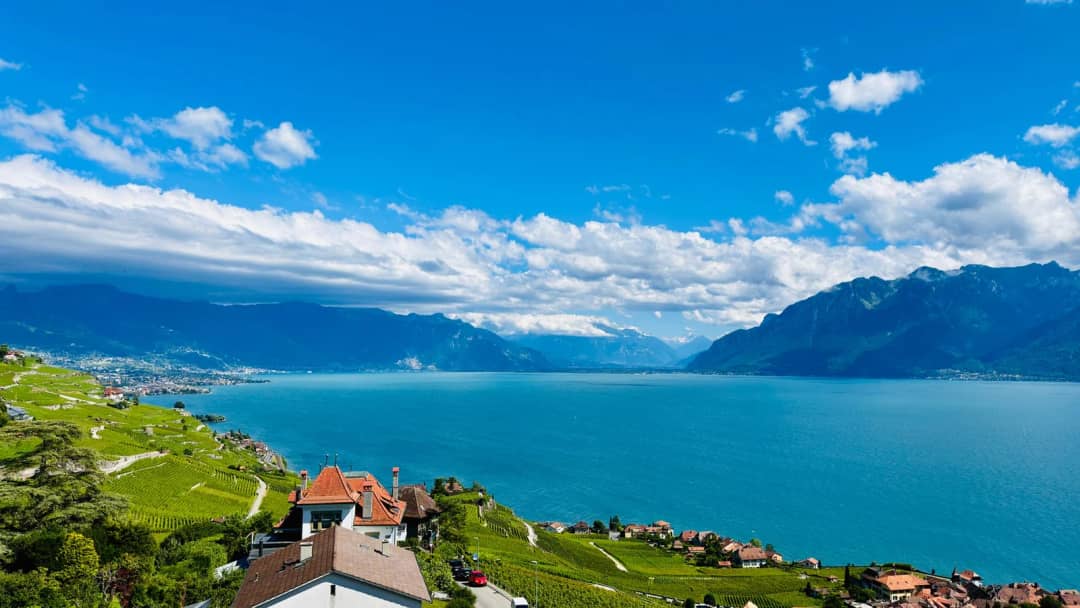
Switzerland has six wine regions, according to Swiss Wine Promotion: Valais, Vaud, Geneva, Ticino, German-speaking Switzerland and the Three Lakes, with 14,569 hectares of vines. From Interlaken, pick Spiez, 19 minutes by train, for a half day, and Lavaux, about 2 hours 40 minutes away, for a full day (checked on 10 November 2026).
98% of Swiss wine never leaves the country. Every bottle you taste here stays here. That is not a marketing line. It is a supply reality: Swiss production is small, domestic demand is high, and export volumes are negligible compared to France or Italy.
What that means for you is simple. The wine you drink in a Swiss vineyard is wine you cannot buy at home. It does not exist on shelves in London, New York, or Tokyo. That exclusivity is not accidental. It is baked into the geography of this country.
Switzerland has six wine regions, and this guide picks five wine areas from them, each shaped by a different climate, grape, and landscape. Some are world-famous. Some barely appear in English-language guides. This article covers all five, with honest guidance on which are worth visiting if you are based in Interlaken, and why one of them, Spiez, tends to surprise visitors the most.
The best wine regions in Switzerland, and the six official ones
Switzerland has six wine-producing regions, according to Swiss Wine Promotion: Valais, Vaud (home to Lavaux), Geneva, Ticino, German-speaking Switzerland and the Three Lakes region. The most visited are Lavaux and Valais. The most underrated, especially from Interlaken, is Spiez on the shores of Lake Thun.
Each region produces wine with a character you will not find anywhere else. The altitude, the south-facing slopes, and the local grape varieties create flavours that are genuinely distinct from French or Italian wine, even when the same grape is used.
If you have two weeks in Switzerland, you could visit all five. If you have a few days around Interlaken, the realistic options are Spiez (20 minutes by train) and Lavaux (roughly 2 hours 40 minutes, timetable checked on 8 October 2026). Valais is doable as a full day. The others require more time.
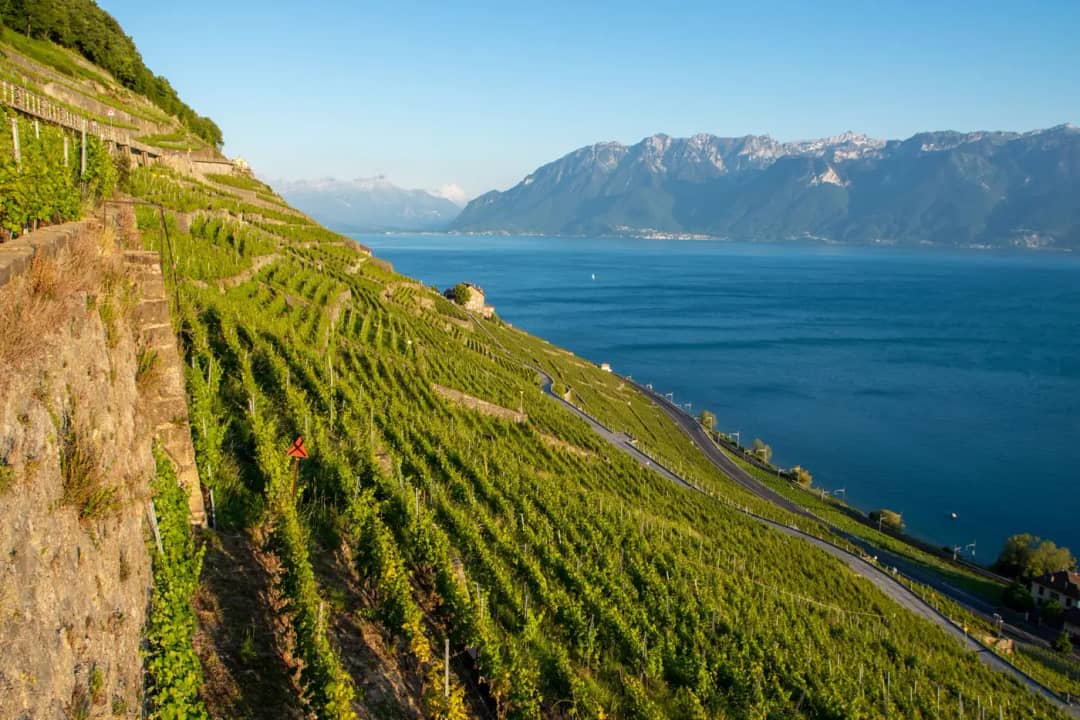
1. Lavaux: The UNESCO Vineyard That Earned Its Status
Lavaux is the most photographed wine landscape in Switzerland and, arguably, one of the most striking vineyard settings in Europe. The terraced vines stretch along the northern shore of Lake Geneva, between Lausanne and Montreux, rising steeply from the water's edge toward the ridge above.
UNESCO inscribed Lavaux in 2007, recognising its continuous cultivation since the 11th century and the extraordinary feat of engineering its terraces represent. Walking through the vineyards, you see walls built by hand over centuries, retaining soil that would otherwise wash into the lake.
The "Three Suns" Legend
Lavaux growers speak of three suns: the sun in the sky, the sun reflected from Lake Geneva, and the heat radiating from the stone walls overnight. Together, they extend the growing season and produce a warmth the numbers alone do not capture.
The dominant grape is Chasselas, a variety almost unknown outside Switzerland and largely dismissed by the global wine trade. In Lavaux, it produces something quite different: mineral, delicate, with a slight effervescence that comes from the natural CO2 retained during winemaking. The best examples come from Grand Cru plots such as Calamin and Dézaley, inside the vineyard landscape UNESCO listed in 2007. Quality at that level sits alongside serious white Burgundy.
Fun fact: UNESCO inscribed Lavaux in 2007, and vines have been cultivated on its terraces since the 11th century.
Producers in Lavaux are small by design. Most are family-owned. You do not find large commercial wineries here. Tastings are available at estates throughout the Epesses, Rivaz, and Saint-Saphorin villages, and several producers open their cellars on weekend afternoons without advance booking.
The villages themselves reward time. Grandvaux and Rivaz have the feel of places that have not needed to change, because the wine draws visitors without any additional attraction.
Best for: visitors who want to combine wine tasting with walking along the lakeside, who appreciate old-world viticulture, and who want the most scenic wine landscape in Switzerland. Plan a full day from Interlaken.
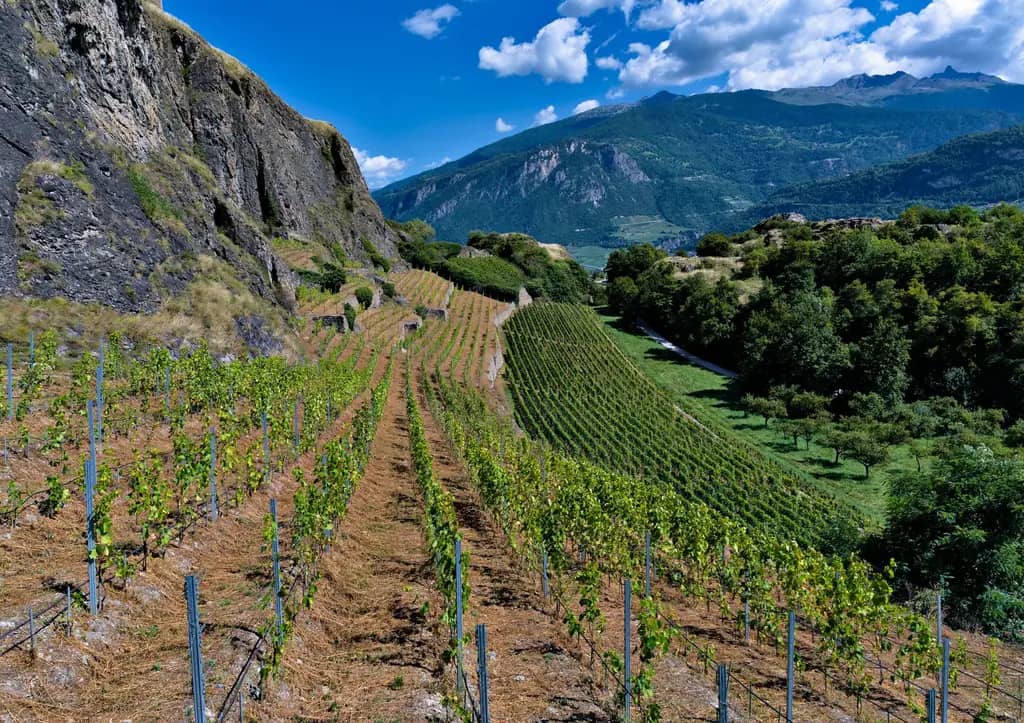
2. Valais: Switzerland's Largest and Most Varied Wine Region
Valais produces more Swiss wine than any other region. It runs along the Rhone valley from Port-Valais near Lake Geneva in the west to Brig in the east, sheltered from the north by the Bernese Alps and benefiting from a dry, sunny climate that has more in common with southern France than with the rest of Switzerland.
The region accounts for roughly one-third of all Swiss wine production. The grape range is extensive: Chasselas under the local name Fendant, Pinot Noir as Dôle when blended with Gamay, and a collection of rare indigenous varieties found nowhere else. Heida, Petite Arvine, Cornalin, and Amigne are grapes that exist in commercial quantity only here.
What Makes Valais Wine Different
The altitude is significant. Many Valais vineyards sit between 600 and 800 metres. At that elevation, warm days and cool nights preserve acidity and aromatic intensity in a way that lower-altitude regions cannot. The combination produces wines that taste simultaneously ripe and fresh.
Olivia says: "If you open one bottle in Valais, make it a Petite Arvine. You will not find that grape in serious, well-made form anywhere else in the world."
Olivia Lufman, your travel writer at Swiss Local Adventures
Sierre and Sion are the two towns most associated with wine tourism. Both have producers who welcome visitors, and the main cantonal road through the valley passes vineyard after vineyard.
If you are interested in rare indigenous grape varieties, Valais is the only place in the world where you can taste them in serious, well-made form. Petite Arvine in particular has attracted international attention in recent years.
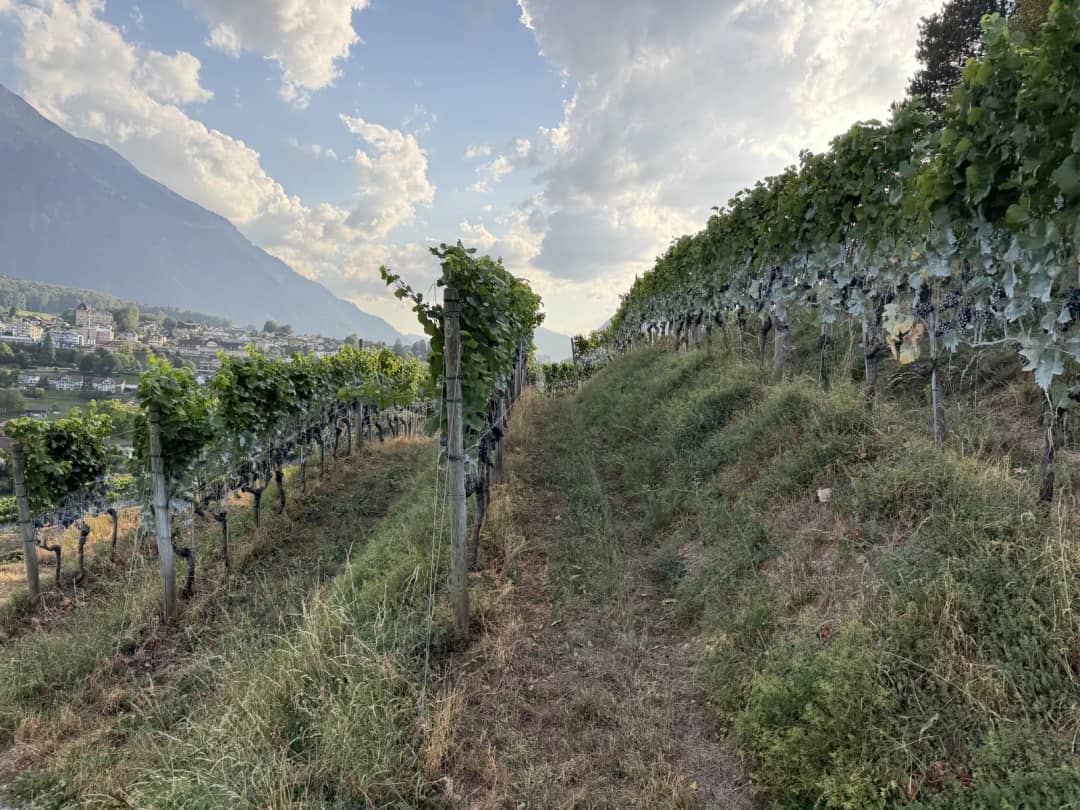
Best for: wine drinkers who want variety and depth, travellers with a full day or overnight available, and anyone interested in rare indigenous Swiss grape varieties. From Interlaken: about 1 hour 20 minutes by train to Sierre and 1 hour 30 minutes to Sion, changing at Spiez and Visp (timetable checked on 8 October 2026).
3. Bündner Herrschaft: Switzerland's "Little Burgundy"
Bündner Herrschaft sits in the canton of Graubünden, in eastern Switzerland, and produces some of the country's most respected Pinot Noir. The climate here is sheltered and surprisingly warm, protected from cold winds by the surrounding mountains. The comparison to Burgundy is used cautiously by producers, but quality at the top level is serious.
Note for Interlaken-based travellers: this region is more than 3 hours away each way (about 3 hours 15 minutes to Maienfeld, timetable checked on 8 October 2026). Worth the detour if you have a full free day and a specific interest in Pinot Noir.
Best for: serious red-wine drinkers and Pinot Noir enthusiasts. Combine with a visit to Chur.
4. Ticino: Where Switzerland Meets the Mediterranean
Ticino is the Italian-speaking canton in the south of Switzerland, and its wine tastes like it belongs there. The climate is warm and Mediterranean, and the dominant grape is Merlot. Ticinese Merlot is lighter and more herbal than Bordeaux or California versions, with a freshness that reflects the altitude and local winemaking style.
From Interlaken, Ticino is close to 4 hours away by train (3 hours 54 minutes to Lugano, timetable checked on 8 October 2026). It is genuinely worth visiting as part of a broader Swiss itinerary, particularly if you travel via the Gotthard route.
Best for: visitors exploring southern Switzerland and Italian wine lovers. Plan at least one night in Lugano.
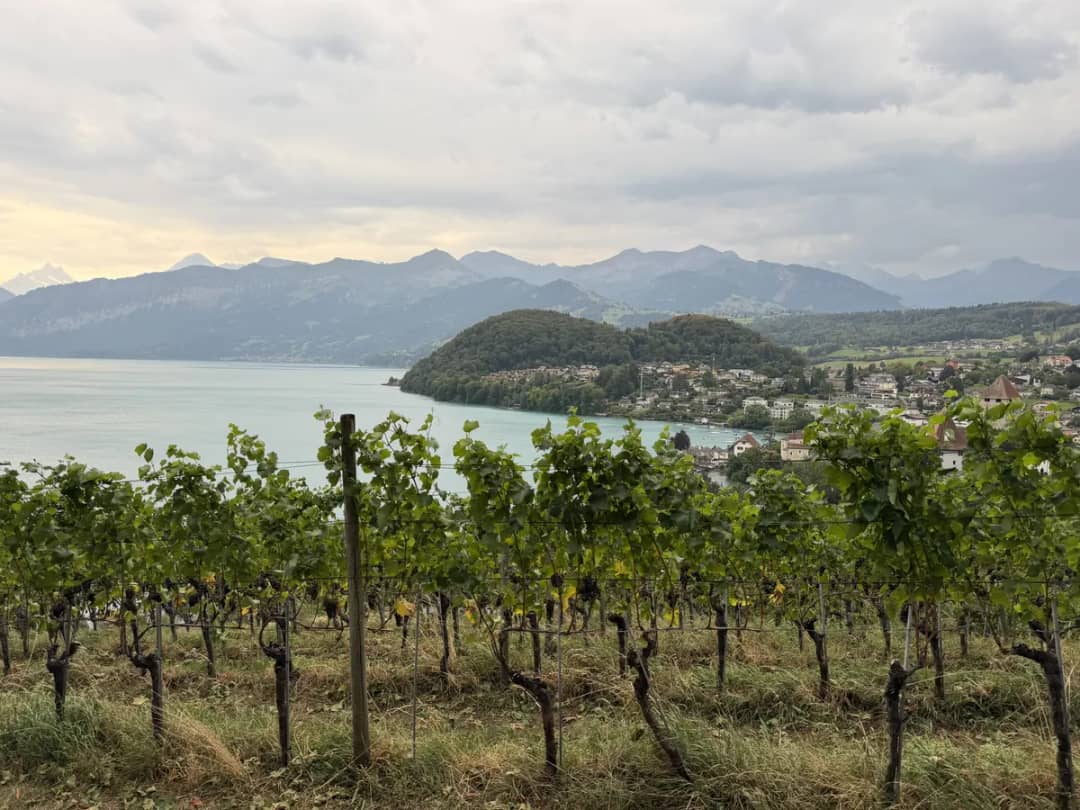
5. Spiez: The Hidden Alpine Wine Gem Near Interlaken
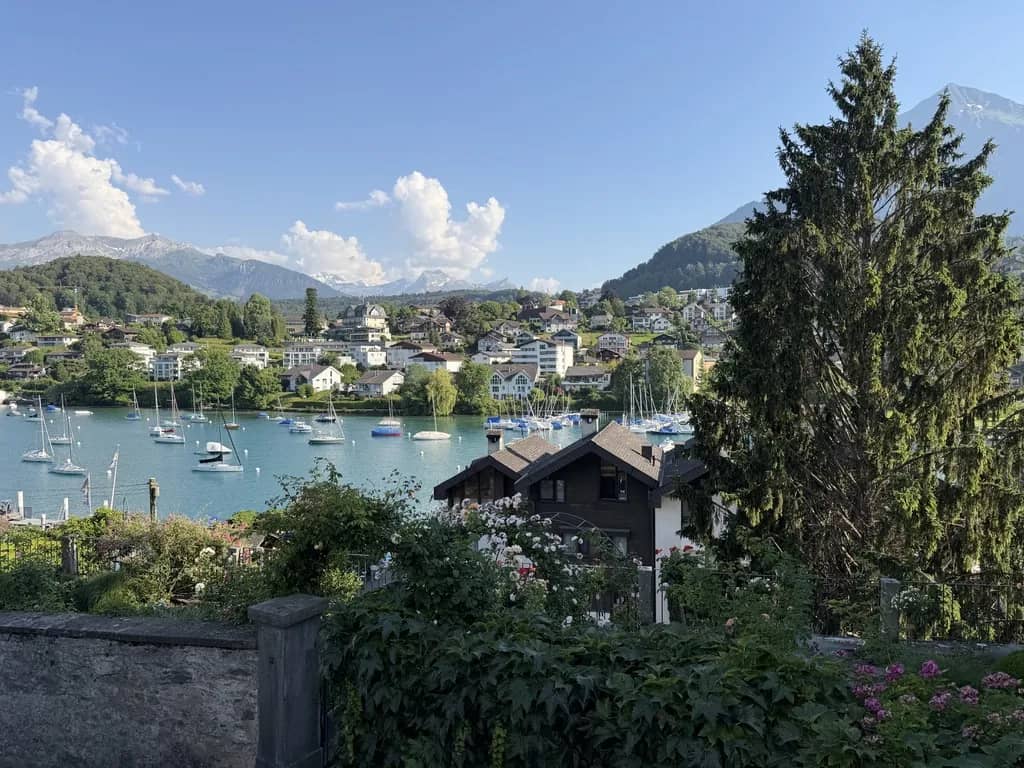
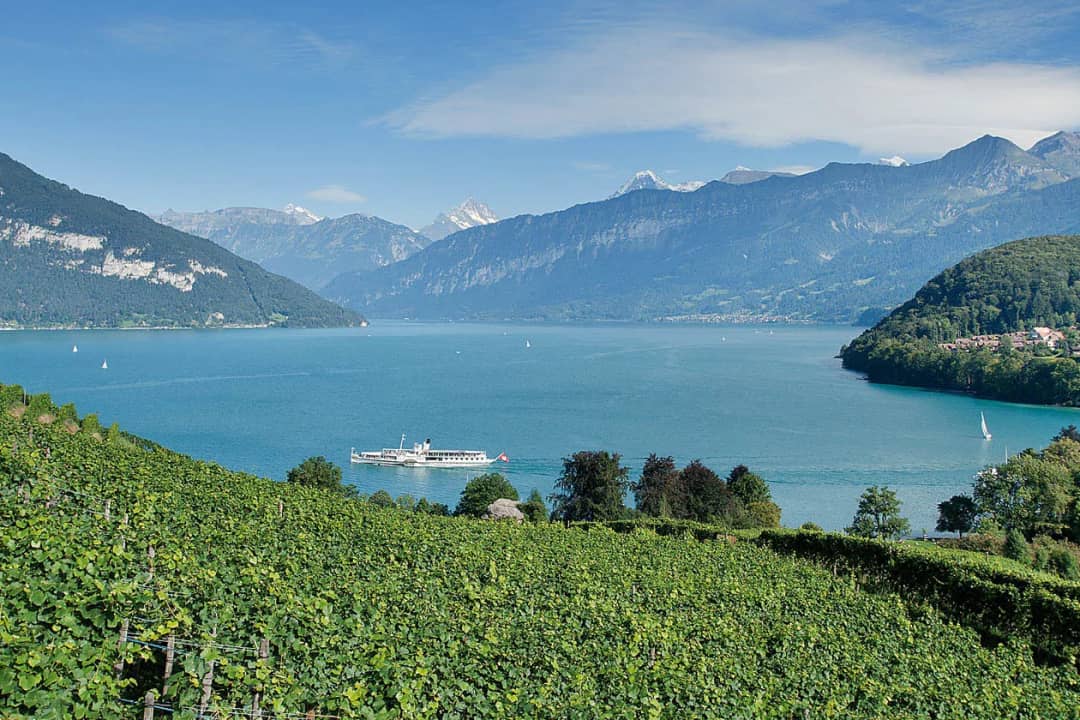
Spiez sits on a promontory jutting into Lake Thun, 20 minutes by direct train from Interlaken. Most visitors know it as the castle on the postcard. Fewer know that winegrowing in the region was first recorded in 994 AD, according to the municipality of Spiez.
The winery behind those vines today is Alpine Weinkultur Spiez, and the article on Swiss wine since 994 AD traces how that millennium of growing is still managed on the same slope.
The vineyard footprint is small. Spiez does not produce wine at scale. That is part of what makes a visit different: you are not joining a commercial tasting operation. You are accessing a working estate that makes its wine for local consumption, with a tasting experience that exists through a direct partnership with Swiss Local Adventures.
Why Spiez Feels Different From Lavaux or Valais
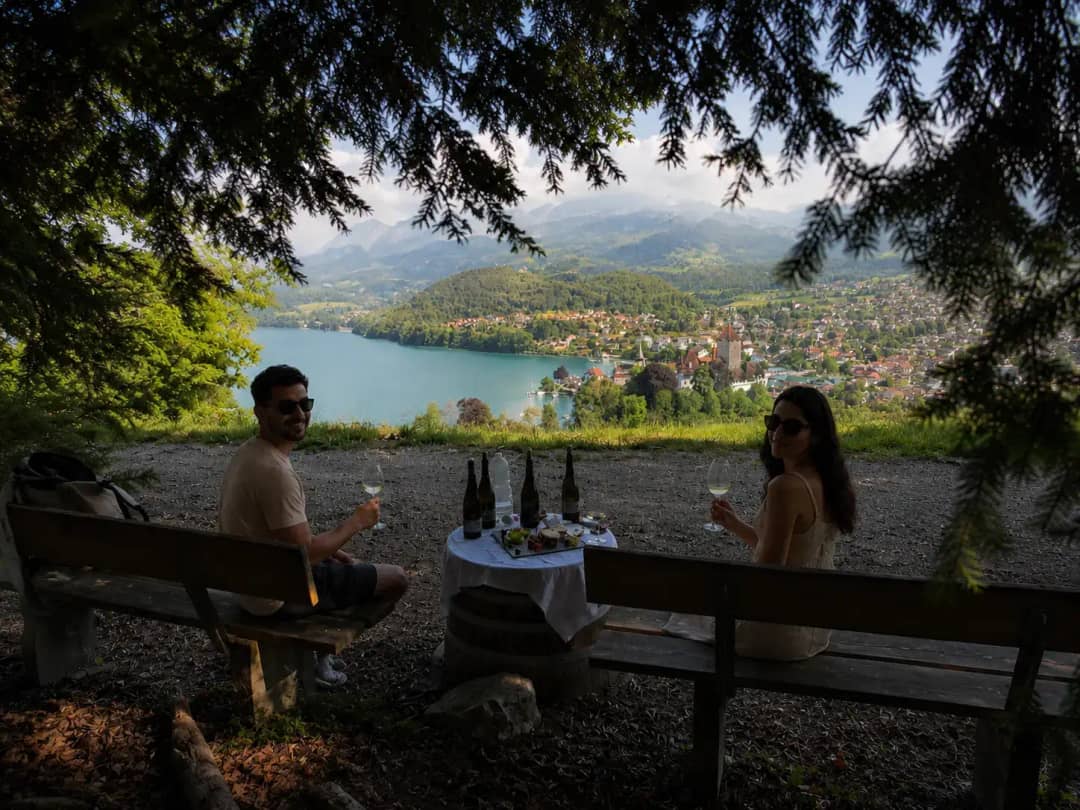
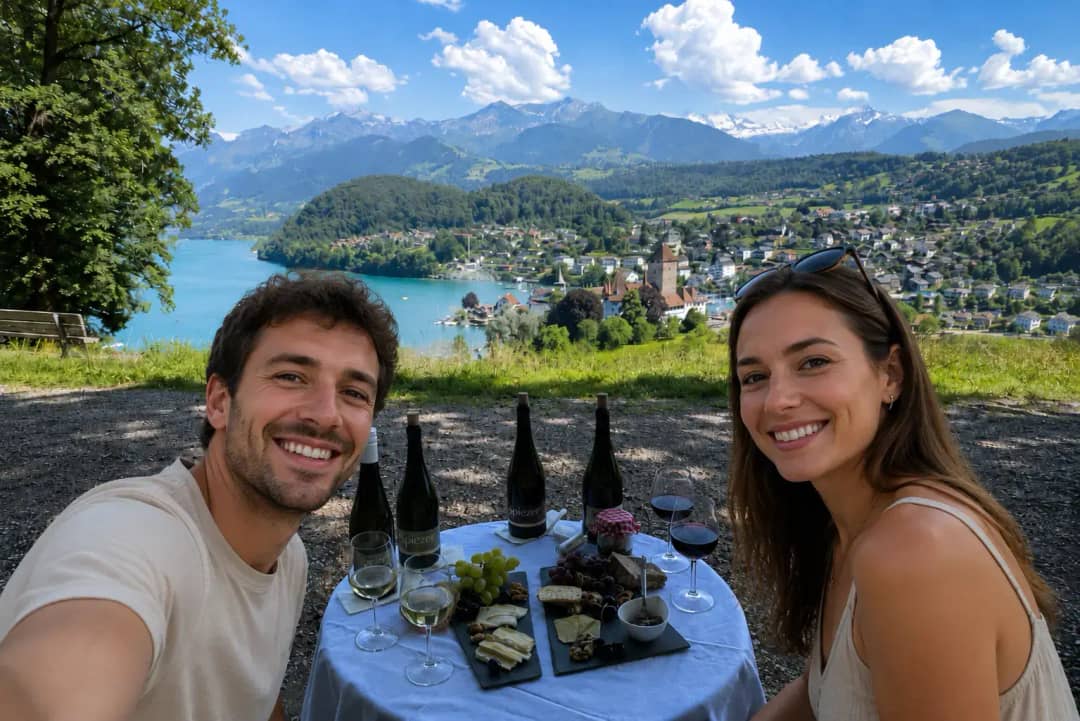
The view from the vineyard terrace is the first answer. Lake Thun is a specific shade of blue-green that changes with the light and the season. The Swiss Alps rise directly behind it, snow-capped through most of the year. The castle occupies the lower part of the slope. You hold a glass of wine and look at a composition that took geology and history several thousand years to arrange.
The second answer is scale. There are no tour buses at Spiez. The tasting group has a maximum of 8 people. That is by design, not accident.
Asked for his clearest memory of the Spiez vineyard, Pierre answered with the light, not the wine:
"Late afternoon in summer, low light skimming over Lake Thun."
Pierre Vetsch, guide and founder, interview of 9 October 2026
What You Drink at Spiez
The tour pours four local wines from Spiez: a Souvignier Gris, a blend of Souvignier Gris and Sauvignac, a Cabernet Jura and a Pinot Noir. Your guide explains each one in plain language as you taste it. The estate also bottles a Riesling-Sylvaner (Müller-Thurgau), sold in its own wine shop.
Four cheeses come with the wines, with bread, fruit and nuts, served in the vineyard with the lake below you.
The Rebbau Spiez Partnership
Rebbau Spiez is the cooperative behind the Spiezer Alpine Weinkultur brand. Our contact there is Sebastian, and the guided tasting with cheese you join exists because of that partnership. The estate also opens its own wine shop for tastings on Friday evenings and Saturdays from May to October (checked on 10 November 2026).
This is not a walk-in experience. It runs through the at 3:30 pm, from May to October. CHF 139 per person (CHF 129 each from 6 people) covers the van from Interlaken and back, four local wines, regional cheese with fresh bread, and your guide, in a group of 8 people at most.
You can also take the train to Spiez and taste at the estate's shop on its opening days. What the tour adds is the pick-up at Interlaken West station, the Adventure Hostel or Balmers, the walk through the vines and the castle courtyards with a guide, and the cheese served in the vineyard.
Best for: travellers based in Interlaken with a half day free, visitors who want an intimate rather than a large-group experience, anyone who wants to combine wine and local food culture with a genuinely exceptional landscape.
Swiss wine outside Switzerland: hard to find, and the reason
Swiss wine is hard to find abroad because almost none is exported. The country produces around 90 million litres of wine in an average year (82 million in 2025, according to the Federal Office for Agriculture), a small output by global standards. Swiss domestic consumption absorbs the output. There is no surplus for export, and Swiss production costs make competitive pricing in foreign markets nearly impossible.
The result is that 98% of Swiss wine stays in Switzerland. The wines you taste here are not available at home. That is a statement of supply, not of quality.
Swiss wine does not suffer from a quality problem. It suffers from an invisibility problem. The Grand Cru Chasselas from Lavaux, the best Petite Arvine from Valais, and the Riesling-Sylvaner from Spiez all offer quality that competes with established European wine regions. They are simply absent from the global market.
The invisibility is not only abroad. Asked what visitors get most wrong about wine in this region, Pierre kept it to one line:
"They don't even know there's wine here."
Pierre Vetsch, guide and founder, interview of 9 October 2026
Grape varieties grown in Switzerland, white and red
Switzerland grows both international and indigenous varieties, with a sharp difference between regions.
White grapes: Chasselas is the national grape, dominating in Vaud, Valais (as Fendant), and Geneva. Riesling-Sylvaner (Muller-Thurgau) is the main variety at Spiez. Petite Arvine and Amigne are rare indigenous varieties found almost exclusively in Valais.
Insider tip: In Lavaux, several producers open their cellars on weekend afternoons without advance booking. If you have dismissed Chasselas before, try it there.
Red grapes: Pinot Noir is the leading red, widespread across all regions. Gamay is common in Valais (blended as Dôle). Cornalin and Humagne Rouge are rare indigenous reds found only in Valais. Merlot dominates in Ticino.
Chasselas deserves particular mention. It is considered neutral or thin in most wine-producing countries. In the hands of Swiss growers in Lavaux and Valais, it produces something entirely different: a wine with mineral precision, light structure, and a slight prickle from retained CO2. If you have dismissed Chasselas before, try it in the region where it was made.
The Swiss wine region to visit from Interlaken, by time available
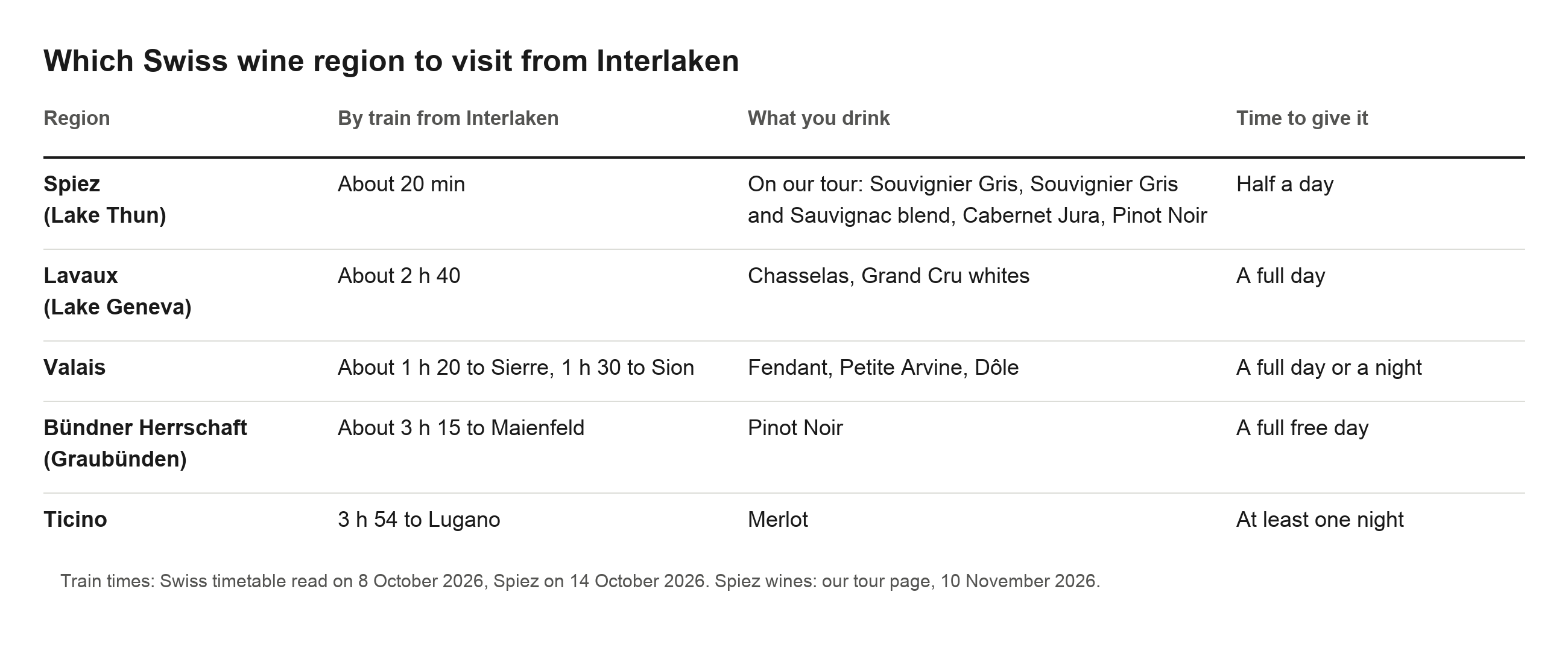
Spiez fits a half day, and Lavaux or Valais a full day. Here is the comparison by time and interest.
By train, Lavaux takes about 2 hours 40 minutes, Bündner Herrschaft about 3 hours 15 and Ticino close to 4 hours, as the region sections above say, and the Spiez tour pours a Souvignier Gris, a Souvignier Gris and Sauvignac blend, a Cabernet Jura and a Pinot Noir rather than Riesling-Sylvaner.
If you have a half day: Spiez is the clear answer. On your own, the direct train from Interlaken West takes about 20 minutes (timetable checked on 14 October 2026). On the tour, a van picks you up in Interlaken and brings you back, so there is no timetable to plan. The tasting runs in groups of maximum 8 people.
The half day costs CHF 139 per person, and if you want to see what that price covers compared with a standalone tasting at a Swiss estate, the breakdown of what the Spiez tour includes lays it out line by line.
If you want to see how those few hours actually unfold, from the 3:30 pm pick-up in Interlaken to the last glass, the Spiez wine tour minute by minute lays out the full timeline.
If you have a full day: Lavaux or Valais. Both require advance planning for transport and, in the case of some producers, reservations.
The best time to visit Swiss wine regions: May, June, September, October
The best months are May, June, September, and October. Each has a different character.
May and June bring the vineyards to full foliage, wildflowers between the vines, and temperatures comfortable for walking. It is the quietest period for visitors and the most photogenic for landscape shots.
September and October are the harvest months, known in German as Läset. This is when the vineyards are most active: pickers move through the vines, the air carries the scent of fermenting must, and the landscape shifts from deep green to gold and red.
The Spiezer Läset-Sunntig (Spiez Harvest Sunday) is the regional harvest festival held every September. In 2026 it took place on 13 September; the next one is on 12 September 2027, within the Läset Fest from 11 to 13 September (checked on 10 November 2026). It is a rare opportunity to see the harvest in action and to taste wines from multiple producers in a single afternoon.
Mid-July to mid-August is peak tourist season. Advance booking matters more during these months. Winter sees most vineyards quiet, with limited visiting hours.
Your Questions About Swiss Wine Regions
Does Switzerland have good wine?
Yes, and consistently better than visitors expect. The absence of Swiss wine from international markets creates a false impression that it is inferior. In reality, Swiss wine has never needed to compete for export. The domestic market absorbs everything at prices that support serious winemaking. Grand Cru Chasselas from Lavaux and the best Valais Petite Arvine are wines that impress experienced drinkers, not just curious tourists.
Why is Swiss wine so hard to find outside Switzerland?
Supply and economics. Switzerland produces around 90 million litres of wine in an average year (82 million in 2025, according to the Federal Office for Agriculture), a small output by global standards. Domestic consumption accounts for nearly all of it. The production cost per bottle is high because Swiss land and labour costs are high, which makes competitive export pricing nearly impossible. The result is that 98% of Swiss wine stays in Switzerland. This is not a decision made by winemakers to protect their market. It is a structural reality of a small country with strong local demand. The wine you drink in a Swiss vineyard is wine you genuinely cannot buy at home.
What is Chasselas wine and why is it so different in Switzerland?
Chasselas is a grape variety that most wine-producing countries treat as a table grape: pleasant, neutral, unremarkable. In Switzerland, particularly in the Lavaux and Vaud regions, it is the national wine grape and is cultivated with the same seriousness that Burgundy applies to Chardonnay. Swiss Chasselas is light in colour, delicate in structure, and mineral in character. The CO2 naturally produced during fermentation is retained rather than removed, giving the wine a slight prickle that makes it feel alive in the glass. The best examples, from Grand Cru plots like Calamin and Dézaley, have a complexity and specificity of place that rewards serious attention.
Where is the best wine tasting near Interlaken?
Spiez. The vineyard sits on a hillside above Lake Thun, about 20 minutes by direct train from Interlaken West, and it is the only region in this guide that fits into a half day. Days, price and what the guided tasting includes are in the Spiez section above, and this breakdown answers whether the Spiez wine tour is worth CHF 139.
Is Lavaux wine region worth visiting?
Yes, without hesitation, if you have a full day to give it. Lavaux is a UNESCO World Heritage site for a reason: the terraced vineyards above Lake Geneva are one of the most striking landscapes in Europe, and the Chasselas wines produced there are the best version of that grape anywhere in the world. The villages of Grandvaux, Rivaz, and Saint-Saphorin are quiet and authentic. Walking the wine route takes two to three hours at a comfortable pace, with tastings available at several estates along the route. From Interlaken, count on about 2 hours 40 minutes by train each way (timetable checked on 8 October 2026).
What food pairs with Swiss wine?
Swiss wine was designed, over centuries, to pair with Swiss food. Chasselas pairs best with cheese fondue and raclette: the wine's acidity cuts through the fat of the melted cheese and refreshes the palate between bites. Riesling-Sylvaner, which the Spiez estate also bottles, pairs well with freshwater fish from Lake Thun, air-dried meats from Valais, and mild hard cheeses like Emmentaler. At the Spiez tasting, each of the four wines comes with regional Swiss cheese. Dôle, the Valais red blend of Pinot Noir and Gamay, pairs naturally with the local air-dried beef known as Viande séchée.
When is the Swiss wine harvest and what is it called?
The harvest is called the Läset in German-speaking Switzerland. It typically runs from mid-September through October, with the exact timing varying by region, altitude, and vintage conditions. In Spiez, the Spiezer Läset-Sunntig (Harvest Sunday) is the main annual festival, held in autumn and open to visitors. During harvest season, the vineyards are at their most active and the landscapes are at their most dramatic: the green of summer shifts to orange, gold, and red. If your travel dates allow it, planning a Swiss wine visit to coincide with the harvest adds a dimension that off-season visits cannot replicate.
What kind of wine is Switzerland known for?
White Chasselas, on 24% of Swiss vineyards and the leading white grape of Vaud, Valais and Geneva, and Pinot Noir, the leading red. Swiss Wine Promotion adds that Merlot covers more than 80% of the vineyards in Ticino, and that Pinot Noir and Müller-Thurgau, the grape Spiez sells as Riesling-Sylvaner, dominate in German-speaking Switzerland. For rare grapes, look to Valais natives such as Petite Arvine and Cornalin.
Our pick from Interlaken: Spiez first
If you are based in Interlaken, the answer is Spiez, and it comes quickly.
We asked Pierre whether Lavaux or Valais is the better choice from Interlaken.
"Neither of the two if you only have 3 days. Do Spiez."
Pierre Vetsch, guide and founder, interview of 9 October 2026
Spiez is 20 minutes away by train. The experience is small-scale, scenically exceptional, and accessible without specialist wine knowledge. You do not need to understand wine to enjoy the view from that terrace or to appreciate the difference between a wine made in that specific place and anything you could buy at home.
Spiez is not the only place to taste near Interlaken, and if you would rather stay in town, the guide to six real wine tasting options in Interlaken compares bars, shops and tours with their actual opening days.
Lavaux and Valais are both worth the journey if your schedule allows a full day. They are different in character from each other and from Spiez, and a traveller who visited all three would come away with a genuinely rounded picture of what Swiss wine is.
The 98% statistic is worth holding onto. The wine you drink in Switzerland is wine that stays in Switzerland. That is the most honest case for taking a half day from your Interlaken itinerary and heading toward a vineyard.
If you have already decided on Spiez and want to know exactly what to expect on the day, our wine tour Spiez guide covers the visit step by step.
The first worry people tell us about is not the price or the train. It is "I don't know anything about wine."
"It's made for beginners, we start from zero."
Pierre Vetsch, guide and founder, interview of 9 October 2026
For more things to do in Interlaken, see the 25 picks of our local guide.
How we made this: facts and prices checked at the official sources on 8 October 2026, written with AI assistance. Opening answer, the six regions, tour season, the cooperative's tasting days, festival dates, train times to Spiez and Lavaux and the new FAQ answer checked on 10 November 2026 against Swiss Wine Promotion, our tour page, the websites of the cooperative and the festival, and the Swiss timetable.
*Written by Olivia Lufman, your travel writer at Swiss Local Adventures
Tags
#wine-tour-interlaken#swiss-wine#wine-regions-switzerland#lavaux#valais#spiez#lake-thun#bernese-oberland#interlaken
Sources & References
- •Swiss Wine
- •Lavaux UNESCO
- •Photo: Spiezer Alpine Weinkultur
- •Photo: Amauri Filho on Pexels
- •Photo: Loïc Privet on Pexels
- •Photo: Jean-Paul Wettstein on Pexels
- •SLA, Scenic Wine Tour activity page (read 14.10.2026): 15:30 start, CHF 139 / CHF 129 from 6, max 8, pick-up West Station / Adventure Hostel / Balmers, 4 wines (Souvignier Gris, Souvignier Gris + Sauvignac, Cabernet Jura, Pinot Noir), regional cheese and bread; booking calendar availableDays Mon/Wed/Fri, 18.05 to 30.09.2026
- •search.ch timetable API, Interlaken West to Spiez, direct, 19-20 min (queried 14.10.2026 for 16.10.2026)
- •search.ch timetable API, Interlaken Ost to Spiez, 24-25 min (queried 14.10.2026 for 16.10.2026)
- •Alpine Weinkultur Spiez, wine shop: Spiezer Riesling-Sylvaner (Thunersee AOC) bottled by the estate (read 14.10.2026)
- •SLA blog, Spiez wine tour itinerary: 15h30 pickup from Interlaken (read 14.10.2026)
Share this article
Similar Articles
Continue your reading with these related articles
Farm, Wine & Fondue
11/13/2026
9 min
How to Eat Cheese Fondue: Swiss Rules, Tea Wins
How to eat cheese fondue: bread through the crust, fork off your lips, crust last. In a 2010 BMJ trial, tea beat white wine on digestion.
how-to-eat-fondueswiss-fondue-etiquettecheese-fondue
By Pierre VetschRead More
Farm, Wine & Fondue
10/3/2026
12 min
Best Fondue in Interlaken: Where a Local Guide Eats
Best fondue in Interlaken: a local guide's pick is the Taverne at CHF 30 per person. Where our groups eat, what to order, how to skip the traps.
best-fondue-interlakencheese-fondue-interlakenwhere-to-eat-interlaken
By Pierre VetschRead More
Farm, Wine & Fondue
8/20/2026
7 min
Swiss Food Experiences: What to Try and Where It Is Made
What Swiss food to try, and where to watch it made: alpine cheese on summer pastures from May to September, fondue in winter, 25 AOP specialities.
swiss-food-experiencesalpine-cheeseswiss-dairy-farm
By Pierre VetschRead More