Farm Tour
Alpine Farm Tour Near Interlaken, Switzerland
T
Teona Gvasalia
Author
June 17, 2026
6 min
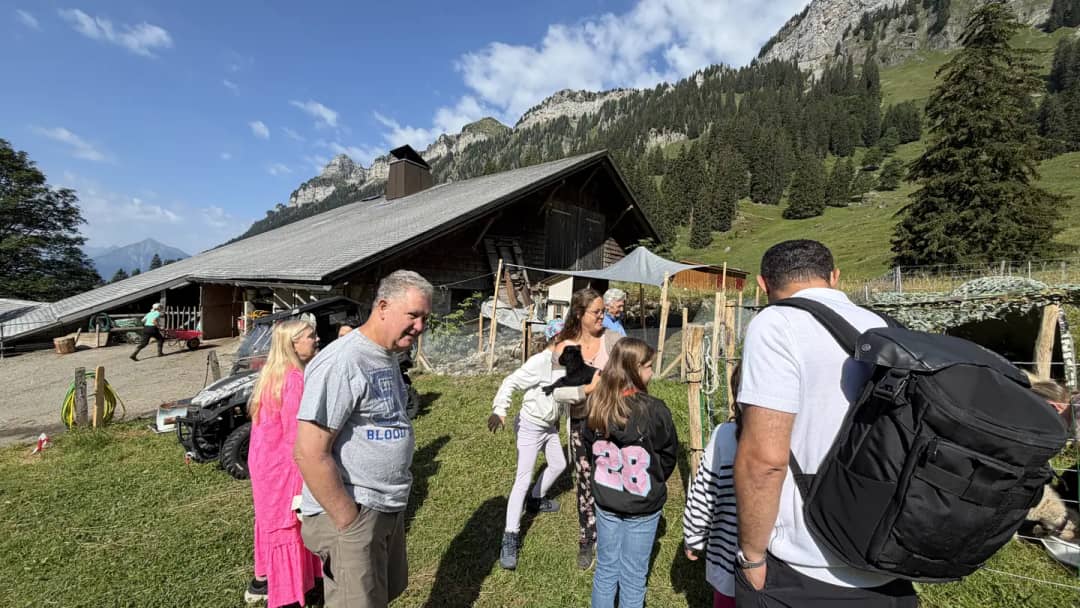
We Left Interlaken at 8am. By 9:00, We Were Eating Breakfast With 21 Swiss Cows
It starts the way most good things start in the Alps: earlier than you'd like, with fog still sitting on the lake.
We leave Interlaken at 8:00am. The city is still asleep. The swans are still on the water. By the time most guests are opening their hotel breakfast buffet, our van is already climbing the road to Beatenberg, towards a valley that the guidebooks forgot to mention.
The Justistal doesn't have a cable car. No view platform, no audio guide, no suggested selfie spot. What it has is 7.5 kilometres of valley floor, nine farming operations that share one summer of cheese, and a tradition of making cheese that predates Switzerland as a country.
The same valley has a second season once the cows have come down: from early September to early October, stags roar across its slopes at dusk, and we explain where and when to listen in our guide to the red deer rut in the Justistal.
It is the kind of access that feels genuinely off the tourist map, not just marketed as that.
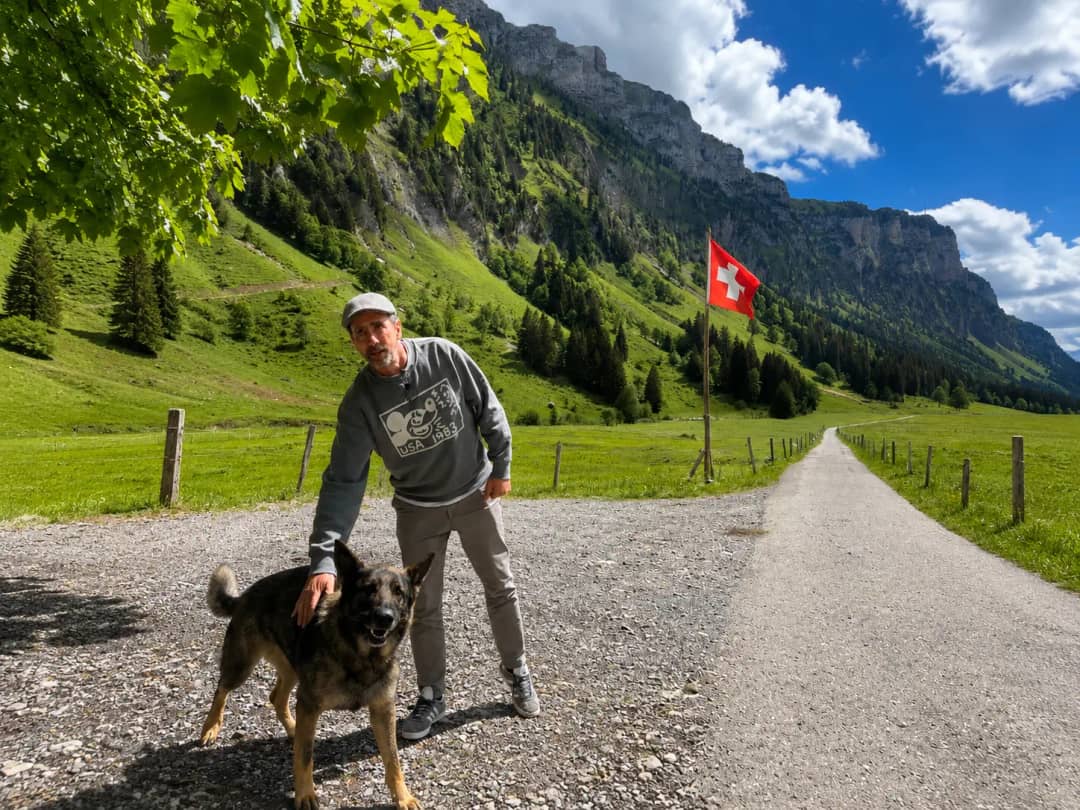
How Do You Get to Sigriswiler Bärgli?
There is no walk. The van leaves Interlaken West at 8:00am, takes about 35 minutes over Beatenberg and parks directly at the farm. You only move around the farmyard, so the tour suits guests with limited mobility, though it is not wheelchair accessible. The farm sits at 1,370 metres above sea level in the Justistal, the valley the tourist maps skip. No special gear needed.
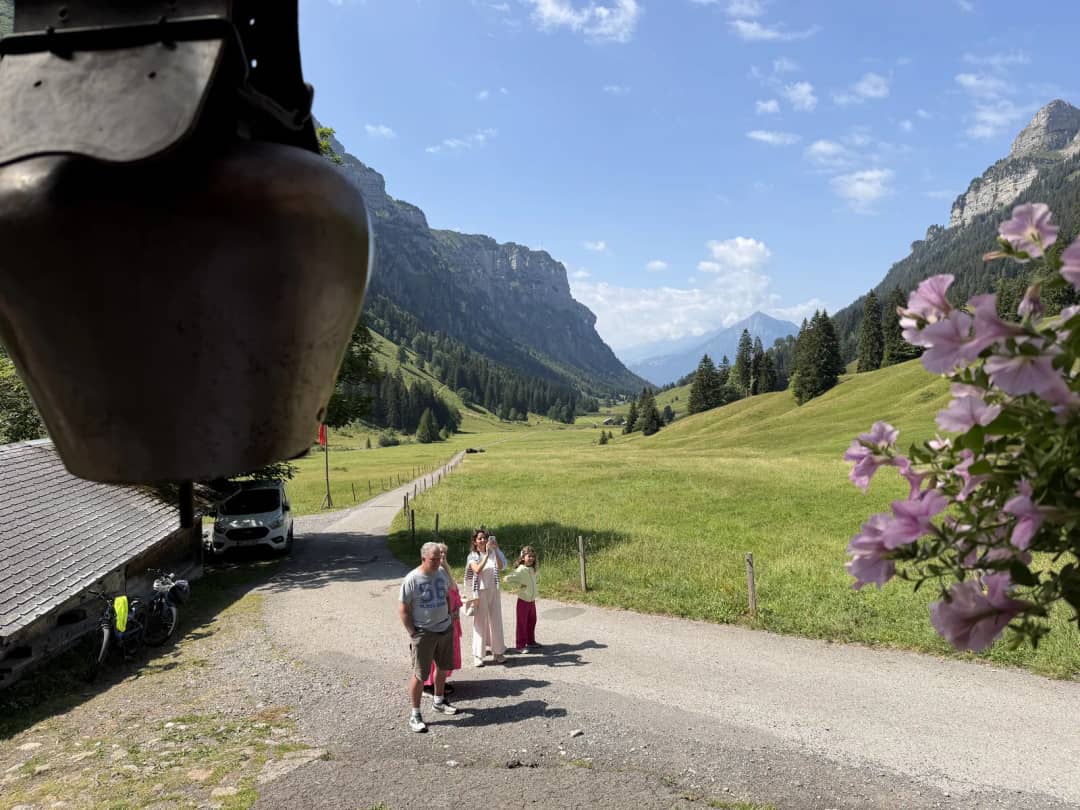
The road climbs out of Interlaken to Beatenberg, with Lake Thun below the window and the Niederhorn above. On the last stretch, the landscape starts to look like the Dolomites without the tour buses: steep ridges on both sides, valley floor below, alpine meadows catching the morning light.
Insider tip: We drive right up to the farm, so rain never cuts the visit short, and breakfast has cover.
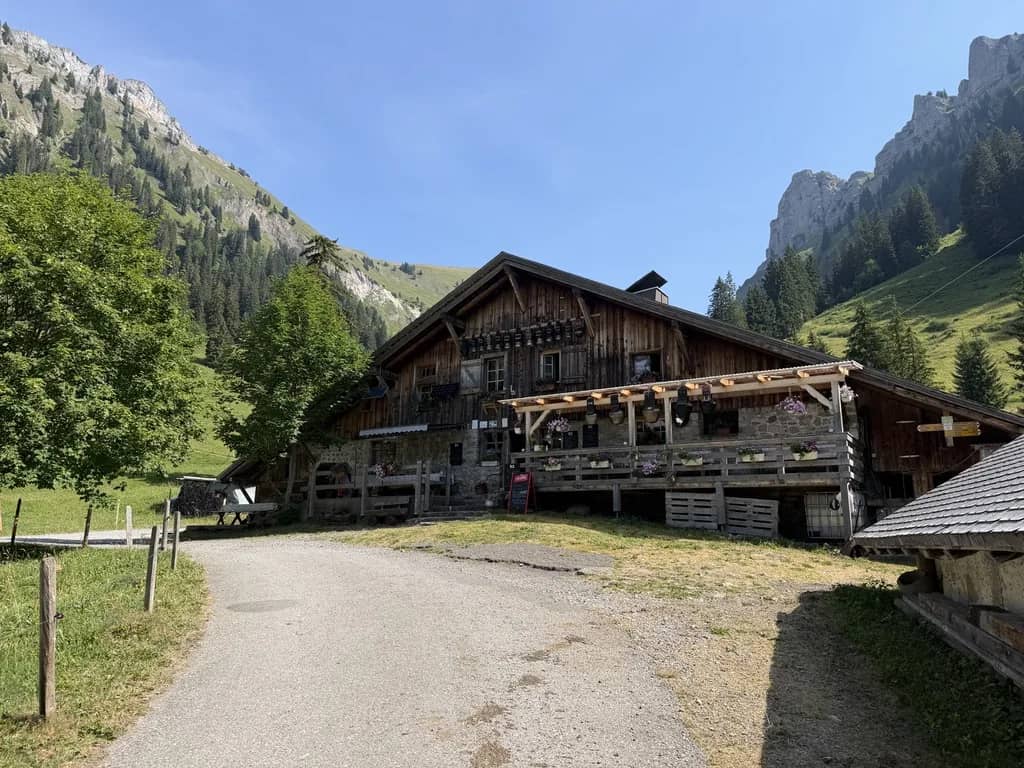
Around 8:45am, the buildings appear: wooden structures set into the hillside, smoke rising from somewhere, cows already on the slope above.
We park in the farmyard. Daniela is already there, and so are the animals: the farm dog, the goats roaming free, the cows watching from the slope.
Nobody says anything. You don't need to.
What Do You Eat at an Alpine Farm Breakfast?
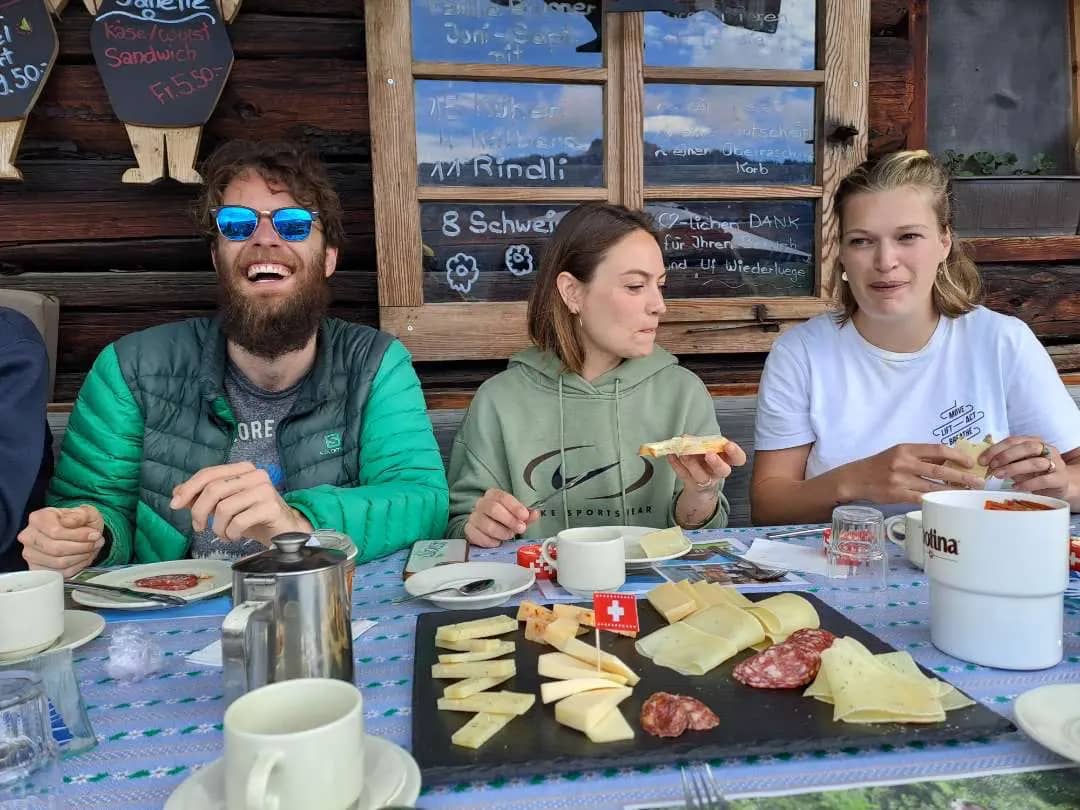
The farm breakfast includes Alpkäse from the cellar, aged from a few months to over a year, butter churned on the farm, bread baked that morning, coffee, and eggs from the farm hens. Everything comes from within a few hundred metres of the table. You eat outside when the weather holds, with the valley below and the herd above.
The first thing that happens at the farm is breakfast. Not at the end of the tour. First.
Daniela's team sets the table outside, in the open air above the valley. The view from where you sit runs down 7.5 kilometres of valley floor, framed by the ridges on both sides. The cows are on the slope above. You can hear them.
Cheese from the cellar, some a few months old, some over a year. Butter made from the milk of those cows. Bread baked the same morning. Coffee in large cups. Sometimes jam, sometimes honey. Sometimes a soft-boiled egg from the hens you'll meet later.
We've guided this tour enough times to know when people go quiet. This is the moment. Not because there's nothing to say. Because they're actually somewhere.
The food is good. That's not the point. The point is that you know exactly where it came from, and you're eating it 200 metres from the source.
Teona says: "I've guided this tour enough times to know when people go quiet. This is the moment."
Teona Gvasalia, your alpine guide at Swiss Local Adventures
More than one guest has told us it was the highlight of their European trip. Not the Alps. The breakfast.
What Daniela Is Already Doing When We Arrive
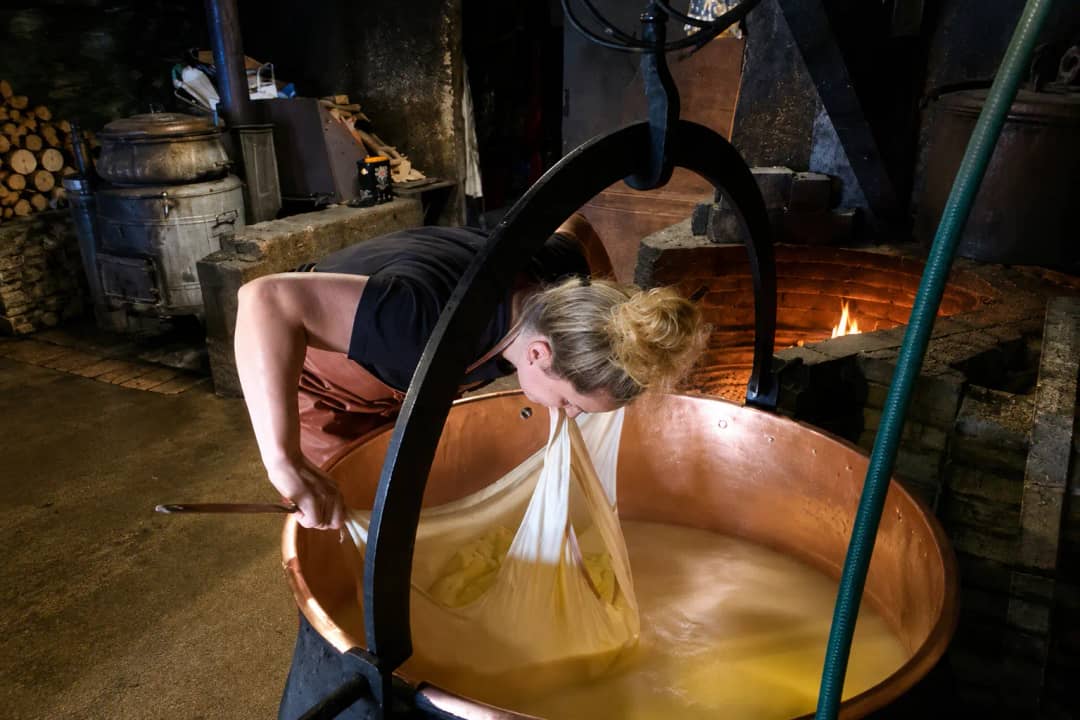
When the group arrives, around 8:45am, Daniela has been working since 5am. The morning milking is done. She makes cheese every day of the season, three wheels a day and 348 wheels a summer at Sigriswiler Bärgli, and her morning does not wait for guests.
Breakfast comes first. Around 10:00am, you step into the dairy and watch Daniela make the day's batch in the copper cauldron, the Chäschessi. The milk heats. The curd forms. The whey drains. Then she presses the cheese into wooden molds, the start of the round firm wheels you'll see aging on the cellar shelves at 10:30.
Three hundred and forty-eight of these, every summer.
You watch her cut the curd with a long-handled lyre. You catch the moment the heat goes up and the dairy fills with the sharp smell of fresh cheese. It is her real batch for the day, made in front of you, not a reconstruction of one.
You stand close enough to film every step and ask questions, and your guide translates Daniela's answers. Nobody else touches the curd or the molds: you watch, she works. Daniela has been doing this since before most of her guests were born.
If you want to know how she got here, how a summer on the alp is organised and what those 348 wheels mean for one family, we sat down with her for a portrait of Daniela the alpine farmer.
Which Animals Live on the Farm?
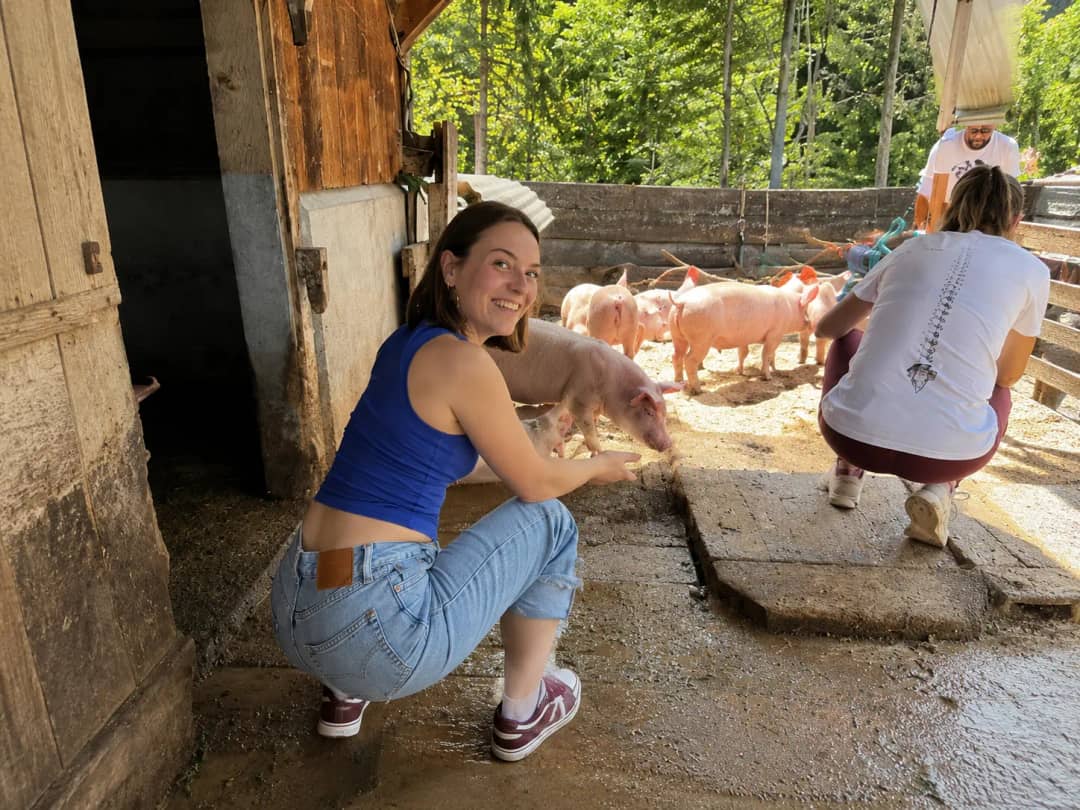
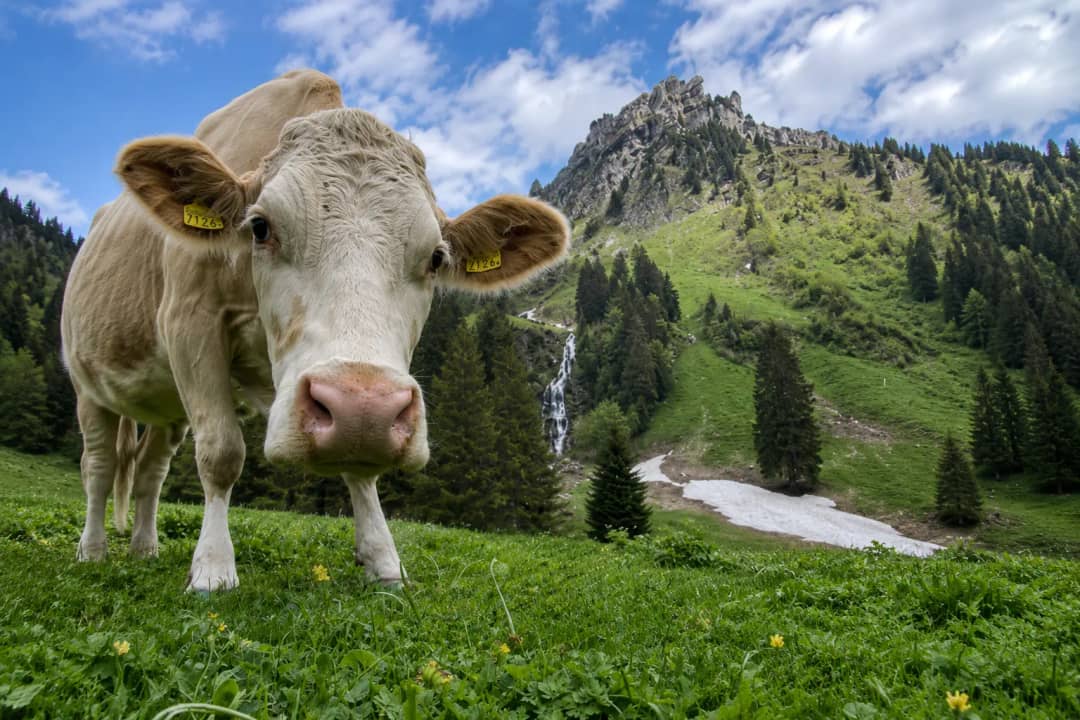
Sigriswiler Bärgli is home to 21 dairy cows, pigs, sheep, hens, rabbits, guinea pigs, goats, and a working farm dog. The cows graze on 1,370-metre alpine pasture from May to the end of September. The mineral-rich grass at this altitude is what gives the milk, and the cheese, its distinct flavour.
After the cellar, you spend about an hour around the farm with the animals, and finish breakfast if you like.
Sigriswiler Bärgli keeps dairy cows, pigs, sheep, hens, rabbits, guinea pigs, goats that roam free, and a dog who takes his job seriously. The herd is Daniela's own: 21 cows.
They all live here for the same reason: the alpine grass at 1,370 metres is denser in minerals and richer in the flavour compounds that make this cheese taste like nowhere else. Nothing on this farm is decorative.
Teona asked a farmer: "Is any animal on an alp just for show?"
"None of them. The pigs take the whey, the hens lay the breakfast eggs, and the dog works."
Teona Gvasalia, your alpine guide at Swiss Local Adventures
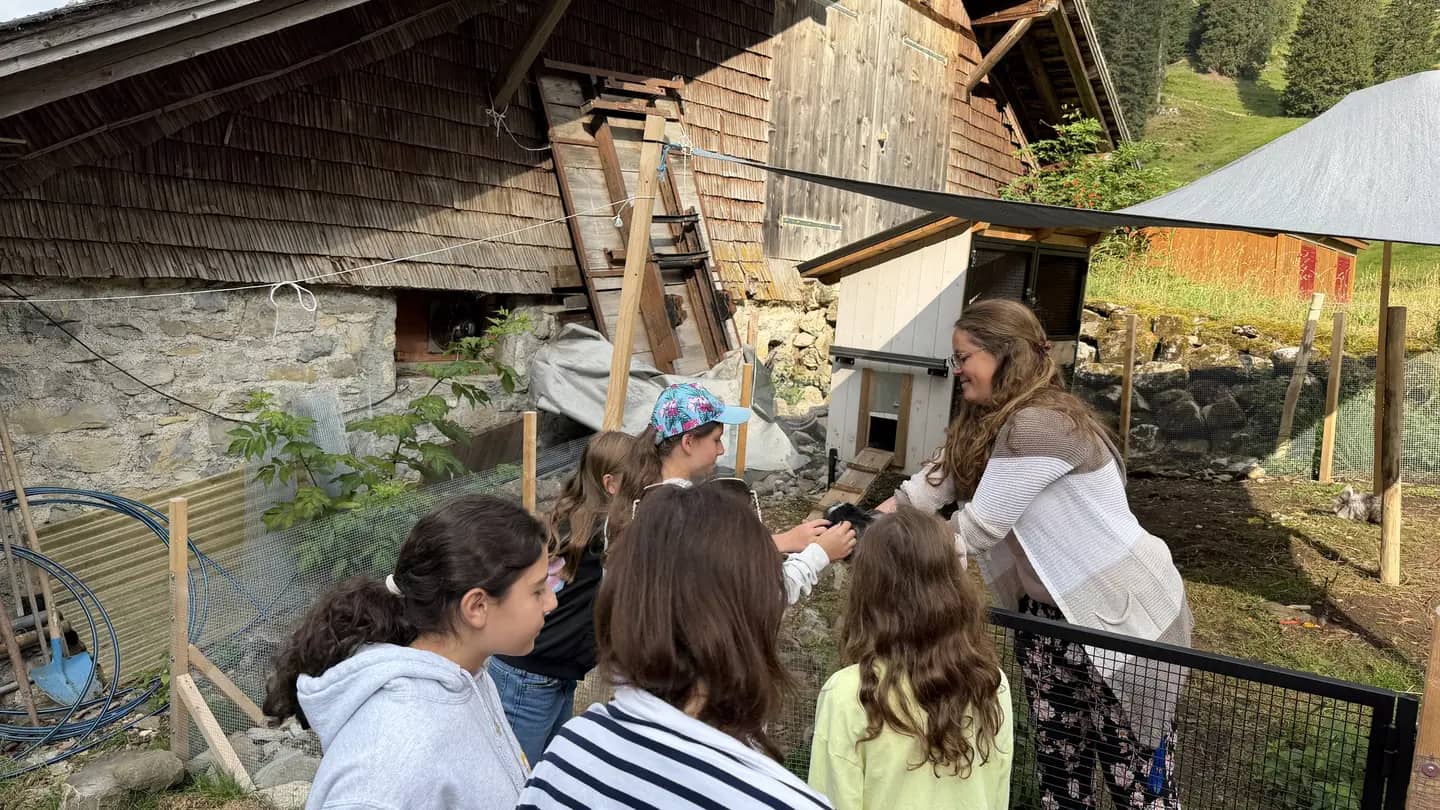
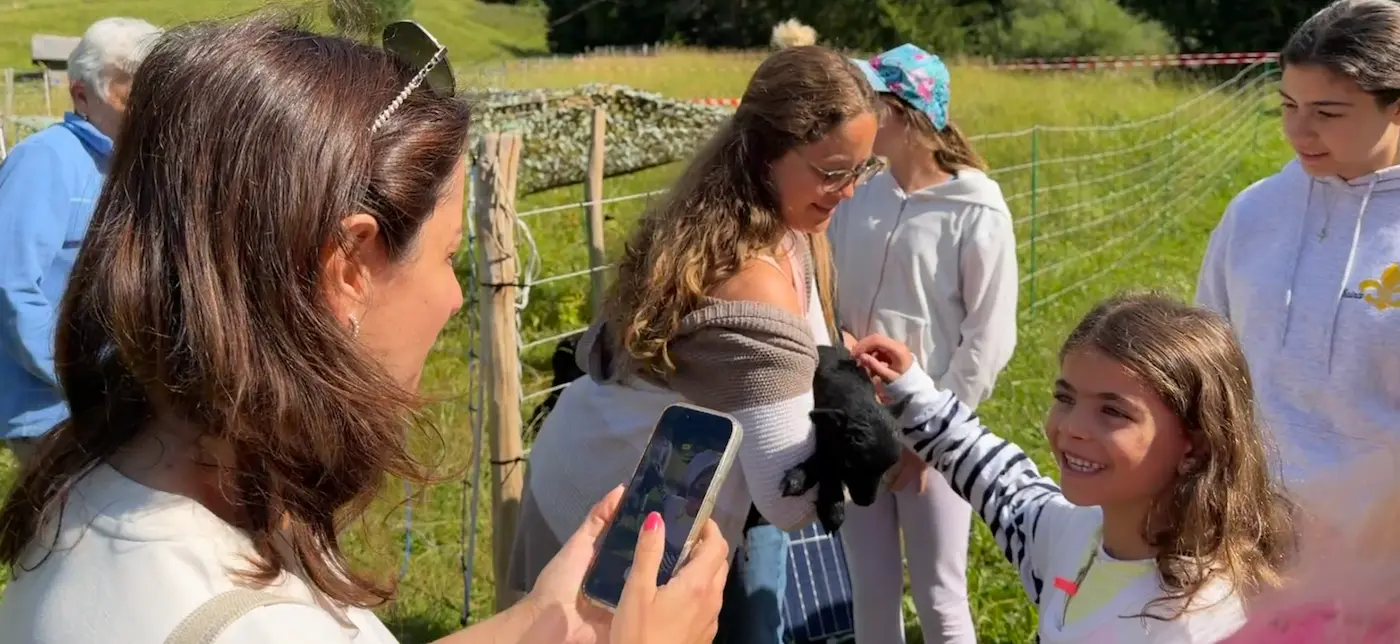
The cows get curious. Some will walk right up to you. We always remind guests to move slowly. The pigs and goats are less subtle about what they want. The hens have their own agenda. The dog will have decided what to make of you before you reach the gate.
How Is Swiss Alpine Cheese Actually Made?
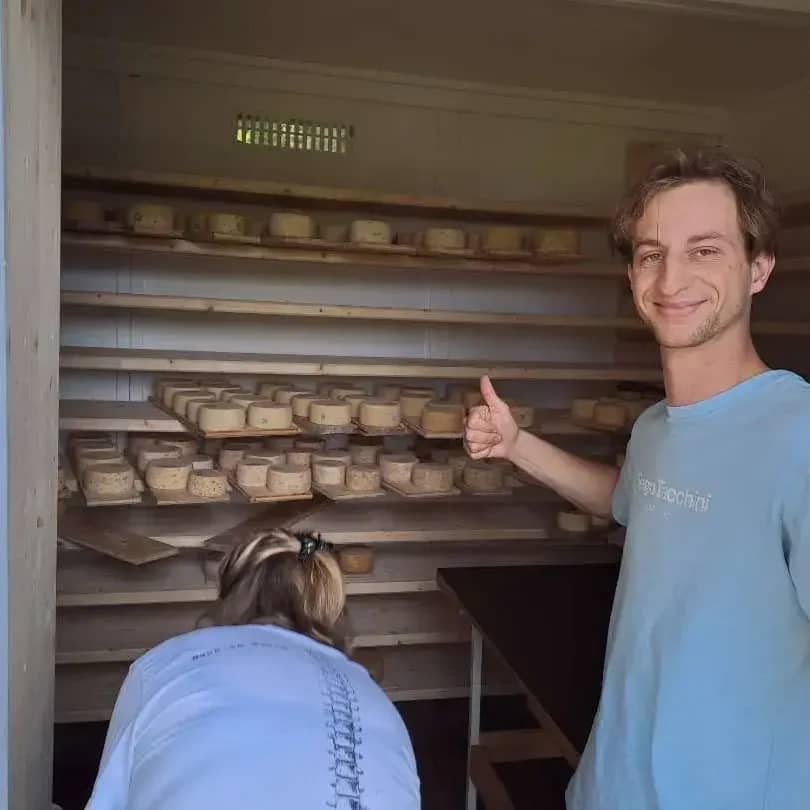
Daniela follows AOC regulations for Alpkäse: raw milk from that morning's milking, heated in a copper cauldron, curd cut by hand, pressed into moulds, aged in the cellar. The process has not changed significantly since 1739, when the Justistal families first organised the cooperative Chästeilet system.
Everybody asks some version of it: "Is this the same cheese you buy in Coop?"
No. Not close.
The cheese made at Daniela's farm falls under strict AOC regulations. The cows graze at altitude on grass that doesn't grow in the valley below. The milk composition changes based on what they eat, when they eat it, and how high up they are. What ends up on the cellar shelves came from this valley, this altitude, these hands.
That is also why you will rarely find this cheese in a shop: the rules on altitude, season and milk that define it, and where it ends up, are explained in our article on what makes Alpkäse different.
Fun fact: The Chästeilet, the cooperative cheese sharing in the Justistal, dates back to 1739: each family's share follows how much milk its cows produced.
The farm is part of the , a cooperative system documented in the Justistal since 1739. At the end of each summer, the valley's nine farming operations divide the season's cheese in proportion to how much milk each operation's cows produced. Same rules for nearly three centuries.
You can buy a wheel on the way out. Cash only. CHF 20/kg. Bring some.
For a side-by-side breakdown of how this compares to lowland production, see Alpine Farm vs Cheese Factory.
What Happens After the Morning Ends?
After the cellar and an hour with the animals, the tour ends at the farm around 11:30am. The van leaves straight from the farmyard and drops you in Interlaken around noon. The full morning is about 4 hours from departure. You are back in Interlaken with half a day still ahead of you.
We leave by 11:30. Daniela's team has a lunch service to prepare.
The drive back over Beatenberg takes the same 35 minutes. Same road, same lake below. Somehow the valley looks different going out.
Most people don't say much in the van on the way back. Some sleep. Some watch the lakes through the window. Some are already working out when they can come back.
Teona says: "Plan something slow for the afternoon. After a morning at 1,370 metres, I would pick a swim in the lake over a second early start."
Teona Gvasalia, your alpine guide at Swiss Local Adventures
We leave at 8am. We're back in Interlaken around noon. The morning stays longer than that.
What stays with most people is not the process itself but the sense of the hard working lifestyle behind every wheel.
The Justistal is one working alp among many. If you are travelling across the country and want to compare this morning with other visits, from Gruyères to the Emmental, we have gathered them in our overview of alpine farm tours in Switzerland.
Your Questions About the Farm Tour
Can Kids Come on the Farm Tour?
Yes. There is no walk: the van parks at the farm, and younger guests tend to engage immediately once they arrive. The farm keeps goats, sheep, chickens, and pigs alongside the dairy cows, and the animals are approachable. There is no minimum age. Parents supervise throughout. Watching Daniela make cheese up close holds a child's attention, and the farm breakfast gives everyone something concrete to start with.
What's included in CHF 149?
Transport from and back to Interlaken, the drive into the valley, the farm visit and cheesemaking demonstration with Daniela, and the full alpine breakfast. The cheese you buy on the way out is separate: CHF 20/kg, cash only.
What happens if it rains?
The tour runs in all weather. We always drive directly to the farm, so rain does not change how you get there. The breakfast has cover, the dairy is under roof, and the animals don't cancel. If we ever have to cancel entirely, you'll get a WhatsApp by 7am with your options.
Do I need to be fit for this tour?
No. There is no walk: we park at the farm, and you only move around the farmyard, which is uneven in places. The tour suits guests with limited mobility, though the farm is not wheelchair accessible. This is not a hiking tour.
Can I buy cheese at the farm?
Yes. Daniela sells directly at the end of the visit. CHF 20/kg, cash only. There's no card reader at 1,370 metres. Bring CHF 40-60 if you plan to take some home.
What Should I Wear for the Farm Tour?
Closed shoes are required on a working farm. No sandals. Wear clothes you do not mind marking. At 1,370 metres, a summer morning at 9:00 can be noticeably cooler than Interlaken felt the evening before, so bring a warm layer regardless of the valley forecast. The farmyard is uneven in places. For a full packing list: What to Wear on the Farm Tour.
Is the Alpine Farm Tour Touristy?
No. Sigriswiler Bärgli is a private working farm that produces 348 wheels of cheese every summer. We run the Farm Tour on Tuesdays and Thursdays, other days on request, at maximum eight guests, not to accommodate crowds but because more than eight people cannot follow a real production morning. Daniela does not pause the process for a lecture. Breakfast comes first, then you watch her make the day's real batch. Visitors who come expecting a staged show tend to be the ones most surprised by how alive it all feels.
Is the Alpine Farm Tour Worth CHF 149?
For someone who wants an experience outside the standard Interlaken circuit, yes. CHF 149 covers return transport from Interlaken, exclusive access to a private working alp, a cheesemaking demonstration with Daniela, a farm breakfast made with the farm's own cheese, butter and eggs, and a maximum of eight guests. The small group size is not a marketing detail: a real production morning cannot happen with a crowd. For the full breakdown, see Is the Farm Tour Worth CHF 149?.
Come With Us
Departure: 8:00am from Interlaken West
Return: around noon
Duration: about 4 hours
Price: CHF 149/person
Group size: Maximum 8 guests
Days: Tuesdays and Thursdays, other days on request
Season: May to 15 September
Fitness: Easy (we park at the farm)
Included: Transport, guided visit, cheesemaking demonstration, alpine breakfast
Bring: Warm layers, closed shoes, cash for cheese
Also read:
→ Meet Daniela: The Alpine Farmer Behind Our Farm Tour
→ What Is Alpkäse? The Alpine Cheese That Never Leaves Switzerland
→ 348 Wheels. One Summer. What Actually Happens Inside a Swiss Alpine Dairy.
*Written by Teona Gvasalia, your alpine guide at Swiss Local Adventures
Source:
On-site experience, Swiss Local Adventures Farm Tour, Sigriswiler Bärgli, Justistal, 2026.
Tags
#farm-tour-interlaken#swiss-alpine-breakfast#alpine-farm-visit#cheese-making-switzerland#justistal#things-to-do-interlaken#bernese-oberland#swiss-food-experience#swiss-dairy-farm#homepage
Sources & References
Share this article
Similar Articles
Continue your reading with these related articles
Farm Tour
8/17/2026
6 min
Chästeilet Justistal: Cheese Shared by Lottery Since 1739
Each September the Justistal divides its cheese by drawing tokens from a sack. Free, no bus into the valley: how the date is set and how to get there.
farm-tour-interlakenswiss-dairy-farmalpine-cheese
By Teona GvasaliaRead More
Farm Tour
8/4/2026
6 min
Interlaken Farm Tour Itinerary: 8am to Noon
The full schedule of our alpine farm morning, from the 08:00 pickup at Interlaken West to being back in town close to noon. Zero walking, a real cheese batch you watch rather than make, and a farm breakfast that surprises most guests. Written by the founder who drives the van.
farm-tour-interlakenswiss-dairy-farmalpine-cheese
By Teona GvasaliaRead More
Farm Tour
7/22/2026
5 min
Farm Tour with Kids in Interlaken: A Parent's Guide
No strict minimum age, no walk to reach the farm, a car seat on request, and a breakfast even picky eaters will finish. Here is exactly how the Interlaken Farm Tour works with kids, based on the real family of six who took our very first tour.
farm-tour-interlakenswiss-dairy-farminterlaken-with-kids
By Teona GvasaliaRead More