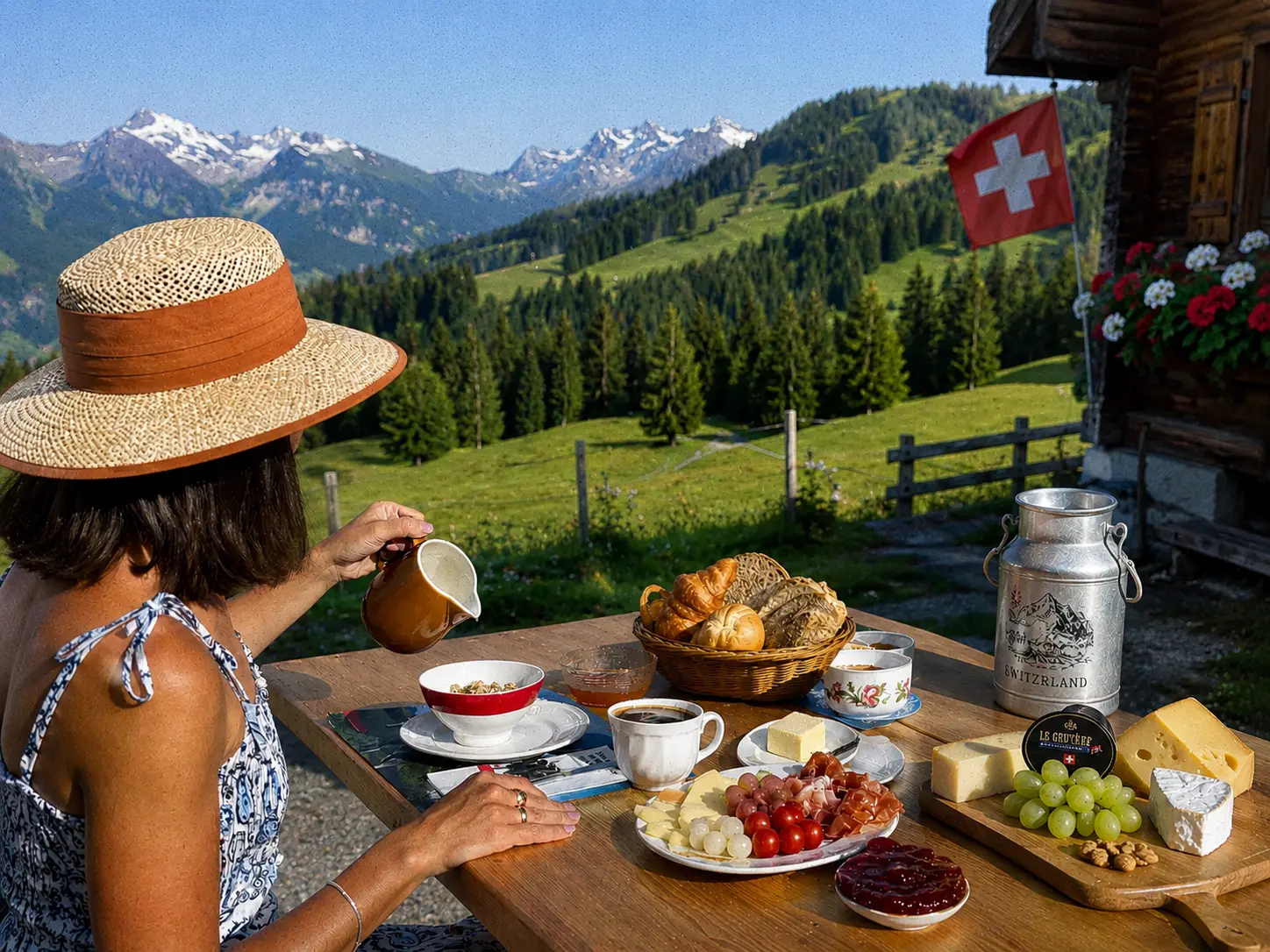
Switzerland has more than 450 varieties of cheese. You've probably tasted about four of them.
Most of them never leave Switzerland.
Alpkäse is the most extreme example.
[PHOTO 1 — HEADER | Alpkäse wheels aging on spruce wood planks in the cellar at Alp Signswiler, Justistal]
The Cheese That Only Exists in Summer
Alpkäse, literally "alpine cheese" in Swiss German, is made on high-altitude farms between June and September. Not in factories. Not in valleys. On alps: seasonal farms above 1,000 metres where cows graze on wild mountain grass until the first frost sends them back down.
The production stops the moment the cows return to the valley. No winter Alpkäse exists. The cheese sitting in the cellar in October was made in July.
That's a calendar constraint, not a marketing story.
[PHOTO 2 | Brown Swiss cows grazing on alpine pastures above Interlaken, Switzerland, the source of Alpkäse milk]
Why It Tastes Different
Most Swiss cheese, Emmentaler, Gruyère, Raclette, is produced in modern dairies year-round. The milk comes from cows that eat silage: fermented grass stored in bales. Consistent feed, consistent taste, consistent product.
Alpkäse comes from cows that spend summer eating hundreds of different alpine plants. Dandelions, clover, wild thyme, mountain herbs that don't grow at lower elevations. The same cow, eating different grass, produces milk with a completely different fat and protein profile. The milk is never pasteurised. Alpine milk is significantly richer in omega-3 fatty acids and conjugated linoleic acid than lowland dairy, compounds directly linked to the specific grasses and herbs growing at this altitude.
Cheesemakers have a word for this: terroir. The same word winemakers use for grapes.
This is why a wheel of Alpkäse from the Justistal tastes different from a wheel made twenty kilometres away. Same breed of cow. Different mountain.
Alpkäse vs Gruyère: What's the Actual Difference
Both are Swiss. Both are hard cheeses. Both are made with raw milk. The difference is everything else.
Gruyère is a protected AOP cheese produced in the Gruyères region by dairies that operate year-round. The production is standardised: consistent feed, consistent process, consistent result. Gruyère is excellent. It's also available in 40 countries.
Alpkäse is made by individual farmers for one season, on one mountain, from one herd. The process varies farm by farm. The result varies week by week within the same farm, depending on what the cows ate that morning.
You can buy Gruyère at Heathrow. You cannot buy real Alpkäse anywhere outside the farm that made it.
What Alpkäse Looks Like
Alpkäse wheels are large, typically 4 to 10 kilograms, with a thick natural rind that forms during months of cellar aging. The interior is firm but not crumbly. Semi-hard to hard, depending on how long it's been aged.
The colour ranges from pale yellow to deep gold. Older wheels have a stronger, nuttier flavour. Young Alpkäse (2 to 3 months) is milder, almost buttery.
The defining detail: each wheel is stamped with the farm name, the alp number, and the production date. The Swiss traceability system means you can trace a wheel back to which cow, on which mountain, in which week of summer.
[PHOTO 3 | Close-up of Alpkäse wheel with farm stamp and production date, Alp Signswiler alpine cheese]
Why You Won't Find It at the Supermarket
Most of Switzerland's Alpkäse production is sold directly from the farm or at regional markets. The quantities are small. One alpine farm might produce 200 to 700 wheels in a summer. No farm can supply a supermarket chain at that volume.
What you find labelled "Alpkäse" in supermarkets is often valley-produced cheese made to resemble the alpine version. Legal under Swiss law. Not the same thing.
Part of what keeps the real version rare is the Chästeilet: the traditional end-of-summer ceremony where each farming family receives cheese proportional to how much milk their cows produced. The cooperative system has worked the same way in the Justistal since 1739. Most of the cheese goes directly to the families and their networks before it ever reaches a market.
The real version requires going to the source.
Where to Taste It Near Interlaken
Daniela Thierstein's farm, Alp Signswiler, sits in the Justistal valley above Interlaken. Every summer, she produces around 700 wheels of Berner Alpkäse AOP before the season ends.
On our Farm Tour & Swiss Breakfast, you taste this cheese at the source: cut the morning it's served, not pre-packaged. The experience is hands-on — you see the cellar, meet Daniela, and watch (or try) the process directly. You can buy wheels to take home at CHF 20 per kilo.
Seven hundred wheels. One summer. No intermediary.
[PHOTO 4 | Aging cheese wheels on wooden shelves in the cellar at Alp Signswiler, farm tour Interlaken]
Your Questions About Alpkäse
Is Alpkäse the same as Emmentaler or Gruyère?
No. Emmentaler and Gruyère are produced in modern dairies year-round from standardised feed. Alpkäse is made on high-altitude farms in summer only, by small producers who sell most of their production directly from the farm. The taste, production method, and availability are completely different.
Can children join the Farm Tour?
Yes. The walk from Büffelboden is flat and takes about 20 minutes at a relaxed pace. Children generally love the animal part of the visit: cows, pigs, sheep, hens, goats, and turkeys are all on the farm. We keep groups to a maximum of 8 people, which means it never feels crowded. In bad weather, we drive directly to the farm.
Where can I buy real Alpkäse near Interlaken?
The most reliable source is a working alpine farm. On our Farm Tour, you taste and buy cheese directly from Daniela Thierstein's cellar in the Justistal: CHF 20 per kilo, cash only. Regional markets in Interlaken occasionally carry it, but availability varies.
How long does Alpkäse keep once I buy it?
A properly aged wheel keeps three to four weeks refrigerated once cut. It tastes better at room temperature. It travels fine in a carry-on in a sealed bag, but doesn't do well in checked luggage on long flights.
Book your Farm Experience
Also read:
→ We Left Interlaken at 8am. By 9:15, We Were Eating Breakfast With 250 Swiss Cows.
→ Meet Daniela: The Alpine Farmer Behind Our Farm Tour
→ [Seven Hundred Wheels. One Summer. What Actually Happens Inside a Swiss Alpine Dairy.] (add URL when published)
*Written by Teona Gvasalia, your alpine guide at Swiss Local Adventures
Source:
On-site visit, Alp Signswiler, Justistal, 2026.